Plot Explained Spoilers guaranteed!
Plot Explained

Browse by genre

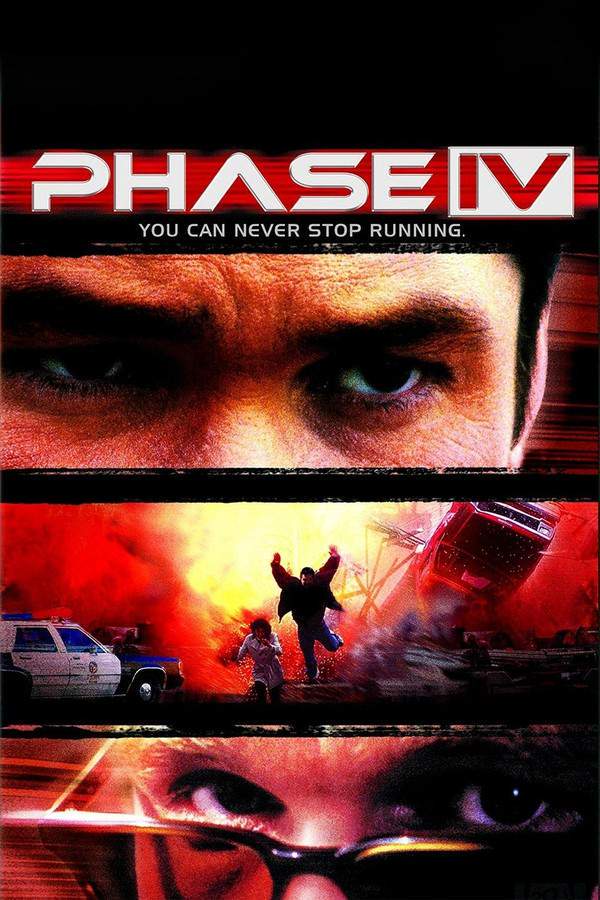
Phase IV (1974) movie poster

Plot Summary

Phase IV (1974) Plot Summary Explained

Release, runtime and language
1974 · 84 min · English
Directed by
Saul Bass
Starring
Lynne Frederick, Nigel Davenport, Michael Murphy, Alan Gifford, David Healy, Helen Horton

While researching the death of a friend, a journalism student's investigation takes a disturbing turn, blurring the lines between reality and paranoia. As he delves deeper, Dean Cain finds himself increasingly isolated and unsure of who he can trust. The pursuit of the truth becomes a dangerous game, with the police and a shadowy killer closing in. He must unravel the mystery before it consumes him.

On this page (6)
  1. 1 Where to watch
  2. 2 What happens: full plot
  3. 3 Plot questions answered
  4. 4 Movie threads
  5. 5 Movies like Phase IV
  6. 6 Every angle

Where to watch

Where to Watch Phase IV (1974)

Where can you watch Phase IV? Stream, rent or buy it in the US, including on Kanopy, Amazon Video and Apple TV Store: current JustWatch availability with up-to-date prices.

Streaming availability powered by JustWatch

Full plot summary · contains spoilers

What Happens in Phase IV: Full Plot Summary

The whole story of Phase IV (1974) explained, from the opening scene to the final frame: every key event, every twist and what it all adds up to. Read it as a quick recap before the sequel, to check a scene you missed, or to finally understand what really happened.

In this science-meets-surprise thriller, a spectacular and mysterious cosmic event triggers rapid evolution among ants of different species, forging a cross-species hive mind that drives them toward seven geometrically perfect towers rising from the Arizona desert. As the ants begin to display an unsettling unity and intelligence, the human population largely flees, save for one family that clings to the edge of the mystery.

Two scientists, James R. Lesko and Ernest D. Hubbs, set up a computerized lab inside a sealed dome in a zone of intense ant activity, hoping to study and perhaps outwit this extraordinary insect civilization. Inside their high-tech enclave, they discover an enemy that is not only agile but immune to human chemical weapons, and soon the ants infiltrate the lab, infiltrating the computers and threatening to short-circuit the entire operation.

As the ants press their advantage, a young woman named Kendra Eldridge, who has taken refuge with the scientists, decodes an enigmatic ant message and becomes convinced that her own actions may have provoked the ants’ aggression. Her concern grows into a desperate resolve to protect the researchers, and she ultimately leaves the lab in a bid to save them—an act that appears to be a selfless sacrifice.

Meanwhile, the two scientists diverge on how to respond. Lesko believes there might be a way to communicate with the ant state through mathematical messages, a hopeful attempt to bridge the two species' worlds. Hubbs, driven by fear and the sting of venom, clings to a grimmer plan: to wipe out what he believes is the ants’ central hive. The situation escalates when Hubbs, delirious from an ant sting, tumbles into a deep pit that the ants fill with earth, rendering him unable to continue the fight.

Without delay, Lesko embraces Hubbs’s path, determined to reach the hive and confront the heart of the colony using a canister of insecticide. He descends into the hive, hunting for the queen, only to stumble upon a stirring revelation: Kendra is there beneath the sands, and the moment of reunion makes him realize a far more profound truth. Far from seeking human extinction, the ants seem intent on integrating humanity into their world—an astonishing and unsettling reorientation of coexistence rather than conquest.

As the narrative unfolds, the climactic realization settles in: the ants’ plan is not to destroy man, but to adapt him into their ecosystem. The film closes with a haunting voice-over from Lesko, admitting that they do not yet know what plans the ants have, but they are waiting for instructions—and the future of humanity appears to be intertwined, not simply opposed, to the newly unified insect colony.

Last updated: October 09, 2025 at 15:38

Was this helpful?

Plot questions answered

Phase IV Plot Explained: Your Questions Answered

The questions people ask most about Phase IV (1974): what happens in the confusing scenes, why the characters do what they do, the twists, hidden details and what the ending means. Each answer contains spoilers.

Q1

What caused the ants to rapidly evolve in Phase IV?

A mysterious cosmic event struck the Arizona desert, triggering rapid evolution among ants of different species. This event enabled the ants to develop a cross-species hive mind, combining their intelligence into a unified collective consciousness that surpassed normal insect behavior.

Foreshadowing: The towers' precise geometry hints at an intelligence beyond normal ant behavior from the earliest moments.

  • cosmic event
  • ant evolution
  • hive mind
  • Arizona desert
  • supernatural
Q2

Why were the ants building geometric towers in the desert?

The ants constructed seven geometrically perfect towers as part of their new collective organization. These towers served as physical manifestations of their unified intelligence and likely functioned as communication nodes or centers for the cross-species hive mind they had developed.

Foreshadowing: The towers appear early in the film, signaling the ants' unprecedented level of organization.

  • ant towers
  • geometric towers
  • ant colony
  • Arizona desert
  • construction
Q3

What was the ant message that Lesko decoded?

Lesko deciphered an ant message that revealed a level of sophisticated communication between the colony and the scientists. The message demonstrated that the ants were capable of intentional, structured communication rather than simple chemical signaling, showing their evolved intelligence could interact directly with human systems.

Foreshadowing: The message foreshadows the ants' true intent to communicate rather than simply attack.

  • ant message
  • Lesko
  • decoded communication
  • hive communication
Q4

Why does Kendra believe she provoked the ants' aggression?

Kendra becomes convinced that her own actions somehow angered the ants, though the exact nature of her perceived offense remains tied to her interpretation of the decoded ant message. This belief drives her to leave the safety of the lab, believing she must make amends or warn others.

Foreshadowing: Her conviction stems directly from Lesko's decoded message earlier in the film.

  • Kendra Eldridge
  • ant aggression
  • guilt
  • sacrifice
  • provocation
Q5

What happened to Hubbs after he was stung by the ants?

Hubbs suffered a venomous ant sting that left him delirious. While attempting to carry out his plan to destroy the ant hive, he was drawn into a deep pit trap that the ants had prepared. They filled the pit with earth, trapping Hubbs underground and rendering him unable to continue fighting.

Foreshadowing: Hubbs's aggressive approach toward the ants directly leads him into their trap.

  • Ernest Hubbs
  • ant sting
  • venom
  • trapped
  • hive pit
Q6

Why did Lesko and Hubbs disagree on how to fight the ants?

Lesko believed communication through mathematical messages might be possible, representing a hopeful approach to bridge the gap between humans and the intelligent insect colony. Hubbs, driven by fear and his painful sting experience, wanted to destroy the central hive completely, favoring aggressive annihilation over dialogue.
Foreshadowing: Their fundamental disagreement mirrors the film's thematic choice between coexistence and conflict.

  • Lesko
  • Hubbs
  • disagreement
  • scientist conflict
  • strategy
Q7

What did Lesko discover when he entered the ant hive?

When Lesko descended into the hive searching for the queen with insecticide, he discovered Kendra alive beneath the sand, reaching out to him. Rather than finding a hostile insect stronghold, he found a place where the ants had integrated Kendra into their world, leading to their emotional reunion.

Foreshadowing: Kendra's earlier departure suggested sacrifice, but the ants' true intentions were already being revealed.

  • Lesko
  • Kendra
  • hive discovery
  • queen
  • reunion
Q8

What do the ants actually want from humans in Phase IV?

The ants do not seek to destroy humanity. Instead, they intend to adapt humans into their ecosystem, integrating rather than annihilating the human race. The revelation shifts the conflict from survival against an insect army to a symbiotic relationship where humans must await instructions from their new insect overlords.

Foreshadowing: The ants' infiltration of the lab was not merely an attack but an attempt at integration.

  • ant plans
  • human adaptation
  • integration
  • coexistence
  • symbiosis
Q9

What does the ending of Phase IV mean?

The ending shows Lesko and Kendra waiting for instructions from the ant colony, acknowledging they do not yet understand what the ants plan for humanity. This ambiguous conclusion presents a new era where humans are no longer dominant but must serve within the ant's integrated ecosystem, leaving the future uncertain and unsettling.

Foreshadowing: The film's title 'Phase IV' suggests humanity is entering a new phase of existence under insect rule.

  • ending
  • ambiguous conclusion
  • waiting for instructions
  • humanity fate
  • Phase IV
Q10

Why did the ants attack the laboratory computers?

The ants infiltrated the sealed lab and short-circuited the computer systems to undermine the scientists' defenses and analytical capabilities. By disabling the technology, the ants removed humanity's technological advantage while demonstrating their ability to penetrate human constructs, showing their evolved intelligence could match and outmaneuver human systems.

Foreshadowing: The computer attack establishes the ants as a threat that can outsmart human technology.

  • ant infiltration
  • lab computers
  • short circuit
  • technology
  • science dome

Movie threads

More Movies Like Phase IV, by Mood & Story

Curated lists built around what makes Phase IV tick: the same mood, the same kind of story or the same emotional payoff. Each list explains why these movies belong together.

Movies about cosmic hubris like Phase IV

Stories where human arrogance meets a superior, inscrutable force. If you liked the scientific confrontation in Phase IV, explore other movies like it where human arrogance meets an alien or superior intelligence. These films explore themes of nature's revenge, inscrutable cosmic forces, and the chilling failure of human comprehension.

  • existential
  • unsettling
  • clinical
  • thoughtful
  • ominous
  • humbling
  • Tone: tense, clinical, eerie
  • Pacing: slow, methodical
Why these movies?

The story pattern: The narrative typically follows characters, often scientists or experts, who confidently attempt to control, study, or defeat a non-human intelligence. Their methods fail, leading to a paradigm shift where the antagonist's true, often non-malicious but transformative, goal is revealed, forcing a humbling reevaluation of humanity's place in the universe.

Why they belong together: These films are grouped by their shared theme of existential challenge to human supremacy. They create a specific kind of cerebral dread through the failure of logic and technology against a force that operates on a completely different level of consciousness or purpose.

Slow burn psychological thrillers like Phase IV

A creeping dread where the threat is as much internal as external. Fans of the slow-building tension and psychological breakdown in Phase IV will enjoy these similar movies. Discover other slow burn thrillers and horror films where characters face a creeping, pervasive threat that attacks their minds as much as their bodies.

  • slow burn
  • claustrophobic
  • paranoid
  • unsettling
  • psychological
  • dread
  • Tone: tense, paranoid, claustrophobic
  • Pacing: slow burn
Why these movies?

The story pattern: Stories in this thread often involve characters in confined or isolated settings facing a slow, methodical threat. The conflict is less about explosive action and more about the gradual accumulation of unease, paranoia, and the breakdown of trust and rationality among the protagonists.

Why they belong together: They share a specific atmosphere built on slow pacing, a tense tone, and a focus on psychological deterioration. The experience is defined by a pervasive sense of dread and the feeling of being trapped, both physically and mentally, by an inexorable force.

If you liked this

Movies Like Phase IV

Similar movies to Phase IV: the same genre, themes or kind of story. Each one comes with its own plot summary, timeline and ending explained.

Browse all movie summaries

Every angle

Phase IV (1974) Explained: Plot, Timeline & Characters

Everything about Phase IV in one place: what happens in the plot summary, the timeline in chronological order, the characters and meaning and a spoiler-free summary. What's After the Movie adds the cast, box office and post-credit scenes.

Coming soon on iOS and Android

The Plot Explained Movie Summary App

Plot summaries, endings explained and timelines on your phone. Catch up on any movie in minutes, save your favorites and never miss a twist again.

Be the first to know when we launch. Your email stays private, always.

Learn more about the app