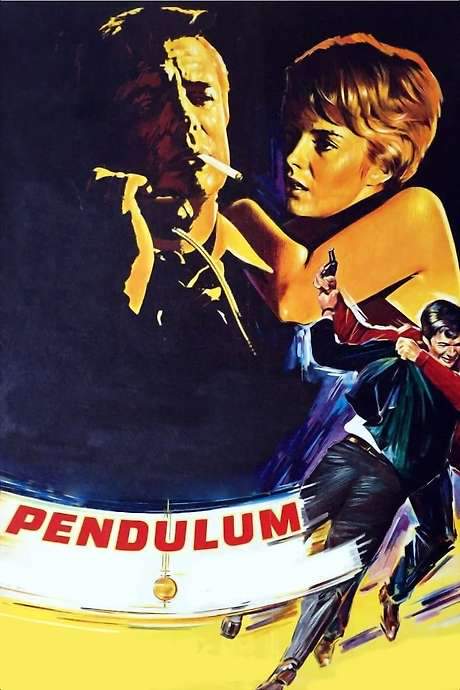
In Washington, D.C., police captain Frank Matthews George Peppard is climbing the career ladder, recently tapped as a consultant to a powerful U.S. senator, and his professional future looks bright. Yet his home life is far from steady: he suspects his wife Adele Matthews Jean Seberg of sharing more than a few late-night secrets with an old flame. After attending a political function in Baltimore, Matthews decides to stay out overnight, a choice that will quietly unravel the world he knows. The next day, a chilling discovery rocks the capital: his wife has been shot to death in bed with her lover, who is also dead. Suddenly, the man who once seemed poised for influence learns that his police colleagues have branded him the prime suspect in the brutal crime. The shift from esteemed officer to potential killer happens with a cold deflation, as the very people he has trusted begin to scrutinize his alibis and motives.
Amid this personal catastrophe runs a tense, morally charged side plot involving a death row inmate, Paul Martin Sanderson Robert F. Lyons. Convicted of rape and murder, Sanderson is released on a technicality that Matthews once helped secure, a fact that Matthews views as a grave injustice. The release of Sanderson muddles the line between law and vengeance, and the film pivots on the idea that justice can be both righteous and corrupted by procedure. The irony intensifies as Matthews, now pursued by his own colleagues, seeks to clear his name even as the system he once helped uphold seemed to fail him.
As the drama unfolds, Matthews enlists Sanderson’s own lawyer, Woodrow Wilson King Richard Kiley, a decision that binds the fates of the two men in a treacherous legal game. The hiring of King signals a broader critique of power and due process, showing how legal maneuvering can become a weapon when a man’s reputation is on the line. The relationship between Matthews and King becomes a central tension in the narrative, highlighting themes of loyalty, guilt, and the slippery slope between upholding the law and finding the truth at any cost. The courtroom and the streets both become arenas where truth clings to the smallest of details, and every choice reverberates through the lives of those connected to the case.
The cast also threads in a supporting web of characters who populate the investigation and the political sphere. Adele Matthews’s world is touched by the uneasy presence of those around her, including the sharp eyes of Deputy Chief John P. Hildebrand Charles McGraw and the persistent investigations of Det. J.J. “Red” Thornton Dana Elcar. In the backdrop, the film introduces figures such as Mrs. Eileen Sanderson Madeleine Sherwood and Liz Tennant Marj Dusay, each adding layers to a story where personal history and public duty collide. The legal machinery is personified by U.S. Attorney Grady Butler Jock Mackelvie and Judge Kinsella S. John Launer, whose interactions with the central characters push the narrative toward its climactic resolution.
As the plot threads converge, Pendulum deftly maintains a cool, analytical tone while letting the suspense build through the mounting questions: Who is really in control of the truth, and who is willing to bend the rules to seize it? The film’s momentum comes from the precarious balance between a man accused and a system that may be guilty of its own shortcuts. The intersecting storylines—Matthews’s fall from grace and Sanderson’s startling release—drive the action toward a dramatic and violent conclusion, leaving the audience to ponder the costs of justice when pride, fear, and ambition collide.
Throughout the film, the tension never eases, and the characters’ motivations are laid bare with careful, measured reveals. The result is a taut, morally complex thriller that keeps a steady pulse even as it widens its scope from personal tragedy to institutional critique. Pendulum invites viewers to weigh the line between protector and suspect, the ethics of legal strategy, and the high price paid when assumptions harden into certainty. The ending lands with a blunt finality, a reminder that in systems built on law and order, the pendulum can swing with devastating force.