Plot Explained Spoilers guaranteed!
Plot Explained

Browse by genre

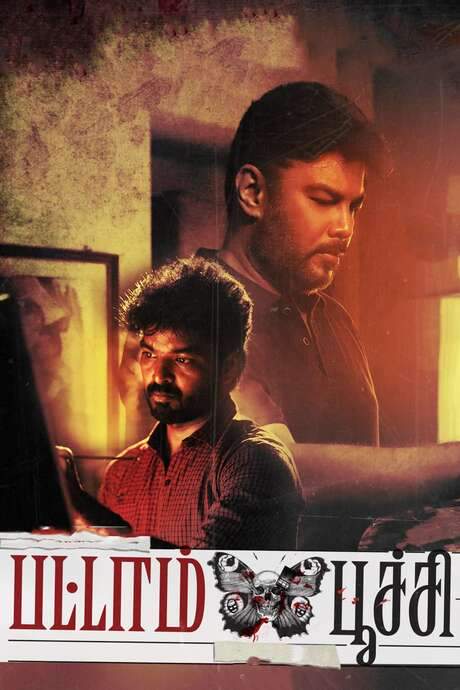
Pattampoochi (2022) movie poster

Plot Summary

Pattampoochi (2022) Plot Summary Explained

Release, runtime and language
2022 · 135 mins · Tamil
Directed by
Badri
Starring
Jai Sampath, Imman Annachi, Honey Rose, Sundar C, Manasvi Kottachi, Ajith Koshy

A man on death row for murder claims to be responsible for a string of unsolved crimes. A police officer struggling with PTSD must determine if the convict's confession is genuine and, if so, protect those around him from further danger. The officer races against time to uncover the truth and prevent potential future victims.

On this page (6)
  1. 1 Where to watch
  2. 2 What happens: full plot
  3. 3 Plot questions answered
  4. 4 Movie threads
  5. 5 Movies like Pattampoochi
  6. 6 Every angle

Where to watch

Where to Watch Pattampoochi (2022)

Where can you watch Pattampoochi? Stream, rent or buy it in the US, including on Amazon Video, Google Play Movies and YouTube: current JustWatch availability with up-to-date prices.

Streaming availability powered by JustWatch

Full plot summary · contains spoilers

What Happens in Pattampoochi: Full Plot Summary

The whole story of Pattampoochi (2022) explained, from the opening scene to the final frame: every key event, every twist and what it all adds up to. Read it as a quick recap before the sequel, to check a scene you missed, or to finally understand what really happened.

Set in 1989, a tense, morally charged cat-and-mouse drama unfolds between Kumaran, a seasoned inspector wrestling with PTSD from personal tragedy, and Sudhakar, an ultra-violent cannibalistic serial killer who taunts the system with his claimed truths. The film begins with Vijayalakshmi, known as Viji, a determined Vijayalakshmi reporter for Vikatan, visiting a death-row inmate who asserts he is Pattampoochi—the killer behind a string of grisly murders. The inmate, Sudhakar, says he did not commit the Ismayil murder, yet admits to seven other killings and insists he is Pattampoochi, even handing over a butterfly drawing that matches one found at the crime scenes. His confession erupts into a media storm, casting doubt on the case and prompting the court to pause the death penalty while a 30-day investigation proceeds to determine the truth.

The investigation lands with Kumaran, who also carries the burden of a troubled family history: his own daughter was killed in a car bombing tied to an illicit liquor dealer, and the trauma has left him with PTSD that complicates both his personal life and professional decisions. The police, coupled with media scrutiny, question Kumaran’s suitability for a high-profile case, while Sudhakar dismisses him as an ineffectual cop who will only confess to Viji if his story is given front-page treatment. A flashback reveals Sudhakar’s brutal upbringing—an abusive, wealth-dominated father, the mother’s suicide, and years of emotional and physical torment that drive him toward painting as a coping mechanism. The abuse culminates in a chilling act that fuels his later murders and his terrifying appetite.

To untangle the truth, Kumaran crafts a careful plan. He discovers that Sudhakar’s alleged Pattampoochi persona targets men with loving fathers, and, in a bid to test the killer’s claims without prematurely leaking details, he arranges a makeshift, jail-bound “Pattampoochi” front page in a controlled newspaper to test responses and gather evidence. Meanwhile, Viji builds a bond with Kumaran and even learns more about his father—who quietly, and unknowingly, nudges her toward a potential future with Kumaran. The elder Kumaran shares a painful memory of his daughter’s death and the impact it had on his wife, pushing him deeper into PTSD; through this, Viji’s own life comes into sharper focus, including her separation and life with her daughter.

As the investigation advances, Sudhakar agrees to cooperate only if Kumaran physically takes him to the places where the crimes were committed. Kumaran reluctantly complies, planning a controlled pursuit, but the plan is thwarted when the victims’ families launch an attack. Kumaran saves Sudhakar and returns him to jail, only for another murder to occur the next morning under Pattampoochi’s name. It becomes clear that Sudhakar manipulated the situation to leave confinement, while the police conceal a critical hair strand detail that would prove copycat activity. Sudhakar then murders the man who actually killed Ismayil and seizes the murder weapon, along with the hair strand, to guard his story and ensure the police face fewer consequences.

In court, Sudhakar contends that the Pattampoochi drama was a ruse to escape the death sentence, arguing that he could not have committed Ismayil’s murder from prison. The judge releases Sudhakar, citing insufficient evidence and his disability as reasons, leaving Kumaran to confront the consequences of an illegal move that allowed Sudhakar to walk free. The second half of the story pivots into a more personal, dangerous cat-and-mouse game: Kumaran, feeling responsible for any future killings, is shifted to a desk job, while Sudhakar grows more reckless and vengeful. The police, including Fernandaz, are humiliated as Sudhakar forces a confrontation that results in a brutal kill, prompting Kumaran to lash out.

The chase accelerates as Sudhakar targets Viji and Kumaran’s father, pushing the conflict toward a final, brutal confrontation. Kumaran defeats Sudhakar in a climactic moment and attempts to portray Pattampoochi as the killer who took Sudhakar’s life, using the disguise to mask his own actions. The aftermath sees Viji and Kumaran marry and settle with Viji’s daughter, but the enigmatic Pattampoochi continues to strike—now seemingly targeting criminals. In a shocking twist, Viji uncovers that Kumaran adopted the Pattampoochi identity to carry out his own vigilantism, raising questions about justice, deception, and where one man’s moral line ends and another’s begins. The story closes on this uneasy note: the line between hunter and hunted remains blurred, and the city must live with the unsettling truth that Pattampoochi’s reign may be fueled by more than the original killer alone.

Last updated: March 05, 2026 at 18:39

Was this helpful?

Plot questions answered

Pattampoochi Plot Explained: Your Questions Answered

The questions people ask most about Pattampoochi (2022): what happens in the confusing scenes, why the characters do what they do, the twists, hidden details and what the ending means. Each answer contains spoilers.

Q1

Why does Sudhakar claim to be Pattampoochi from death row?

Sudhakar confesses to being Pattampoochi to delay his execution. He admits to seven murders but claims he did not kill Ismayil. By presenting the butterfly drawing found at crime scenes as proof, he creates enough doubt to pause his death sentence while a 30-day investigation proceeds. However, he later reveals in court that the entire Pattampoochi drama was a calculated ruse to escape execution.

Foreshadowing: Earlier, Sudhakar tells Viji he wants to die as a man who has killed seven people, hinting at his need for notoriety.

  • sudhakar
  • pattampoochi
  • confession
  • death row
  • execution
  • butterfly drawing
Q2

Why is Kumaran assigned to the Pattampoochi case despite his PTSD?

Kumaran is assigned despite his PTSD because the police have limited experienced detectives for a high-profile case. Though he requests a desk job to care for his elderly father, his superiors insist he continue investigating. His personal trauma, including his daughter's death in a car bombing, makes him emotionally invested, though it also impairs his judgment throughout the case.

Foreshadowing: The media openly questions Kumaran's competence, foreshadowing the complications his PTSD will cause.

  • kumaran
  • ptsd
  • investigator
  • police
  • assignment
  • trauma
Q3

What is the hair strand evidence in the Pattampoochi case?

The hair strand is crucial forensic evidence that distinguishes the real Pattampoochi from copycats. When a new murder occurs after Sudhakar's jail outing, investigators notice the hair strand is missing from the victim, suggesting a copycat killer. Sudhakar later murders the real Ismayil killer and steals the hair strand to manipulate evidence and control the narrative about Pattampoochi.

Foreshadowing: The police conceal the hair anomaly to avoid alerting copycats, keeping this detail hidden from Sudhakar.

  • hair strand
  • evidence
  • forensics
  • copycat
  • murder
  • crime scene
Q4

How does Sudhakar commit murders while in prison?

The film reveals Sudhakar orchestrated murders from prison by manipulating others and exploiting his claimed identity. He eliminates the actual Ismayil murderer during his temporary release, taking the murder weapon and hair strand to control the evidence. The film implies he has either accomplices or uses his Pattampoochi persona to coerce others into killing on his behalf while he remains incarcerated.

Foreshadowing: Sudhakar demands to be taken to crime scenes, revealing his continued engagement with the outside world despite imprisonment.

  • sudhakar
  • prison
  • murders
  • incarceration
  • killings
  • accomplices
Q5

Who actually killed Ismayil in Pattampoochi?

Ismayil was killed by a different person, not Sudhakar. During the investigation, Sudhakar discovers the real Ismayil murderer and kills him to prevent the truth from emerging. By eliminating this person, Sudhakar ensures no one can prove he didn't commit the Ismayil murder, allowing him to maintain his Pattampoochi claim and control the narrative.

Foreshadowing: Sudhakar's insistence that he did not kill Ismayil foreshadows this revelation.

  • ismayil murder
  • killer
  • real murderer
  • sudhakar
  • killing
Q6

Why is Sudhakar released from death row?

Sudhakar is released due to insufficient evidence and his disability. During the court hearing, he argues that the Pattampoochi drama was a ruse to escape execution, claiming he could not have committed Ismayil's murder from prison. The judges accept this argument and release him, despite Kumaran's objections. The court also cites Sudhakar's Tourette syndrome as a factor in his disability.

Foreshadowing: The media storm and public pressure create doubt, influencing the court's decision.

  • sudhakar
  • release
  • court
  • death row
  • insufficient evidence
  • disability
Q7

What is the butterfly drawing significance in Pattampoochi?

The butterfly drawing is Sudhakar's signature proof linking him to the Pattampoochi murders. He gives this drawing to reporter Viji during their first meeting, and it matches one found at the actual crime scenes. This butterfly becomes the key evidence that convinces Viji and the public that Sudhakar is truly Pattampoochi, though later revelations complicate this assumption.

Foreshadowing: The butterfly drawing appears in multiple murder scenes, establishing it as the killer's signature.

  • butterfly
  • drawing
  • signature
  • evidence
  • crime scenes
  • pattampoochi
Q8

Does Kumaran become Pattampoochi at the end?

Yes, the twist reveals that Kumaran adopts the Pattampoochi identity after killing Sudhakar. During the final confrontation, Kumaran defeats Sudhakar but stages it as if Pattampoochi killed him. Afterward, Pattampoochi-like killings continue, and Viji discovers that Kumaran has been using the identity to eliminate dangerous criminals. This ambiguous ending suggests Kumaran has become a vigilante operating under the Pattampoochi name.

Foreshadowing: Kumaran's personal trauma and his willingness to bend the law foreshadow his transformation into a killer.

  • kumaran
  • pattampoochi
  • vigilante
  • ending
  • identity
  • killer
  • twist
Q9

Why does Viji marry Kumaran despite learning the truth?

Viji marries Kumaran after he kills Sudhakar, and they settle with her daughter. However, the film does not explicitly show her reaction to discovering Kumaran became Pattampoochi. The marriage occurs before this revelation, suggesting she marries him believing the case is closed. The ending implies she learns the truth afterward, leaving their relationship's future uncertain.

Foreshadowing: Viji's connection to Kumaran develops throughout the investigation, culminating in marriage.

  • viji
  • kumaran
  • marriage
  • relationship
  • ending
  • love
Q10

How does the real Pattampoochi die in the movie?

The real Pattampoochi, Sudhakar, dies in the final confrontation with Kumaran. After Sudhakar is released and continues his killing spree, Kumaran lures him into a trap. During the struggle, Kumaran kills Sudhakar but stages the death to appear as if Pattampoochi killed him. This allows Kumaran to take the Pattampoochi identity for himself while making it seem like the original killer is dead.

Foreshadowing: The cat-and-mouse chase escalates as Sudhakar targets Viji and Kumaran's father.

  • sudhakar
  • death
  • pattampoochi
  • kumaran
  • confrontation
  • finale
Q11

What triggers Kumaran's PTSD in Pattampoochi?

Kumaran's PTSD stems from his daughter being killed in a car bombing linked to an illicit liquor dealer. This tragedy caused his wife to commit suicide, leaving him with severe trauma. Throughout the film, triggers like fire and sirens worsen his condition. His personal loss makes him obsessed with catching Pattampoochi, ultimately driving him to become the killer himself.

Foreshadowing: Kumaran's father reveals this painful memory to Viji, explaining Kumaran's emotional state.

  • kumaran
  • ptsd
  • trauma
  • daughter
  • death
  • car bombing
  • trigger
Q12

Why does the police conceal the hair evidence in Pattampoochi?

The police conceal the missing hair strand evidence to prevent copycat killers from knowing how to replicate Pattampoochi's crimes. By keeping this detail secret, they hope to identify anyone who commits similar murders as copycats rather than the real killer. This concealment also protects their investigation from being compromised as they try to determine if Sudhakar is truly Pattampoochi.

Foreshadowing: The absence of hair on the new victim raises suspicion about a copycat.

  • police
  • conceal
  • evidence
  • hair
  • investigation
  • copycat
  • secrecy

Movie threads

More Movies Like Pattampoochi, by Mood & Story

Curated lists built around what makes Pattampoochi tick: the same mood, the same kind of story or the same emotional payoff. Each list explains why these movies belong together.

Thrillers with Traumatized Investigators like Pattampoochi

Stories where the hero's own trauma becomes a weapon in the hunt. If you liked the intense psychological battle in Pattampoochi, explore more movies like it. This list features dark thrillers where police officers or detectives grappling with PTSD face off against cunning serial killers who manipulate their weaknesses.

  • tense
  • psychological
  • dark
  • disturbing
  • suspenseful
  • tragic
  • Tone: dark, tense, psychologically complex
  • Pacing: steady, building dread
Why these movies?

The story pattern: These stories typically follow a cat-and-mouse game where the hunter's psychological scars are central to the plot. The killer often targets the hero's trauma, blurring the lines between professional duty and personal vendetta. The climax often involves a morally ambiguous choice rooted in the protagonist's damaged psyche.

Why they belong together: Movies in this thread share a focus on the psychological damage of the heroes, making them vulnerable and complex. The shared tone is dark and tense, with a heavy emotional weight derived from exploring trauma, violence, and the cost of justice.

Movies with Dark Vigilante Endings like Pattampoochi

When the hunt for a killer ends with the hero becoming the monster. Fans of the morally complex conclusion in Pattampoochi will appreciate these similar films. Discover other intense thrillers and crime dramas where the hero's quest for justice results in them assuming the killer's identity or methods, leading to an ambiguous and thought-provoking finale.

  • dark
  • tense
  • disturbing
  • violent
  • bleak
  • suspenseful
  • Tone: dark, bleak, morally complex
  • Pacing: steady, procedural with intense climax
Why these movies?

The story pattern: The narrative pattern involves a protagonist, often a law enforcement officer, who becomes so consumed by a case that they ultimately adopt the violence or identity of the criminal they sought to stop. This transformation is the climax, forcing the audience to grapple with the cost of vengeance and the fragility of morality.

Why they belong together: These films are grouped by their shared exploration of justice's dark side, where the line between hero and villain dissolves. They feature high tension, heavy emotional weight, and endings that are deliberately ambiguous, leaving a lasting, unsettling feeling.

If you liked this

Movies Like Pattampoochi

Similar movies to Pattampoochi: the same genre, themes or kind of story. Each one comes with its own plot summary, timeline and ending explained.

Browse all movie summaries

Every angle

Pattampoochi (2022) Explained: Plot, Timeline & Characters

Everything about Pattampoochi in one place: what happens in the plot summary, the timeline in chronological order, the characters and meaning and a spoiler-free summary. What's After the Movie adds the cast, box office and post-credit scenes.

Coming soon on iOS and Android

The Plot Explained Movie Summary App

Plot summaries, endings explained and timelines on your phone. Catch up on any movie in minutes, save your favorites and never miss a twist again.

Be the first to know when we launch. Your email stays private, always.

Learn more about the app