Plot Explained Spoilers guaranteed!
Plot Explained

Browse by genre

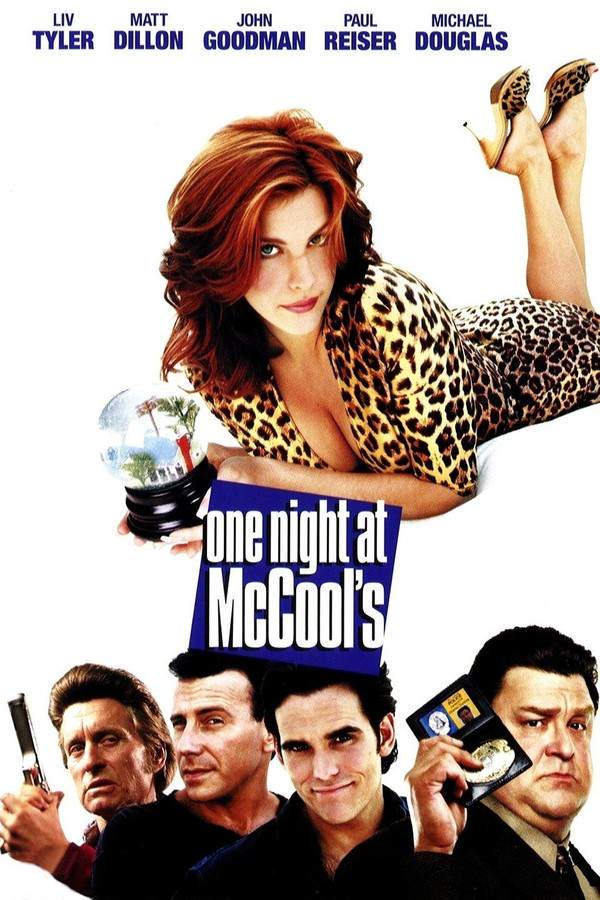
One Night at McCool's (2001) movie poster

Plot Summary

One Night at McCool's (2001) Plot Summary Explained

Release, runtime and language
2001 · 93 min · English
Directed by
Harald Zwart
Starring
Liv Tyler, Matt Dillon
Budget
$18M

Within the vibrant atmosphere of McCool's bar, a single night takes a dramatic turn. Bartender Randy, lawyer Carl, and Detective Dehling find their lives intertwined with the arrival of Jewel, a captivating woman. When a body is discovered, hidden desires and long-held secrets begin to surface. The story unfolds through three distinct viewpoints, exploring the complex relationships and unexpected consequences that arise as the night progresses, ultimately revealing a surprising connection between the men.

On this page (5)
  1. 1 What happens: full plot
  2. 2 Plot questions answered
  3. 3 Movie threads
  4. 4 Movies like One Night at McCool's
  5. 5 Every angle

Full plot summary · contains spoilers

What Happens in One Night at McCool's: Full Plot Summary

The whole story of One Night at McCool's (2001) explained, from the opening scene to the final frame: every key event, every twist and what it all adds up to. Read it as a quick recap before the sequel, to check a scene you missed, or to finally understand what really happened.

As the cinematic story unfolds, a captivating blend of conflicting narratives emerges, featuring characters like Randy, Carl, and Detective Dehling, each offering their own accounts of their entanglement with the enigmatic Jewel. These intricate tales are interwoven through dramatic re-enactments of crucial scenes, each layer revealing deeper complexities in the web of events that have transpired.

Randy, a bartender with a flair for storytelling, engages in an unexpected conversation with Mr. Burmeister at a bingo hall. He shares the dramatic turn his life took on a fateful night at McCool's, where he claims to have saved Jewel from the clutches of her abusive boyfriend, Utah. However, Carl, Randy's distant relative and an unintentional witness, spins a dramatically different yarn during a session with his therapist.

In Carl's account, he was merely dozing off in his car outside McCool's when the confrontation between Randy and Utah unfolded. Yet, what particularly captured Carl's attention was Jewel's seemingly calculated performance afterward, designed to manipulate Randy into taking her home. What followed was an intimate moment between Randy and Jewel that soon devolved into chaos, as Jewel reveals her true con artist nature just as Utah reenters the scene, harboring sinister intentions.

When events spiral dangerously out of control, Jewel resorts to shooting Utah in self-defense, but Randy—ever the chivalrous storyteller—takes the fall, claiming his actions were purely out of self-defense. This pivotal moment sets off a series of events that draw Detective Dehling into the web of the investigation, leading him to question the authenticity of Randy's narrative as he relays his own version to Father Jimmy.

As Jewel moves into Randy's home, she embarks on a mission to redesign his space to reflect her taste, much to Randy's dismay, particularly since he's just lost his job at McCool's due to the downturn in the bar's reputation. Meanwhile, Dehling becomes fixated on an edited tape of a heated argument between Randy and Jewel, interpreting it as evidence of Randy's abusive tendencies, despite Randy's fervent claims that their relationship thrives on mutual respect and trust.

As tensions rise, Jewel subtly manipulates Randy into acts of impulsivity, including the theft of valuable memorabilia from his former workplace. Her charm is further evidenced when she acquires a new vehicle, deceptively claimed to be borrowed from a friend, signaling the start of their latest scheme aimed at one of Carl's associates.

However, their luck eventually runs out when a seemingly routine robbery goes awry, trapping Randy in a closet while Jewel is forced to make drastic decisions regarding their captured accomplice. Although they succeed in escaping, the pressure of their ongoing illegal activities strains their already fragile relationship.

When Detective Dehling digs deeper into the murder investigation, he uncovers a complex web of deceit linking Carl and Randy, forcing him to confront Randy in his own home. Yet, beneath the weight of the case, Dehling finds himself strangely drawn to Jewel, which further complicates matters when he notices the bruised remnants of a relationship likely rooted in manipulation.

As the narrative twists, Randy, filled with desperation, confides in Burmeister about his dark intentions to eliminate Jewel and gain her affection. Together, they concoct a plan that involves Randy parting with a considerable sum to ensure Jewel's end, but Carl, with his own agenda, complicates matters by wanting to rekindle his passionate affair with Jewel.

Tensions peak when Detective Dehling arrives on the scene, flowers in hand yet an air of authority surrounding him. As Randy tries to distance Carl from Jewel, a chaotic intruder—Utah's twin brother Elmo, seeking revenge—adds fuel to the fire.

What follows is a catastrophic melee, bullets flying and Detective Dehling caught in the crossfire, ultimately meeting his untimely demise. Carl makes a narrow escape, while Randy, bearing the weight of loss and destruction, surveys the wreckage of his life.

In the aftermath, Jewel slips into Burmeister's car, lured by the promises of a lavish lifestyle—a big-screen TV and a DVD player, all embodying her dreams. She leaves a poignant reminder of her tumultuous past—a snow globe—before driving off towards an uncertain future. Meanwhile, Carl's brief taste of freedom ends with a twist of fate, leaving him crushed beneath the weight of a dumpster—a symbolic end reflecting the ruin of his ambitions.
Last updated: November 22, 2024 at 14:30

Was this helpful?

Plot questions answered

One Night at McCool's Plot Explained: Your Questions Answered

The questions people ask most about One Night at McCool's (2001): what happens in the confusing scenes, why the characters do what they do, the twists, hidden details and what the ending means. Each answer contains spoilers.

Q1

Why does Randy take the blame for Jewel shooting Utah?

Randy takes the blame to protect Jewel, claiming the shooting was self-defense. This decision stems from his chivalrous nature and his attraction to her, even though he's being manipulated. By taking the fall, he entangles himself deeper in her web of deception, setting the stage for the disastrous events that follow.

Foreshadowing: Randy's tendency to dramatize events and see himself as a hero is established early in his bingo hall conversation with Burmeister.

  • randy
  • jewel
  • utah
  • shooting
  • self-defense
  • blame
Q2

Why is Jewel manipulating all three men?

Jewel is a con artist whose primary motivation is financial gain. She uses her charm and calculated performances to manipulate Randy, Carl, and Detective Dehling into doing what she wants. Each man represents a different opportunity, Randy provides shelter and affection, Carl offers a potential business scheme, and Dehling represents a complication she can exploit. Ultimately, she leaves with Burmeister because he promises a lavish lifestyle.

Foreshadowing: Carl's therapy session reveals how he witnessed Jewel's 'calculated performance' immediately after the confrontation with Utah.

  • jewel
  • manipulation
  • con artist
  • randy
  • carl
  • dehling
  • money
Q3

How does Detective Dehling die?

Detective Dehling is killed during the chaotic showdown at Randy's home. He arrives with flowers, intending to confront the situation, but the arrival of Elmo (Utah's twin brother seeking revenge) escalates everything into a violent melee. Dehling is caught in the crossfire and fatally shot. His obsession with Jewel and misinterpretation of the edited tape ultimately led him to his death.

Foreshadowing: Dehling's growing infatuation with Jewel and his fixation on the edited argument tape hint at his compromised judgment.

  • detective dehling
  • death
  • elmo
  • utah
  • crossfire
  • showdown
Q4

Why does Carl die at the end?

Carl's death is a darkly ironic conclusion to his character's arc. After escaping the chaotic shootout at Randy's home, Carl experiences a brief moment of freedom. However, his luck runs out when he is crushed beneath a dumpster in an alleyway. This tragic end serves as a metaphor for how his ambitions and entanglements with Jewel ultimately crushed him, reflecting the film's theme that criminal and manipulative behavior leads to ruin.

Foreshadowing: Carl's competing interests, he wants to rekindle his affair with Jewel while also being involved in the criminal schemes, set up his downfall.

  • carl
  • death
  • dumpster
  • alleyway
  • downfall
  • ironic
Q5

What happens to Jewel at the end?

Jewel escapes the violence and leaves with Mr. Burmeister, lured by his promises of a lavish lifestyle including a big-screen TV and DVD player. She drives off toward an uncertain future, leaving behind a snow globe as a symbolic reminder of her tumultuous past. Her departure represents her continued pattern of using men for material gain without any genuine emotional attachment.

Foreshadowing: Throughout the film, Jewel's materialistic nature is evident in how she redesigns Randy's home, acquires a new car through deception, and constantly manipulates men for financial benefit.

  • jewel
  • burmeister
  • leaves
  • snow globe
  • escape
  • materialistic
Q6

Why are there three different versions of events in the movie?

The three conflicting narratives, from Randy, Carl, and Detective Dehling, reflect the film's exploration of subjective truth and deception. Each character tells their version to someone: Randy to Burmeister at the bingo hall, Carl to his therapist, and Dehling to Father Jimmy. Each account is self-serving and manipulated, showing how the truth becomes ambiguous when everyone has their own agenda. This structure highlights how the characters lie not just to others but also to themselves.

Foreshadowing: The opening sequence establishes Randy as a storyteller with a flair for drama, immediately setting up that his account may not be reliable.

  • three perspectives
  • conflicting narratives
  • unreliable narrators
  • truth
  • deception
Q7

Why does Randy want to kill Jewel?

Randy becomes desperate and confides in Burmeister about his intention to eliminate Jewel, believing that getting rid of her would somehow win her affection or free him from her manipulation. This dark moment reveals how twisted his relationship with Jewel has become, his obsession has transformed into murderous intent. Together, they devise a plan involving a significant sum of money to orchestrate her death, but the chaotic events that follow prevent this from happening as planned.

Foreshadowing: Randy's frustration grows as Jewel manipulates him into theft, loses him his job, and continues her deceptive ways despite his sacrifices.

  • randy
  • jewel
  • murder
  • burmeister
  • plan
  • desperation
Q8

Who is Utah's twin brother Elmo and why does he appear?

Elmo is Utah's twin brother who appears at the climax seeking revenge for Utah's death. His arrival at Randy's home during the chaotic showdown adds fuel to the fire, turning an already tense situation into violent chaos. Elmo's presence forces everyone into immediate danger and contributes directly to Detective Dehling's death by being part of the crossfire that kills him.

Foreshadowing: Utah's return with sinister intentions earlier in the film establishes that his death would have consequences.

  • elmo
  • utah
  • twin brother
  • revenge
  • showdown
  • climax
Q9

Why does Detective Dehling think Randy is abusive?

Dehling becomes fixated on an edited tape of a heated argument between Randy and Jewel. Because of the editing, the tape appears to show Randy behaving abusively toward Jewel. Dehling interprets this as evidence of Randy's violent tendencies, despite Randy's claims that their relationship is built on mutual respect and trust. This misinterpretation drives Dehling's investigation and adds another layer of misunderstanding to the already complex web of deception.

Foreshadowing: Jewel's manipulative nature is established early on, and the film shows her subtly encouraging Randy's worst impulses.

  • dehling
  • randy
  • edited tape
  • argument
  • misunderstanding
  • abuse accusation
Q10

Why does Jewel shoot Utah?

Jewel shoots Utah in self-defense when he returns to Randy's home with sinister intentions after the initial confrontation. This moment occurs right after she reveals her true con artist nature to Randy, creating a chaotic situation. Utah's reappearance with harmful intent forces Jewel to act desperately, and the shooting becomes the pivotal event that sets off the chain of consequences affecting all characters throughout the night.

Foreshadowing: The tension between Utah and Randy over Jewel, established in the opening confrontation, makes Utah's return predictable.

  • jewel
  • utah
  • shooting
  • self-defense
  • return
  • confrontation

Movie threads

More Movies Like One Night at McCool's, by Mood & Story

Curated lists built around what makes One Night at McCool's tick: the same mood, the same kind of story or the same emotional payoff. Each list explains why these movies belong together.

Femme Fatale stories with manipulation like in One Night at McCool's

Stories where a mysterious woman manipulates flawed men towards ruin. If you enjoyed the cunning Jewel in One Night at McCool's, you'll find similar movies here featuring charismatic but dangerous women who masterfully manipulate men. Discover other crime thrillers and neo-noirs where seduction leads to deception, betrayal, and destructive consequences, capturing that specific vibe of lustful chaos.

  • manipulative
  • lustful
  • deceptive
  • suspenseful
  • cynical
  • chaotic
  • Tone: dark, cynical
  • Pacing: fast, chaotic
Why these movies?

The story pattern: Narratives in this thread typically follow a pattern where a new woman disrupts the status quo, captivating one or more male protagonists. Through seduction and cunning lies, she involves them in her schemes, often criminal, exposing their weaknesses and ambitions. The story unfolds as the web of deceit tightens, culminating in betrayal, violence, and the collapse of the men's lives, while the femme fatale's fate varies from tragic to triumphant escape.

Why they belong together: Movies are grouped here based on their shared focus on the femme fatale trope, a tone of cynical suspense, and themes of manipulation and lust. They deliver a specific experience where the viewer watches a carefully constructed deception unravel, often with a fast-paced, chaotic energy and a morally ambiguous or darkly satisfying conclusion.

Movies with multiple perspectives like in One Night at McCool's

Crime stories where the truth is fragmented through multiple unreliable viewpoints. Fans of the three-sided story in One Night at McCool's will appreciate these films that unravel a central crime or event through conflicting character viewpoints. Explore similar complex narratives where the truth is subjective, revealing hidden motives and lies, perfect for viewers who enjoy piecing together a puzzle from unreliable narrators.

  • unreliable narrator
  • deceptive
  • complex
  • suspenseful
  • puzzle
  • cynical
  • Tone: dark, suspenseful
  • Pacing: variable, complex
Why these movies?

The story pattern: The defining narrative pattern involves a central, impactful event (a murder, a heist, a confrontation) that is revisited from the distinct perspectives of several key participants. Each retelling reveals new information, contradicts previous accounts, and exposes the narrator's biases and secrets. The audience's role is active, as they must sift through the versions to approach a fuller, often ambiguous, picture of what truly happened.

Why they belong together: These films are grouped by their shared complex narrative structure and the thematic focus on the relativity of truth. They deliver a specific intellectual and suspenseful experience, engaging the viewer not just with the plot itself but with the meta-puzzle of interpreting the differing accounts. The tone is often dark, cynical, or tense as deception is layered upon deception.

If you liked this

Movies Like One Night at McCool's

Similar movies to One Night at McCool's: the same genre, themes or kind of story. Each one comes with its own plot summary, timeline and ending explained.

Browse all movie summaries

Every angle

One Night at McCool's (2001) Explained: Plot, Timeline & Characters

Everything about One Night at McCool's in one place: what happens in the plot summary, the timeline in chronological order, the characters and meaning and a spoiler-free summary. What's After the Movie adds the cast, box office and post-credit scenes.

Coming soon on iOS and Android

The Plot Explained Movie Summary App

Plot summaries, endings explained and timelines on your phone. Catch up on any movie in minutes, save your favorites and never miss a twist again.

Be the first to know when we launch. Your email stays private, always.

Learn more about the app