





Plot Explained Spoilers guaranteed!
Plot Explained

Browse by genre

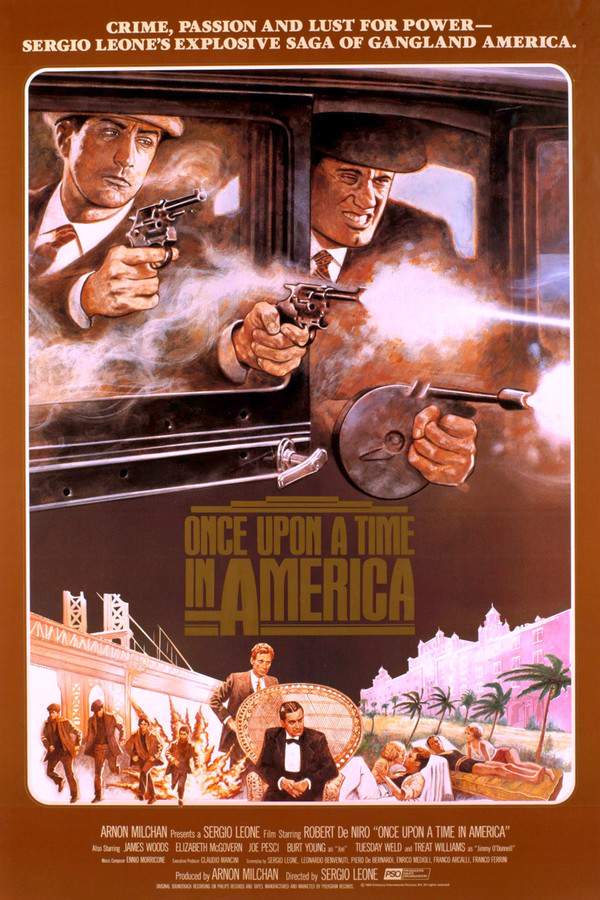
Once Upon a Time in America (1984) movie poster

Timeline

Once Upon a Time in America (1984) Timeline Explained – Every Event in Order

Release, runtime and language
1984 · 229 min · English
Directed by
Sergio Leone
Starring
Robert De Niro, Burt Young, Joe Pesci, Treat Williams, Tuesday Weld, Danny Aiello

In 1968, David "Noodles" Aaronson returns to New York City, reflecting on his complex past. Flashbacks reveal his early years in the Lower East Side, where he and his friends became involved in organized crime. The film explores themes of violence, loyalty, and the consequences of their actions as they navigate a dangerous world and face difficult choices that will shape their lives forever.

On this page (6)
  1. 1 Where to watch
  2. 2 Events in order (15)
  3. 3 Timeline questions answered
  4. 4 Movie threads
  5. 5 Movies like Once Upon a Time in America
  6. 6 Every angle

Where to watch

Where to Watch Once Upon a Time in America (1984)

Where can you watch Once Upon a Time in America? Stream, rent or buy it in the US, including on Amazon Video, Apple TV Store and Fandango At Home: current JustWatch availability with up-to-date prices.

Streaming availability powered by JustWatch

15 events in order · contains spoilers

Once Upon a Time in America Timeline: Events in Chronological Order

Every key event of Once Upon a Time in America (1984) in order, scene by scene, with when and where it takes place. Use it to untangle flashbacks, time jumps and parallel storylines, to refresh your memory before the sequel or to find the exact scene you are thinking of.

  1. Return to the Neighborhood

    The film begins in 1968, when David 'Noodles' Aaronson returns to his old haunts in the Lower East Side of Manhattan. He is drawn back by a mysterious letter from a rabbi regarding a cemetery's closure, igniting memories of his turbulent past.

    When
    1968
    Where
    Lower East Side, Manhattan
  2. Settling In

    Once back, Noodles settles above a bar owned by Fat Moe Gelly, an acquaintance from his youth. As he grapples with the weight of his nostalgia, he begins investigating the letter and its meaning, which leads him to confront the ghosts of his past friendships.

    Where
    Fat Moe's Bar
  3. Flashback to Childhood Dreams

    The narrative flashes back to 1920, where a younger Noodles and his friends are introduced, struggling with poverty yet aspiring for a brighter future. Their lives circle around petty crime, revealing their aspirations and camaraderies.

    When
    1920
    Where
    Lower East Side, Manhattan
  4. Meeting Max

    Amidst their criminal endeavors, Noodles and his friends encounter Max, who captivates them with his charm and intelligence. This meeting marks the beginning of a pivotal friendship that will shape their futures and dreams.

  5. Rise to Notoriety

    As the boys transition into teenagers, they grow bolder in their criminal undertakings and begin to establish themselves within their community. They cunningly manipulate Whitey, a local figure, marking their rise in the underground world.

  6. Noodles' Crush

    Noodles becomes infatuated with Deborah, the sister of Fat Moe, whose elegance and ballet practice enchant him. Despite his feelings, he remains largely unnoticed by her, intensifying his desire for a life beyond crime.

    Where
    Fat Moe's Bar
  7. Violent Confrontation

    Tension escalates when Bugsy aggressively confronts Noodles and Max after a botched robbery. This brutal encounter not only changes the dynamics among the boys but also sets Noodles on a path toward imprisonment.

    Where
    Lower East Side, Manhattan
  8. Imprisonment

    Noodles is incarcerated for twelve years due to the fallout from the robbery. During this time, his friendship bonds and aspirations fray amidst the harsh realities of prison life, shaping his outlook on the world.

    When
    1932
    Where
    Prison
  9. Release and Reunion

    Upon his release in 1932, Noodles finds a transformed world filled with both opportunity and danger. He reunites with Max, who now leads a bootlegging operation that cleverly disguises a darker business within a speakeasy.

    When
    1932
    Where
    Speakeasy
  10. Escalating Ambitions

    The gang's bootlegging ventures intertwine with labor movements, generating moral conflicts as they devise plans involving a police captain's newborn son. These choices lay the groundwork for their eventual descent into chaos.

  11. Rekindling Romance

    Noodles attempts to rekindle his relationship with Deborah, navigating the complexities of love amid violent aspirations and deep-seated regrets. Their connection symbolizes hope, yet the lingering shadows of the past threaten their bond.

  12. Betrayal and Tragedy

    As the gang’s activities spiral into violent confrontations, betrayal rear its ugly head. Friends start falling victim to the brutal world they have created, leading to Noodles grappling with guilt and despair over their shared decisions.

  13. Confronting the Past

    In 1968, Noodles confronts the consequences of his actions as he visits the mausoleum that memorializes his fallen friends. This moment forces him to reckon with the intertwining echoes of friendship, betrayal, and lost opportunities.

    When
    1968
    Where
    Mausoleum
  14. Fateful Reunion

    A chance encounter reunites Noodles with Max once more, merging past and present in a complex interplay of emotions. This haunting moment underscores the irreversible choices that continue to shape their fates.

  15. Blurring Reality and Fantasy

    In the film's closing moments, Noodles returns to an opium den, where reality and dreams intertwine. This unsettling resolution leaves the audience questioning the lasting impacts of the past and the nature of one's existence.

    Where
    Opium Den

Last updated: November 07, 2024 at 23:25

Was this helpful?

Timeline questions answered

Once Upon a Time in America Timeline Explained: Your Questions Answered

When does it happen, and why in that order? The questions people ask about the chronology of Once Upon a Time in America (1984): time jumps, flashbacks, cause and effect between scenes and the correct order of events, each answered with spoilers.

Q1

Why was Noodles imprisoned for 12 years?

Noodles was imprisoned for 12 years after a botched robbery that went violently wrong. Following a robbery attempt, Bugsy brutally confronted Noodles and Max. The confrontation escalated, leading to criminal charges that resulted in Noodles serving a lengthy prison sentence while Max remained free outside.

Foreshadowing: Earlier scenes show the boys' growing boldness in petty crime, which inevitably leads to dangerous confrontations with established gangsters like Bugsy.

  • noodles imprisonment
  • bugsy robbery
  • 12 years prison
Q2

What was the baby switching plan in the film?

During the labor strike era in 1932-33, Max devised a scheme to switch a police captain's newborn son with another baby to ensure the gang's safety. The plan involved using the police captain's newborn as leverage, creating a protective insurance policy against law enforcement intervention in their criminal activities.

Foreshadowing: The gang's bootlegging operations were already intertwining with labor movements, creating dangerous tensions with authorities.

  • baby switching
  • police captain
  • labor strikes
  • max scheme
Q3

Why did Noodles betray his friends?

Noodles betrayed his friends, particularly Max, because he was consumed by guilt and wanted to save them from the destructive path they were on. When Noodles discovered the full extent of their violent criminal enterprise and its consequences, he made a desperate choice that he believed would end the cycle of violence, though it ultimately led to tragedy.

Foreshadowing: Throughout the film, Noodles struggles with the moral weight of their criminal lifestyle, particularly his romantic hopes for a life beyond crime with Deborah.

  • noodles betrayal
  • max
  • friendship
  • guilt
Q4

Who dies in Once Upon a Time in America?

Multiple characters die as a result of the gang's violent activities. The film's 1968 timeline reveals that Noodles's childhood friends, Patsy, Cockeye, and others, have all been killed. The exact circumstances and timing of each death are revealed through the non-linear narrative, with violence and betrayal claiming the lives of those involved in the criminal enterprise.

Foreshadowing: The film consistently emphasizes the brutal consequences of their criminal lifestyle, with each violent act building toward this tragic outcome.

  • character deaths
  • patsy
  • cockeye
  • gang violence
Q5

Is Max alive at the end of the film?

The ending deliberately leaves this question ambiguous. In 1968, Noodles encounters what appears to be Max, now an elderly man, but the film's final opium den sequence blurs the line between reality and fantasy. This ambiguity reinforces the film's exploration of memory, guilt, and the unreliability of the past.

Foreshadowing: The final scene's return to the opium den mirrors Noodles's state at the very beginning, suggesting the entire 1968 reunion may be a drug-induced memory or fantasy.

  • max ending
  • alive
  • opium den
  • ambiguous
Q6

What does the final opium den scene mean?

The final opium den scene represents the culmination of Noodles's lifelong struggle with guilt and memory. By returning to the opium den where the film began, the narrative suggests that Noodles has never truly escaped his past. The blurred reality raises questions about whether his 1968 journey was real or a morphine-induced dream, symbolizing how the burden of past choices continues to haunt him.

Foreshadowing: The film opens with Noodles in an opium den, establishing the cyclical nature of his escape from reality.

  • opium den
  • dream
  • reality
  • memory
  • ending
Q7

Why does Noodles return to New York in 1968?

Noodles returns to New York after receiving a mysterious letter from a rabbi about a cemetery's closure. The letter serves as the catalyst that draws him back to his old neighborhood, forcing him to confront the ghosts of his past and the unresolved consequences of his actions decades earlier.

Foreshadowing: The film opens with this mysterious letter, establishing it as the central mystery that propels the narrative forward.

  • rabbi letter
  • cemetery
  • return to new york
Q8

What happened to Deborah in the film?

Deborah, Noodles's lifelong love interest and Fat Moe's sister, represents Noodles's hope for a life beyond crime. Their relationship rekindles in 1932, but tragic circumstances prevent them from being together. By 1968, Deborah appears to have died, as she is memorialized in the mausoleum alongside Noodles's fallen friends, symbolizing another victim of the violent world they inhabited.

Foreshadowing: Noodles's crush on Deborah is established early, with her ballet practice representing a life of beauty and aspiration far from criminality.

  • deborah fate
  • death
  • love
  • noodles relationship
Q9

Why does Max become Noodles's nemesis?

Max's transformation from Noodles's closest friend to his adversary stems from their diverging paths during Noodles's imprisonment. While Noodles served 12 years, Max built a powerful criminal empire that increasingly embraced ruthless tactics. Their friendship fractured through betrayals, competing ambitions, and the deadly consequences of their criminal enterprise, ultimately leading to mutual destruction.

Foreshadowing: The early friendship between Noodles and Max, founded on Max's charisma and leadership, plants the seeds for their eventual conflict as their ambitions diverge.

  • max nemesis
  • betrayal
  • friendship fractured
Q10

How does the film's timeline structure work?

The film employs a non-linear narrative across three distinct time periods: 1920 (childhood), 1932-33 (the criminal peak), and 1968 (the present). The story primarily unfolds through Noodles's memories and guilt, shifting between these eras to reveal how past actions directly shaped his tragic present. This structure creates psychological depth rather than chronological clarity.

Foreshadowing: The film immediately establishes its complex structure by opening in 1968 before flashing back to 1920, signaling the importance of time and memory.

  • timeline
  • 1920
  • 1932
  • 1968
  • nonlinear structure

Movie threads

More Movies Like Once Upon a Time in America, by Mood & Story

Curated lists built around what makes Once Upon a Time in America tick: the same mood, the same kind of story or the same emotional payoff. Each list explains why these movies belong together.

Epic tales of memory and regret like Once Upon a Time in America

Sweeping, melancholic narratives built on the ruins of memory and irreversible choices. For viewers who enjoyed the reflective, time-hopping narrative of 'Once Upon a Time in America,' this section gathers films that share a similar epic scope and melancholic tone. These movies use memory as a central character, exploring themes of guilt and the irreversible consequences of one's actions in a life of crime or ambition.

  • fatalistic
  • nostalgic
  • melancholic
  • remorseful
  • dreamlike
  • atmospheric
  • Tone: melancholic, fatalistic, nostalgic
  • Pacing: slow, deliberate, atmospheric
Why these movies?

The story pattern: These stories often weave together multiple timelines to reveal how past actions define a character's present. The narrative is driven by introspection and regret, unfolding at a deliberate pace that allows the audience to fully absorb the emotional gravity of the protagonist's journey and the fatalistic nature of their destiny.

Why they belong together: They are grouped by their shared focus on the burden of memory, a non-linear structure that enhances the melancholic mood, and a pervasive sense of fatalism. The viewing experience is defined by a heavy emotional weight, a slow, immersive pace, and an ambiguous or bittersweet resolution that lingers long after the film ends.

Crime stories of brotherhood and betrayal like Once Upon a Time in America

Intimate crime sagas exploring the violent dissolution of loyalty among friends. If you were captivated by the complex dynamics of friendship and betrayal in 'Once Upon a Time in America,' this collection features similar movies. These films delve into the intimate, often tragic relationships within criminal enterprises, where loyalty is the ultimate currency and its violation has devastating consequences.

  • somber
  • tragic
  • intense
  • fatalistic
  • remorseful
  • violent
  • Tone: somber, tragic, intense
  • Pacing: steady, character-driven
Why these movies?

The story pattern: The narrative follows a 'coming of age' arc within a criminal context, charting the journey from idealism to corruption. The central conflict arises from within the group itself, as personal ambitions clash with collective loyalty, culminating in a pivotal act of betrayal that shatters the bonds of brotherhood and leaves a lasting legacy of guilt.

Why they belong together: These movies share a deep focus on the theme of brotherhood fractured by betrayal, set against a backdrop of organized crime. They possess a heavy emotional weight, high dramatic intensity, and a somber, often bleak tone that underscores the tragic cost of the characters' life choices.

If you liked this

Movies Like Once Upon a Time in America

Similar movies to Once Upon a Time in America: the same genre, themes or kind of story. Each one comes with its own plot summary, timeline and ending explained.

Browse all movie summaries

Every angle

Once Upon a Time in America (1984) Explained: Plot, Timeline & Characters

Everything about Once Upon a Time in America in one place: what happens in the plot summary, the timeline in chronological order, the characters and meaning and a spoiler-free summary. What's After the Movie adds the cast, box office and post-credit scenes.

Coming soon on iOS and Android

The Plot Explained Movie Summary App

Plot summaries, endings explained and timelines on your phone. Catch up on any movie in minutes, save your favorites and never miss a twist again.

Be the first to know when we launch. Your email stays private, always.

Learn more about the app