Plot Explained Spoilers guaranteed!
Plot Explained

Browse by genre

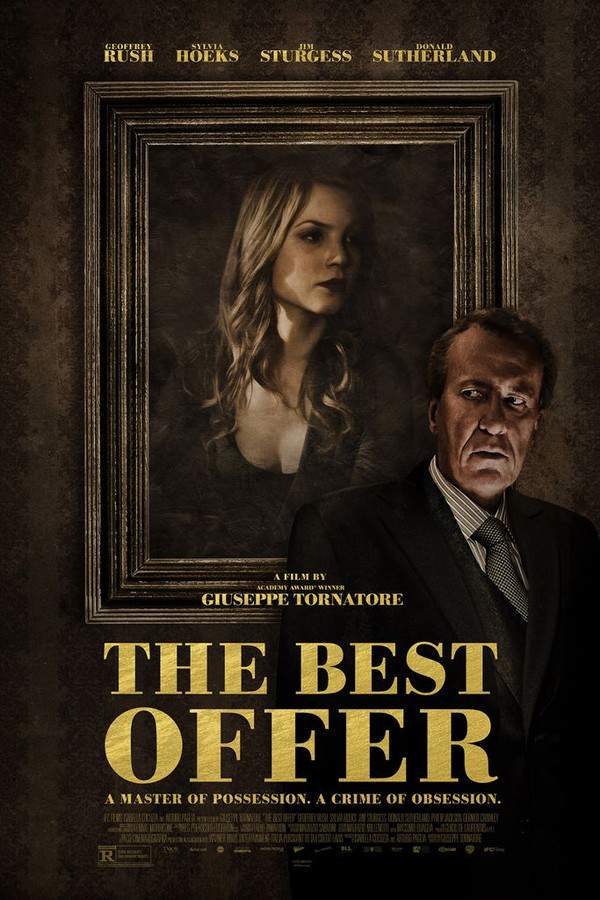
The Best Offer (2014) movie poster

Plot Summary

The Best Offer (2014) Plot Summary Explained

Release, runtime and language
2014 · 131 min · English
JustWatch #9,345 345
Directed by
Giuseppe Tornatore
Starring
Donald Sutherland, Sylvia Hoeks, Geoffrey Rush, Jim Sturgess

A reclusive art restorer, Virgil Oldman, is hired to assess the collection of a mysterious young woman. As he delves deeper into the task, he becomes increasingly captivated by her and determined to uncover her identity. Virgil's pursuit leads him into a complex and alluring world of art, passion, and hidden agendas, challenging his own personal demons and blurring the boundaries between reality and illusion.

On this page (6)
  1. 1 Where to watch
  2. 2 What happens: full plot
  3. 3 Plot questions answered
  4. 4 Movie threads
  5. 5 Movies like The Best Offer
  6. 6 Every angle

Where to watch

Where to Watch The Best Offer (2014)

Where can you watch The Best Offer? Stream, rent or buy it in the US, including on AMC+, Philo and Sundance Now: current JustWatch availability with up-to-date prices.

Streaming availability powered by JustWatch

Full plot summary · contains spoilers

What Happens in The Best Offer: Full Plot Summary

The whole story of The Best Offer (2014) explained, from the opening scene to the final frame: every key event, every twist and what it all adds up to. Read it as a quick recap before the sequel, to check a scene you missed, or to finally understand what really happened.

In this intricate tale, we delve into the world of Virgil Oldman, portrayed by Geoffrey Rush, who is not only the managing director of a renowned auction house but also a man grappling with his own obsessions and eccentricities. With meticulous attention to detail, he presents his unique skills during auction performances, but behind this polished facade lies a man plagued by obsessive-compulsive disorder. This affliction dictates that he only removes his gloves when handling classic artworks and vehemently avoids modern technologies such as cell phones.

Virgil's life takes an unexpected turn when he is approached by Claire Ibbetson, played by Sylvia Hoeks, a reclusive young heiress who has come into possession of an extensive collection of art and antiques inherited from her family. Constrained by severe agoraphobia, Claire confines herself to the sanctuary of her secure safe room, where she unexpectedly places her trust in Virgil due to their mutual discomfort with physical intimacy. As they engage in this partnership, Virgil's fascination with Claire deepens, spiraling into a consuming obsession.

Enter Robert, a talented young artisan brought to life by Jim Sturgess. He operates a shop dedicated to restoring intricate mechanical devices and becomes an invaluable ally to Virgil, assisting him in unraveling the cryptic mystery surrounding a series of intricate mechanical gears discovered on Claire's estate. These gears hint at the existence of a potentially precious historical automaton. Robert's ability to navigate human emotions makes him a wise advisor for Virgil, guiding him on how to forge a connection with Claire and manage the turbulence of his feelings.

The narrative unfolds further with an air of mystery surrounding the automaton. Robert proposes that its seemingly conversational abilities might be attributed to clever design and a hidden dwarf within the mechanism. Curiously, despite its murky origins, the automaton remains consistently accurate in its responses to various inquiries. As Virgil becomes captivated by uncovering the mysteries tied to Claire’s estate, he frequently visits a nearby café, unknowingly sharing space with a dwarf who astounds patrons with her remarkable aptitude for mathematical calculations.

As Virgil's obsession with solving the enigma encircling Claire and the automaton grows stronger, his idiosyncrasies bubble to the surface, setting the stage for a captivating exploration of art, deception, and obsession. The veneer of Virgil’s esteemed reputation begins to crack, revealing that his image as an infallible expert is little more than an elaborate facade. Behind the scenes, he orchestrates a sophisticated deception involving genuine masterpieces masquerading as mere reproductions, leading unsuspecting clients astray.

His accomplice in this ruse, Billy Whistler, portrayed by Donald Sutherland, unwittingly plays a key role by placing undervalued bids, further enabling Virgil's schemes. One poignant example is when Virgil diminishes the value of a charred piece of wood, only for its restoration to uncover a hidden masterpiece. He spins a tale suggesting it's a forgery marked by a mysterious "V," claiming that each forger is intrinsically compelled to express their true creativity through their work. Unfortunately, the aftermath of his manipulations leaves Virgil facing severe consequences when a late bidding maneuver allows another buyer to acquire the painting, originally deemed worthless, for an astounding £90,000.

The intensity of Virgil's deceitful actions becomes evident when he confronts Billy, unveiling that the painting in question is an original worth £8 million. While the sting of his betrayal still lingers, Billy intervenes by purchasing the painting from the original buyer for £250,000, only to return it to Virgil at cost, disguising it as a gesture to mend their fractured friendship. As the connection between Virgil and Claire deepens, Virgil's professional life starts to unravel under the weight of their romance, even as Billy warns him about the mutable nature of human relationships. A severe encounter with a gang sees Virgil battered, yet it is Claire's newfound courage that leads her to step outside, rescuing him.

As their relationship reaches a climactic point, Virgil chooses to unveil his most treasured secret—a lifetime accumulated collection of art. Claire’s heartfelt reaction to his revelation is profound, as she fiercely asserts her love for him, regardless of what may come. During a dinner gathering with Robert and his partner, Virgil presents Claire with an ornate catalog of his collection, and instead of considering its potential for profit, she declares that she won't sell it. Overcome with excitement, Virgil exuberantly tears up the catalog, demonstrating his commitment to her.

The stage is set for a grand auction in London just a week later. Following this momentous event, Virgil is given a parting gift from Billy: one of his own paintings, adorned with a poignant reminder that his belief in himself could have led to greatness as an artist. Virgil's humorous reply reveals his reluctance to bring harm to his friend's masterpiece.

Returning home, however, brings an emotional blow; Claire and his entire collection have vanished, leaving behind only the cherished automaton. Its mechanical voice delivers Robert’s message, echoing a profound truth about the authenticity concealed within every forgery, leaving Virgil to wrestle with a profound sense of loss. Among the remnants is a portrait purported to be of Claire's mother, which turns out to be a creation by Billy, complete with a touching dedication that showcases the artist's admiration for Virgil.

As he reckons with the weight of his treachery, Virgil's thoughts remain consumed by the elusive Claire, her dual identities haunting him. The burden of his guilt is tangible as he clutches Billy's portrait, marking the turbulence of their affair. Desperate for closure, he embarks on a solitary pilgrimage to Prague, meticulously arranging his surroundings to mirror his chaotic mindset. The portrait, now displayed prominently, serves as a bittersweet memory of their fleeting romance.

Settling into a restaurant steeped in sentimental value for Claire, adorned with intricate clock mechanisms, Virgil experiences a deepening existential crisis. The waiter’s inquiry about his companion prompts a poignant moment of reflection, revealing his silent hope of reuniting with Claire. As the camera slowly pans away, the rhythmic ticking of timepieces envelops the scene, accentuating the relentless march of time and Virgil's unwavering longing for resolution.
Last updated: November 22, 2024 at 16:23

Was this helpful?

Plot questions answered

The Best Offer Plot Explained: Your Questions Answered

The questions people ask most about The Best Offer (2014): what happens in the confusing scenes, why the characters do what they do, the twists, hidden details and what the ending means. Each answer contains spoilers.

Q1

Why did Claire pretend to have agoraphobia?

Claire's agoraphobia was entirely fabricated as part of an elaborate con orchestrated by a criminal gang. She was not truly housebound, in fact, she was the one who approached Virgil at the café and later rescued him from the gang attack. The entire relationship was designed to manipulate Virgil into revealing his valuable collection, using his emotional vulnerability against him.

Foreshadowing: Earlier scenes show Claire suddenly capable of leaving her safe room when it serves the con's needs, such as rescuing Virgil after the gang attack.

  • claire ibbetson
  • agoraphobia
  • fake
  • con
  • manipulation
Q2

How did the automaton predict things accurately?

The automaton contained a dwarf hidden inside its mechanism who listened to questions and provided responses through the mechanical voice. This explains how it could give seemingly intelligent answers, it was a real person operating it, not magic or supernatural prediction. The same dwarf was the woman at the café who amazed patrons with mathematical calculations.

Foreshadowing: Robert initially suggests the automaton might have a dwarf hidden within it, which turns out to be literally true.

  • automaton
  • dwarf
  • mechanism
  • prediction
  • mystery
Q3

What happened to Virgil's art collection?

Claire and the gang stole Virgil's entire lifetime collection of art after the London auction. This was the ultimate goal of the con, to gain access to his most prized possessions. Only the automaton remained, which delivered Robert's final message about authenticity in forgeries.
Foreshadowing: Billy's warning about the mutable nature of human relationships foreshadows the betrayal, and Claire's unusual interest in his collection's emotional rather than monetary value was a manipulation tactic.

  • art collection
  • stolen
  • claire
  • betrayal
  • auction
Q4

Why did Claire leave Virgil after the auction?

Claire's departure was always the plan. The romantic relationship was a calculated con to gain Virgil's trust and access his valuable art collection. Once she had obtained what she wanted, she disappeared with everything. Her tearful declaration of love and refusal to sell his catalog were performances designed to manipulate him emotionally.
Foreshadowing: Claire's insistence that she wouldn't sell his collection, rather than asking about its monetary value, reveals her focus on obtaining rather than buying.

  • claire
  • departure
  • con
  • love
  • betrayal
Q5

What message did the automaton deliver at the end?

The automaton's mechanical voice delivered Robert's message: 'There is always something genuine in every forgery.' This poignant statement reflects the film's themes about authenticity, as Robert, the one genuine person in Virgil's life, was the one who truly tried to help him understand love and human connection, unlike the fraudulent Claire.

Foreshadowing: Robert consistently served as Virgil's moral compass throughout the film, advising him on genuine human connection.
  • automaton
  • message
  • robert
  • forgery
  • authenticity
Q6

What was the £8 million painting incident about?

Virgil devalued a charred piece of wood at auction, claiming it was a forgery marked with a fake 'V.' After Billy accidentally sold it for a low price, the buyer discovered it was actually an original worth £8 million. Billy then bought it back for £250,000 and returned it to Virgil at cost, pretending it was to mend their friendship, but this was actually part of the setup for the larger con against Virgil.

Foreshadowing: Virgil's own forgery business and his habit of manipulating art values planted the seeds for his ultimate downfall.

  • painting
  • 8 million
  • forgery
  • auction
  • billy
Q7

Was Claire's rescue of Virgil after the gang attack real?

Claire's rescue of Virgil appears to have been staged as part of the con to gain his complete trust. By saving him in a dramatic moment, she solidified her position in his life and made him more vulnerable to her manipulation. The gang confrontation itself may have been arranged to create this opportunity for emotional bonding.

Foreshadowing: The gang attack seems oddly convenient for advancing the relationship, and Claire's sudden courage contradicts her supposed severe agoraphobia.

  • claire
  • rescue
  • gang
  • attack
  • trust
Q8

Why did Virgil tear up his art catalog?

Virgil tore up his prized catalog in a moment of emotional overwhelm when Claire declared she wouldn't sell his collection and seemed to love him unconditionally. This gesture symbolized his complete emotional surrender to the relationship, abandoning his guarded, transactional approach to art and human connection.

Foreshadowing: This moment represents Virgil's vulnerability, which the con artists exploit to gain access to his most treasured possessions.

  • catalog
  • tear
  • love
  • virgil
  • art collection
Q9

Who painted the portrait of Claire's mother?

The portrait purportedly showing Claire's mother was actually painted by Billy Whistler, Virgil's accomplice in his forgery schemes. The painting included a dedication from Billy to Virgil, revealing that even this seemingly personal artifact was part of the larger deception. Billy was working with the con artists against Virgil.

Foreshadowing: Billy's gift of a painting at the end, ironically one of his own works, ties back to his role as both Virgil's friend and secret collaborator in the forgery business.

  • portrait
  • billy
  • mother
  • painting
  • forgery
Q10

What did Virgil realize during his trip to Prague?

Virgil's pilgrimage to Prague, Claire's supposed hometown, was his desperate attempt to find closure and understand what was real. Sitting in the restaurant filled with clocks (her supposed favorite), he confronted the emptiness of his belief in their relationship. The restaurant's clock mechanisms mirror his realization that he wasted time on illusions, and his silent answer to the waiter about waiting for someone reveals his lingering hope for reconciliation.

Foreshadowing: Claire's mention of Prague as her hometown and the restaurant with clocks were likely planted details from the con, which Virgil only recognizes in hindsight.

  • prague
  • restaurant
  • clocks
  • closure
  • regret
Q11

Why was Virgil attacked by the gang?

The gang attack on Virgil was likely orchestrated as part of the con to create a dramatic situation where Claire could 'rescue' him, deepening his emotional dependence on her. This calculated manipulation was designed to make Virgil trust Claire completely and lower his defenses before the final theft of his collection.

Foreshadowing: The attack occurs shortly after Virgil begins sharing personal details about his collection, providing the con artists with timing cues.

  • gang
  • attack
  • con
  • manipulation
  • virgil
Q12

What was Virgil's forgery business?

Virgil ran a sophisticated fraud operation where he would undervalue artworks at auction, then secretly acquire them through his accomplice Billy Whistler who placed undervalued bids. He created elaborate stories about forgeries to manipulate prices, keeping valuable originals for himself. This moral corruption made him vulnerable to the same kind of manipulation he inflicted on others.

Foreshadowing: Virgil's own advice to Claire about authenticity, 'each forger is intrinsically compelled to express their true creativity', becomes ironic when applied to his own deceptive practices.

  • forgery
  • fraud
  • auction
  • billy
  • art

Movie threads

More Movies Like The Best Offer, by Mood & Story

Curated lists built around what makes The Best Offer tick: the same mood, the same kind of story or the same emotional payoff. Each list explains why these movies belong together.

Movies about sophisticated deceptions like The Best Offer

Intelligent stories where masterful cons unravel with devastating emotional consequences. If you liked the psychological manipulation and elegant con artistry in The Best Offer, explore these movies. This thread features stories of calculated betrayals in sophisticated worlds, where the line between reality and illusion is masterfully blurred.

  • deceptive
  • sophisticated
  • psychological
  • obsessive
  • calculating
  • melancholic
  • Tone: melancholic, deceptive
  • Pacing: slow, deliberate
Why these movies?

The story pattern: These narratives follow a slow, meticulous build-up where a seemingly genuine relationship or opportunity is revealed to be an elaborate scam. The protagonist, often an expert in their field, is targeted and their deepest vulnerabilities are exploited, leading to a climactic twist that recontextualizes the entire story.

Why they belong together: These films are grouped by their shared focus on high-stakes psychological manipulation, complex plotting with major twists, and a heavy emotional impact stemming from betrayal. They create a specific atmosphere of sophisticated unease and tragic revelation.

Movies with obsessive loners like the protagonist in The Best Offer

Character studies of isolated protagonists whose fixations distort their perception of truth. For viewers who appreciated the character study of Virgil Oldman in The Best Offer, this thread collects movies featuring reclusive, obsessive protagonists. These films explore themes of isolation, unreliable perception, and the tragic consequences of a consuming fixation.

  • obsessive
  • lonely
  • unreliable narrator
  • melancholic
  • reflective
  • atmospheric
  • Tone: melancholic, reflective
  • Pacing: slow, character-driven
Why these movies?

The story pattern: The story is built around a central character who is deeply isolated, either physically or emotionally. Their intense obsession—with a person, an art form, or a mystery—drives the plot and gradually casts doubt on the objectivity of their experience, culminating in a moment of stark, painful clarity.

Why they belong together: This thread connects movies through a shared protagonist archetype: the brilliant but socially impaired loner. The similarity lies in the melancholic mood, heavy emotional weight, and the complex narrative structure that challenges the viewer's trust in the main character's perspective.

If you liked this

Movies Like The Best Offer

Similar movies to The Best Offer: the same genre, themes or kind of story. Each one comes with its own plot summary, timeline and ending explained.

Browse all movie summaries

Every angle

The Best Offer (2014) Explained: Plot, Timeline & Characters

Everything about The Best Offer in one place: what happens in the plot summary, the timeline in chronological order, the characters and meaning and a spoiler-free summary. What's After the Movie adds the cast, box office and post-credit scenes.

Coming soon on iOS and Android

The Plot Explained Movie Summary App

Plot summaries, endings explained and timelines on your phone. Catch up on any movie in minutes, save your favorites and never miss a twist again.

Be the first to know when we launch. Your email stays private, always.

Learn more about the app