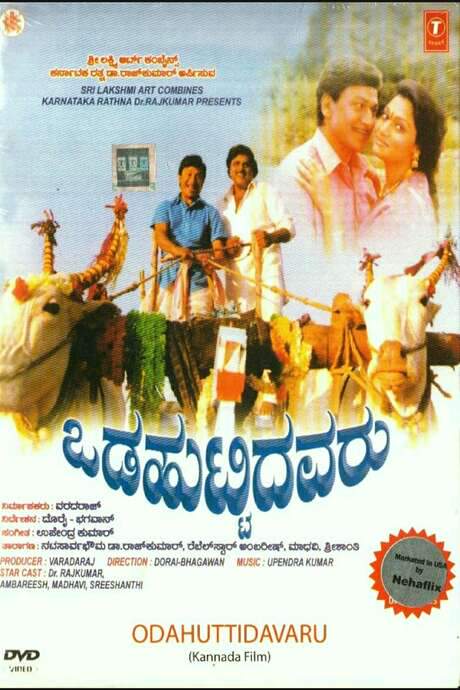
Gajendra Narayana Varma is a brave man who lives with his four brothers—Nagendra, Vijayendra, Surendra, and Rajendra—in a village in Karnataka. They are known for frequent brawls, and their trouble is usually nipped in the bud by Adv. Chari, who bails them out when the law catches up with their fiery ways. Gajendra, however, harbors a deep aversion to marriage, convinced that a wife could disrupt the delicate balance and harmony among his brothers. Though the younger siblings pretend they don’t want to marry, each secretly carries a hidden love, a fact that quietly nourishes the tension beneath their rough exterior.
The brothers’ curiosity and care for Gajendra ignite a plan born from memories: their childhood acquaintance, DC Krishnamurthy, reveals that in school days Gajendra was once in love with a girl named Shakambari Devi, affectionately called Sakku. In a bold, if mischievous, move, the brothers decide to locate her and reintroduce her to Gajendra, hoping to rekindle the spark that once lit his heart. But fate has a twist—Sakku is now married with children. Undeterred, the brothers pivot to finding another woman who bears the same name, hoping the name itself will reach Gajendra’s heart. When he finally meets a new Shakambari Devi, he finds his feelings reignited—not just for the name, but for the person who bears it. In time, Gajendra himself is drawn to her, and the spark grows into something deeper.
A clash with the market’s looming menace, a goon named Bettappa, sets the immediate stakes. Bettappa threatens the safety of the village and his henchmen target Gajendra’s brothers, prompting a bold move: Gajendra abducts Bettappa’s son in a bid to curb Bettappa’s violence and banishes him from the town. The tension escalates as the couple’s journey continues, and a train ride to Sakku’s village unfolds a crucial backstory. Sakku shares her family’s history with Gajendra: her father, Srinivas Odeyar, is a respected man who despises violence, while his son—one connected to Sakku’s world—walked a violent path. After a violent act leads to tragedy, Srinivas Odeyar refuses to bury the perpetrator, choosing a path of peace and harmony instead. The train is interrupted by a group of goons, and Gajendra’s swift, fearless defense of Sakku shatters her impression of him as a non-violent man—she leaves him with a painful warning to stay away.
Undaunted, Gajendra and his brothers reach Sakku’s village with a clean-shaven look, and he never stops proving that he has changed. The welcome from Sakku’s family is warm and full of affection, and Gajendra is deeply moved by the love that surrounds them. Yet danger lurks: a dangerous figure named Narasimha aims to strike at Srinivas Odeyar and his kin. In a tense confrontation, Gajendra learns that Narasimha’s father, Durga Prasad, was connected to a devastating blast at a local matchstick factory, a discovery that fuels Narasimha’s rage and thirst for revenge. Durga Prasad’s own death—an act of despair after his arrest—deepens the feud and hardens Narasimha’s resolve.
Driven by a steadfast vow to protect Srinivas Odeyar’s family, Gajendra takes on Narasimha’s threats, dismantling the goons one by one while keeping Srinivas Odeyar’s kin unaware of the danger he faces on their behalf. Narasimha’s relentless pursuit reaches a fever pitch when he finally kidnaps Surendra, pulling Gajendra into a perilous rescue that comes at a heavy cost. In the nick of time, Gajendra arrives to save his brother, only to be brutally assaulted in the process. The arrival of Srinivas Odeyar and his family at the scene marks a turning point, as they witness the extraordinary risk Gajendra has taken to safeguard them. Even in the face of brutal injury, Gajendra’s resolve hardens, and he confronts Narasimha and his men in a brutal showdown that ends with Narasimha and his henchmen defeated.
In the wake of these trials, Srinivas Odeyar is moved by Gajendra’s courage and dedication. The elder’s respect and gratitude pave the way for a union that brings peace to the village: Gajendra and Sakku marry, cementing a bond that unites two families and symbolizes the triumph of restraint, courage, and love over violence. With the conspiracies unraveled and old wounds healed, Gajendra and his brothers are able to wed their own devoted partners, finally welcoming the harmony they had long imagined but struggled to attain.
The tale unfolds as an action-packed, heartfelt blend of loyalty, redemption, and second chances, anchored by a fearless lead performance and a rich tapestry of village life, family ties, and moral choices.