Plot Explained Spoilers guaranteed!
Plot Explained

Browse by genre

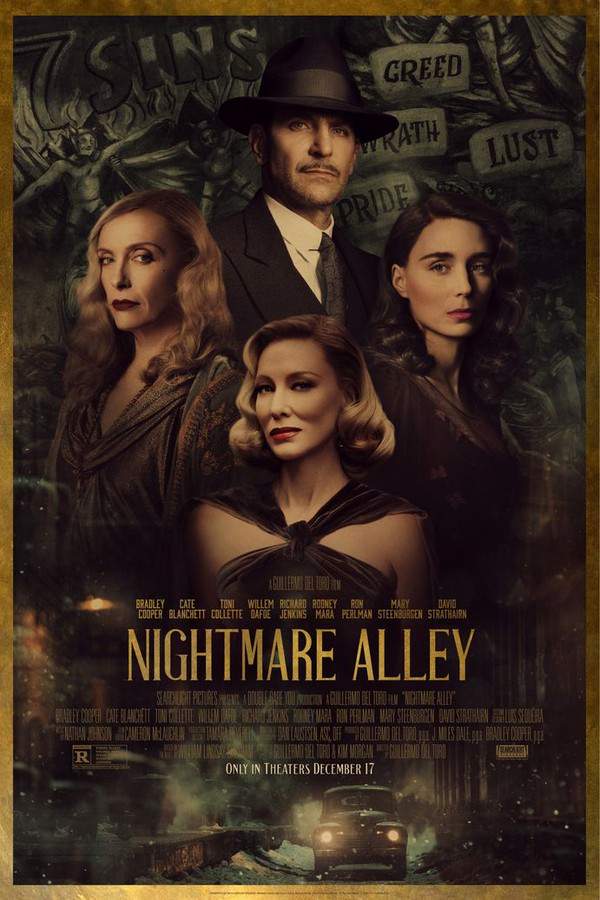
Nightmare Alley (2021) movie poster

Plot Summary

Nightmare Alley (2021) Plot Summary & Ending Explained

Release, runtime and language
2021 · 150 min · English
Echo score 68
JustWatch #4,152 39
Directed by
Guillermo del Toro
Starring
Mary Steenburgen, Cate Blanchett, Ron Perlman, Bradley Cooper, Willem Dafoe, David Strathairn
Budget
$60M

In 1940s New York, Stanton Carlisle joins a traveling carnival and learns the tricks of the trade from a seasoned mentalist. Using these skills, he reinvents himself as a legitimate psychic and rises to prominence, captivating the city’s wealthy and powerful. However, his carefully constructed world is threatened when he encounters a manipulative and enigmatic psychiatrist who seems to see right through his act, leading him down a dangerous path.

On this page (8)
  1. 1 Where to watch
  2. 2 What happens: full plot
  3. 3 Plot questions answered
  4. 4 How it ends
  5. 5 The book behind the movie
  6. 6 Movie threads
  7. 7 Movies like Nightmare Alley
  8. 8 Every angle

Where to watch

Where to Watch Nightmare Alley (2021)

Where can you watch Nightmare Alley? Stream, rent or buy it in the US, including on fuboTV, FXNow and YouTube TV: current JustWatch availability with up-to-date prices.

Streaming availability powered by JustWatch

Full plot summary · contains spoilers

What Happens in Nightmare Alley: Full Plot Summary

The whole story of Nightmare Alley (2021) explained, from the opening scene to the final frame: every key event, every twist and what it all adds up to. Read it as a quick recap before the sequel, to check a scene you missed, or to finally understand what really happened.

Stanton "Stan" Carlisle, having set his Midwestern home ablaze, embarks on a new chapter of his life as he takes up work with a traveling carnival. When Clem, the carnival owner, needs assistance in dealing with a sick geek, he turns to Stan for help in disposing of the unfortunate man. Witnessing the sordid reality of a geek's life—living in squalor and enduring the humiliation of biting off the heads of live chickens for entertainment—deeply disturbs him. Clem explains that he targets men with troubled pasts, often struggling with addiction, and entices them with the promise of a "temporary" job and opium-laced booze. This manipulative cycle ensures their dependence, leaving them with no choice but to remain trapped in their misery.

As Stan adjusts to his new surroundings, he becomes entangled in the act of Madame Zeena, portrayed by Toni Collette, and her alcoholic husband Pete, a role played by David Strathairn. Utilizing a clever coded language and cold reading techniques, they create the illusion of extraordinary psychic abilities. However, both Zeena and Pete warn him never to exploit their skills in a "spook show" that misleads patrons about the dead; it's crucial to reveal the ruse afterward to prevent harm.

In the carnival's hustle and bustle, Stan's heart is captured by fellow performer Molly, played by Rooney Mara, and he proposes they craft a two-person act separate from the carnival's unseemly nature. Tragedy strikes when Stan mistakenly administers the wrong alcohol to Pete, leading to the elder man's death from wood alcohol. This event propels Stan to declare his love for Molly, and they leave the carnival behind to pursue their ambitions.

Two years later, Stan has transformed himself into "The Great Stanton," a psychic performer for Chicago's wealthy elite, with Molly by his side. Their act, however, faces scrutiny when the astute psychologist Dr. Lilith Ritter interrupts, seeking to unveil their secrets. Stan's adept cold reading skills secure their performance, but Dr. Ritter remains undeterred, eventually testing his legitimacy at the behest of the affluent Judge Harrington.

Harrington, convinced of Stan's gifts, pays him to establish contact with his deceased son, disregarding Molly's disapproval of this unethical "spook show." Stan's relationship with Ritter grows complicated, morphing into a manipulative affair that spirals out of control. She exploits sensitive information from her therapy sessions, and together, they scheme to dupe Harrington further.

However, their charade leads Stan to Ezra Grindle, a powerful man yearning to communicate with his lost love, Dory, who tragically suffered a forced miscarriage. Ignoring Ritter's warnings about Grindle's volatile nature, Stan attempts to con him. The situation escalates, and when Molly, cast as Dory, discovers Stan's betrayal, she departs, leaving him vulnerable. Grindle, enraged by the deception, threatens both Stan and Molly, ultimately leading to Grindle's demise at Stan's hands.

Betrayed by Ritter, who has been pilfering his earnings and poised to expose him, Stan is left alone, injured, and hunted. Attempting to seek solace in a carnival, he is met with rejection until he is offered a final drink and the "temporary" job as the new geek. In a haunting admission of his broken spirit, Stan laughs and sobs as he resigns himself to his fate, declaring, > "Mister, I was born for it."
Last updated: November 03, 2024 at 21:59

Was this helpful?

Plot questions answered

Nightmare Alley Plot Explained: Your Questions Answered

The questions people ask most about Nightmare Alley (2021): what happens in the confusing scenes, why the characters do what they do, the twists, hidden details and what the ending means. Each answer contains spoilers.

Q1

Why did Stanton burn down his house before leaving?

Stan set fire to his Midwestern home to erase his past and signal a complete break from his previous life. This drastic act represents his desire for a fresh start and underscores his willingness to destroy everything familiar to reinvent himself.

  • stanton carlisle
  • fire
  • midwest
  • new start
Q2

Why did Zeena and Pete warn Stan about the spook show?

Zeena and Pete taught Stan cold reading but warned him never to use their techniques in a 'spook show', a fraudulent séance to contact the dead. They emphasized revealing the trick afterward because tricking grieving people about communicating with deceased loved ones causes serious psychological harm and can provoke violent reactions from those desperate to believe.

  • cold reading
  • spook show
  • psychic fraud
  • ethics
Q3

How did Pete die from the alcohol?

Stan mistakenly gave Pete wood alcohol (methanol) instead of regular alcohol. Wood alcohol is highly toxic and causes blindness and death even in small amounts. Pete, already an alcoholic, drank it without realizing, leading to his death, an accident that haunts Stan throughout the film.

  • pete death
  • wood alcohol
  • poisoning
  • accident
Q4

Why did Dr. Ritter want to expose Stan's psychic act?

Dr. Ritter was a psychologist who genuinely saw through Stan's cold reading tricks. Initially she sought to expose the fraud, but her motives shifted when she realized she could exploit Stan's abilities to access information from her wealthy patients. She ultimately wanted control over his skills rather than purely exposing him.

  • dr ritter
  • psychologist
  • expose
  • cold reading
Q5

Why did Molly leave Stan after the Grindle confrontation?

Molly discovered Stan's plan to use her as a fake Dory Grindle to con Ezra Grindle. This betrayal of trust, especially using her in a dangerous deception, convinced her that Stan had become the exploitative con artist she always feared. She left him immediately after the confrontation with Grindle.

  • molly leaves
  • ezra grindle
  • betrayal
  • dory
Q6

How did Ezra Grindle die in the film?

Stan killed Grindle during a confrontation at his mansion. When Grindle discovered the séance was a fraud and attacked Stan with a fireplace poker, Stan defended himself and struck Grindle repeatedly, killing him. This murder marks Stan's descent into physical violence rather than just psychological manipulation.

  • ezra grindle death
  • murder
  • fireplace poker
  • self defense
Q7

Why did Dr. Ritter betray Stan and steal his money?

Dr. Ritter betrayed Stan because she saw him as a liability after his failed con with Grindle turned violent. She had been secretly stealing his earnings throughout their affair, and when Stan became dangerous and exposed, she planned to abandon him with his money while exposing his fraud to protect her own reputation and wealth.

  • dr ritter betrayal
  • theft
  • money
  • affair
Q8

Why did Stan become the carnival geek at the end?

After being betrayed by Dr. Ritter, injured, and rejected by the carnival he once looked down on, Stan had no money, no connections, and no way to survive. He accepted the geek job, the same degrading role he once witnessed, because he had become the desperate, broken man the carnival preys upon, completing his tragic cycle.

Foreshadowing: The film opens with Stan witnessing the geek's miserable existence, foreshadowing his own fate.

  • geek ending
  • fate
  • carnival
  • exploitation
  • tragic cycle
Q9

What is a 'geek' in the context of Nightmare Alley?

In carnival terms, a 'geek' is the lowest, most exploited performer, a usually desperate, addicted man who performs degrading acts like biting the heads off live chickens for tips. Clem specifically targets broken men with addiction problems, trapping them in a cycle of dependency through opium-laced alcohol.

  • geek definition
  • carnival exploitation
  • addiction
Q10

Why did Judge Harrington pay Stan to contact his dead son?

Judge Harrington was grieving intensely over his son's death and desperately wanted to believe Stan could actually communicate with the dead. His wealth and status couldn't bring his son back, making him vulnerable to the false hope Stan's psychic act provided. He paid handsomely for this false comfort.

  • judge harrington
  • dead son
  • séance
  • grief
Q11

Why did Stan choose to work with Dr. Ritter instead of staying with Molly?

Stan's ambition drove him to pursue the lucrative high-society cons that Ritter could provide access to. While Molly disapproved of the unethical spook shows, Ritter encouraged them and offered the connections and information Stan needed to succeed among Chicago's elite. His desire for wealth and status outweighed his relationship with Molly.

  • ambition
  • dr ritter
  • molly
  • betrayal
  • wealth

Ending explained

What Happens at the End of Nightmare Alley?

How Nightmare Alley (2021) ends, in short: the final scene, the last twist and what it means for the characters. The full ending explained, with every spoiler, lives on its own page.

Read the full ending explained

The ending of “Nightmare Alley” reveals that Stan Carlisle’s pursuit of power, fame, and wealth ultimately leads him to his own destruction. Throughout the film, Stan’s actions are driven by greed and a desire to escape his tragic past, but his lies and manipulations create a web of deception that spirals out of control. As he builds his reputation as a mentalist and con artist, he becomes increasingly ruthless and morally compromised, pushing others aside and turning into a figure as hollow and cursed as the sins he has committed.

In the final act, Stan’s world collapses when his past sins catch up with him. The betrayal by Lilith, who exposes his manipulations, and Molly’s departure, realizing his true nature, leave him utterly alone. His plan to start fresh by running away is thwarted when Lilith reveals her revenge, exposing his downfall. Reduced to a broken, drunken shell resembling his father, Stan is abandoned and destitute.

Continue reading the ending (1 more paragraphs)

Desperate and past saving, Stan is lured back into the corrupt carnival world, where he is tricked into becoming a “geek,” a figure used to entertain and shock audiences by embodying the dehumanized, drug-addicted performer. The method involves covertly spiking him with opium to break him mentally and strip him of all dignity, turning him into the very beast he once dreamed of escaping. In this grim conclusion, Stan’s hubris and relentless pursuit of his desires seal his fate, as he ends up as the tragic embodiment of his own tragic dreams—destined to be forever haunted by the sins of his past, much like the myth of Icarus who flew too high and fell. The film leaves us with a haunting reminder that no matter how high one aims, the sins and consequences can always catch up, pulling a person into an inevitable downfall.

Nightmare Alley ending explained in full

Movie threads

More Movies Like Nightmare Alley, by Mood & Story

Curated lists built around what makes Nightmare Alley tick: the same mood, the same kind of story or the same emotional payoff. Each list explains why these movies belong together.

Crumbling Facades and Moral Decay in movies like Nightmare Alley

Stories where ambitious deceptions lead to an inevitable, bleak collapse. If you liked Nightmare Alley, explore more movies about deceptive rises and bleak falls. These films feature morally ambiguous characters whose intricate cons and ambitious schemes ultimately lead to their own destruction, offering a similarly tense and cynical viewing experience.

  • morally ambiguous
  • manipulative
  • suspenseful
  • downward spiral
  • noirish
  • grim
  • Tone: dark, cynical, tense
  • Pacing: steady, methodical
Why these movies?

The story pattern: The narrative pattern typically involves a protagonist mastering a skill of deception (con artistry, performance, manipulation) to gain power or wealth. Their initial success creates a false sense of security, but the story is fundamentally a downward spiral, where their own greed, paranoia, or a formidable opponent exposes their fraud, resulting in a complete personal and professional collapse.

Why they belong together: Movies are grouped here for their shared focus on the psychological toll of living a lie, the tension of maintaining a deception, and the bleak, often ironic, justice meted out to the protagonist. The tone is consistently dark, cynical, and suspenseful.

Grim neo-noir atmosphere in movies like Nightmare Alley

Atmospheric thrillers steeped in psychological dread and a grim worldview. Find movies with a similar grim, neo-noir atmosphere to Nightmare Alley. These films share a suspenseful, morally complex vibe, often set in evocative worlds like carnivals or gritty cities, where the visual style enhances a story of psychological manipulation and dread.

  • noirish
  • atmospheric
  • grim
  • suspenseful
  • cynical
  • morally ambiguous
  • Tone: dark, suspenseful, morally ambiguous
  • Pacing: steady, atmospheric
Why these movies?

The story pattern: Stories in this thread are often character-driven thrillers or crime dramas where the plot is secondary to the mood and environment. The narrative unfolds in a world that feels slightly off-kilter or predatory, with protagonists who are either corrupt or become corrupted by their surroundings. The focus is on sustaining a feeling of unease and impending doom.

Why they belong together: These movies are grouped by their shared, overpowering mood—a blend of visual style, soundtrack, and setting that creates a consistent sense of grim suspense. They prioritize a specific, cynical atmosphere over complex plotting, making the viewing experience immersive and psychologically unsettling.

If you liked this

Movies Like Nightmare Alley

Similar movies to Nightmare Alley: the same genre, themes or kind of story. Each one comes with its own plot summary, timeline and ending explained.

Browse all movie summaries

Every angle

Nightmare Alley (2021) Explained: Plot, Ending, Timeline & Characters

Everything about Nightmare Alley in one place: what happens in the plot summary, the timeline in chronological order, the characters and meaning, the ending explained and a spoiler-free summary. What's After the Movie adds the cast, box office and post-credit scenes.

Coming soon on iOS and Android

The Plot Explained Movie Summary App

Plot summaries, endings explained and timelines on your phone. Catch up on any movie in minutes, save your favorites and never miss a twist again.

Be the first to know when we launch. Your email stays private, always.

Learn more about the app