









Plot Explained Spoilers guaranteed!
Plot Explained

Browse by genre

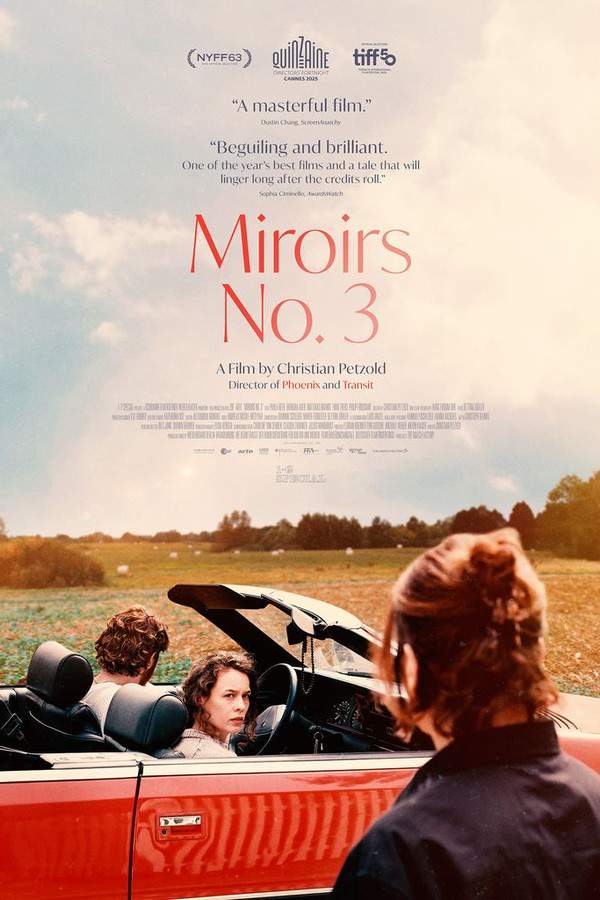
Miroirs No. 3 (2026) movie poster

Characters & Themes

Miroirs No. 3 (2026) Characters, Setting & Themes Explained

Release, runtime and language
2026 · 1 h 26 m · German
Echo score 76
JustWatch #1,864
Directed by
Christian Petzold
Starring
Philip Froissant, Enno Trebs, Paula Beer, Barbara Auer, Matthias Brandt, Victoire Laly

During a weekend trip to the countryside, Laura (Paula Beer), a young piano student from Berlin, miraculously survives a severe car crash. She awakens in a nearby house where a kindly local woman tends to her with motherly devotion. As she recovers, Laura gradually becomes part of the woman's daily life and the surrounding rural community.

On this page (7)
  1. 1 Where to watch
  2. 2 Characters explained (5)
  3. 3 Where & when it takes place
  4. 4 Themes & meaning (3)
  5. 5 Character & meaning questions
  6. 6 Movie threads
  7. 7 Every angle

Where to watch

Where to Watch Miroirs No. 3 (2026)

Where can you watch Miroirs No. 3? Stream, rent or buy it in the US, including on MUBI, Kanopy and Amazon Video: current JustWatch availability with up-to-date prices.

Streaming availability powered by JustWatch

5 main characters · contains spoilers

Miroirs No. 3 Characters Explained: Who Is Who

The main characters of Miroirs No. 3 (2026), heroes and villains: what drives them, how they change over the course of the story and what each of them reveals about the film's bigger ideas.

  • Laura (Paula Beer)

    Laura is a depressed music student who falls ill after a car accident during a weekend trip. She is taken in by Betty and gradually becomes part of the household while grappling with being mistaken for Jelena. Her experiences with Max and Richard reveal her sensitivity and resilience, though she remains wary of the family's hidden resentments. Laura's decision to audition publicly serves as a turning point toward belonging and self-definition.

    • 💫 Sensitive
    • 🎶 Music student
    • 🤝 Seeker of belonging
    • 💭 Introspective
  • Betty (Barbara Auer)

    Betty is a solitary country woman who shelters Laura and witnesses the accident. She forms a caregiver bond with Laura and invites the family to dinner, though her warmth unsettles Laura as it mirrors a memory she cannot claim. Betty's attachment to Jelena's memory creates boundary tensions and a fragile emotional shelter. Her breakdown at the end reveals the limits of her coping and the weight of memory.

    • 🫂 Maternal
    • 🌾 Rural
    • 🔒 Boundaries
    • 🌀 Enigma
  • Richard (Matthias Brandt)

    Richard is Betty's husband who runs a car repair shop and attends the country dinner reluctantly. He is wary of Laura and quick to challenge the propriety of Betty's care, reflecting a tense dynamic within the household. His reactions reveal a protective but suspicious stance toward the intruder who displaces Jelena in their memory. He embodies the spectrum from practical toughness to emotional defensiveness.

    • 🧭 Reserved
    • ⚙️ Practical
    • 🕊️ Tension
    • 🔎 Suspicion
  • Max (Enno Trebs)

    Max is Betty and Richard's son who bears Jelena's memory. He grows uncomfortable around Laura, attempting to tell her something he can't yet voice and ultimately pushing Laura away when she reaches for a connection. His grief makes him protective of Jelena's memory and wary of new relationships entering the family's orbit. His reactions reveal the fragility of family bonds under the weight of past loss.

    • 💔 Grieving
    • 🤐 Reserved
    • 💭 Protective of Jelena's memory
  • Laura's Father (Christian Koerner)

    Laura's father appears as a stabilizing figure who eventually picks her up to leave Betty's house. He embodies the traditional parental role, offering safety and guidance after Laura's ordeals. His presence suggests a possible return to normalcy and care beyond the troubled household. He serves as a quiet counterpoint to the drama unfolding at the country home.

    • 👨‍👧 Father figure
    • 🧭 Steady
    • 🎭 Complex

Last updated: May 19, 2026 at 05:52

Was this helpful?

Setting

Where and When Does Miroirs No. 3 Take Place?

The setting of Miroirs No. 3 (2026): the year and time period, the places and locations, and how they shape the characters, the mood and the tension of the story.

Time period

Location

Berlin, Germany, Uckermark, Germany

Berlin is the setting for Laura's studies and the film opens in the city before sending her to the quiet Uckermark countryside. Betty's country house and the nearby car repair shop become a fragile refuge where the drama unfolds. The rural landscape's stillness contrasts with Laura's inner turmoil and the family's hidden tensions.

  • 🏙️ Urban Berlin
  • 🌿 Countryside Uckermark
  • 🎼 Music culture

Last updated: May 19, 2026 at 05:52

Was this helpful?

3 major themes

Miroirs No. 3 Meaning: Themes & Message Explained

What is Miroirs No. 3 (2026) really about? The emotional, social and philosophical themes the film keeps returning to, its symbolism and the message beneath the surface.

  • Grief

    Grief threads through the household after Jelena's death, shaping every interaction. Betty's devotion to her daughter's memory clashes with Laura's need for care, revealing how loss can blur boundaries. Max's guarded hostility and Laura's vulnerability mix into a fragile triage of affection and guilt. The film uses this theme to show how mourning can either shelter or erode trust.

  • Music Healing

    Music becomes Laura's language when words fail. The piano tuner and the revived practice at the country house unlock a path to self-expression and potential reconciliation. Laura's public audition offers a moment of recognition that breaks through the family's secrecy. Through performance, the film frames art as a conduit for healing and identity.

  • Family Secrets

    The family's quiet dysfunction is revealed through Laura's presence, as memory shapes perceptions and propriety. The attempt to keep Jelena's memory intact leads to misperception and boundary-crossing behavior by Betty's household. Laura's arrival unsettles a delicate balance, revealing emotional wounds beneath polite routines. The ending hints that shared creative moments can bridge gaps between truth and feeling.

Last updated: May 19, 2026 at 05:52

Was this helpful?

Character & theme questions

Miroirs No. 3 Characters & Meaning: Your Questions Answered

The questions people ask about Miroirs No. 3 (2026): who the characters really are, their relationships, what the symbols mean, where it takes place and what the movie is really about. Each answer contains spoilers.

Q1

Where is the movie set?

The story unfolds in two main locations: Berlin, where Laura studies piano, and the quiet Uckermark countryside in Germany where she recovers after the accident. The rural setting provides a peaceful contrast to Laura's inner turmoil, with Betty's country house and nearby car repair shop serving as the primary settings for the emotional drama.

  • berlin
  • uckermark
  • countryside
  • setting
  • location
  • germany
Q2

What is Berlin's role in the story?

Berlin represents Laura's former life as a music student before the accident. The city establishes her identity as a pianist and provides the context for her studies. The film opens in Berlin before sending her to the countryside, establishing the stark contrast between urban music culture and the isolated rural environment where recovery unfolds.

  • berlin
  • music student
  • piano studies
  • city
  • urban
Q3

What is the Uckermark countryside like in the film?

The Uckermark countryside appears as a tranquil, isolated rural landscape that serves as both a refuge and a space of emotional confinement for Laura. Its stillness contrasts sharply with her psychological state, creating an atmosphere of quiet tension where the family's hidden grief and secrets gradually surface.

  • uckermark
  • countryside
  • rural
  • germany
  • nature
  • isolation
Q4

What is the movie about regarding grief?

Grief is the central theme, threading through the household after Jelena's death. Betty's obsessive devotion to her daughter's memory conflicts with Laura's need for care, showing how loss can blur boundaries between caregiver and patient. The film explores how mourning can either shelter or erode trust within a family.

  • grief
  • loss
  • mourning
  • betty
  • jelena
  • death
  • family
Q5

How does music function in the story?

Music becomes Laura's primary language when words fail her after the accident. The piano tuner and revived piano practice at the country house unlock a path to self-expression and potential healing. Her public audition represents a turning point where performance becomes a conduit for identity and reconciliation.

  • music
  • piano
  • healing
  • performance
  • audition
  • art
  • expression
Q6

What family secrets does the film explore?

The family harbors secrets centered around Jelena's memory and death. Betty's attempt to keep Jelena's memory alive leads to boundary-crossing behavior, including mistaking Laura for her deceased daughter. Laura's arrival unsettles the family's delicate emotional balance, revealing hidden resentments and the fragile nature of their coping mechanisms.

  • family secrets
  • jelena
  • memory
  • boundaries
  • betty
  • household
Q7

Who is Laura in the story?

Laura is a young piano student from Berlin who survives a severe car crash during a weekend trip to the countryside. She is taken in by Betty and gradually becomes part of the household while grappling with being mistaken for Jelena. Her journey involves vulnerability, resilience, and ultimately finding belonging through her public audition.

  • laura
  • piano student
  • berlin
  • accident
  • recovery
  • jelena
Q8

Who is Betty and what is her role?

Betty is a solitary country woman who witnesses the accident and takes Laura in as a caregiver. She forms a motherly bond with Laura but her attachment to Jelena's memory creates problematic boundaries. Betty's warmth mirrors a memory Laura cannot claim, and her emotional breakdown at the end reveals the limits of her coping mechanisms.

  • betty
  • caregiver
  • motherly
  • jelena
  • memory
  • grief
  • household
Q9

Who is Max in the film?

Max is Betty and Richard's son who carries the weight of Jelena's memory. He becomes uncomfortable around Laura, attempting to tell her something he cannot voice and ultimately pushing her away when she reaches for connection. His grief makes him protective of Jelena's memory and wary of new relationships entering the family's orbit.

  • max
  • son
  • grief
  • jelena
  • protection
  • family
  • resentment
Q10

Who is Richard in the story?

Richard is Betty's husband who runs the local car repair shop. He attends the country dinner reluctantly and is wary of Laura, quickly questioning the propriety of Betty's care. His reactions reveal a protective but suspicious stance toward the intruder who threatens to displace Jelena in the family's memory.

  • richard
  • husband
  • car repair
  • protection
  • suspicion
  • household
Q11

What is the tone and mood of the movie?

The film has a consistently melancholic tone reflecting themes of loss and recovery. The pacing is slow, focusing on atmospheric buildup and character interactions rather than rapid plot developments. It deals with serious themes of grief and suicide without graphic content, resulting in a bittersweet ending where healing suggests possibility but not complete resolution.

  • tone
  • mood
  • melancholic
  • slow pacing
  • atmosphere
  • emotional
  • bittersweet
Q12

What genre does the film belong to?

Miroirs No. 3 is a drama with elements of music, mystery, and thriller. It focuses on psychological tension and emotional revelations rather than action. The moderate complexity comes from subtle psychological layers and a central revelation about Betty's motives, with low humor and romance but significant emotional weight.

  • genre
  • drama
  • mystery
  • thriller
  • music
  • psychological
  • emotional

Movie threads

More Movies Like Miroirs No. 3, by Mood & Story

Curated lists built around what makes Miroirs No. 3 tick: the same mood, the same kind of story or the same emotional payoff. Each list explains why these movies belong together.

Psychological dramas in isolated settings like Miroirs No. 3

Stories where remote locations intensify psychological tension and hidden trauma. Discover movies similar to Miroirs No. 3 that explore psychological tension in remote locations. These films feature atmospheric storytelling, themes of grief and identity, and slow-burn narratives set against rural backdrops.

  • atmospheric
  • tense
  • unsettling
  • somber
  • quiet
  • psychological
  • Tone: melancholic, tense, unsettling
  • Pacing: slow burn, atmospheric
Why these movies?

The story pattern: The narrative typically follows an outsider or vulnerable individual entering an isolated community or setting, where they uncover hidden traumas and unsettling truths. The story unfolds through atmospheric tension and psychological revelation rather than action, often building to a climax that exposes deep emotional wounds and fragile family dynamics.

Why they belong together: These films are grouped by their shared use of rural isolation as a psychological pressure cooker, their melancholic tone, and their focus on internal trauma rather than external threats. They create a specific mood of quiet unease and emotional revelation.

Movies about healing through music like Miroirs No. 3

Journeys of emotional healing where creativity becomes the path to processing pain. Explore films similar to Miroirs No. 3 where characters use musical expression to process trauma and find emotional healing. These bittersweet dramas combine psychological depth with artistic catharsis.

  • reflective
  • somber
  • cathartic
  • emotional
  • melancholic
  • hopeful
  • Tone: bittersweet, reflective, melancholic
  • Pacing: slow, character-driven
Why these movies?

The story pattern: The narrative follows characters who have experienced significant emotional trauma—often loss or accident—who discover healing and catharsis through artistic practice. The journey involves confronting painful memories, often with the help of a mentor or community, culminating in a transformative artistic expression that represents both acceptance and moving forward.

Why they belong together: These films share a focus on artistic expression as therapeutic process, particularly using music as a vehicle for emotional release. They combine medium emotional weight with bittersweet resolutions, creating stories about recovery that acknowledge both pain and progress.

Every angle

Miroirs No. 3 (2026) Explained: Plot, Ending, Timeline & Characters

Everything about Miroirs No. 3 in one place: what happens in the plot summary, the timeline in chronological order, the characters and meaning, the ending explained and a spoiler-free summary. What's After the Movie adds the cast, box office and post-credit scenes.

Coming soon on iOS and Android

The Plot Explained Movie Summary App

Plot summaries, endings explained and timelines on your phone. Catch up on any movie in minutes, save your favorites and never miss a twist again.

Be the first to know when we launch. Your email stays private, always.

Learn more about the app