







Plot Explained Spoilers guaranteed!
Plot Explained

Browse by genre

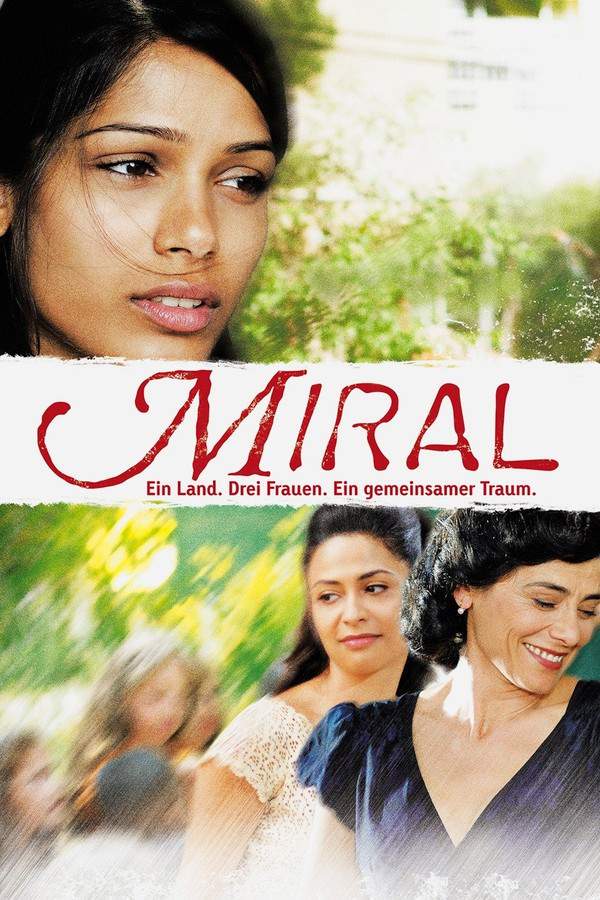
Miral (2011) movie poster

Plot Summary

Miral (2011) Plot Summary Explained

Release, runtime and language
2011 · 112 min · English
Directed by
Julian Schnabel
Starring
Willem Dafoe, Hiam Abbass, Freida Pinto

Set against the backdrop of a turbulent Jerusalem, this story follows four women whose lives become unexpectedly linked. Hind Husseini takes in orphaned children, while Miral, a passionate young teacher, joins her efforts. As Miral develops a relationship with Hani and becomes involved in activism, she must choose between pursuing her own ideals and embracing the guidance of Mama Hind, who believes education offers the best path towards reconciliation and lasting peace.

On this page (6)
  1. 1 Where to watch
  2. 2 What happens: full plot
  3. 3 Plot questions answered
  4. 4 Movie threads
  5. 5 Movies like Miral
  6. 6 Every angle

Where to watch

Where to Watch Miral (2011)

Where can you watch Miral? Stream, rent or buy it in the US, including on Fandango at Home Free, Tubi TV and YouTube Free: current JustWatch availability with up-to-date prices.

Streaming availability powered by JustWatch

Full plot summary · contains spoilers

What Happens in Miral: Full Plot Summary

The whole story of Miral (2011) explained, from the opening scene to the final frame: every key event, every twist and what it all adds up to. Read it as a quick recap before the sequel, to check a scene you missed, or to finally understand what really happened.

The cinematic journey unfolds with the inspiring tale of Hind Husseini, a woman determined to mend the wounds inflicted by war. In the chaos following the 1948 Arab–Israeli War and the tragic Deir Yassin Massacre, which left a scarred landscape behind, Hind resolves to create an orphanage in Jerusalem. As she valiantly maneuvers through the perilous aftermath, she encounters 55 abandoned children wandering the streets, their eyes yearning for care and shelter. With unwavering compassion, she embraces them as if they were her own, providing them with nourishment and protection.

As time progresses, the count of children under her care balloons to nearly 2,000, leading to the establishment of the Dar Al-Tifel Institute—a shining beacon of hope amid the remnants of destruction. This sanctuary not only offers refuge but also stands as a testament to Hind's relentless commitment to nurturing young lives.

Fast forward to 1978, and we meet a five-year-old Miral (Freida Pinto), who arrives at the Institute after losing her mother. Growing up within the protective walls of the Institute, she remains sheltered from the harsh realities that surround her, benefiting from a sense of safety and security. However, upon reaching 15, she is assigned to teach at a refugee camp, where the brutal truth of the Palestinian plight strikes her profoundly.

As Miral begins to comprehend the struggles faced by her community, she experiences an internal conflict between the fiery urgency of her people's First Intifada and Mama Hind's unwavering belief that education is the pathway to peace. It is within this tumultuous setting that Miral finds herself enchanted by Hani, a militant who embodies the spirit of resistance. This relationship propels her onto a transformative journey, challenging her perceptions of herself, her people, and the complex world surrounding her.

Last updated: November 22, 2024 at 14:58

Was this helpful?

Plot questions answered

Miral Plot Explained: Your Questions Answered

The questions people ask most about Miral (2011): what happens in the confusing scenes, why the characters do what they do, the twists, hidden details and what the ending means. Each answer contains spoilers.

Q1

Why did Hind Husseini decide to create an orphanage in Jerusalem?

Hind Husseini was motivated to establish the orphanage after witnessing the devastation of the 1948 Arab-Israeli War and the Deir Yassin Massacre. She encountered 55 abandoned children wandering the streets of Jerusalem and felt compelled to provide them with shelter, food, and protection. Her compassion drove her to eventually care for nearly 2,000 children, founding the Dar Al-Tifel Institute as a safe haven.

Foreshadowing: The institute's founding in 1948 sets the foundation for Miral's arrival decades later.

  • hind hosseini
  • orphanage
  • dar al-tifel
  • 1948 war
  • children
Q2

What was the Deir Yassin Massacre and why is it significant to the story?

The Deir Yassin Massacre was a tragic event that occurred during the 1948 Arab-Israeli War, leaving the landscape scarred and creating widespread chaos in Jerusalem. It represents the violent backdrop that prompted Hind Husseini to take action and establish the orphanage. The event is significant because it establishes the historical trauma that shapes the characters' lives and motivations throughout the film.

Foreshadowing: The violence of 1948 directly leads to the orphan crisis that Hind addresses.

  • deir yassin
  • massacre
  • 1948
  • jerusalem
  • war
Q3

Why was Miral assigned to teach at a refugee camp at age 15?

When Miral turned 15, the Institute assigned her to teach at a refugee camp as part of her development within the organization. This was a deliberate choice to expose her to the realities faced by Palestinians beyond the protected walls of the Institute. The experience was intended to help her understand the struggles of her community firsthand.

Foreshadowing: This assignment marks the beginning of Miral's awakening to the harsh realities outside the Institute.

  • miral
  • refugee camp
  • teaching
  • education
  • awakening
Q4

What caused Miral's sudden awareness of the Palestinian plight?

Miral's exposure to the refugee camp at age 15 was the catalyst that shattered her sheltered existence at the Institute. Teaching there, she witnessed firsthand the harsh living conditions and injustice faced by her community. This jarring experience forced her to confront the reality of the Palestinian struggle, which she had been protected from during her childhood.

Foreshadowing: The contrast between her safe childhood and the refugee camp realities sets up her internal conflict.

  • miral
  • awareness
  • refugee camp
  • palestinian struggle
  • realization
Q5

When did the First Intifada occur and how did it affect Miral?

The First Intifada began in 1987, when Miral was approximately 14-15 years old. This uprising against Israeli occupation ignited a passionate resistance among Palestinians, creating a volatile environment. Miral found herself torn between her mother's peaceful educational philosophy and the urgent call to join the resistance, as the Intifada intensified the political pressure around her.

Foreshadowing: The Intifada coincides with Miral's coming-of-age, amplifying her difficult choices.

  • first intifada
  • 1987
  • uprising
  • resistance
  • palestine
Q6

Who was Hani and what role did he play in Miral's transformation?

Hani was a young militant who embodied the spirit of Palestinian resistance during the First Intifada. Miral became enchanted by him, and their relationship pulled her deeper into the struggle. Through her connection with Hani, Miral underwent a significant transformation, as the relationship challenged her identity and forced her to reconcile her peaceful upbringing with her growing passion for her people's cause.

Foreshadowing: Hani enters Miral's life precisely when she is questioning everything she was taught.

  • hani
  • militant
  • relationship
  • love
  • resistance
Q7

What was the fundamental disagreement between Miral and Mama Hind?

Mama Hind believed that education was the pathway to lasting peace and reconciliation, a philosophy she had championed since founding the Institute. Miral, however, felt the urgency of the First Intifada demanded more immediate action. This created a philosophical rift: Miral was drawn to militant resistance while Mama Hind urged patience through learning. The conflict represented the broader tension between peaceful activism and armed struggle.

Foreshadowing: This ideological clash mirrors the historical debate within Palestinian leadership.

  • mama hind
  • education
  • peace
  • conflict
  • philosophy
Q8

Why did Miral face such a difficult choice between education and activism?

Miral's internal crisis stemmed from her unique position as both a product of the Institute's peaceful teachings and a witness to the urgent suffering of her people. The First Intifada created intense pressure to act immediately, while Mama Hind's decades of work demonstrated the power of education. Miral had to decide whether to pursue her own ideals of resistance or embrace the guidance of the woman who raised her.

Foreshadowing: This choice represents the culmination of everything Miral has witnessed and experienced.

  • choice
  • education
  • activism
  • ideals
  • decision
Q9

Why did Miral come to live at the Dar Al-Tifel Institute in 1978?

Miral arrived at the Dar Al-Tifel Institute in 1978 when she was five years old, after losing her mother. The Institute, originally founded by Hind Husseini in the late 1940s, provided her with a nurturing environment filled with love and security. This protective childhood shielded her from the political turmoil surrounding her community.

Foreshadowing: Miral's arrival connects her story to Hind's legacy of caring for orphaned children.

  • miral
  • 1978
  • arrival
  • orphanage
  • childhood
Q10

What does the Dar Al-Tifel Institute represent in the story?

The Dar Al-Tifel Institute represents hope and resilience in the face of devastation. It serves as both a literal sanctuary for orphaned children and a symbol of Hind Husseini's belief that education and compassion can foster peace. The Institute stands in contrast to the violence of the outside world, offering a space where children can grow up protected from conflict, though eventually, the characters must confront whether such shelter is sustainable.

Foreshadowing: The Institute's philosophy of peace is directly challenged by the political events of the Intifada.

  • dar al-tifel
  • institute
  • hope
  • sanctuary
  • education

Movie threads

More Movies Like Miral, by Mood & Story

Curated lists built around what makes Miral tick: the same mood, the same kind of story or the same emotional payoff. Each list explains why these movies belong together.

Coming of age stories in political conflict like Miral

Young protagonists find their identity and purpose amidst war and political strife. If you liked Miral's portrayal of a young woman's awakening within a tense political landscape, you'll appreciate these movies. They share stories of youth navigating ideologies, personal ideals, and the heavy weight of history, often facing a conflicted path to adulthood.

  • thought-provoking
  • turbulent
  • somber
  • hopeful
  • conflicted
  • intense
  • Tone: tense, somber, thought-provoking
  • Pacing: steady, character-driven
Why these movies?

The story pattern: The narrative pattern centers on a young protagonist, often initially sheltered, whose worldview is shattered by exposure to a harsh political reality. Their journey involves a fraught ideological education, wrestling with conflicting loyalties, and ultimately making a defining choice about how to engage with the struggle.

Why they belong together: Movies in this thread are grouped by their focus on the intense, formative experience of growing up within a conflict zone. They share a heavy emotional weight, a tense tone, and a central character arc defined by a difficult political and personal awakening.
Movies about idealism versus pragmatism like Miral

Characters are torn between radical action and peaceful resistance for a greater cause. For viewers who appreciated the central conflict in Miral between passionate activism and peaceful education, this list features similar dramas. Explore stories where characters grapple with the most effective way to fight for their beliefs amidst historical turmoil and moral complexity.

  • tense
  • thought-provoking
  • conflicted
  • somber
  • turbulent
  • ideological
  • Tone: tense, thought-provoking, conflicted
  • Pacing: steady
Why these movies?

The story pattern: The narrative often presents a mentor figure advocating for a long-term, peaceful strategy, contrasted with a newer, more radical force pushing for immediate results. The protagonist is caught in the middle, forced to weigh the costs and morality of each approach, leading to an ambiguous or bittersweet resolution.

Why they belong together: These films are connected by their exploration of a core ideological conflict. They share a tense, thought-provoking tone, high emotional stakes, and a narrative structure built around a character's difficult choice between competing philosophies of resistance and change.

If you liked this

Movies Like Miral

Similar movies to Miral: the same genre, themes or kind of story. Each one comes with its own plot summary, timeline and ending explained.

Browse all movie summaries

Every angle

Miral (2011) Explained: Plot, Timeline & Characters

Everything about Miral in one place: what happens in the plot summary, the timeline in chronological order, the characters and meaning and a spoiler-free summary. What's After the Movie adds the cast, box office and post-credit scenes.

Coming soon on iOS and Android

The Plot Explained Movie Summary App

Plot summaries, endings explained and timelines on your phone. Catch up on any movie in minutes, save your favorites and never miss a twist again.

Be the first to know when we launch. Your email stays private, always.

Learn more about the app