Plot Explained Spoilers guaranteed!
Plot Explained

Browse by genre

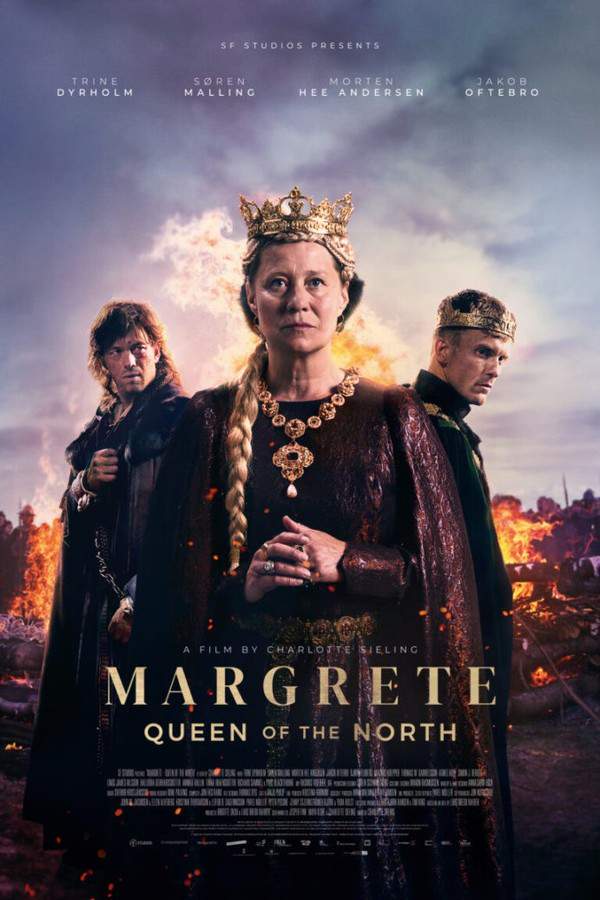
Margrete: Queen of the North (2021) movie poster

Plot Summary

Margrete: Queen of the North (2021) Plot Summary Explained

Release, runtime and language
2021 · 120 min · Danish
Echo score 73
JustWatch #8,802 4
Directed by
Charlotte Sieling
Starring
Magnus Krepper, Jakob Oftebro, Bjørn Floberg, Trine Dyrholm, Agnes Westerlund Rase, Linus James Nilsson

In 1402, the union of Denmark, Norway, and Sweden forged by Margrete faces a perilous crisis. Political intrigue and treachery threaten to shatter her carefully constructed realm. As she guides her young heir, Erik, Margrete seeks to secure a strategic marriage alliance with England to strengthen her power. However, a web of conspiracies emerges, and she must confront those plotting to destroy the kingdom she has fought so hard to build, risking everything she has achieved.

On this page (6)
  1. 1 Where to watch
  2. 2 What happens: full plot
  3. 3 Plot questions answered
  4. 4 Movie threads
  5. 5 Movies like Margrete: Queen of the North
  6. 6 Every angle

Where to watch

Where to Watch Margrete: Queen of the North (2021)

Where can you watch Margrete: Queen of the North? Stream, rent or buy it in the US, including on Amazon Prime Video, Fawesome and Hoopla: current JustWatch availability with up-to-date prices.

Streaming availability powered by JustWatch

Full plot summary · contains spoilers

What Happens in Margrete: Queen of the North: Full Plot Summary

The whole story of Margrete: Queen of the North (2021) explained, from the opening scene to the final frame: every key event, every twist and what it all adds up to. Read it as a quick recap before the sequel, to check a scene you missed, or to finally understand what really happened.

The film commences in 1361, where the infant Princess Margrete of Denmark is an unwilling witness to the violent consequences of her father, King Valdemar IV's victory during the Battle of Visby. Fast forward to 1402, and we see Margrete, now a formidable queen regnant, traversing the breathtaking Hardangervidda plateau in Norway alongside her loyal retinue. Accompanying the journey is a caption revealing her significant achievement: she has unified Denmark, Norway, and Sweden under her rule, governing through her adopted son, King Erik. This historic moment has ushered in an era of unprecedented peace across the Nordic countries, a rarity that hasn't been seen for centuries.

As she arrives at a majestic fjord, Margrete addresses a gathering of the leading Nordic magnates. She emphasizes the peace that the Kalmar Union has brought over the past decade but insists that it is now essential to establish a Union army. In a bold announcement, she reveals plans for Erik to be betrothed to Princess Philippa, the daughter of King Henry IV of England. Margrete explains that a robust military force is vital for securing a military alliance with England, which would serve to deter the looming threats posed by German forces, particularly the Teutonic Order, especially after their recent seizure of the Swedish island of Gotland. Each of the magnates agrees to contribute troops to this noble cause.

In a strategic move, Margrete enlists the help of Roar, a pirate from Kullen in Scania, tasking him with blockading Gotland. She also takes under her wing Astrid, a Swedish girl who has been rescued from a German vessel, bringing her to Kalmar Castle in Sweden. Here, she confides in her friend and financial backer, Peder Jensen Lodehat (Søren Malling), the Bishop of Roskilde, about the fruitful outcome of her travels.

Months later, Margrete gathers the magnates again in Kalmar to welcome Princess Philippa and Sir William Bourcier, an English lord charged with negotiating the terms of the marriage agreement. During a celebratory feast, Asle Jonsson (Bjørn Floberg), leader of the Norwegian Council, brings disconcerting news from Graudenz in Prussia: he believes he has seen King Oluf, Margrete's son, who has been presumed dead for 15 years. Despite her assurances that Oluf is no longer alive, Asle is adamant, claiming that the Man from Graudenz is indeed "my King" and he has brought him to Smedby. Margrete suspects that this so-called 'false Oluf' might be part of a devious plot devised by the Teutonic Knights and, needing Norway's pledge of troops, she orders Asle to bring the man to Kalmar for interrogation.

As rumors swirl during the feast, Margrete is faced with a rising tide of mistrust, especially after Astrid overhears troubling stories about Erik being Margrete's sister's grandson and whispers regarding Margrete's alleged involvement in Oluf's death years before. Constrained by her role, Margrete reluctantly declares that the pretender's claim is an act of treason against the Union, assuring everyone that he will receive a fair trial.

However, negotiations with Bourcier soon hit a roadblock due to the sudden question surrounding Erik's legitimacy as king. While the Man from Graudenz stands accused in handcuffs, claiming to be Oluf, Margrete remains skeptical yet resolute: "My son died," she responds coldly. The man states that he was meant to have been killed by Esge Vind, a retainer who ultimately spared his life but allowed him to be captured by the Germans. As this shocking tale unfolds, Danish Council leader Jens Due (Thomas W. Gabrielsson) dismisses the man's claims as mere fantasy, while the Norwegian magnates rally behind Asle's insistence that they are in the presence of their legitimate king.

As the drama intensifies, Margrete grapples with her predicament. If the Man from Graudenz is truly Oluf, it could mean Erik’s throne is in jeopardy. As tension mounts, Peder urges her to execute the pretender swiftly to maintain peace among the three realms, while Bourcier warns that negotiations would end if Erik’s status remains unresolved. Amidst the chaos, Margrete’s growing dialogue with the Man from Graudenz leads her to ponder whether he truly might be her long-lost son. Doubts further deepen when she learns that none of her advisors were present during Oluf's burial, nor did they open his coffin due to fears of plague.

In her quest for the truth, Margrete instructs her Swedish retainer Jakob Nilsson (Simon J. Berger) to seek out Roar for additional insights into this complex situation. She proposes a desperate solution: if the Man from Graudenz renounces his claim as Oluf, she will allow him to live. However, he remains obstinately unwilling to claim falsehood. Meanwhile, Bishop Peder argues that as long as the pretender lives, he poses an ongoing threat to their unity.

With time running out, Margrete experiences a sudden realization: the Man from Graudenz’s assertion of an assassination order may be crucial. She confronts Peder, who ultimately confesses his role in this tragic affair, having conspired to eliminate Oluf for what he deemed the greater good. He explains that Oluf’s temperament would never have been accepted by the Swedes, thereby justifying his drastic actions to secure Margrete's reign over Denmark-Norway and subsequently Sweden.

Convinced of the man's identity as Oluf, Margrete's resolve is tested when Erik, desperate to maintain his grip on power, produces a false witness who claims to have taught the imposter how to mimic Oluf. The court is swayed, and Oluf is found guilty of treason, condemned to death despite Margrete and the Norwegian magnates’ desperate protests. The Danish and Swedish factions rally behind Erik, compounding Margrete’s isolation.

That fateful evening, Margrete contrives a plan to rescue Oluf with the help of Asle. Yet, things take a dramatic turn when Jakob Nilsson and Roar return with alarming news: the Teutonic Order is preparing to invade mainland Sweden, deliberately manipulating Oluf's situation to disrupt the fragile alliance with England and jeopardize the Kalmar Union. Confronted with this dire threat, Margrete makes a heart-wrenching decision—she betrays her son, leading to his recapture. Although she manages to plead for Asle’s safety, Oluf is publicly executed by fire, casting a haunting shadow over Margrete as she puts the greater good of the Union above her personal sorrow.

In the end, the film closes with a poignant reminder: the legacy of the Kalmar Union endured for an additional century following Margrete's death, underscoring her pivotal role in forging lasting connections among the three Nordic nations, an affinity that resonates even to this day.
Last updated: December 03, 2024 at 14:27

Was this helpful?

Plot questions answered

Margrete: Queen of the North Plot Explained: Your Questions Answered

The questions people ask most about Margrete: Queen of the North (2021): what happens in the confusing scenes, why the characters do what they do, the twists, hidden details and what the ending means. Each answer contains spoilers.

Q1

Why does Margrete allow the man claiming to be her son Oluf to be executed?

Margrete ultimately allows Oluf's execution because she learns that the Teutonic Order is using the pretender situation as a distraction to invade Sweden. Faced with the choice between saving her son and protecting the Kalmar Union from invasion, she chooses the greater good. She betrays Oluf's escape plan, leading to his recapture and execution by fire, believing this sacrifice is necessary to preserve peace across the three kingdoms.

Foreshadowing: Earlier, Margrete tells the magnates that the Union army is essential to deter German threats from the Teutonic Order.

  • margrete
  • olu execution
  • kalmar union
  • teutonic order
  • queen margrete
Q2

Who is the Man from Graudenz in the movie?

The Man from Graudenz is revealed to be Oluf, Margrete's biological son who was presumed dead for 15 years. He was supposedly killed as a child, but Bishop Peder had actually ordered his assassination to prevent the volatile young prince from causing unrest that would threaten Margrete's rule. The man was spared by his executioner Esge Vind and eventually captured by German forces, leading to his eventual claim to the throne.

Foreshadowing: Asle Jonsson insists from the feast that he recognizes the man as 'my King' from Graudenz.

  • olu
  • man from graudenz
  • pretender
  • king oluf
  • margrete son
Q3

Why did Bishop Peder order Oluf's death?

Bishop Peder confesses to orchestrating Oluf's assassination because he believed the young prince's temperament would never have been accepted by the Swedish nobility, potentially causing rebellion and threatening Margrete's hard-won unification of the three kingdoms. Peder viewed this murder as a necessary sacrifice for the greater good of the Kalmar Union, choosing to eliminate Margrete's biological son to ensure stable rule through her adopted son Erik.

Foreshadowing: Earlier, Astrid overhears whispers about Margrete's alleged involvement in Oluf's death years before.

  • bishop peder
  • olu death
  • assassination
  • conspiracy
  • roskilde bishop
Q4

How does Margrete's betrayal of Oluf save the Kalmar Union?

When Margrete discovers the Teutonic Order is using the pretender crisis as a cover to launch an invasion of mainland Sweden, she realizes that entertaining Oluf's claim would fracture the fragile alliance needed to defend against invasion. By condemning her son and allowing his execution, she prevents the internal division that would have weakened the Union's military response, causing the Teutonic forces to retreat when they lose their political opportunity.

Foreshadowing: Margrete had earlier warned the magnates about German threats and the need for a unified army to counter the Teutonic Order.

  • margrete betrayal
  • kalmar union
  • teutonic invasion
  • sacrifice
  • queen margrete
Q5

Why does King Erik condemn the real Oluf to death?

Erik produces a false witness who claims to have taught the pretender how to mimic Oluf, securing a guilty verdict of treason. Despite knowing the man may truly be Oluf, Erik's motivation is political survival, accepting the pretender would mean losing his throne as the adopted heir. The Danish and Swedish factions rally behind Erik, leaving Margrete and the Norwegian magnates isolated in their attempts to save Oluf.

Foreshadowing: Margrete had earlier worried that if Oluf is true, Erik's throne would be in jeopardy.

  • king erik
  • olu trial
  • treason
  • execution
  • kalmar castle
Q6

What is the Teutonic Order's role in the conspiracy?

The Teutonic Order deliberately manufactured the Oluf crisis to destabilize the Kalmar Union and sabotage the English alliance. They had held the real Oluf for years and released him knowing his claim would create political chaos, preventing the Union from mounting an effective defense. Their ultimate goal was to invade Sweden, particularly after seizing Gotland, but Margrete's willingness to sacrifice her son removes the pretext for their invasion and forces their retreat.

Foreshadowing: The Teutonic Order had recently taken Gotland, prompting Margrete's call for a Union army.

  • teutonic order
  • gotland
  • german invasion
  • conspiracy
  • kalmar union
Q7

What happens to Erik and Princess Philippa's marriage?

The marriage negotiations between Erik and Princess Philippa collapse due to the controversy surrounding Erik's legitimacy. Sir William Bourcier warns that negotiations would end if Erik's status remains unresolved. With Oluf executed and Erik's position secured through political maneuvering rather than proven legitimacy, the English alliance falls through, leaving the Kalmar Union without the military support Margrete had hoped to secure.

Foreshadowing: Bourcier initially comes to negotiate the marriage terms with Margrete at Kalmar Castle.

  • princess philippa
  • king erik
  • marriage alliance
  • england
  • bourcier
Q8

How did Margrete unite Denmark, Norway, and Sweden?

Margrete achieved the unification through political skill and strategic governance rather than military conquest. After her father King Valdemar IV's victories, she leveraged her position as queen regnant to forge alliances, eventually ruling through her adopted son Erik. The Kalmar Union, established a decade before the film's events, brought unprecedented peace to the region, something the film notes hadn't been seen for centuries.

Foreshadowing: The film opens with infant Margrete witnessing her father's victory at the Battle of Visby, establishing her future political destiny.

  • kalmar union
  • unification
  • denmark
  • norway
  • sweden
  • queen margrete
Q9

Why is Gotland important in the film?

Gotland represents the immediate military threat facing the Kalmar Union. The Teutonic Order had recently seized the Swedish island, prompting Margrete's urgent call for a Union army. She commissions the pirate Roar to blockade Gotland and prevent further German incursions. The island's capture also serves as the pretext for the Teutonic Order's larger invasion plan, which they execute under the cover of the political chaos surrounding Oluf.

Foreshadowing: Margrete announces to the magnates that Gotland's seizure by Germans requires a unified military response.

  • gotland
  • teutonic order
  • blockade
  • roar
  • swedish island
Q10

What is Margrete's legacy after the film ends?

The film concludes with Margrete's legacy being the preservation of the Kalmar Union for another century following her death. While her personal sacrifice, executing her own son, haunts her, her decision to prioritize the Union over personal grief ensures continued peace among Denmark, Norway, and Sweden. The epilogue emphasizes her pivotal role in fostering enduring connections among the Nordic nations that resonate to this day.

Foreshadowing: Throughout the film, Margrete consistently prioritizes the Union's stability over personal desires.

  • margrete legacy
  • kalmar union aftermath
  • peace
  • nordic kingdoms
  • century

Movie threads

More Movies Like Margrete: Queen of the North, by Mood & Story

Curated lists built around what makes Margrete: Queen of the North tick: the same mood, the same kind of story or the same emotional payoff. Each list explains why these movies belong together.

Movies about painful leadership choices like Margrete: Queen of the North

Stories about rulers who must sacrifice their humanity to protect their kingdoms. Explore movies like 'Margrete: Queen of the North' that delve into the heavy weight of leadership. If you were fascinated by Queen Margrete's sacrifice, you'll find similar historical dramas and thrillers where rulers face soul-crushing decisions for the greater good of their people or nation.

  • political intrigue
  • somber
  • tragic
  • psychological
  • high stakes
  • oppressive
  • Tone: dark, tragic, serious
  • Pacing: steady, deliberate
Why these movies?

The story pattern: These narratives typically follow a leader—a monarch, a general, a CEO—faced with an existential threat to their domain. The central conflict is an internal moral crisis, where the 'right' choice for their role is the 'wrong' choice for their heart. The plot often involves political intrigue, betrayal, and a climax that forces a devastating personal sacrifice.

Why they belong together: Movies in this thread are grouped by their exploration of the leader's dilemma, where the stability of a nation or institution comes at an unbearable personal price. They share a dark, serious tone, high emotional weight, and a focus on the psychological torment of power rather than its glamour.

Somber historical epics of political conspiracy like Margrete: Queen of the North

Tense period dramas where court intrigue threatens to tear empires apart. Find movies similar to 'Margrete: Queen of the North' in their depiction of grim historical political struggles. If you enjoyed the tense atmosphere and intricate web of treason in 15th century Scandinavia, you'll appreciate these other serious period dramas focused on conspiracies that threaten kingdoms and empires.

  • tense
  • political intrigue
  • somber
  • high stakes
  • oppressive
  • melancholic
  • Tone: dark, tense, somber
  • Pacing: steady, building tension
Why these movies?

The story pattern: These stories unfold in a steady, deliberate pace, building tension through whispered conversations, hidden agendas, and the constant threat of betrayal. The plot revolves around a central conspiracy that challenges the established order, forcing characters to navigate a dangerous web of loyalties. The endings are often bittersweet or tragic, preserving power but at a great cost.

Why they belong together: These films are united by their specific blend of a historical setting, a dark and serious tone, and a plot driven by political conspiracy and high-stakes intrigue. They prioritize atmosphere and psychological tension over action, creating a consistently oppressive and gripping experience.

If you liked this

Movies Like Margrete: Queen of the North

Similar movies to Margrete: Queen of the North: the same genre, themes or kind of story. Each one comes with its own plot summary, timeline and ending explained.

Browse all movie summaries

Every angle

Margrete: Queen of the North (2021) Explained: Plot, Timeline & Characters

Everything about Margrete: Queen of the North in one place: what happens in the plot summary, the timeline in chronological order, the characters and meaning and a spoiler-free summary. What's After the Movie adds the cast, box office and post-credit scenes.

Coming soon on iOS and Android

The Plot Explained Movie Summary App

Plot summaries, endings explained and timelines on your phone. Catch up on any movie in minutes, save your favorites and never miss a twist again.

Be the first to know when we launch. Your email stays private, always.

Learn more about the app