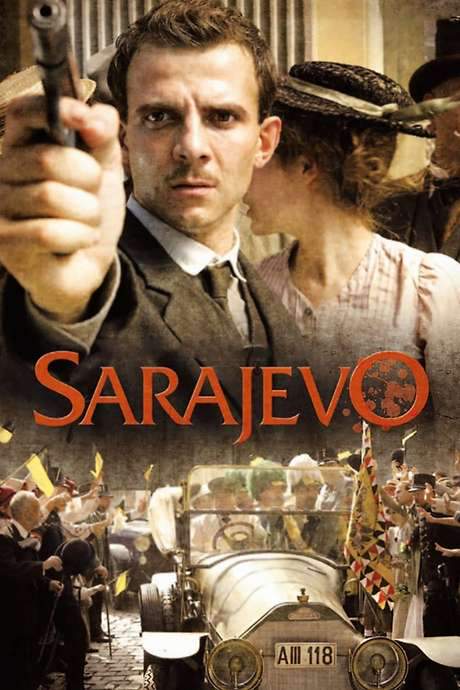
This German film, set in June 1914, offers a provocative alternate take on the assassination of Archduke Franz Ferdinand, the event that sparked World War I. While the official account pins the crime on six Bosnian Serb separatists connected to the Serbian government, this movie pushes a different hypothesis, weaving a darker web of motives that reach beyond a single conspiracy.
Dr. Leo Pfiffer, Florian Teichtmeister, a district magistrate for the Austrian administration in Sarajevo who is ethnically Hungarian and Jewish, is tasked with interrogating the young men accused of the deed. At first, he clings to the belief that the Serbian government ordered the assassination to reclaim Bosnia and other territories annexed by Austria. But as the interrogations unfold, he starts to doubt this simplified version. The suspects struggle to recount their journeys from Serbia across the mountains into Sarajevo, including a confessed route that seems inconsistent with what they described. Pfiffer also notes the oddly sparse police presence—only 36 officers on the day of the royal procession—and questions why the parade route was made public in newspapers, all within a volatile and politically charged environment.
As Pfiffer travels deeper into the case, he encounters shadowy figures from both Austria and Germany who seem to pull strings behind the scenes. He begins to suspect that the six youngsters acted more out of local nationalist fervor than direct orders from a distant government. Yet there is a broader design at play: the film argues that wealthy industrialists envision a railroad from Berlin to Baghdad crossing Serbia, and that both Austria and Germany would seize the opportunity to shape Serbia as a buffer against Russia. With every step, Pfiffer uncovers clues suggesting that the assassination was used as a pretext to advance a larger geopolitical agenda.
The narrative tightens around the question of who really benefits from such upheaval. Pfiffer discovers that the motive behind the plot may lie not merely in nationalist fervor but in a calculated, high-stakes plan to redraw power in the region. The film suggests that Germany’s military strength helped set the wheels in motion, potentially sacrificing Archduke Ferdinand to justify swift annexation of Serbia. In a striking closing turn, Pfiffer is warned by a German military doctor—an ally he has come to trust—that Germany intends to overtake Paris within a month, underscoring how quickly war ambitions could unfold once set in motion.
Amid the political intrigue runs a poignant romance: Pfiffer becomes involved with a wealthy Serbian heiress, Melika Foroutan portraying Marija Jeftanović, who lives with her father in Sarajevo. Their clandestine relationship deepens Pfiffer’s humanity amid the murky moral calculus around power, loyalty, and national interest. The couple’s happiness is interrupted by the harsh realities of war, as Marija and her father are forced to return to Paris after discovering she is married to a man there, all while the German army closes in.
The cast threads a web of tense performances that anchor the story. Heino Ferch embodies Dr. Herbert Sattler, a pivotal figure who looms large in Pfiffer’s investigations. The investigators and officials Pfiffer encounters—including Erwin Steinhauer as Oskar Potiorek, Friedrich von Thun as Sektionsrat Wiesner, Edin Hasanović as Danilo Ilic, Juraj Kukura as Stojan Jeftanovic, and Martin Leutgeb as Schimpf—paint a portrait of a world where personal ambition, political maneuvering, and the fate of nations intersect.
The film is presented in both German and Serbian, with English subtitles to guide viewers through its multilingual, historically charged dialogue. Its atmosphere is tense, methodical, and contemplative, inviting audiences to weigh competing narratives while considering how information can be shaped to justify broader imperial ambitions. The result is a thoroughly modern historical drama that stays true to its core events while offering a thought-provoking reinterpretation of a watershed moment in world history.