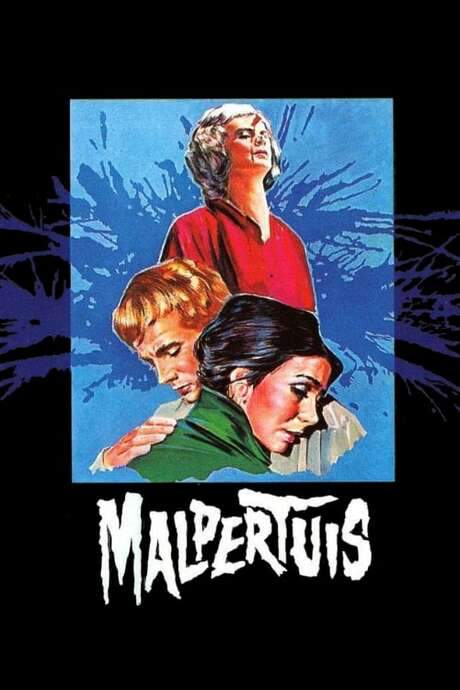
Carrère, a middle-class man convicted of financial fraud, arrives in a grim prison and finds himself sharing a cramped cell with three other inmates: Lassalle, an old librarian who murdered his wife; Pâquerette, a childlike lunatic who ate his infant sister; and Marcus, a muscular young transgender woman whose crime is not spoken aloud but whose longing for a different life crackles beneath the surface. The four men and one woman—each with their own secrets—tentatively form a fragile alliance as they try to make sense of their strange surroundings, a place where rules feel negotiable and danger lurks just behind the walls.
Behind a loose brick in the cell wall, they discover an old, hand-written journal belonging to a prisoner named Charles Danvers from the 1920s, who mysteriously disappeared. The book is filled with incantations and symbols of black magic. Skeptical at first, Carrère reads aloud one of the incantations, and a bright, burning symbol briefly materializes on the floor, as if the page itself had come alive. The glow unsettles the trio, and they begin to have disturbing visions. One morning, Pâquerette wakes to find that his fingers have vanished, a cruel hint that the book’s powers are not merely theatrical tricks but dangerous forces at work.
The cellmates wrestle with what to do about the book. In a rash moment, Pâquerette seizes the volume and starts to eat its pages, only to be overwhelmed by an unseen force that twists his body and snaps his spine and neck. The guards blame the three others and condemn them to spend life behind bars. Lassalle believes the book is defending itself, a sentient thing that will not be trifled with. Then a new prisoner named Picus arrives, a friendly, eccentric man who always carries a video camera, adding another layer of mystery to the cell’s already unsettled atmosphere. The staff claim ignorance about who the cellmates are talking about when Picus vanishes; the journal and the camera are left behind, and the last footage on the camera shows Picus reading an incantation from the book, after which a doorway of light appears on the wall and he steps through.
Carrère’s personal life is in tatters as well—his wife has left him, and he believes he will never see his beloved son again. The only relic he clings to is an action figure doll that belonged to his boy. The journal seems to offer his best chance to escape not just physically but emotionally, if escape is even possible at all. The cellmates read the same incantation that Picus read, and the doorway reappears. They step through and find themselves in a dirty, older prison cell, realizing they have entered Danvers’ world as it was in the 1920s. Carrère and Marcus grow angry, but Lassalle remains calm for the moment. Then, without warning, Lassalle kills Marcus with a sharpened rock. Carrère roars in fury, but Lassalle unmasks the true nature of the book’s powers: it was never meant to grant a simple escape. It was designed to reveal each prisoner’s deepest desires, but at a terrible price.
A flashback sequence reveals the fates of Danvers’ original cellmates and, more chillingly, Danvers’ own downfall. Obsessed with youth, Danvers utters his final spell and the book literally transforms him into a younger version of himself, only to have the reverse aging continue unchecked until he dissolves into nothingness as an unborn infant. Lassalle, who has always been both fascinated and terrified by the written word, seizes the book for one final act and merges with it, its powers crushing the life out of him. With Lassalle gone, Carrère becomes the sole survivor and speaks aloud his deepest wish—to see his son once more—and as his mouth opens in a silent scream, his eyes vanish.
The action pulls back to the outside world. Carrère’s estranged wife and son arrive to collect his belongings, and a prison official explains that Carrère and his cellmates have vanished without a trace. As they drive away, Carrère’s young son plays with the action figure that had lived in his father’s cell. In a final, quiet image, the doll’s head is shown in close-up, and the living eyes inside belong to Carrère, now able to truly see his son again in a way that the prison’s walls could never contain.