Plot Explained Spoilers guaranteed!
Plot Explained

Browse by genre

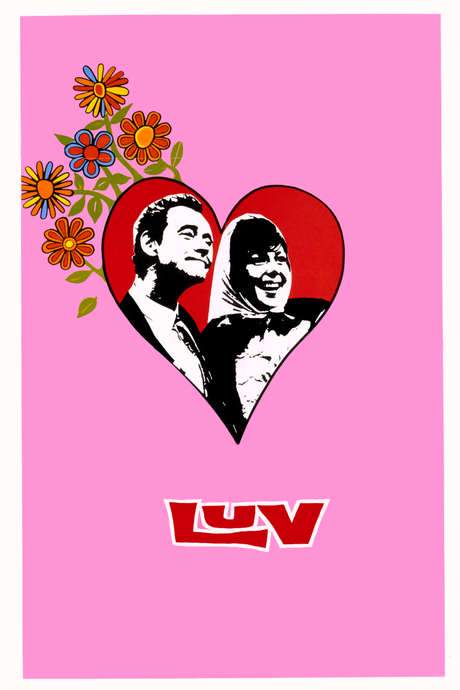
Luv (1967) movie poster

Plot Summary

Luv (1967) Plot Summary Explained

Release, runtime and language
1967 · 93 mins · English
Loading streaming availability…
Directed by
Clive Donner
Starring
Harrison Ford, Peter Falk, Jack Lemmon, Elaine May, Paul Hartman, Tina Menard

In this darkly comic tale, depressed by his life's direction, Harry plans to end it by leaping from the Manhattan Bridge, but an old friend, successful broker Milt Manville, stops him at the last moment. Milt, disillusioned with his argumentative wife Ellen, impulsively pairs her with Harry, hoping they will fall in love and solve both their woes.

On this page (6)
  1. 1 Where to watch
  2. 2 What happens: full plot
  3. 3 Plot questions answered
  4. 4 Movie threads
  5. 5 Movies like Luv
  6. 6 Every angle
Loading streaming availability…

Full plot summary · contains spoilers

What Happens in Luv: Full Plot Summary

The whole story of Luv (1967) explained, from the opening scene to the final frame: every key event, every twist and what it all adds up to. Read it as a quick recap before the sequel, to check a scene you missed, or to finally understand what really happened.

Scrawny Harry Berlin, [Jack Lemmon], is a barely functional man standing on the edge of a bridge, brooding over a life that seems unworkable and perhaps not worth living. Just as he teeters on the verge, a blast from the past arrives in the form of Milt Manville, [Peter Falk], an old friend whose forceful personality pulls Harry away from the ledge and into a world that feels both familiar and unpredictable. The contrast between the two men is stark: Milt exudes confidence and outward success, while Harry clings to a fragile thread of hope and humor that hasn’t yet faded.

Milt takes Harry to his home to introduce him to Ellen Manville, the long-suffering wife who is openly irritated by a sex life that feels hollow. Ellen is unaware that Milt has a secret lover in the form of Linda, a beautiful fitness instructor who embodies the life Milt is secretly chasing. In a bid to reignite Ellen’s spark and nudge her toward divorce, Milt persuades the uncertain Harry to pursue Ellen with renewed ardor, hoping this will catalyze Ellen’s decision to leave him. The plan isn’t simply romantic; it’s a calculated move to realign their lives around a fresh arrangement. Ellen and Harry’s initial interactions are charged with awkward hope, and before long they find themselves drawn to one another, their connection growing deeper than either expected. Ellen, played with sharp pragmatism by [Elaine May], begins to experience real affection for Harry, and the pair eventually marry and embark on a honeymoon to Niagara Falls.

But the newlyweds soon discover that Harry is not the ideal roommate—he remains impulsive, childish, and stubborn at heart. A telling moment comes when he stomps on Ellen’s toe to test her love, prompting her to ask, “What did you do that for?” This exchange underscores how their love is built on tests and endurance, rather than easy accord, and the couple’s dynamic becomes a study in the limits and resilience of commitment. The honeymoon’s glow gives way to a volatile rhythm of conflicts and reconciliations as they try to prove that their bond can survive constant strain.

Meanwhile, Milt faces a dramatic reversal of fortune. With the divorce settlement leaving him resource-poor, he quickly remarries Linda, the fitness instructor who was once his lover, and the two settle into a smaller, more modest apartment. Linda quits her fitness work and becomes a more sedentary partner, which places even more pressure on Milt to maintain a lifestyle he can’t easily sustain. The financial squeeze deepens, and Linda eventually boots him from the life she initiated, prompting Milt to reevaluate his loyalties and decisions. He comes to see that he misses Ellen and the life they once shared, a realization that stirs a longing to win her back.

Back at the center of these tangled relationships, Ellen and Milt scheme to restore their own marriage by drawing Harry back into the fold. To demonstrate his commitment and balance the scales, Harry agrees to take a job as an elevator operator in a department store, hoping to be a true partner in their shared life. The plot thickens as Linda and Ellen cross paths at a Japanese restaurant, where old wounds flare and the possibility of renewed affection becomes a volatile force in the room. The ex-spouses’ plan to force Harry into a position where he will choose to stay with Ellen reaches a tense peak as they orchestrate a precarious encounter on the very edge of danger.

In a final, desperate gambit, Milt again brings Harry to the bridge where their lives first began to unravel, hoping to coerce him into a suicide or a dramatic falsehood. Ellen arrives with a mix of horror and resolve, aware of the moral danger but torn by her own complicated feelings. The attempt collapses under the weight of risk and reality. In the ensuing chaos, Milt twice ends up on the bridge’s scaffold, while Ellen’s attempt to help leads to danger for both of them. Linda, who is out for a late-night walk, becomes the crucial catalyst that shifts the balance. She persuades the scaffold to rise, setting in motion a dangerous rescue attempt that pulls all four into the water. Harry, unable to swim, struggles to stay afloat, and it is Linda’s athletic strength that keeps him buoyant. In this moment of crisis, Harry’s gaze drifts toward Linda, and an unexpected attraction begins to take root as the quartet’s fates collide.

In the end, the crisis resolves not through triumph of one plan over another, but through a mixture of peril and something like mercy. Linda’s presence proves transformative, enabling Harry to survive and reshaping his view of love and partnership. Milt and Ellen, having weathered deceit, fear, and risk, reaffirm their own connection, while Harry’s bond with Linda hints at a possible new chapter—one built on honesty, balance, and the messy, unpredictable reality of human desire. The film closes on a nuanced note about love’s capacity to endure conflict, grow through imperfection, and connect people who were once ready to break apart.
Last updated: October 07, 2025 at 08:13

Was this helpful?

Plot questions answered

Luv Plot Explained: Your Questions Answered

The questions people ask most about Luv (1967): what happens in the confusing scenes, why the characters do what they do, the twists, hidden details and what the ending means. Each answer contains spoilers.

Q1

Why does Milt want Harry to pursue his wife Ellen?

Milt wants Ellen to fall in love with Harry so she will agree to a divorce, freeing him to marry his secret lover Linda. It's a calculated scheme where Milt uses Harry as a pawn to orchestrate his own exit from the marriage while appearing to do Ellen a favor by pairing her with someone new.

Foreshadowing: Early in the film, Ellen complains about her hollow sex life with Milt, hinting at the marital dissatisfaction Milt aims to exploit.

  • milt manville
  • ellen
  • divorce scheme
  • harry berlin
  • manipulation
Q2

Why does Harry stomp on Ellen's toe during their honeymoon?

Harry tests Ellen's love through childish and cruel behavior, including stomping on her toe. This reflects his deep insecurity and fear that her affection isn't genuine. He needs constant reassurance that she loves him despite his own perceived inadequacies.

Foreshadowing: Harry's fragile mental state is established from the bridge scene, where he considers suicide due to feeling worthless.

  • harry berlin
  • ellen
  • honeymoon
  • toe
  • test of love
  • niagara falls
Q3

Why does Linda dump Milt after their marriage?

After marrying Milt and quitting her fitness career, Linda becomes dependent on him financially. When Milt struggles to maintain their lifestyle, she eventually kicks him out. The financial pressure and his inability to provide expose the hollowness of their relationship.

Foreshadowing: Linda's attraction to Milt is tied to his successful broker image, which diminishes after the divorce settlement.

  • linda
  • milt manville
  • divorce
  • financial pressure
  • fitness instructor
Q4

What happens during the bridge confrontation in the finale?

Milt brings Harry back to the same bridge where they first met, staging either a suicide or its illusion to force a dramatic resolution. During the chaotic attempt, Milt falls from the scaffold twice, endangering Ellen. Linda arrives during the late-night rescue and helps keep Harry afloat since he cannot swim.

Foreshadowing: The bridge echoes the film's opening, completing a circular structure where the same location becomes the site of transformation.

  • bridge
  • manhattan bridge
  • rescue
  • milt
  • ellen
  • linda
  • scaffold
  • drowning
Q5

Why does Harry become attracted to Linda after the rescue?

When Harry falls into the water, he cannot swim and begins to drown. Linda's physical strength saves his life by keeping him afloat. In that moment of vulnerability, he realizes she is his lifeline, literally and emotionally, sparking genuine attraction where none existed before.

Foreshadowing: Linda's fitness instructor background establishes her as physically capable, making her the only one who could save a drowning man.

  • harry berlin
  • linda
  • attraction
  • rescue
  • drowning
  • swimming
Q6

Why do Milt and Ellen decide to get back together at the end?

After experiencing loss, financial hardship, and near-death trauma together, Milt and Ellen realize their original marriage was worth preserving. The crisis at the bridge forces them to confront what they truly value, and they reaffirm their connection despite all the manipulations and mistakes.

Foreshadowing: Their early marriage problems stem from boredom and neglect, not fundamental incompatibility, leaving room for reconciliation.

  • milt manville
  • ellen
  • reconciliation
  • marriage
  • second chance
Q7

Why does Harry agree to work as an elevator operator?

Harry takes a job as an elevator operator in a department store to prove himself as a worthy partner to Ellen. After Milt and Ellen scheme to rebuild their own marriage, Harry wants to demonstrate he can be a responsible, equal contributor to their relationship.

Foreshadowing: Harry's earlier aimlessness and lack of purpose contrast sharply with this attempt at genuine contribution.

  • harry berlin
  • elevator operator
  • job
  • department store
  • responsibility
Q8

Why do Ellen and Milt try to get Harry and Linda together?

Ellen and Milt scheme to make Harry fall for Linda so they can engineer a divorce, allowing Milt and Ellen to remarry each other. It's a final manipulation attempt to restore their original marriage by eliminating Harry from the equation.

Foreshadowing: Their earlier roles reverse - Milt originally pushed Harry toward Ellen, now they push him toward Linda.

  • ellen
  • milt manville
  • scheme
  • linda
  • manipulation
  • love triangle
Q9

Why can't Harry swim when he falls into the water?

Harry cannot swim, which becomes critical during the bridge rescue scene. This weakness makes him completely dependent on Linda to survive, transforming what could be a minor incident into a life-or-death moment that shifts all character relationships.

Foreshadowing: Harry's general incompetence and lack of practical skills are established throughout the film.

  • harry berlin
  • swimming
  • rescue
  • water
  • vulnerability
Q10

Why does Milt struggle financially after divorcing Ellen?

The divorce settlement leaves Milt resource-poor, forcing him to sell items to former clients to maintain appearances. When he remarries Linda and she quits working, the financial pressure becomes unsustainable, leading to their eventual split.

Foreshadowing: Milt's broker identity is tied to wealth and status, which diminish significantly after the divorce.

  • milt manville
  • divorce settlement
  • finances
  • money
  • poverty

Movie threads

More Movies Like Luv, by Mood & Story

Curated lists built around what makes Luv tick: the same mood, the same kind of story or the same emotional payoff. Each list explains why these movies belong together.

Movies with dark comedy and unconventional relationships like Luv

Stories where flawed characters try to solve their problems with desperate, messy romance. If you enjoyed the darkly comedic and bittersweet vibe of Luv, this thread features movies with similar themes of desperate characters orchestrating messy romances. These stories balance awkward humor with the genuine emotional fallout of flawed relationship experiments, perfect for fans of quirky, character-driven narratives.

  • quirky
  • awkward
  • melancholic
  • desperate
  • reflective
  • absurd
  • Tone: bittersweet, melancholic, darkly comic
  • Pacing: steady, character-driven
Why these movies?

The story pattern: These narratives often begin with a character in a state of desperation or disillusionment who concocts a misguided plan to fix their life, usually involving manipulating the relationships of others. The plot follows the chaotic chain reaction of this plan, blending slapstick or absurd situations with moments of poignant emotional reflection as characters confront their flaws.

Why they belong together: They are grouped together by their unique tonal blend of bittersweet melancholy and dark, situational humor, their focus on midlife crises and emotional endurance, and their shared narrative pattern of desperate characters attempting to control fate through unconventional relationships.

Bittersweet character dramas with moral complexity like Luv

Character-driven dramas where imperfect choices lead to nuanced, imperfect resolutions. For viewers who appreciated the nuanced ending and moral ambiguities of Luv, this collection features movies where characters navigate emotional manipulation and flawed choices. These stories culminate in bittersweet resolutions that offer a sense of hope without ignoring the scars of the journey, perfect for fans of emotionally mature dramas.

  • bittersweet
  • reflective
  • melancholic
  • complex
  • emotional
  • mature
  • Tone: bittersweet, reflective, melancholic
  • Pacing: steady, deliberate
Why these movies?

The story pattern: The narrative follows characters who, driven by desperation or a desire for change, engage in emotionally manipulative or ethically gray behavior. The story explores the consequences of these actions, not through simple punishment, but through a gradual coming-to-terms, resulting in an ending that acknowledges both the pain caused and the possibility of a fragile, new beginning.

Why they belong together: They share a specific emotional arc that concludes with a bittersweet feel, a moderate level of narrative complexity stemming from character-driven moral dilemmas, and a steady pacing that allows for reflection on the consequences of the characters' actions.

If you liked this

Movies Like Luv

Similar movies to Luv: the same genre, themes or kind of story. Each one comes with its own plot summary, timeline and ending explained.

Browse all movie summaries

Every angle

Luv (1967) Explained: Plot, Timeline & Characters

Everything about Luv in one place: what happens in the plot summary, the timeline in chronological order, the characters and meaning and a spoiler-free summary. What's After the Movie adds the cast, box office and post-credit scenes.

Coming soon on iOS and Android

The Plot Explained Movie Summary App

Plot summaries, endings explained and timelines on your phone. Catch up on any movie in minutes, save your favorites and never miss a twist again.

Be the first to know when we launch. Your email stays private, always.

Learn more about the app