Plot Explained Spoilers guaranteed!
Plot Explained

Browse by genre

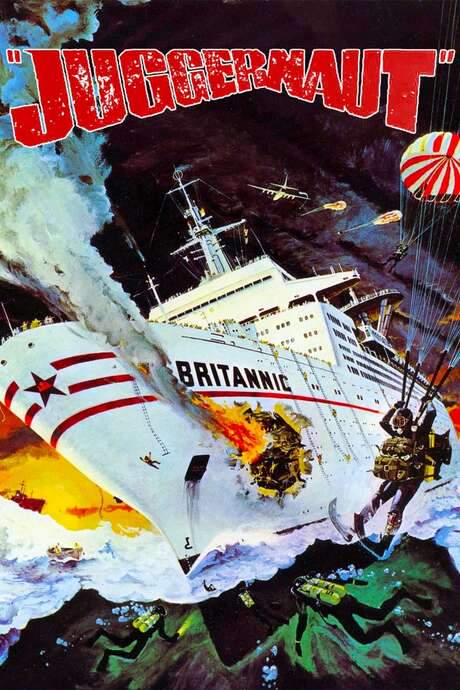
Juggernaut (1974) movie poster

Plot Summary

Juggernaut (1974) Plot Summary Explained

Release, runtime and language
1974 · 109 mins · English
JustWatch #8,016 19
Directed by
Richard Lester
Starring
Anthony Hopkins, David Hemmings, Ian Holm, Roy Kinnear, Michael Hordern, John Stride

An unprecedented maritime thriller erupts when a terrorist hijacks a trans‑Atlantic cruise liner, planting seven hidden bombs. He demands a massive ransom and holds the only code to defuse the devices. As the ship sails toward disaster, passengers and crew race against time to locate the crucial disarm information and avert catastrophe.

On this page (6)
  1. 1 Where to watch
  2. 2 What happens: full plot
  3. 3 Plot questions answered
  4. 4 Movie threads
  5. 5 Movies like Juggernaut
  6. 6 Every angle

Where to watch

Where to Watch Juggernaut (1974)

Where can you watch Juggernaut? Stream, rent or buy it in the US, including on fuboTV, MGM Plus and Philo: current JustWatch availability with up-to-date prices.

Streaming availability powered by JustWatch

Full plot summary · contains spoilers

What Happens in Juggernaut: Full Plot Summary

The whole story of Juggernaut (1974) explained, from the opening scene to the final frame: every key event, every twist and what it all adds up to. Read it as a quick recap before the sequel, to check a scene you missed, or to finally understand what really happened.

On the ocean liner SS Britannic, carrying 1200 passengers across the North Atlantic, a chilling threat arrives from a caller who styles himself as “Juggernaut,” claiming to have planted timed explosives aboard and vowing to sink the ship at dawn. The bombs are booby-trapped in various ways, and any attempt to move them could trigger detonation. He demands £500,000 and offers technical instructions in exchange for the ransom. To prove he’s serious, he detonates a demonstration behind the ship’s funnel, injuring a crewman. With rough seas making passenger evacuation by lifeboats impossible, the ship’s owners are tempted to pay, but government officials warn that appeasement would invite more terrorism.

To meet the crisis, a Royal Navy bomb-disposal unit led by Lt. Cmdr. Anthony Fallon [Richard Harris] arrives by air, parachuting onto the Britannic to defuse the devices before dawn. Back in London, Supt. John McCleod [Anthony Hopkins] heads Scotland Yard’s investigation to identify the mastermind and capture the impostor Juggernaut. Fallon’s team drops into a high-stakes, high-stakes operation, where timing is everything and every move could be fatal.

Fallon adopts a daring plan: split his squad and work on the remaining devices in parallel, coordinating each step by radio so that, if one bomb detonates, the others can continue and the team will know what went wrong. An initial attempt to drill into a barrel-bomb fails, triggering a blast that damages the ship. Fallon presses on, guiding the operation methodically, until tragedy strikes: a hidden mechanism within a bomb detonates, killing his close ally and second-in-command, Charlie Braddock [David Hemmings]. Devastated, Fallon momentarily abandons the mission and urges the captain to tell the owners to pay the ransom to stop further carnage, but Brunel refuses to surrender and orders the operation to continue.

In London, the real bomber is captured: Sidney Buckland [Freddie Jones], a disillusioned former bomb-disposal officer who layered himself into the supposed Juggernaut persona. When Fallon learns of Buckland’s capture, he insists on making contact; Buckland explains that he trained Fallon and once saved his life, and he is brought to the police situation room to testify. Fallon now has critical insight into the bombs’ mechanisms, but time is running out and he faces a grim choice between two possible wire cuts, red or blue, with the correct option hidden in a trap-filled sequence of defusal steps.

Juggernaut, bound by their shared past, offers a final hint, telling Fallon to cut the blue wire. Sensing a deceitful trap, Fallon chooses the red wire instead, and the rest of the bomb-disposal team follows his lead. The correct procedure unfolds, the remaining devices are neutralized, and the Britannic is steered away from catastrophe as dawn breaks.

The operation underscores a tense duel of wits and nerve between Fallon, the London investigators, and the enemy they never fully see, all while the ship’s passengers remain largely unaware that a careful balance of courage and precision stands between disaster and survival. The voyage ends with the ship saved and a dramatic testament to disciplined teamwork under pressure.
Last updated: October 09, 2025 at 11:10

Was this helpful?

Plot questions answered

Juggernaut Plot Explained: Your Questions Answered

The questions people ask most about Juggernaut (1974): what happens in the confusing scenes, why the characters do what they do, the twists, hidden details and what the ending means. Each answer contains spoilers.

Q1

Why does the British government refuse to pay the ransom?

The British government follows a strict non-appeasement policy toward terrorism. Officials warn that paying the £500,000 would invite future terrorist attacks and could jeopardize government subsidies or policy positions. The decision becomes a public test of resolve against terrorist coercion, with ministers believing that giving in would set a dangerous precedent.

Foreshadowing: Earlier in the film, officials explicitly state that paying would encourage more terrorism, establishing the moral dilemma that drives much of the tension.

  • non-appeasement policy
  • ransom demand
  • government decision
  • terrorism response
Q2

How do the police identify the real Juggernaut?

Supt. McCleod in London leads Scotland Yard's investigation and traces the threatening calls, eventually unmasking the man posing as Juggernaut as Sidney Buckland, a disaffected former bomb-disposal officer who designed the entire operation.

Foreshadowing: The investigation in London runs parallel to the maritime crisis, with officers working against the clock to identify the mastermind before the bombs detonate.

  • sidney buckland
  • scotland yard
  • investigation
  • juggernaut identity
Q3

Why does Fallon choose to cut the red wire instead of the blue?

When Juggernaut calls to hint at cutting the blue wire, Fallon senses it's a trap. Despite their shared history, Buckland having trained Fallon and once saved his life, Fallon trusts his own judgment and chooses the red wire instead. His instincts prove correct, and the bombs are neutralized.

Foreshadowing: Buckland's hint about the blue wire comes just before dawn, when Fallon has already worked out the defusal method but faces uncertainty about which wire to cut.

  • red wire
  • blue wire
  • defusal choice
  • buckland
  • fallon judgment
Q4

How does Braddock die during the defusal operation?

Braddock, Fallon's trusted second-in-command, accidentally triggers a hidden mechanism inside one of the bombs while attempting to defuse it. The device detonates, killing him instantly. The explosion devastates Fallon and forces him to confront the personal cost of the mission.

Foreshadowing: The timeline shows Braddock working on a bomb when the hidden mechanism activates, causing the fatal detonation that shocks the entire team.

  • braddock death
  • bomb explosion
  • hidden mechanism
  • fallon team
Q5

Why can't the passengers be evacuated from the Britannic?

Rough seas across the North Atlantic make it impossible to safely launch lifeboats, leaving the 1200 passengers and crew trapped aboard with the live bombs. This forces the government and ship owners to choose between paying the ransom or attempting to defuse the devices.

Foreshadowing: Early in the crisis, rough seas are mentioned as preventing evacuation, trapping everyone on board the ship.

  • evacuation
  • rough seas
  • lifeboats
  • passenger safety
Q6

What happens when the team first tries to defuse a bomb?

An initial attempt to drill into a barrel-bomb backfires and detonates the device, damaging the Britannic. The failure confirms that the bombs are booby-trapped and any improper handling could trigger immediate detonation, raising the stakes significantly.

Foreshadowing: The failed drill demonstrates that the bombs have sophisticated triggering mechanisms that respond to physical interference.

  • drill attempt
  • bomb detonation
  • barrel bomb
  • failed defusal
Q7

Why does Juggernaut hint about the blue wire if it's a trap?

Buckland, the real Juggernaut, has a personal connection to Fallon, he trained him and once saved his life. When he offers the blue wire hint, it's unclear whether he genuinely wants to help or is setting a final test. Fallon interprets it as a trap, suspecting Buckland might try to deceive him given their complicated past.

Foreshadowing: The phone call where Juggernaut offers the hint comes just before the final defusal sequence, creating one last psychological battle between the two men.

  • blue wire hint
  • buckland trap
  • psychological game
  • juggernaut call
Q8

What is Fallon's strategy for defusing multiple bombs?

After the failed drill, Fallon divides his bomb-disposal team so each man works on different devices simultaneously. He coordinates all efforts through radio from a central location, ensuring that if one bomb detonates, the others can continue and the team will know what went wrong. This parallel approach maximizes their chance of success before the dawn deadline.

Foreshadowing: The strategy is shown in the timeline after the first detonation, where Fallon realizes time is running out and must maximize efficiency.

  • team coordination
  • radio link
  • parallel defusal
  • strategy
Q9

Why does Captain Brunel refuse to pay the ransom after Braddock's death?

After Braddock's death, Fallon urges Captain Brunel to advise the owners to pay the ransom to prevent further casualties. Brunel refuses, stating they cannot surrender to coercion. Despite the emotional pressure and the loss of his men, the captain orders the operation to continue, prioritizing the larger mission over immediate safety concerns.

Foreshadowing: Fallon's plea to pay comes right after the devastating explosion that kills Braddock, creating a moment of moral weakness that Brunel must counter.

  • captain brunel
  • ransom refusal
  • fallon plea
  • leadership decision
Q10

What does the demonstration attack behind the funnel prove?

Shortly after issuing his threat, Juggernaut detonates small bombs behind the Britannic's funnel to prove he is serious. The blast injures a crewman and demonstrates that the threat is real, not a hoax. It also establishes that attempting to move the bomb drums will trigger detonations, limiting the crew's options.

Foreshadowing: The demonstration attack occurs early in the crisis, immediately establishing the deadly stakes and Juggernaut's willingness to follow through.

  • demonstration blast
  • funnel attack
  • crewman injured
  • proof of threat
Q11

How is Buckland connected to Fallon before the crisis?

Sidney Buckland, the real Juggernaut, reveals during his capture that he trained Anthony Fallon in bomb disposal and once saved his life. This personal connection becomes crucial when Buckland is brought to the police situation room and directly assists Fallon with critical information about the bomb mechanisms, though Fallon must still judge whether to trust his guidance.

Foreshadowing: The connection is revealed when Buckland is brought to the police station, adding psychological complexity to the final defusal decision.

  • buckland
  • fallon
  • training connection
  • former bomb disposal officer
Q12

Why does Juggernaut plant seven bombs across the ship?

Juggernaut plants seven hidden bombs in various locations on the Britannic, each booby-trapped to detonate if moved improperly. By distributing multiple devices throughout the ship, he creates a scenario where defusing all of them before dawn becomes nearly impossible, forcing the authorities to consider paying the ransom.

Foreshadowing: The seven bombs are mentioned at the start of the crisis, with each device presenting its own unique defusal challenge.

  • seven bombs
  • multiple devices
  • booby trapped
  • ship distribution

Movie threads

More Movies Like Juggernaut, by Mood & Story

Curated lists built around what makes Juggernaut tick: the same mood, the same kind of story or the same emotional payoff. Each list explains why these movies belong together.

Ticking Clock Thrillers like Juggernaut

Thrillers where heroes must beat a literal or psychological countdown to avert disaster. Explore movies like Juggernaut where teams or individuals face a high-stakes race against time. This thread focuses on fast-paced, high-intensity thrillers involving bomb disposal, hostage crises, or other disasters, perfect if you enjoyed the desperate countdown and heroic efforts aboard the ship.

  • high-stakes
  • race against time
  • nerve-wracking
  • suspenseful
  • desperate
  • procedural
  • Tone: tense, desperate
  • Pacing: fast, urgent
Why these movies?

The story pattern: The narrative is a linear sprint from the moment the threat is revealed until its resolution. It's structured around escalating attempts to solve the problem, often with failed efforts that raise the stakes, forcing characters to their absolute limits in a final confrontation with the clock.

Why they belong together: These films are grouped by their core engine: a ticking clock that dictates the pacing and heightens every moment with life-or-death consequences. They share a tone of acute tension and a focus on procedural problem-solving under extreme duress.

Claustrophobic Disaster Movies like Juggernaut

Stories where characters are confined with a large-scale threat, creating intense, trapped anxiety. Find films similar to Juggernaut that trap their characters in a confined space during a major crisis. If you liked the tense, claustrophobic atmosphere of a storm-tossed ship under threat from a terrorist, you'll enjoy these stories of survival and crisis management in isolated settings.

  • claustrophobic
  • disaster
  • trapped
  • anxious
  • teamwork
  • survival
  • Tone: tense, anxious, somber
  • Pacing: steady, building to fast
Why these movies?

The story pattern: The plot revolves around managing a crisis from within a bounded space, with no easy escape. The narrative explores the psychological dynamics of the group, the logistical challenges of the confined setting, and the direct confrontation with a threat that cannot be outrun.

Why they belong together: They share a powerful combination of a high-stakes disaster plot and a claustrophobic setting that magnifies the tension. The experience is defined by a feeling of being trapped with danger, focusing on teamwork, leadership, and the raw will to survive against impossible odds.

If you liked this

Movies Like Juggernaut

Similar movies to Juggernaut: the same genre, themes or kind of story. Each one comes with its own plot summary, timeline and ending explained.

Browse all movie summaries

Every angle

Juggernaut (1974) Explained: Plot, Timeline & Characters

Everything about Juggernaut in one place: what happens in the plot summary, the timeline in chronological order, the characters and meaning and a spoiler-free summary. What's After the Movie adds the cast, box office and post-credit scenes.

Coming soon on iOS and Android

The Plot Explained Movie Summary App

Plot summaries, endings explained and timelines on your phone. Catch up on any movie in minutes, save your favorites and never miss a twist again.

Be the first to know when we launch. Your email stays private, always.

Learn more about the app