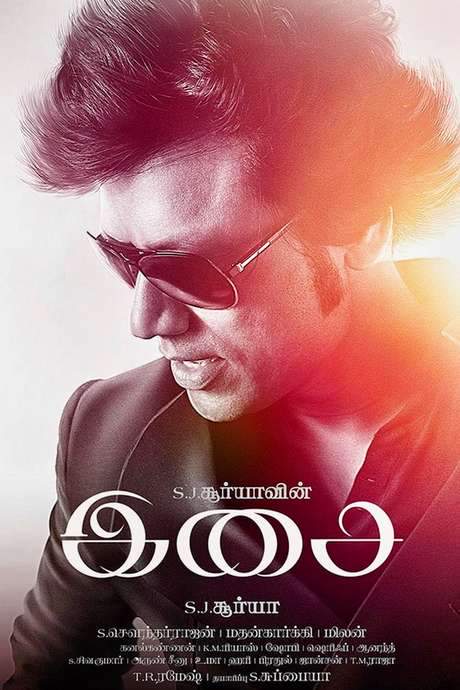
Vetriselvan [Sathyaraj] is celebrated as an established and old-fashioned music director whose work commands respect and affection from fans and peers alike, often hailed as the greatest musician of his time. He stands as a stable pillar of tradition in a rapidly changing industry. Opposite him, the younger A. K. Shiva [S. J. Suryah], initially working as his assistant, borrows from that tradition but also embraces a bold, modern approach by introducing synthesizers and new techniques that instantly draw attention from music lovers. This fresh sound quickly elevates Shiva to the top, and he goes on to establish his own studio, carving out his own path to fame.
As Shiva’s star climbs, he falls in love with Jeni, whom he later marries, sealing the ascent with a personal milestone. Yet the glow of success casts a shadow over Vetriselvan, who recoils from being outpaced and begins to reveal a darker, more calculated side of his personality. He decides to exact revenge by pulling Shiva down, not through direct confrontation but by enlisting the help of those closest to Shiva—the car driver, the manager, the cook, and the front-office staff—to disrupt Shiva’s life and undermine his peace of mind.
The plan unfolds through a chain of deliberate provocations. The car driver lets Shiva’s car stall in peak traffic, leaving him stranded amid a chorus of honks and confusion. The manager feeds Shiva a set of fake incidents that don’t correspond to reality, pushing him toward doubt and disruption. Tragedy intensifies when Jeni’s pregnancy ends in miscarriage after the cook contaminates her meals, leaving Shiva overwhelmed by fear, guilt, and the sense that something deeply wrong is happening to him. The mounting strain triggers a media circus that distorts Shiva’s public image, further alienating him from the world he once conquered. Throughout these trials, Vetriselvan basks in the illusion that his restored influence signals a return to glory.
The plot twists when the story takes a shocking turn: Jeni is revealed to be Vetriselvan’s daughter, sent to manipulate Shiva as part of a bitter scheme to erase his rival. Yet Jeni’s own admissions complicate the plan—she confesses real love for Shiva and reveals that she is carrying his child again. In a tense confrontation, Vetriselvan pressures Shiva to act against Jeni, all while the elder musician’s manipulations threaten to tear the couple apart. The moment of crisis arrives when Vetriselvan stabs Shiva, a stab that promises triumph for the schemer.
But the calamity bends toward dreamlike realization. Shiva awakens to reveal that the preceding chain of events was a dream, a nocturnal sketch born from his own fears and ambitions. In this new waking world, Madhu [Meera Chopra]—the wife who appears in the singer’s life—speaks of the waiting fans and the ten-year gap since Shiva’s last screen project. The sense of possibility lingers as Shiva contemplates a fresh story drawn from the dream, leaving the film on a cliffhanger where the climax remains to be decided. The framing of this ending invites viewers to ponder whether dreams can seed genuine inspirations for real-life art, and whether a musician’s next move might finally reconcile past resentments with future creativity. The film closes with Shiva contemplating the path forward, while the world around him awaits a new cinema that bears his mark.
Cameos weave through the narrative, adding a layer of metafiction to the tale: A.R. Murugadoss appears as himself, along with other industry figures who show up briefly to remind the audience of the film world’s interconnected circle—Raju Sundaram and Vishnu Varadhan among them—each contributing a fleeting, self-referential echo to the story. Jenny, portrayed by Savithri, anchors a crucial element of the emotional arc, giving a human anchor to the film’s dramatic escalation and its revelations. The presence of these cameos enriches the texture, offering a sense of lived-in cinema that blurs the line between dream, performance, and reality.