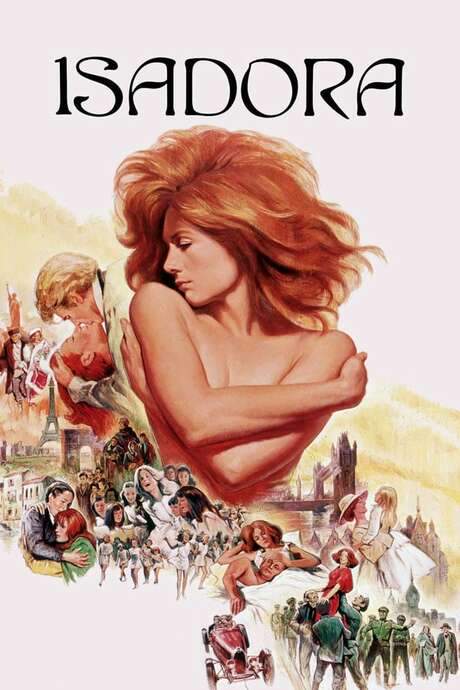
An expansive biography of pioneering dancer Isadora Duncan, the 1920s icon who reshaped ballet with her free‑flowing style. It examines her bold, often nude or semi‑nude performances, her pro‑Soviet projects and her outspoken views on free love, debt, dress and lifestyle, all of which scandalized the public of her era.
Find where to stream, rent, or buy Isadora (1968) in the US with current JustWatch availability, up-to-date pricing, and platform listings for subscription, rental, and digital purchase options.
Warning: spoilers below!
Haven’t seen Isadora yet? This summary contains major spoilers. Bookmark the page, watch the movie, and come back for the full breakdown. If you're ready, scroll on and relive the story!
Explore the full timeline and setting of Isadora (1968). Follow every major event in chronological order and see how the environment shapes the story, characters, and dramatic tension.
Last updated: October 04, 2025 at 18:52
Meet the key characters of Isadora (1968), with detailed profiles, motivations, and roles in the plot. Understand their emotional journeys and what they reveal about the film’s deeper themes.
Last updated: October 04, 2025 at 18:52
Explore the central themes of Isadora (1968), from psychological, social, and emotional dimensions to philosophical messages. Understand what the film is really saying beneath the surface.
Last updated: October 04, 2025 at 18:52
Browse frequently asked questions about Isadora (1968) focused on characters, relationships, themes, symbols, setting, and story context. This movie info FAQ gives spoiler-aware explanations for character arcs, world details, and thematic interpretation so readers can better understand what the film is really about.
The film spans multiple cosmopolitan cities across several decades, beginning in Chicago where Isadora performed in the 1890s, then moving through European cultural capitals like Berlin and Paris, with significant chapters in England and the Soviet Union. Later portions of her life unfold in Boston and the French Riviera, reflecting her status as a transnational figure in modern dance.
The narrative traces Isadora Duncan's life from the 1890s, when she performed in Chicago, through her rise to world-renowned status by the 1920s. It encompasses the fin-de-siècle bohemian era and post-World War I Europe, capturing a period of dramatic artistic experimentation, celebrity, and personal upheaval.
The film portrays Isadora Duncan as an innovator who challenged conventional dance and social norms, creating a free-flowing movement style inspired by classical forms. Her philosophy treated art and life as inseparable, accepting public censure and personal risk as necessary costs of authentic creative expression. Her work embodied the belief that beauty and authenticity justify personal sacrifice.
The film examines how Isadora's personal choices, her romances, political stances, and controversial performances, became matters of public spectacle. The Boston breast-bearing incident and anti-Bolshevik backlash demonstrate how fame magnified every private decision. The narrative uses these scandals to explore the price of living defiantly in the public eye.
Personal tragedy punctuates her journey most devastatingly through the drowning of her children, which shatters her family and redirects her entire life path. This loss colors her later travels and artistic choices, as the film presents tragedy as a catalyst for reinvention rather than destruction, driving her continued pursuit of artistic expression despite overwhelming grief.
Isadora's identity is defined by her continual movement across continents, cultures, and roles, from dancer to lover to school founder. The film emphasizes her search for belonging and self-definition in a world that resists fixed labels, presenting her bohemian lifestyle as a conscious choice where art becomes a way of living rather than simply a profession.
Isadora Duncan (played by Vanessa Redgrave) is portrayed as a legendary innovator of modern dance who defied social norms in pursuit of artistic vision. She evolves from a rebellious young performer in California to a globally famous bohemian figure, enduring personal losses and relationships across continents while remaining intensely devoted to her creative vision throughout a life marked by upheaval.
Paris Singer (played by Jason Robards) is a wealthy benefactor who showers Isadora with gifts and later funds her School for Life. He embodies luxury and financial security, offering Isadora comfort that contrasted sharply with her need for artistic freedom. Their relationship shaped the later chapters of her career and provided material support for her artistic ventures.
Gordon Craig (played by James Fox) was a young stage designer and Isadora's passionate, complicated lover who dreamed of reshaping theatre. He fathered a daughter with Isadora while already married, and their relationship exemplifies the tumultuous personal life that intertwined with artistic collaboration in her story.
Sergei Essenin (played by Zvonimir Črnko) was a volatile Russian poet whose intense affair with Isadora coincided with a controversial marriage that confirmed her willingness to blend personal passion with public life. His unpredictable behavior and literary fame complicated their union and drew significant public attention to their relationship.
Isadora Duncan pioneered a free-flowing dance style that rejected classical ballet conventions in favor of natural, expressive movement inspired by ancient Greek aesthetics. She believed dance should be an extension of genuine emotion and personal truth, not merely technical execution. Her performances, often nude or semi-nude, scandalized audiences but also revolutionized what dance could express.
The film ends with Isadora's dramatic and accidental death when her long scarf becomes tangled in the wheel of a car driven by her Italian admirer Bugatti. This fatal accident occurs during a road trip and underscores the tragic dimension of her legendary status, closing her story with the same sense of drama and fate that characterized her unconventional life.
Discover curated groups of movies connected by mood, themes, and story style. Browse collections built around emotion, atmosphere, and narrative focus to easily find films that match what you feel like watching right now.
Biographical dramas about groundbreaking creators shadowed by personal tragedy.Discover films like Isadora that explore the passionate and often tragic lives of revolutionary artists. If you were captivated by the story of a creator whose genius was intertwined with profound personal loss and societal defiance, these movies offer similar bittersweet and heavy emotional journeys.
These films typically follow a linear biographical arc, tracing an artist's rise to fame through their groundbreaking work. The central conflict often arises from the clash between their unconventional lifestyle and a conservative society, with a devastating personal tragedy serving as a pivotal point that shadows their subsequent achievements and ultimate demise.
Movies in this thread share a heavy emotional weight, a bittersweet tone, and a focus on the immense personal cost of artistic genius. They are united by themes of creative passion, defying convention, and the inextricable link between great art and profound grief.
Epic biographical dramas where profound personal loss defines a legendary life.Find movies similar to Isadora that are sweeping biographical dramas with a heavy emotional core. If you appreciated the film's steady exploration of a famous life defined by profound loss, these stories offer a comparable mix of historical scope and deep, personal sadness.
The narrative pattern involves a steady, often chronological recounting of a famous person's life, establishing their public achievements and personal passions. A central, catastrophic event—such as the death of a loved one—serves as an emotional turning point, casting a long shadow over the remainder of their story and leading to a ultimately sad ending.
These films are grouped by their combination of a biographical format, a steady pacing that allows for deep character study, and an overwhelmingly heavy emotional focus stemming from a central tragedy. They deliver a viewing experience that is both historically informative and deeply melancholic.
Don't stop at just watching - explore Isadora in full detail. From the complete plot summary and scene-by-scene timeline to character breakdowns, thematic analysis, and a deep dive into the ending - every page helps you truly understand what Isadora is all about. Plus, discover what's next after the movie.
Read a complete plot summary of Isadora, including all key story points, character arcs, and turning points. This in-depth recap is ideal for understanding the narrative structure or reviewing what happened in the movie.
Track the full timeline of Isadora with every major event arranged chronologically. Perfect for decoding non-linear storytelling, flashbacks, or parallel narratives with a clear scene-by-scene breakdown.
Discover movies like Isadora that share similar genres, themes, and storytelling elements. Whether you’re drawn to the atmosphere, character arcs, or plot structure, these curated recommendations will help you explore more films you’ll love.
Isadora (1968) Plot Summary & Movie Recap
Isadora (1968) Scene-by-Scene Movie Timeline
Isadora (1968) Spoiler-Free Summary & Key Flow
Movies Like Isadora – Similar Titles You’ll Enjoy
Dancing on Glass (2022) Full Summary & Key Details
Ondine (2010) Full Movie Breakdown
Sade (2002) Detailed Story Recap
Wild Orchid (1990) Spoiler-Packed Plot Recap
I Am Dina (2002) Spoiler-Packed Plot Recap
The Diaries of Vaslav Nijinsky (2001) Ending Explained & Film Insights
Dancers (1987) Full Summary & Key Details
The Red Dance (1928) Full Summary & Key Details
Our Dancing Daughters (1928) Complete Plot Breakdown
Isadora Duncan, the Biggest Dancer in the World (1966) Movie Recap & Themes
Introducing Dorothy Dandridge (1999) Film Overview & Timeline
Dance, Girl, Dance (1940) Movie Recap & Themes
The Dancing Hawk (1978) Detailed Story Recap
Artemisia (1997) Complete Plot Breakdown
Isabel (1968) Film Overview & Timeline