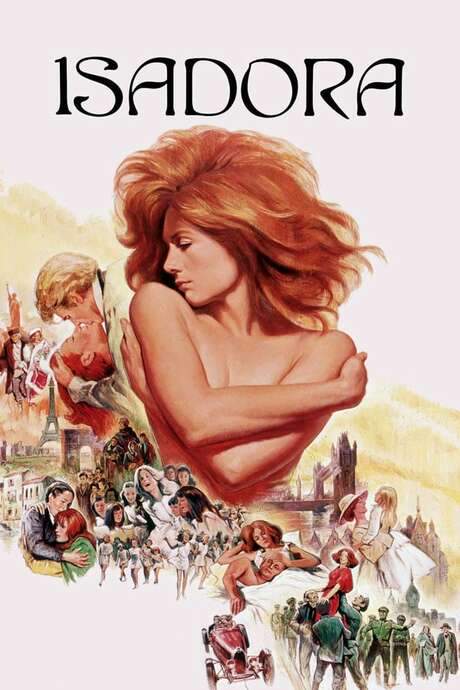
Isadora

Isadora

JustWatch#7,42417

Year: 1968

Runtime: 131 mins

Language: English

Director: Karel Reisz

HistoryMusicDrama

An expansive biography of pioneering dancer Isadora Duncan, the 1920s icon who reshaped ballet with her free‑flowing style. It examines her bold, often nude or semi‑nude performances, her pro‑Soviet projects and her outspoken views on free love, debt, dress and lifestyle, all of which scandalized the public of her era.

Where to Watch Isadora?

Find where to stream, rent, or buy Isadora (1968) in the US with current JustWatch availability, up-to-date pricing, and platform listings for subscription, rental, and digital purchase options.

Warning: spoilers below!

Haven’t seen Isadora yet? This summary contains major spoilers. Bookmark the page, watch the movie, and come back for the full breakdown. If you're ready, scroll on and relive the story!

Timeline – Isadora (1968)

Trace every key event in Isadora (1968) with our detailed, chronological timeline. Perfect for unpacking nonlinear stories, spotting hidden connections, and understanding how each scene builds toward the film’s climax. Whether you're revisiting or decoding for the first time, this timeline gives you the full picture.

1

Isadora's 1927 life in poverty, dictating memoirs

Isadora Duncan is living in poverty in a small hotel on the French Riviera, dictating her memoirs to Mary and Roger. The scene frames her as a legendary artist facing precarious finances, merging memory with art. It establishes the memoir as both a personal confession and a chronicle of her life.

1927 Nice, French Riviera
2

A rebellious California girl

She is a young girl in California who rejects conventional expectations by burning her parents' marriage certificate. She pledges to dedicate her life to art and beauty, foreshadowing a life lived on her own terms. These acts reveal her fearless defiance and fierce creative drive.

late 19th century California, USA
3

Chicago 1896: Peppy Dora earns her chance

In 1896, Isadora performs under the name Peppy Dora in a rowdy Chicago music hall. She publicly shames the manager into paying her $300 so she can take her family to England. The performance launches her on a path to international recognition.

1896 Chicago, USA
4

Greek-inspired dance and international fame

She develops a free-form style modeled on Greek classicism and quickly earns international acclaim. Her daring dances and costumes push boundaries of what performance can be. The rising fame carries her across Europe, setting the stage for future collaborations.

late 1890s – early 1900s Europe
5

Berlin meeting with Gordon Craig

Berlin is where she meets Gordon Craig, a promising stage designer who envisions a new world of theatre. Their intense partnership leads to the birth of a daughter for Isadora. The relationship marks a turning point from solo dancer to powerful artistic collaborator.

early 1900s Berlin, Germany
6

Paris and Paris Singer: estate for School for Life

She moves to Paris, where Paris Singer showers gifts on her and buys an enormous estate to open a School for Life, teaching beauty and simplicity. The arrangement expands her artistic reach beyond performance into education and patronage. This period blends romance, luxury, and a new public persona.

early 1900s Paris, France
7

Birth of a son and return to England with Singer

Following the birth of a son, Isadora returns to England with Singer, seeking a quieter life but quickly grows restless again. The domestic path gives way to new artistic ambitions and travel across Europe. The episode foreshadows the continual reshaping of her life.

early 1900s England
8

Affair with Armand; the tragedy of the drowning children

Isadora begins an affair with her pianist Armand while still with Singer. Soon after, tragedy strikes when both of her children drown after their chauffeur-driven car plunges into the Seine. The catastrophe shatters her family and drives her into a period of wandering.

early 1900s Seine, France
9

Wandering Europe and the Soviet offer

Broken by the tragedy, she leaves Singer and wanders across Europe until 1921, when she is offered to open a dancing school in the Soviet Union. The opportunity marks a dramatic turn toward cultural diplomacy in a communist state. Her wanderings finally funnel into a defined new phase of her career.

1921 Europe; Soviet Union
10

Affair and marriage with Sergei Essenin

In the Soviet Union, she forms a passionate relationship with Sergei Essenin, a volatile poet. To obtain a visa to accompany her to the United States, she marries Essenin. The marriage becomes entangled with his temper and public notoriety.

early 1920s Soviet Union
11

US controversy: Boston recital and anti-Bolshevik backlash

Essenin's antics and Isadora's free-spirited performances boil over in the United States, culminating in a chaotic press conference and a controversial moment when she bares her breasts during a Boston recital. Anti-Bolshevist sentiment in the country intensifies the personal and professional strain. The episode hardens her resolve to continue her art on her own terms.

early 1920s Boston, USA
12

Memoirs, a new Paris school, and Bugatti

After the marriage dissolves, she returns to Nice to write her memoirs and, impulsively, sells her possessions to open a new school in Paris. While celebrating in a local café, she spots Bugatti, a handsome Italian driver, and begins a new, unsettled romance. Her plans to reshape her life through art face a dramatic detour.

1920s Nice; Paris, France
13

Tragic death: scarf strangulation in the car

Back on the road near the sea, Isadora's long chiffon scarf catches in the spokes of a wheel and strangles her, ending her life and sealing her legend. The accident crystallizes the paradox of a life lived for freedom and danger. Her death becomes a final, iconic image of the Isadora Duncan story.

1927 Near the French Riviera

Last updated: October 07, 2025 at 08:55

Was this helpful?

Isadora (1968) Timeline Questions Answered – Chronology FAQ

Find frequently asked questions about the Isadora (1968) timeline, including chronological order, nonlinear jumps, cause-and-effect links, and scene sequence clarifications. This timeline FAQ helps explain when key events happen, how moments connect, and why the story unfolds in that specific order.

Q1

Why did Isadora burn her parents' marriage certificate?

A.

As a young girl in California, Isadora rejected conventional domestic expectations and burned her parents' marriage certificate as a symbolic act of defiance. She pledged herself to art and beauty, choosing a path of artistic freedom over traditional family life. This early act of rebellion foreshadowed her lifelong challenge to societal norms.

Her childhood pledge to art anticipates a lifetime of defying conventions in pursuit of her artistic vision.

childhood rebellioncaliforniamarriage certificateartistic pledge
Q2

Who was Gordon Craig and what was his relationship with Isadora?

A.

Gordon Craig was a promising stage designer Isadora met in Berlin in the early 1900s. He envisioned creating a new form of theatre and became her first great artistic muse. Though already married, Craig entered into an intense partnership with Isadora, and they had a daughter together. The relationship marked a turning point in her career, moving her from solo dancer to powerful artistic collaborator.

Their meeting in Berlin sets the stage for her evolution from individual performer to collaborative artist.

gordon craigberlinstage designerdaughterartistic collaboration
Q3

What happened to Isadora's children?

A.

Both of Isadora's children died in a tragic accident when their chauffeur-driven car plunged into the Seine. She had a daughter from her relationship with Gordon Craig and a son from her relationship with Paris Singer. The devastating loss shattered her family and sent her into a period of profound grief, causing her to abandon her comfortable life with Singer and wander aimlessly across Europe.

The earlier birth of her children establishes the devastating weight of this tragedy.

children deathseinecar accidenttragedyparis singergordon craig
Q4

Why did Isadora go to the Soviet Union?

A.

After losing both children in the Seine accident and wandering Europe in grief, Isadora was invited in 1921 to open a dancing school in the Soviet Union. The opportunity gave her a new purpose and direction after her devastating personal loss. She saw it as a chance to spread her art in a society that embraced radical new ideas.

Her aimless wandering across Europe directly leads to this pivotal opportunity.

soviet uniondancing school1921griefnew purpose
Q5

What caused the controversy in Boston?

A.

During a Boston recital, Isadora publicly bared her torso, a moment that became a flashpoint in her controversial career. This occurred amid heightened tensions from her marriage to Sergei Essenin, whose volatile behavior had already destabilized their public appearances. The combination of her provocative performance and growing anti-Bolshevik sentiment in America turned public opinion sharply against her.

Her history of challenging performance norms makes this Boston incident a predictable escalation.

bostoncontroversybreastsanti-bolshevismsergei essenin
Q6

How did Isadora die?

A.

In 1927 near the French Riviera, Isadora died when her long chiffon scarf became tangled in the spokes of the car wheel while driving with her Italian admirer Bugatti. The scarf strangled her, ending her life in a dramatic, emblematic accident. Her death symbolized the paradox of a life lived for freedom and danger, becoming the final iconic image of her legend.

The film opens with her dictating memoirs in 1927, already aware of her impending death.

deathscarfcar accidentbugattifrench riviera1927
Q7

Why did Isadora marry Sergei Essenin?

A.

Isadora married Sergei Essenin, a volatile Russian poet, primarily to secure him a visa to accompany her to the United States. Their passionate relationship in the Soviet Union had deepened into love, but his turbulent behavior made it impossible for him to travel legally without being her husband. The marriage ultimately became strained by his uncontrollable antics and public disruptions.

Their meeting in the Soviet Union establishes the romantic foundation for this practical marriage.

sergei esseninmarriagevisapoetsoviet union
Q8

What was the School for Life that Isadora founded?

A.

Paris Singer, a wealthy patron, bought Isadora a vast estate in Paris where she established the School for Life. The school aimed to teach her philosophy of beauty and simplicity through dance, expanding her influence beyond performance into education. It represented her belief that art should be accessible to all and that movement could alter perception.

Her earlier work in Paris with Singer enables this educational venture.

school for lifeparis singerestateeducationbeautysimplicity
Q9

Why did Isadora leave Paris Singer?

A.

Isadora left Paris Singer after the tragic drowning of both her children in the Seine. Crushed by grief and unable to bear the domestic life they had built, she abandoned Singer and his wealth to wander across Europe. The loss of her children fundamentally broke her, making the comfortable life with Singer feel unbearable.

The birth of her son with Singer and the subsequent domestic life foreshadows her inability to remain in that situation.

paris singerleavechildren deathgriefwandering
Q10

Why was Isadora in poverty in 1927?

A.

By 1927, Isadora was living in poverty on the French Riviera despite her past fame and relationships with wealthy patrons. After years of living extravagantly and the collapse of her relationships with Singer and later Essenin, she had squandered her resources. She was dictating her memoirs, looking back on a life of artistic triumph but financial instability.

The timeline shows her various relationships and ventures that did not lead to lasting financial security.

povertynicememoirsfinancial struggle1927
Mobile App Preview

Coming soon on iOS and Android

The Plot Explained Mobile App

From blockbusters to hidden gems - dive into movie stories anytime, anywhere. Save your favorites, discover plots faster, and never miss a twist again.

Sign up to be the first to know when we launch. Your email stays private, always.

Explore Movie Threads

Discover curated groups of movies connected by mood, themes, and story style. Browse collections built around emotion, atmosphere, and narrative focus to easily find films that match what you feel like watching right now.

Tormented Artist Stories Like Isadora

Biographical dramas about groundbreaking creators shadowed by personal tragedy.Discover films like Isadora that explore the passionate and often tragic lives of revolutionary artists. If you were captivated by the story of a creator whose genius was intertwined with profound personal loss and societal defiance, these movies offer similar bittersweet and heavy emotional journeys.

tragicpassionatedefiantmelancholiciconoclasticreflectivevolatile

Narrative Summary

These films typically follow a linear biographical arc, tracing an artist's rise to fame through their groundbreaking work. The central conflict often arises from the clash between their unconventional lifestyle and a conservative society, with a devastating personal tragedy serving as a pivotal point that shadows their subsequent achievements and ultimate demise.

Why These Movies?

Movies in this thread share a heavy emotional weight, a bittersweet tone, and a focus on the immense personal cost of artistic genius. They are united by themes of creative passion, defying convention, and the inextricable link between great art and profound grief.

Sweeping Biographical Tragedies Like Isadora

Epic biographical dramas where profound personal loss defines a legendary life.Find movies similar to Isadora that are sweeping biographical dramas with a heavy emotional core. If you appreciated the film's steady exploration of a famous life defined by profound loss, these stories offer a comparable mix of historical scope and deep, personal sadness.

tragicmelancholicreflectivegrief-strickenpassionatehistoricalsomber

Narrative Summary

The narrative pattern involves a steady, often chronological recounting of a famous person's life, establishing their public achievements and personal passions. A central, catastrophic event—such as the death of a loved one—serves as an emotional turning point, casting a long shadow over the remainder of their story and leading to a ultimately sad ending.

Why These Movies?

These films are grouped by their combination of a biographical format, a steady pacing that allows for deep character study, and an overwhelmingly heavy emotional focus stemming from a central tragedy. They deliver a viewing experience that is both historically informative and deeply melancholic.

Unlock the Full Story of Isadora

Don't stop at just watching - explore Isadora in full detail. From the complete plot summary and scene-by-scene timeline to character breakdowns, thematic analysis, and a deep dive into the ending - every page helps you truly understand what Isadora is all about. Plus, discover what's next after the movie.

Isadora Summary

Read a complete plot summary of Isadora, including all key story points, character arcs, and turning points. This in-depth recap is ideal for understanding the narrative structure or reviewing what happened in the movie.

Isadora Summary

Characters, Settings & Themes in Isadora

Discover the characters, locations, and core themes that shape Isadora. Get insights into symbolic elements, setting significance, and deeper narrative meaning - ideal for thematic analysis and movie breakdowns.

Characters, Settings & Themes in Isadora

Isadora Spoiler-Free Summary

Get a quick, spoiler-free overview of Isadora that covers the main plot points and key details without revealing any major twists or spoilers. Perfect for those who want to know what to expect before diving in.

Isadora Spoiler-Free Summary

More About Isadora

Visit What's After the Movie to explore more about Isadora: box office results, cast and crew info, production details, post-credit scenes, and external links - all in one place for movie fans and researchers.

More About Isadora

Similar Movies to Isadora

Discover movies like Isadora that share similar genres, themes, and storytelling elements. Whether you’re drawn to the atmosphere, character arcs, or plot structure, these curated recommendations will help you explore more films you’ll love.