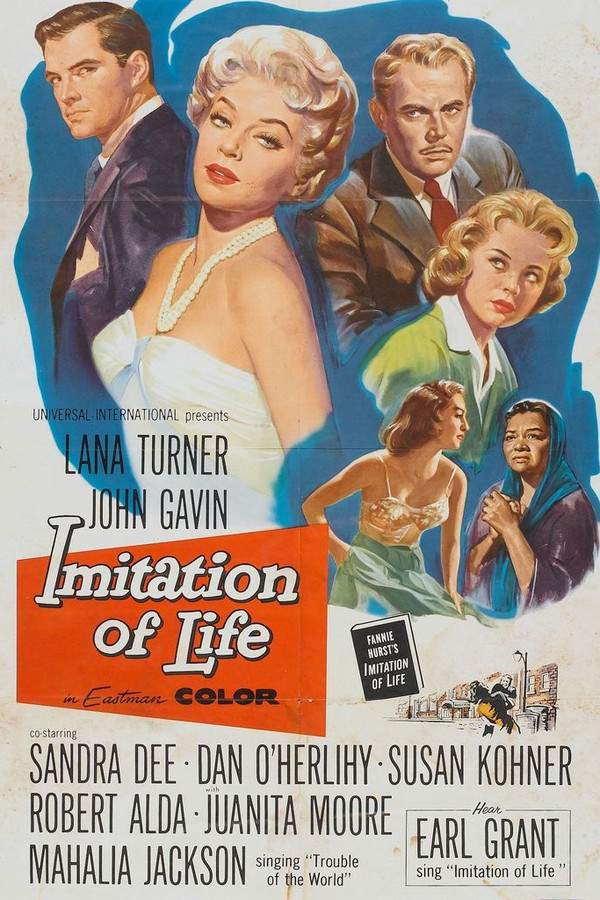
Year: 1959
Runtime: 125 min
Language: English
Director: Douglas Sirk
A struggling single mother, Lora Meredith, dreams of making it on Broadway while raising her young daughter. Her life intersects with Annie Johnson, a black woman raising her own daughter, Sarah Jane. As they navigate the challenges of motherhood together, Lora’s ambition threatens her relationship with her daughter, and Sarah Jane confronts questions about her racial identity. The film explores themes of race, identity, and the complicated bonds between mothers and daughters.
Find where to stream, rent, or buy Imitation of Life (1959) in the US with current JustWatch availability, up-to-date pricing, and platform listings for subscription, rental, and digital purchase options.
Warning: spoilers below!
Haven’t seen Imitation of Life yet? This summary contains major spoilers. Bookmark the page, watch the movie, and come back for the full breakdown. If you're ready, scroll on and relive the story!
Read the complete plot breakdown of Imitation of Life (1959), including all key story events, major twists, and the ending explained in detail. Discover what really happened, and what it all means.
Lola Meredith, played by Lana Turner, is a young widow with a six-year-old daughter named Susie. She moves to New York City with big dreams of making it as a famous actress. However, after several weeks of relentless searching, she struggles to find work and ends up living in a cold-water flat, facing the harsh realities of her pursuit. One fateful summer day on the bustling Coney Island beach, Lola unexpectedly loses her daughter Susie, but luckily, she is quickly reunited with her safe and sound, thanks to Annie Johnson, portrayed by Juanita Moore. Annie, also a widow, is a young black woman with a light complexion, who has an eight-year-old daughter named Sarah Jane. The two girls instantly form a bond, as do their mothers, forging a relationship that becomes central to the story.
Since Annie has no permanent place to stay, she offers to become Lola’s servant and nanny, a gesture of kindness and support. Lola, unable to pay her, agrees to let Annie and her daughter Sarah Jane move in with her, leading to a household filled with both hardship and hope. Meanwhile, on the beach, Lola encounters Steve Archer, an aspiring photographer played by John Gavin, who takes a photograph of the two girls. Steve is attracted to Lola and begins courting her, sensing her longing for a better life. As Lola continues her job search, Annie takes care of the children, handles housework, and takes on menial jobs to help make ends meet, all the while worrying about Sarah Jane, who tries her best to pass as white due to her embarrassment about having a black mother.
Lola enlists the help of agent Allen Loomis, trying to secure acting roles by lying about her background. Loomis, played by Robert Alda, immediately sees through her deception but offers her a deal: he will help make her a star if she agrees to do whatever he asks, regardless of how degrading it might be. Outraged and feeling that her integrity is being compromised, Lola walks away from him. When she confides in Steve about her failed attempt, he encourages her to keep fighting for her dreams. However, things become complicated when Steve sells a photograph of the girls and lands a job with a magazine, prompting him to propose marriage, asking Lola to give up her acting ambitions. She initially accepts, but her chance to work with renowned director David Edwards, played by Dan O’Herlihy, changes her mind. Edwards sees her talent and gives her a small but significant role, which she impresses everyone with, leading to her becoming a star and eventually becoming his lover.
Over the next decade, Lola rises to fame, starring in all of Edwards’s Broadway productions. She, Annie, and her two teenage daughters—Susie, played by Sandra Dee, and Sarah Jane, played by Susan Kohner—move into a large, beautiful house in Manhattan. Despite her professional success, Lola begins to feel unfulfilled with her life, craving more genuine connection rather than fame. Her relationship with Edwards ends as she seeks out roles in more modest, working-class plays, trying to find herself beyond the glitz and glamour. Steve visits her during her celebration after her latest show, and she hints at wanting to reunite with him. Yet, her obsession with her career keeps her distant, and her daughter Susie grows increasingly disenchanted with her mother’s absence.
Susie, feeling neglected, confides in Annie, and their bond deepens. When Lola goes abroad to Europe to star in a movie, Steve steps in to look after Susie, who unexpectedly falls in love with him. Upon Lola’s return, it becomes clear to Susie that Steve has genuine affection for her mother, and their relationship seems headed toward marriage. This realization causes a rift between Lola and Susie, leading to a painful falling out.
Meanwhile, Annie’s health starts to decline, and Sarah Jane begins to draw away from her. In an effort to escape her feelings of alienation, Sarah Jane attempts to pass as white by dating a local high school boy. When her boyfriend discovers she is biracial, he reacts violently, physically assaulting her and ending their relationship. Heartbroken and overwhelmed, Sarah Jane spirals into depression, taking a job as a dancer in a seedy nightclub until Annie intervenes by revealing her own black identity to get her fired. Sarah Jane, overwhelmed, declares she never wants to see her mother again, and she leaves town.
Steve tracks Sarah Jane to Las Vegas, where she is working as a showgirl, and finds her in poor health, likely due to illness. Annie travels there to visit her daughter, promising to stay out of her life but encouraging her to return to New York if she needs help. Sadly, Annie passes away shortly after, leaving Lola and the family devastated. Her funeral is a grand, emotional event, attended by thousands, fulfilling Annie’s wish for a beautiful farewell.
In her final moments, Sarah Jane admits to everyone that she is Annie’s daughter and that she is black. Her raw confession brings a new understanding and acceptance among all involved. In the story’s end, Sarah Jane embraces her identity, and she, Lola, Susie, and Steve come together to move forward with hope, unity, and the acknowledgment of their complex identities and shared struggles.
Last updated: August 19, 2025 at 05:13
Explore frequently asked questions about Imitation of Life (1959) with spoiler-rich answers covering the full plot summary, major story beats, character motivations, hidden details, and ending meaning. This movie summary FAQ helps explain confusing scenes, plot twists, and narrative decisions in clear, searchable detail.
Sarah Jane struggled with her biracial identity throughout her life, feeling embarrassed by her black mother Annie. Her light complexion allowed her to attempt passing as white, which she hoped would help her escape racial discrimination and find acceptance in white society. This rejection stemmed from internalized racism and the societal pressure she faced as a light-skinned Black woman.
Earlier scenes show Sarah Jane trying to hide her mother's presence and avoiding acknowledgment of her Black heritage in public.
Lora became consumed by her ambition to become a star, accepting roles in David Edwards' Broadway productions and eventually becoming his lover. Her obsession with success caused her to prioritize her career over motherhood, leaving Susie feeling abandoned and unloved. This neglect ultimately drove Susie to confide in Annie and later fall in love with Steve.
Even early in the film, Lora struggles to balance her career aspirations with caring for Susie, often leaving her with Annie.
When Lora went abroad to film a movie, Steve stepped in to care for Susie. During this time, Susie developed genuine feelings for him as he provided the emotional support and presence that her mother had long denied her. When Lora returned, Susie realized Steve loved her mother, causing painful conflict within the family.
Steve had been a consistent, caring presence in Susie's life since the early days at Coney Island.
Annie discovered Sarah Jane was working as a dancer in a seedy Las Vegas nightclub, a job that stemmed from her depression after being assaulted. Knowing her daughter was using her light skin to pass and work in a degrading environment, Annie revealed her own Black identity to the club management, getting Sarah Jane fired. This act was meant to force Sarah Jane to stop hiding and confront her true self.
Annie had always worried about Sarah Jane's attempts to pass and had seen her daughter struggle with identity issues for years.
The rift developed from years of Lora's emotional absence as she pursued her career. When Susie realized Steve loved her mother and their relationship was heading toward marriage, Susie felt betrayed, believing Steve would replace her mother in her life. The combination of maternal neglect and this romantic realization caused a painful falling out between Lora and Susie.
Susie had been confiding in Annie about her mother's absence long before this confrontation.
After rejecting agent Allen Loomis's unethical offer, Lora got a small but significant role from director David Edwards, who recognized her talent. She impressed everyone and gradually became his leading lady in all his Broadway productions. Over a decade, she transformed from a struggling actress in a cold-water flat to a renowned Broadway star, eventually also becoming Edwards' romantic partner.
Lora's determination and talent were established early, and her persistence in pursuing acting roles set the foundation for her eventual success.
When Sarah Jane's white boyfriend learned she was biracial, he violently assaulted her, ending their relationship. Heartbroken and unable to cope with the rejection and racism she faced, Sarah Jane fell into depression and took a job as a dancer in a seedy Las Vegas nightclub, distancing herself from her mother and her Black identity.
Sarah Jane's attempts to pass as white had been building throughout the film, showing her desperation to escape her racial identity.
At Annie's funeral, Sarah Jane publicly confessed that she was Annie's daughter and that she was Black, finally embracing her true identity after years of denial and passing. This raw confession was her way of honoring Annie's memory and accepting herself, bringing understanding and reconciliation to the family.
Annie's death and her lifelong love despite Sarah Jane's rejection gave Sarah Jane the emotional catalyst to stop hiding.
Lora initially accepted Steve's marriage proposal, but then received her breakthrough opportunity with director David Edwards. The chance to pursue her lifelong dream of becoming a star on Broadway caused her to choose her career over marriage to Steve. This decision set her on the path to fame but also initiated her neglect of family.
Lora's ambition to become a famous actress was established from her first days in New York City.
After traveling to Las Vegas to visit Sarah Jane and offering her support, Annie returned to New York and passed away from a brief illness. Her death was met with a large, lavish funeral attended by thousands, fulfilling her wish for a beautiful farewell. Her passing deeply affected both Sarah Jane and Lora, who had lived together as family for years.
Annie's health had been declining throughout the later portions of the film.
After Annie's death, Sarah Jane publicly embraced her identity at the funeral, and the family, Sarah Jane, Lola, Susie, and Steve, came together in shared grief and understanding. The tragic loss of Annie brought reconciliation, with Sarah Jane hugging both her mother and Lora, and the family leaving together to begin a new chapter united.
The film had been building toward this moment of acceptance and unity since Sarah Jane's confession at the funeral.
Discover curated groups of movies connected by mood, themes, and story style. Browse collections built around emotion, atmosphere, and narrative focus to easily find films that match what you feel like watching right now.
Character-driven stories where family bonds are tested by ambition and prejudice.For viewers seeking movies like Imitation of Life, this collection features similar deeply emotional dramas. These films focus on complex family relationships tested by ambition and societal prejudice, offering a melancholic and sobering viewing experience with bittersweet conclusions.
These narratives often follow families over an extended period, charting how internal tensions and external pressures (like race, class, or ambition) strain relationships to the breaking point. The plot is driven by emotional revelations and character decisions rather than high-concept events, culminating in a resolution that acknowledges loss but sometimes offers a glimmer of hard-won understanding.
Movies in this thread share a consistent melancholic tone, steady pacing that allows for deep character immersion, and a heavy emotional weight derived from themes of fractured relationships, sacrifice, and identity. They provide a similar, deeply felt, character-centric dramatic experience.
Intimate stories of personal struggle against societal constraints.If you liked Imitation of Life's exploration of racial identity and personal sacrifice, you'll find similar themes here. These character-driven dramas follow individuals grappling with who they are against the backdrop of a judgmental society, resulting in poignant and thought-provoking stories.
The narrative pattern follows a protagonist's arduous journey to reconcile their inner self with the world's perception of them. This often involves a painful process of denial, awakening, and eventual, imperfect acceptance. The plot is built around pivotal emotional choices that carry significant consequences, leading to an ending that is earned through struggle rather than granted through ease.
These films are united by their deep focus on character psychology, their sobering tone, and their exploration of weighty social themes. They share a similar pacing that allows the audience to fully absorb the character's emotional journey, resulting in a cathartic, if not entirely happy, conclusion.
Don't stop at just watching - explore Imitation of Life in full detail. From the complete plot summary and scene-by-scene timeline to character breakdowns, thematic analysis, and a deep dive into the ending - every page helps you truly understand what Imitation of Life is all about. Plus, discover what's next after the movie.
Track the full timeline of Imitation of Life with every major event arranged chronologically. Perfect for decoding non-linear storytelling, flashbacks, or parallel narratives with a clear scene-by-scene breakdown.
Discover the characters, locations, and core themes that shape Imitation of Life. Get insights into symbolic elements, setting significance, and deeper narrative meaning - ideal for thematic analysis and movie breakdowns.
Discover movies like Imitation of Life that share similar genres, themes, and storytelling elements. Whether you’re drawn to the atmosphere, character arcs, or plot structure, these curated recommendations will help you explore more films you’ll love.
Imitation of Life (1959) Scene-by-Scene Movie Timeline
Imitation of Life (1959) Movie Characters, Themes & Settings
Imitation of Life (1959) Spoiler-Free Summary & Key Flow
Movies Like Imitation of Life – Similar Titles You’ll Enjoy
Passing (2021) Plot Summary & Ending Explained
Mother and Child (2010) Film Overview & Timeline
Life Itself (2018) Film Overview & Timeline
Tootsie (1982) Full Movie Breakdown
Just Another Girl on the I.R.T. (1993) Story Summary & Characters
A Raisin in the Sun (1961) Full Movie Breakdown
White Mama (1980) Plot Summary & Ending Explained
Illusions (1982) Spoiler-Packed Plot Recap
This Is My Life (1992) Spoiler-Packed Plot Recap
Life Begins (1932) Detailed Story Recap
Little Black Angels (1970) Spoiler-Packed Plot Recap
Stage Mother (1933) Spoiler-Packed Plot Recap
Imitation of Life (1934) Spoiler-Packed Plot Recap
In This Our Life (1942) Story Summary & Characters
I Passed for White (1960) Spoiler-Packed Plot Recap