


Plot Explained Spoilers guaranteed!
Plot Explained

Browse by genre

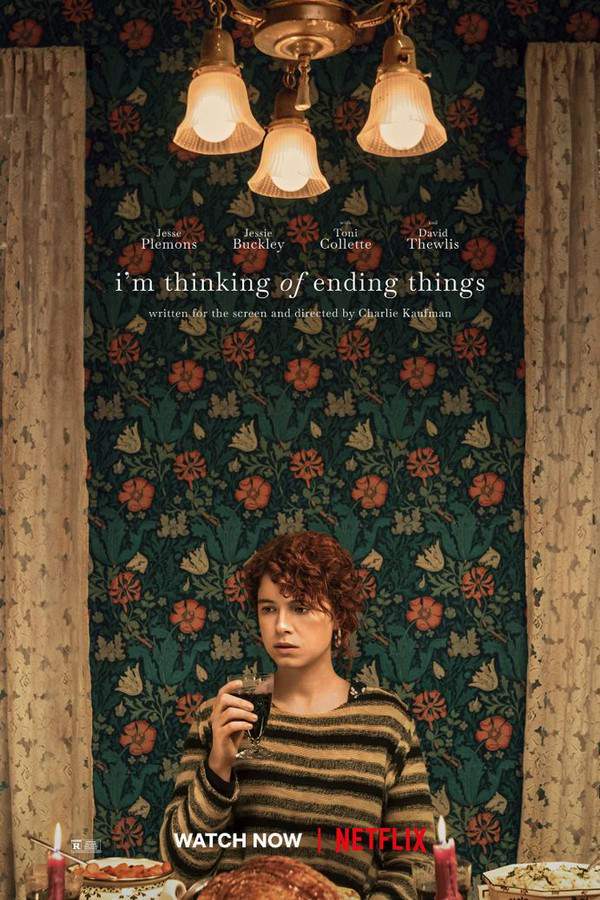
i'm thinking of ending things (2020) movie poster

Timeline

i'm thinking of ending things (2020) Timeline Explained – Every Event in Order

Release, runtime and language
2020 · 134 min · English
Echo score 72
JustWatch #1,830 24
Directed by
Charlie Kaufman
Starring
David Thewlis, Jessie Buckley, Jesse Plemons, Hadley Robinson, Toni Collette, Abby Quinn

A young woman accompanies her boyfriend on a trip to his parents' remote farm as their relationship faces doubts. During a severe snowstorm, unsettling events and fragmented memories surface, blurring the lines of their connection and leading her to question the reality of their relationship and Jake's history. She must confront the unsettling truth about their bond and the secrets hidden within the isolated farmhouse.

On this page (7)
  1. 1 Where to watch
  2. 2 Events in order (15)
  3. 3 Timeline questions answered
  4. 4 The book behind the movie
  5. 5 Movie threads
  6. 6 Movies like i'm thinking of ending things
  7. 7 Every angle

Where to watch

Where to Watch i'm thinking of ending things (2020)

Where can you watch i'm thinking of ending things? Stream, rent or buy it in the US, including on Netflix and Netflix Standard: current JustWatch availability with up-to-date prices.

Streaming availability powered by JustWatch

15 events in order · contains spoilers

i'm thinking of ending things Timeline: Events in Chronological Order

Every key event of i'm thinking of ending things (2020) in order, scene by scene, with when and where it takes place. Use it to untangle flashbacks, time jumps and parallel storylines, to refresh your memory before the sequel or to find the exact scene you are thinking of.

  1. Inner Monologue

    The film opens with a young woman reflecting on her anxiety about her relationship with Jake. She expresses uncertainty about ending their month-long partnership, feeling it has lasted longer than it should.

  2. Road Trip Begins

    Jake takes the young woman on a winter road trip to introduce her to his parents. As she waits for him on the street corner, she regrets agreeing to such a trip without ending their relationship first.

    When
    Winter
  3. Car Ride Conversations

    During the car ride, the woman drifts into her thoughts while Jake attempts to engage her in conversation. They pass a demolition site with a nostalgic swing set, prompting her to remark on the peculiar scene.

  4. Philosophical Discussions

    As they journey through the snow, their discussions evolve into philosophical matters. The couple demonstrates a deep understanding of various topics, revealing their intellectual connection but also their isolation.

  5. Arrival at the Farmhouse

    Upon reaching Jake's parents' farmhouse, tensions arise when Jake hesitates to enter. He chooses to show her the stable first, where they encounter several deceased sheep, fueling her discomfort.

    Where
    Jake's parents' farmhouse
  6. Touring the House

    Inside the farmhouse, they initially find Jake's parents missing, leading to a confusing and uneasy atmosphere. While touring the home, the young woman is struck by a baby photo of Jake that strongly resembles her.

    Where
    Jake's parents' farmhouse
  7. Dinner with Jake's Parents

    Dinner reveals Jake's parents to be warm yet peculiar. The young woman shares her artistic endeavors, but her narrative is riddled with inconsistencies, exacerbating her unease about her relationship with Jake.

    Where
    Dining area of farmhouse
  8. Ominous Voicemail

    During dinner, the young woman receives a cryptic voicemail from someone identified as 'Lucy'. This unsettling message deepens her anxiety and raises questions about her identity and relationship dynamics.

  9. Strange Events at Dinner

    As dessert is served, odd occurrences mount—the young woman's conversation about Gerontology is interrupted by Jake's mother exhibiting signs of confusion. This adds to the surreal feeling enveloping the dinner.

    Where
    Dining area of farmhouse
  10. Uncovering Jake's Past

    After dinner, the young woman finds herself in Jake's childhood bedroom, where she discovers a journal containing her own poem. This blurs the lines of her reality and leaves her questioning everything.

    Where
    Jake's childhood bedroom
  11. The Basement Revelation

    Sent to the basement for laundry, she receives another mysterious call echoing the prior voicemail. Inside, she finds a flooded washing machine and Jake’s paintings that eerily resemble her own artwork.

    Where
    Basement
  12. Decision to Leave

    The young woman insists on leaving, but amid a worsening blizzard, she encounters confusion related to her identity. Jake erroneously calls her by another name, deepening her struggle with self-awareness.

  13. Stopping at Tulsey Town

    Jake makes an impulsive stop for ice cream at Tulsey Town, where the young woman recognizes one of the employees but struggles to remember her. The employee cryptically advises her to reconsider continuing on her journey.

    Where
    Tulsey Town
  14. Encounters with the Janitor

    At Jake's old high school, she encounters the elderly janitor. Initially evasive, she eventually confides in him about her faltering relationship with Jake, revealing her fragmented memories.

    Where
    High school
  15. Surreal Dance Sequence

    The journey culminates in a surreal encounter where Jake and the young woman see two dancers imitating their movements, leading to a dreamlike ballet sequence. This concludes with Jake meeting a tragic fate at the hands of the janitor.

Last updated: November 15, 2024 at 16:51

Was this helpful?

Timeline questions answered

i'm thinking of ending things Timeline Explained: Your Questions Answered

When does it happen, and why in that order? The questions people ask about the chronology of i'm thinking of ending things (2020): time jumps, flashbacks, cause and effect between scenes and the correct order of events, each answered with spoilers.

Q1

Why is the young woman called different names throughout the film?

The woman is called Lucy, Amy, and several other names by Jake and his parents. This suggests the characters are not fully real or that Jake is projecting different aspects of a past relationship onto her. The name confusion reinforces the film's theme of unstable identity and blurred reality.

Foreshadowing: Jake calls her 'Lucy' early in the car ride, establishing the name inconsistency from the start.

  • Lucy
  • Amy
  • name confusion
  • identity
  • Jake
Q2

Who is the janitor and what is his connection to Jake?

The elderly janitor is revealed to be an older version of Jake himself. At the film's end, he kills the younger Jake during the surreal dance sequence. The janitor's isolated life at the high school represents Jake's deepest fear of loneliness and regret, which he confronts through this hallucinatory narrative.

Foreshadowing: The janitor appears throughout the film, often near the same swing set shown in Jake's memories, hinting at his connection to Jake's past.

  • janitor
  • Jake
  • connection
  • identity
  • death
Q3

Why do Jake's parents appear to age and reverse during dinner?

Jake's parents aging and de-aging between scenes is not meant to be literally understood. This supernatural element represents the fluid nature of memory and Jake's distorted perception of his family. It reflects how he remembers them from different periods of his life, blending past and present.

Foreshadowing: The aging reversal becomes noticeable after the young woman explores the house, as Jake's hold on reality loosens.

  • parents
  • aging
  • time
  • dinner scene
Q4

What is the significance of the basement being taped shut?

The basement door is covered in scratches and tape, which Jake claims comes from the family dog. However, the scratches more likely represent Jake's own attempts to escape or hide something from his past. The basement contains flooded laundry and paintings that resemble the young woman's artwork, suggesting the space holds repressed memories or alternate realities.

Foreshadowing: Jake immediately warns the young woman about the basement being unsafe when they arrive, drawing attention to its importance.

  • basement
  • scratches
  • paintings
  • repressed memory
Q5

Why does the baby photo on the wall resemble her?

The baby photo on Jake's wall showing a child that looks like the young woman reinforces the idea that she may not be a real person but rather a projection or memory of someone from Jake's past. This could represent a former girlfriend, or more disturbingly, his own childhood self reflected back at him.

Foreshadowing: This moment occurs during the house tour, early in the visit, establishing the uncanny atmosphere.

  • baby photo
  • resemblance
  • childhood
  • Jake's past
Q6

What does finding her own poem in Jake's journal mean?

Finding her own poem in Jake's childhood journal indicates she is not a separate person but rather a creation or memory within Jake's mind. The poem she recites upon arrival already exists in his journal, proving she is an extension of his consciousness rather than a real girlfriend visiting for the first time.

Foreshadowing: She recites this poem at the farmhouse entrance, and it appears in the journal later, confirming the循环 nature of her existence.

  • poem
  • journal
  • Lucy
  • recursion
  • identity
Q7

Who is Lucy and why does she leave the voicemail?

Lucy appears to be either the young woman's true name or a previous version of her in Jake's mind. The voicemail from Lucy during dinner, warning about being at the farmhouse, could be a message from Jake's subconscious attempting to break through the illusion. It reinforces the fragmented identity theme running throughout the film.

Foreshadowing: Jake already called her Lucy earlier in the car, establishing her connection to this name.

  • Lucy
  • voicemail
  • warning
  • identity
Q8

What is the significance of the Tulsey Town employee recognizing her?

The Tulsey Town employee recognizes the young woman and warns her not to continue, saying 'Amy, don't do this.' This suggests the employee may be another manifestation within Jake's mind, or someone from his actual past who knew the real person the young woman represents. It further blurs the line between reality and Jake's psychological construct.

Foreshadowing: The warning comes at a turning point when the young woman is trying to leave, signaling the point of no return.

  • Tulsey Town
  • employee
  • Amy
  • warning
Q9

What happens during the final dance sequence at the high school?

At the high school, Jake and the young woman encounter two dancers who mimic their movements in a surreal ballet. The sequence ends with the janitor (older Jake) killing the younger Jake. This appears to be a metaphorical representation of Jake's suicide or his rejection of the fantasy he's created, with the janitor finally ending the delusion.

Foreshadowing: The dance begins soon after the young woman admits she cannot visualize Jake's face, indicating his identity is dissolving.

  • dance
  • ballet
  • janitor
  • death
  • high school
Q10

What does the Nobel Prize acceptance speech at the end represent?

The aged Jake giving a Nobel Prize speech in the auditorium represents a fantasy of success and recognition that he never achieved in real life. It shows his regret about wasted potential and loneliness. The speech about a metaphysical journey and his singing of 'Lonely Room' from Oklahoma! reveals his deep isolation and desire for connection he never experienced.

Foreshadowing: The musical Oklahoma! was referenced earlier when Jake sang along in the car, connecting his love of the production to his deepest feelings.

  • Nobel Prize
  • speech
  • Oklahoma
  • lonely room
  • fantasy
Q11

Is any of the story real or is it all in Jake's mind?

The film strongly suggests the entire visit is a psychological construct happening in Jake's mind. Evidence includes the name confusion, the poem appearing before she writes it, the baby photo resembling her, and the janitor being older Jake. The young woman may represent a real person he knew, or more likely, a composite of women from his past merged with his imagination. The farmhouse and its inhabitants are likely manifestations of his memories and regrets.

Foreshadowing: The young woman cannot visualize Jake's face, and she admits nothing significant happened between them at trivia night, both indicating she is not real.

  • reality
  • illusion
  • psychological
  • hallucination
  • mind
Q12

What is the significance of the swing set appearing throughout the film?

The swing set appears at the demolition site, in the janitor's backyard, and in memories. It represents Jake's childhood and innocence lost. The repeated imagery connects the young woman's observations to the janitor's memories, reinforcing that both are the same person at different life stages. The swing set symbolizes the passage of time and things that have been destroyed or abandoned.

Foreshadowing: The first swing set appears during the car ride as they pass the demolition site, early establishing this visual motif.

  • swing set
  • childhood
  • memory
  • janitor
Q13

What happens at the end of the film? Does Jake survive?

The ending is deliberately ambiguous. In the dance sequence, the younger Jake appears to die at the hands of the janitor. However, the final scene shows a car starting in the school parking lot the next morning, suggesting either the janitor survived or the entire narrative was a mental exercise Jake experienced before making a real choice. The final sound of an engine starting may imply he has decided not to end things after all, or it may simply be another layer of the illusion.

Foreshadowing: The opening monologue establishes Jake is someone 'thinking of ending things,' making the final choice ambiguous.

  • ending
  • survival
  • car
  • ambiguity
  • blizzard

Movie threads

More Movies Like i'm thinking of ending things, by Mood & Story

Curated lists built around what makes i'm thinking of ending things tick: the same mood, the same kind of story or the same emotional payoff. Each list explains why these movies belong together.

Movies with unreliable narrators like i'm thinking of ending things

Psychological explorations where perception and memory become untrustworthy. This collection features films like i'm thinking of ending things, where the narrative structure is intentionally unstable. If you enjoyed questioning what was real and piecing together the story from fragmented memories and shifting identities, you'll find similar mind-bending and disorienting experiences here.

  • disorienting
  • dreamlike
  • psychological
  • unsettling
  • mind-bending
  • cerebral
  • Tone: disorienting, melancholic, tense
  • Pacing: slow, deliberate
Why these movies?

The story pattern: These stories often center on a protagonist whose perception is flawed, due to psychological trauma, mental illness, or surreal circumstances. The plot unfolds not as objective truth, but as a distorted reflection of their inner world, leading the audience to constantly question the validity of events and character motivations.

Why they belong together: These films are grouped by their use of an unreliable narrative perspective to create psychological tension and thematic depth. They share a common goal of disorienting the viewer and exploring the malleable nature of truth, memory, and self.
Slow burn existential horror movies like i'm thinking of ending things

Stories where quiet tension builds into a profound sense of unease about life itself. For viewers who appreciated the slow-building, melancholic dread in i'm thinking of ending things, this list highlights similar films. These movies use a slow pace and heavy atmosphere to explore deep anxieties about loneliness, memory, and identity, rather than relying on conventional scares.

  • slow burn
  • existential
  • dread
  • melancholic
  • unsettling
  • atmospheric
  • Tone: melancholic, bleak, unsettling
  • Pacing: very slow, atmospheric
Why these movies?

The story pattern: The narrative is often a gradual descent into anxiety, focusing on a character's internal struggle with profound philosophical fears. The conflict is less about external monsters and more about the terrifying nature of consciousness, regret, and oblivion, revealed through long, tense scenes and symbolic imagery.

Why they belong together: They are united by a specific combination of slow pacing, high emotional weight, and a tone of melancholic dread. The viewing experience is defined by a pervasive sense of unease that builds psychologically, leaving a heavy, contemplative feeling.

If you liked this

Movies Like i'm thinking of ending things

Similar movies to i'm thinking of ending things: the same genre, themes or kind of story. Each one comes with its own plot summary, timeline and ending explained.

Browse all movie summaries

Every angle

i'm thinking of ending things (2020) Explained: Plot, Ending, Timeline & Characters

Everything about i'm thinking of ending things in one place: what happens in the plot summary, the timeline in chronological order, the characters and meaning, the ending explained and a spoiler-free summary. What's After the Movie adds the cast, box office and post-credit scenes.

Coming soon on iOS and Android

The Plot Explained Movie Summary App

Plot summaries, endings explained and timelines on your phone. Catch up on any movie in minutes, save your favorites and never miss a twist again.

Be the first to know when we launch. Your email stays private, always.

Learn more about the app