


Plot Explained Spoilers guaranteed!
Plot Explained

Browse by genre

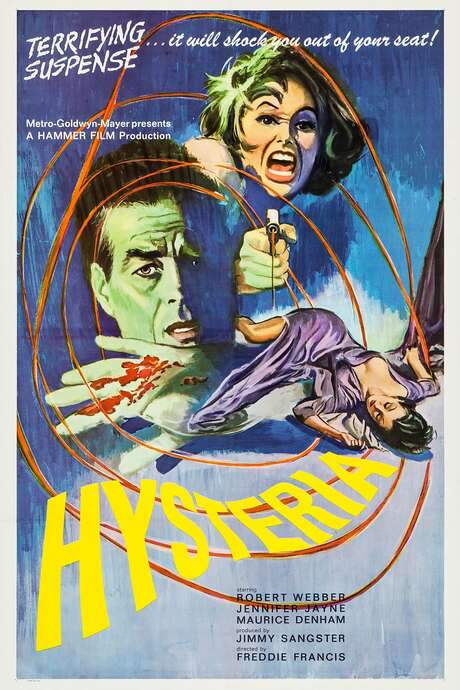
Hysteria (1965) movie poster

Timeline

Hysteria (1965) Timeline Explained – Every Event in Order

Release, runtime and language
1965 · 85 mins · English
Directed by
Freddie Francis
Starring
Robert Webber, Lelia Goldoni, Sue Lloyd, Maurice Denham, Peter Woodthorpe, Marianne Stone

An American man awakens in an English hospital with no memory of his life before a recent car crash. The only clue is a torn newspaper photograph and the aid of an unnamed benefactor. As he pieces together his past, he discovers evidence that suggests a disturbing, seemingly inexplicable murder.

On this page (6)
  1. 1 Where to watch
  2. 2 Events in order (11)
  3. 3 Timeline questions answered
  4. 4 Movie threads
  5. 5 Movies like Hysteria
  6. 6 Every angle

Where to watch

Where to Watch Hysteria (1965)

Where can you watch Hysteria? Stream, rent or buy it in the US, including on Amazon Video and Apple TV Store: current JustWatch availability with up-to-date prices.

Streaming availability powered by JustWatch

11 events in order · contains spoilers

Hysteria Timeline: Events in Chronological Order

Every key event of Hysteria (1965) in order, scene by scene, with when and where it takes place. Use it to untangle flashbacks, time jumps and parallel storylines, to refresh your memory before the sequel or to find the exact scene you are thinking of.

  1. Waking in memory loss

    Chris Smith awakes in an English hospital unable to remember anything about his life before a car crash. Doctors warn that the amnesia is real and could last or fade, adding to his growing confusion. The opening scene establishes the central mystery of who he really is.

    When
    immediately after the accident
    Where
    English hospital
  2. Four months later: treatment and support

    Four months pass and he is physically recovered, yet his memory remains blank. Dr. Keller treats the condition and explains that an anonymous benefactor covers his bills and has provided an apartment. The arrangement hints at a larger secret surrounding his identity.

    When
    four months later
    Where
    Dr. Keller's clinic
  3. A torn photograph as the only link

    The torn photograph, taken from a newspaper, becomes his only tangible link to the past. He studies the image for clues to his history and the people in it. The photo's mystery drives his curiosity and anxiety as memories stay elusive.

    When
    four months later
    Where
    Chris's hospital room
  4. Gina: a nurse and a bond

    Gina, the nurse tending to him, becomes a bright point in his uncertain world as he falls in love with her. Their relationship offers hope and a glimpse of normal life, even as his memory remains elusive. The romance adds urgency to his quest to uncover the truth about himself.

    When
    four months later
    Where
    hospital
  5. Release, flat, and a private investigator

    After his release, Chris moves into a flat and hires Hemmings, a private investigator, to help uncover his past. Hemmings lays out a plan to track down clues and people who might recognize him. The search outside the hospital intensifies the sense that memory and identity are within reach but not yet secure.

    When
    shortly after release
    Where
    Chris's flat
  6. Meeting the photographer

    Chris visits the photographer who produced the only image of the person in the torn photograph. The photographer reveals that the subject is dead and had been murdered in a shower, deepening the mystery. This discovery ties his uncertain life to a real crime and pushes him toward answers.

    When
    soon after release
    Where
    photographer's studio
  7. Strange sounds and a bloody clue

    Back in his flat, Chris hears voices from the next apartment as a couple argues. He keeps seeing a woman around town who resembles the photograph, fueling his paranoia. A bloody knife in his shower confirms that danger is closer than he thinks.

    When
    shortly after the photographer visit
    Where
    Chris's flat
  8. Denise's late-night visit

    Denise arrives late one night claiming to be the widow of the man responsible for the accident that cost him his memory. She resembles the woman in the photo, adding a seductive and menacing layer to the deception. Her visit plunges him deeper into fear and suspicion.

    When
    late night
    Where
    Chris's flat
  9. Drugs and a disappearing body

    Denise drugs Chris, triggering blackouts during which he discovers the body of a murdered woman in his shower, only for it to disappear afterward. The episode leaves him questioning his sanity and the reality of the threats around him. The pattern suggests someone is staging evidence against him.

    When
    after Denise's drug episode
    Where
    Chris's flat
  10. Unmasking the killers

    With Hemmings's help, Chris forces Denise and Keller to admit their roles in the crime, revealing a plan to frame him and identifying the murdered woman as the doctor’s wife. The confrontation exposes the conspiracy and shifts the balance of power back toward him. The revelation marks a turning point in the narrative.

    When
    climax
    Where
    Hemmings's office
  11. Resolution and reunion

    The truth is finally acknowledged: Denise and Keller murdered the doctor’s wife, and Chris is vindicated. Gina reappears in his life, anchoring his restored memory and offering emotional closure. The ending ties memory, love, and justice together amid ongoing uncertainty.

    When
    ending
    Where
    various locations including hospital

Last updated: March 05, 2026 at 18:40

Was this helpful?

Timeline questions answered

Hysteria Timeline Explained: Your Questions Answered

When does it happen, and why in that order? The questions people ask about the chronology of Hysteria (1965): time jumps, flashbacks, cause and effect between scenes and the correct order of events, each answered with spoilers.

Q1

Why is Chris being framed for murder?

Denise James and Dr. Keller orchestrated the frame-up to conceal their actual crime: the murder of Dr. Keller's wife. By planting evidence and manipulating Chris's amnesia, they aimed to pin the shower murder on him, using his memory loss as proof of guilt. This explains why they funded his hospital care, to keep him close enough to manipulate and ultimately incriminate.

Foreshadowing: Earlier scenes establish the anonymous benefactor's unusual interest in keeping Chris dependent on the hospital, hinting at a larger design.

  • frame-up
  • conspiracy
  • denise james
  • dr keller
  • murder frame
Q2

Who is Denise James and why does she resemble the woman in the photo?

Denise James claims to be the widow of the man responsible for Chris's accident, but this is part of the deception. She resembles the woman in the torn photograph because the photograph showed Dr. Keller's murdered wife, Denise and Keller killed her together, and Denise uses the resemblance to unsettle and manipulate Chris while getting close enough to plant evidence against him.

Foreshadowing: The torn photograph shows a dead woman, and the photographer confirms she was murdered in a shower, establishing the real crime that needs a scapegoat.

  • denise james
  • resemblance
  • photograph
  • manipulation
Q3

What really happened to the woman Chris saw in his shower?

The woman Chris sees in his shower is the body of Dr. Keller's wife, whom Denise and Keller actually murdered. They planted the body in Chris's shower during one of his drug-induced blackouts to incriminate him. The body disappears because Denise returns to remove it, creating a cycle of planted evidence designed to make Chris question his sanity while building a case against him.

Foreshadowing: The photographer explicitly states the woman in the photo was murdered in a shower, connecting directly to the staged scene in Chris's flat.

  • shower murder
  • body
  • dr keller's wife
  • planted evidence
Q4

What is Dr. Keller's role in the conspiracy?

Dr. Keller is the mastermind behind the conspiracy alongside Denise. As Chris's psychiatrist, he used his position to monitor Chris's mental state, administer drugs that caused blackouts, and orchestrate the frame-up. His medical authority gave him access to Chris and the means to manipulate the narrative around Chris's amnesia, making his claims of hallucination seem credible.

Foreshadowing: Dr. Keller's warning that amnesia could bring troubling hallucinations early on serves to discredit any real discoveries Chris might make.

  • dr keller
  • psychiatrist
  • conspiracy
  • manipulation
Q5

How does Chris discover the truth about the plot?

Chris discovers the truth through the steady investigation of private investigator Hemmings, who helps him piece together clues that Denise and Keller thought were buried. By tracking the photographer's information about the murdered woman, connecting Denise's resemblance to the photo, and confronting the inconsistencies in their stories, Chris accumulates enough evidence to force their confession during the climactic confrontation.

Foreshadowing: Chris hiring Hemmings early in the film establishes the investigative path that will ultimately expose the conspiracy.

  • hemmings
  • investigation
  • truth
  • confrontation
Q6

Who is the anonymous benefactor paying for Chris's care?

The anonymous benefactor funding Chris's hospital stay and apartment is actually Denise James, acting on behalf of herself and Dr. Keller. This generosity is not kindness but a calculated move to keep Chris nearby, monitor his recovery, and manipulate him into the perfect patsy for their murder. By controlling his environment, they could more easily plant evidence and monitor his progress.

Foreshadowing: Dr. Keller mentions the benefactor has 'provided a furnished apartment,' suggesting unusual personal interest in Chris's living situation beyond mere charity.

  • anonymous benefactor
  • funding
  • denise
  • monitoring
Q7

Why does the murdered woman's body disappear from the shower?

The body disappears because Denise returns to remove it after the staged scene serves its purpose. The disappearing act is intentional, it reinforces Chris's doubt about his own perceptions, making his claims of finding a corpse seem like hallucination rather than evidence. This cycle of planting evidence and removing it keeps Chris destabilized and more controllable.

Foreshadowing: Dr. Keller's earlier warnings about amnesia-related hallucinations prime everyone to dismiss Chris's findings as unreliable.

  • disappearing body
  • planted evidence
  • hallucination
Q8

What does the torn newspaper photograph reveal about Chris's past?

The torn photograph is Chris's only tangible link to his pre-accident life and leads directly to the murdered woman, Dr. Keller's wife. The photograph's significance is that it places Chris somehow connected to the real crime before his amnesia, though the exact nature of that connection remains ambiguous. It serves as the thread that, once pulled, unravels the entire conspiracy.

Foreshadowing: The photographer's studio visit reveals the photo shows a murder victim, directly tying Chris's mystery to an actual crime.

  • torn photograph
  • murder victim
  • clue
  • identity
Q9

What caused Chris's memory loss after the accident?

Chris's memory loss results from the car accident caused by Denise's husband (whom she claims is dead). However, the film suggests the amnesia may have been exploited by Denise and Keller, who used drugs during his recovery to deepen and prolong his confusion. This made him more vulnerable to manipulation and easier to frame for the murder they committed.

Foreshadowing: Denise's pattern of drugging Chris throughout the film establishes that his lucidity has been chemically compromised since the beginning.

  • amnesia
  • car accident
  • drugging
  • memory loss
Q10

Does Chris regain his memory in the end?

The film leaves Chris's pre-accident memory partially ambiguous but focuses on his emotional and romantic closure with Gina, which symbolizes his regained sense of self and future. While the exact恢复 of his past memories isn't detailed, the resolution centers on his vindication from the murder charge and his reunion with Gina, suggesting his identity is now defined by present relationships rather than recovered past facts.

Foreshadowing: Gina's role as the one genuine connection throughout Chris's ordeal positions her as the anchor to his true identity.

  • memory recovery
  • gina
  • resolution
  • vindication

Movie threads

More Movies Like Hysteria, by Mood & Story

Curated lists built around what makes Hysteria tick: the same mood, the same kind of story or the same emotional payoff. Each list explains why these movies belong together.

Psychological thrillers with unreliable perception like Hysteria

Stories where the protagonist's sanity is questioned as they uncover a hidden truth. If you enjoyed the mind-bending mystery of Hysteria, explore more movies where characters struggle to separate truth from illusion. These films feature amnesiacs, gaslighting victims, and paranoid investigators in stories designed to keep you guessing until the very end.

  • suspenseful
  • paranoid
  • disorienting
  • psychological
  • mysterious
  • anxious
  • Tone: tense, paranoid, disorienting
  • Pacing: steady, clue-driven
Why these movies?

The story pattern: The narrative typically follows a central character, often an amnesiac or someone under intense psychological pressure, as they attempt to piece together a disturbing event or conspiracy. The plot is driven by their unreliable perception, filled with red herrings, deceptive characters, and a gradual unveiling of a truth that often implicates the protagonist themselves.

Why they belong together: Movies in this thread are grouped by their shared focus on psychological tension and the theme of an unreliable reality. They excel at creating a claustrophobic, paranoid mood where the central mystery is inextricably linked to the protagonist's own mental state, making for a deeply immersive and suspenseful experience.

Steady-burn conspiracy mystery movies like Hysteria

A methodical investigation unravels a complex web of deception against a lone hero. Fans of Hysteria's methodical clue-gathering and tense conspiracy will enjoy these films. They feature protagonists piecing together a sinister plot, facing psychological manipulation and constant threat, leading to a satisfying resolution where the truth is exposed.

  • suspenseful
  • mysterious
  • investigative
  • conspiracy
  • methodical
  • tense
  • Tone: tense, mysterious, suspenseful
  • Pacing: steady, investigative
Why these movies?

The story pattern: The narrative structure is that of an investigation, where the protagonist acts as a detective of their own life or a larger crime. The story unfolds at a steady pace, layering clues and escalating the threat as the protagonist gets closer to the heart of the conspiracy, creating a sustained sense of dread and anticipation.

Why they belong together: These movies are united by their specific narrative engine: a steady, clue-by-clue investigation into a complex conspiracy that targets the protagonist. The similarity lies in the pacing, the feeling of being hunted while hunting for the truth, and the intellectual satisfaction of solving a multi-layered puzzle.

If you liked this

Movies Like Hysteria

Similar movies to Hysteria: the same genre, themes or kind of story. Each one comes with its own plot summary, timeline and ending explained.

Browse all movie summaries

Every angle

Hysteria (1965) Explained: Plot, Timeline & Characters

Everything about Hysteria in one place: what happens in the plot summary, the timeline in chronological order, the characters and meaning and a spoiler-free summary. What's After the Movie adds the cast, box office and post-credit scenes.

Coming soon on iOS and Android

The Plot Explained Movie Summary App

Plot summaries, endings explained and timelines on your phone. Catch up on any movie in minutes, save your favorites and never miss a twist again.

Be the first to know when we launch. Your email stays private, always.

Learn more about the app