Plot Explained Spoilers guaranteed!
Plot Explained

Browse by genre

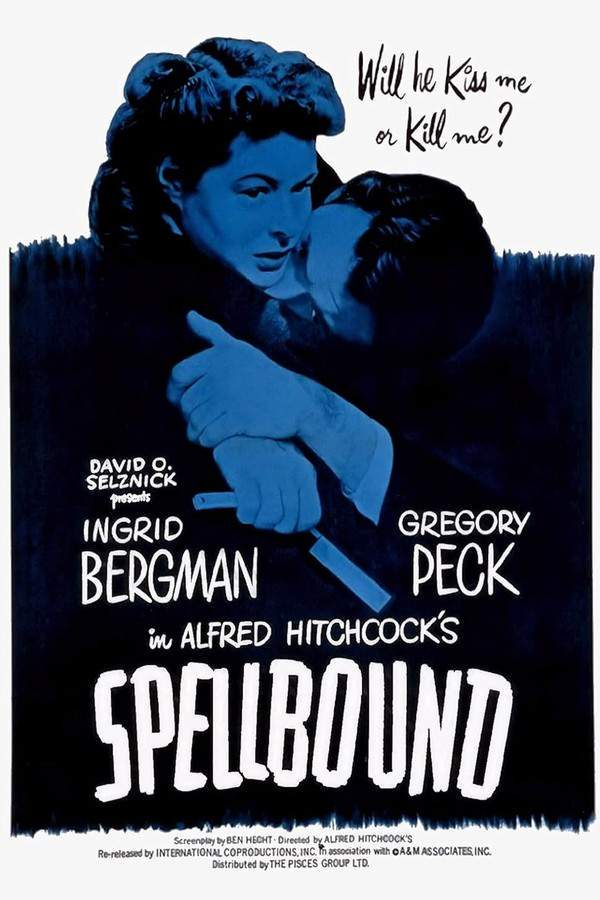
Spellbound (1945) movie poster

Plot Summary

Spellbound (1945) Plot Summary Explained

Release, runtime and language
1945 · 111 min · English
Directed by
Alfred Hitchcock
Starring
Norman Lloyd, Gregory Peck, Ingrid Bergman, Bill Goodwin, Donald Curtis, John Emery

A respected psychiatrist's life is disrupted by the arrival of a captivating stranger who assumes leadership of her Vermont psychiatric facility. As she attempts to understand his complex mind, she discovers a disturbing history of deception and a connection to a series of unsettling events. Together, they must confront a perilous investigation into a forgotten past, revealing secrets and facing danger as they navigate a landscape of murder and betrayal.

On this page (5)
  1. 1 What happens: full plot
  2. 2 Plot questions answered
  3. 3 Movie threads
  4. 4 Movies like Spellbound
  5. 5 Every angle

Full plot summary · contains spoilers

What Happens in Spellbound: Full Plot Summary

The whole story of Spellbound (1945) explained, from the opening scene to the final frame: every key event, every twist and what it all adds up to. Read it as a quick recap before the sequel, to check a scene you missed, or to finally understand what really happened.

At the Green Manors mental hospital situated in Vermont, the alluring yet intelligent psychoanalyst Constance Peterson (Ingrid Bergman) is renowned for her disinterest in the romantic pursuits of her male colleagues, focusing solely on her profession. The institution's director, the elderly Dr. Murchison (Leo G. Carroll), is facing an involuntary retirement due to an episode of nervous exhaustion, prompting the board to seek a replacement in the form of the distinguished Dr. Edwardes (Gregory Peck), known for his celebrated book on guilt complexes.

Upon Dr. Edwardes’ arrival, an undeniable chemistry sparks between him and Dr. Peterson. However, unsettling occurrences begin to unfold. During their first dinner together, he unexpectedly erupts when he observes Dr. Peterson sketching a swimming pool design on a napkin with her fork. As days progress, their relationship deepens, culminating in a heartfelt declaration of love. Yet, while they embrace, Dr. Edwardes has another alarming reaction to the parallel stripes on her robe. Soon after, he receives a sharp call concerning a distressed patient who attempted suicide in the operating room. While assisting, Dr. Edwardes suffers a serious panic attack and is escorted to his quarters.

As Dr. Peterson tends to him, she discovers a discrepancy: his signature in her borrowed book starkly contrasts with a note he previously wrote her. The man before her cannot be Dr. Edwardes. During their confrontation, he confesses he has no memory of his identity, revealing that he has murdered the genuine Dr. Edwardes and assumed his identity, holding onto only a cigarette case engraved with "J.B." Trusting him implicitly, Dr. Peterson vows to aid him in unraveling this enigma.

That night, he slips a letter under her door, asserting that he cannot get her involved in his troubles, professing his love as he departs for the Empire State Hotel in New York. The very next morning, police officers arrive at the hospital, alerted by Dr. Edwardes' secretary, who doubts the voice of the supposed Dr. Edwardes. After confirming the staff's suspicions, they visit Dr. Peterson, who remains unaware of his true identity, too scared to reveal the letter he left behind.

The following day, she travels to New York, eventually locating him after identifying his handwriting on hotel registration forms — he is now living under the name "John Brown." Empowered by her psychoanalytic insight, she commits to healing his amnesia. Although J.B. believes he may have killed the original Dr. Edwardes, Dr. Peterson persists in her belief of his innocence, even after recognizing burn marks on his hand that trigger fleeting yet traumatic memories.

In line for tickets at Grand Central Station, J.B. resorts to free association, requesting two tickets to Rome, Georgia, before realizing a policeman is observing them. Consequently, they pivot and board a train heading to Rochester, the hometown of Dr. Alex Brulov (Michael Chekhov), Dr. Peterson's former teacher and mentor.

While traveling, J.B. gradually recalls being shot down during an Army Medical Corps mission over Italy. Upon arriving in Rochester, they find Dr. Brulov absent but are soon interrupted by two policemen investigating Dr. Edwardes' disappearance. When Dr. Brulov finally enters, he expresses his aversion towards Dr. Edwardes, casting doubt over his methods. After the police leave, Dr. Peterson introduces J.B. as her husband, prompting a friendly but dubious reaction from Dr. Brulov regarding their situation.

That night, anxiety envelops J.B.. As he confronts a horrifying revelation about his past while mixing shaving soap, he becomes entranced once more and is discovered by Dr. Brulov, who silently sedates him. The following morning, Dr. Brulov discusses his suspicions of J.B.'s potential guilt, but Dr. Peterson ardently defends her faith in him, insisting she could never love a man capable of murder. Despite his initial skepticism, she persuades him to assist in J.B.'s recovery without contacting the authorities just yet.

Dr. Brulov begins therapy with J.B., revealing insights about dreams as clues to hidden truths. What follows is a captivating dream sequence crafted by surrealist artist Salvador Dali, featuring extensive psychoanalytic symbolism that uncovers deeper layers of J.B.’s psyche. As he navigates this dreamscape filled with enigmatic visions, the trio uncovers connections to J.B.'s trauma, leading him to recollect a pivotal ski trip with Dr. Edwardes.

Encouraged by Dr. Peterson, J.B. and she venture back to Gabriel Valley, hoping to unlock the secrets of that fateful trip. Facing his fears, he realizes he unwittingly caused his brother’s accidental death in his childhood. This realization allows him to regain his identity — he is John Ballantyne. Yet, just as he comes to terms with his past, authorities trail them to the valley, having discovered Dr. Edwardes' body with a bullet wound, implicating John. He faces arrest and conviction for murder, despite Dr. Peterson's protests of his innocence.

Returning to Green Manors, Dr. Peterson is soon approached by Dr. Brulov, offering his condolences. Meanwhile, Dr. Murchison, now reinstated as the hospital director, inadvertently hints he knew Dr. Edwardes, igniting suspicions in Dr. Peterson. She promptly confronts him, connecting the dots regarding John’s dream and realizing the casino symbolized both Green Manors and the setting of John’s lunch with Dr. Edwardes. Armed with this knowledge, she deduces that Dr. Murchison himself is the true murderer.

In a dramatic confrontation, Dr. Murchison threatens to kill her but, upon her departure, turns the gun on himself in a poignant moment that is visually represented by a vivid flash of red amid the black-and-white narrative.

Ultimately, the story culminates in a tender scene where Constance and John are set to embark on their honeymoon journey, with the wise Dr. Brulov bidding them well, leaving behind the ghost of a tumultuous past as they step towards a hopeful future.
Last updated: November 15, 2024 at 19:34

Was this helpful?

Plot questions answered

Spellbound Plot Explained: Your Questions Answered

The questions people ask most about Spellbound (1945): what happens in the confusing scenes, why the characters do what they do, the twists, hidden details and what the ending means. Each answer contains spoilers.

Q1

Why does Dr. Edwardes react to Dr. Peterson sketching a swimming pool on a napkin?

Dr. Edwardes experiences a panic attack because the swimming pool sketch triggers a repressed memory. He was shot down during an Army Medical Corps mission over Italy, where he crashed near water. This traumatic experience created an unconscious association with parallel lines and water, causing his violent reaction to both the napkin sketch and later the parallel stripes on Dr. Peterson's robe.

Foreshadowing: Earlier in the film, his first panic attack occurs when he receives news of a patient's suicide attempt in the operating room, but the swimming pool sketch is the first visual trigger connected to his wartime trauma.

  • amnesia trigger
  • wartime trauma
  • panic attack
  • swimming pool memory
Q2

Why did Dr. Murchison kill the real Dr. Edwardes?

Dr. Murchison killed Dr. Edwardes because he was being forced into involuntary retirement due to nervous exhaustion. When the board selected Dr. Edwardes as his replacement, Murchison saw his entire career and identity vanish. Rather than accept retirement, he murdered the new director to prevent his forced departure and maintain control over Green Manors.

Foreshadowing: Dr. Murchison's resentment is hinted at early when he is visibly unhappy about being replaced, and his later reinstatement as director after Edwardes' disappearance raises immediate suspicion.

  • motive
  • murder
  • replacement
  • forced retirement
  • career
Q3

How does John recover his identity and remember he is John Ballantyne?

John regains his memory through therapy with Dr. Brulov and a return to Gabriel Valley, where he confronts his repressed childhood trauma. During dream analysis, he recalls a pivotal ski trip with his brother, during which he inadvertently caused his brother's death. This traumatic memory was so painful it created his amnesia and made him assume a new identity. The confrontation with this guilt allows him to reclaim his true name: John Ballantyne.

Foreshadowing: The Salvador Dali dream sequence contains symbols of guilt and childhood imagery that point directly to the ski accident, with fragmented visions of a brother figure and mountainous landscapes.

  • amnesia
  • identity
  • childhood trauma
  • guilt
  • ski accident
  • brother death
Q4

How does Dr. Peterson deduce that Dr. Murchison is the real murderer?

Dr. Peterson realizes Murchison is the killer by connecting his accidental comment that he knew Dr. Edwardes with the symbolism in John's dream. The dream featured a casino that represented both Green Manors and the lunch location where Edwardes was murdered. Murchison's slip-up about knowing Edwardes, combined with his hostile reaction to the investigation and his sudden reinstatement as director, confirmed his guilt.

Foreshadowing: Murchison's knowledge of Edwardes is revealed when he inadvertently mentions knowing him, which shocks Peterson since she never mentioned this connection. His quick return to power after Edwardes' disappearance also signals his involvement.

  • deduction
  • investigation
  • casino symbol
  • Murchison guilt
  • revelation
Q5

What is the purpose of the surreal Salvador Dali dream sequence in the film?

The Dali dream sequence serves as a psychoanalytic tool to unlock John's repressed memories. Through surrealist imagery, falling pillars, giant eyes, geometric shapes, the dream reveals his buried guilt about causing his brother's death during a ski trip. The sequence functions as a visual representation of Freudian dream analysis, showing how the unconscious mind stores traumatic memories that the conscious mind cannot access.

Foreshadowing: Before the dream sequence, Dr. Brulov explains that dreams contain clues to hidden truths, preparing the viewer for the revelation that follows.

  • dream analysis
  • surrealism
  • psychoanalysis
  • memory recovery
  • symbolism
Q6

Who is John Brown and why does he assume Dr. Edwardes' identity?

John Brown is the amnesiac protagonist whose real name is John Ballantyne. After causing his brother's accidental death during a ski trip as a child, he developed such overwhelming guilt that he created a new identity to escape his trauma. When he encountered the real Dr. Edwardes, he killed him, likely in a confused, dissociative state, and assumed his identity, clinging only to a cigarette case engraved with "J.B." as his only connection to his true self.

Foreshadowing: His reactions to stimuli like the swimming pool sketch and parallel lines foreshadow his traumatic past, while his constant state of anxiety and memory gaps hint at deep psychological wounds.

  • amnesia
  • identity theft
  • John Brown
  • dissociation
  • trauma escape
Q7

Why does John become the prime suspect in Dr. Edwardes' murder?

John becomes the prime suspect because the police discover the real Dr. Edwardes' body with a bullet wound shortly after John regains his memory and identity. Since John had assumed Edwardes' identity and was the last person known to be with him, the circumstantial evidence points directly to him. The authorities track him to Gabriel Valley and arrest him for murder before the true culprit is revealed.

Foreshadowing: The police investigation that began early in the film, prompted by the secretary's suspicion about the impostor's voice, builds toward this moment of arrest.

  • arrest
  • bullet wound
  • evidence
  • suspicion
  • police investigation
Q8

What happens during Dr. Peterson's confrontation with Dr. Murchison?

During the confrontation, Dr. Murchison initially threatens to kill Dr. Peterson to prevent her from exposing his crime. However, when she leaves, he turns the gun on himself instead. The film visually represents this moment with a vivid flash of red amid the black-and-white cinematography, symbolizing both his guilt and the violence he commits against himself rather than face justice.

Foreshadowing: Murchison's nervous exhaustion earlier in the film and his forced retirement both hint at his psychological fragility and willingness to do anything to preserve his position.

  • confrontation
  • suicide
  • guilt
  • confession
  • climax
Q9

Why does Dr. Edwardes' secretary become suspicious of the impostor?

Dr. Edwardes' secretary becomes suspicious because she recognizes that the voice of the man claiming to be Dr. Edwardes does not match the real doctor's voice. This simple auditory clue triggers the police investigation into Edwardes' disappearance, leading the authorities to Green Manors and setting the plot in motion.

Foreshadowing: This detail emphasizes the importance of voice and identity throughout the film, themes that culminate in the revelation of John's true identity.

  • secretary
  • voice recognition
  • suspicion
  • police
  • identity
Q10

Why does John ask for tickets to Rome, Georgia during the train station scene?

During the Grand Central Station scene, John uses free association to unlock his memories. When asked for destinations, he initially says "Rome, Georgia", which sounds like "Rome, Italy", before correcting himself. This slip is significant because it connects to his wartime trauma of being shot down over Italy, revealing how his unconscious mind processes buried memories through wordplay and geographic associations.

Foreshadowing: This moment foreshadows the later revelation that John was an Army Medical Corps pilot shot down over Italy, making the Rome reference a critical early clue to his past.

  • free association
  • Rome Georgia
  • Italy
  • wartime
  • memory trigger

Movie threads

More Movies Like Spellbound, by Mood & Story

Curated lists built around what makes Spellbound tick: the same mood, the same kind of story or the same emotional payoff. Each list explains why these movies belong together.

Psychological Noir Movies like Spellbound

Thrillers where characters delve into the dangerous labyrinth of the human psyche. Explore movies like Spellbound that merge the moody suspense of film-noir with deep psychological investigation. If you liked the combination of a tense murder mystery with psychoanalysis and dream interpretation, you'll find similar stories here where the mind is the ultimate crime scene.

  • suspenseful
  • psychological
  • unsettling
  • cerebral
  • noir
  • paranoid
  • Tone: tense, psychological
  • Pacing: steady, analytical
Why these movies?

The story pattern: Stories in this thread typically follow a protagonist, often a doctor or detective, who must unravel a mystery rooted in a character's troubled psyche. The plot unfolds through analytical sessions, probing dialogue, and symbolic clues, leading to a revelation that resolves both the crime and the psychological wound.

Why they belong together: These movies are grouped by their shared atmosphere of intellectual suspense, their focus on mental processes like analysis and memory, and their noir-inspired visual style that reflects the characters' inner turmoil and moral ambiguity.

Amnesia Thrillers Similar to Spellbound

Suspenseful journeys where a character's lost memories hold the key to survival. Discover tense thrillers similar to Spellbound, where the main plot driver is a character's amnesia. If you enjoyed the high-stakes mystery of an amnesiac suspected of murder, these films explore the same compelling narrative of self-discovery amidst peril and deception.

  • suspenseful
  • anxious
  • paranoid
  • unsettling
  • mysterious
  • investigative
  • Tone: tense, paranoid
  • Pacing: steady, mysterious
Why these movies?

The story pattern: The narrative pattern involves a central character who awakens to a life they don't remember, surrounded by suspicion. The journey is a race against time to recover memories, often with the help of an ally, unlocking clues that expose a web of betrayal, crime, or trauma.

Why they belong together: Movies in this thread share the core premise of amnesia as a primary plot device, creating constant suspense and paranoia. They explore themes of identity, guilt, and truth, delivering a puzzle-like structure where the protagonist's mind is both the problem and the solution.

If you liked this

Movies Like Spellbound

Similar movies to Spellbound: the same genre, themes or kind of story. Each one comes with its own plot summary, timeline and ending explained.

Browse all movie summaries

Every angle

Spellbound (1945) Explained: Plot, Timeline & Characters

Everything about Spellbound in one place: what happens in the plot summary, the timeline in chronological order, the characters and meaning and a spoiler-free summary. What's After the Movie adds the cast, box office and post-credit scenes.

Coming soon on iOS and Android

The Plot Explained Movie Summary App

Plot summaries, endings explained and timelines on your phone. Catch up on any movie in minutes, save your favorites and never miss a twist again.

Be the first to know when we launch. Your email stays private, always.

Learn more about the app