Plot Explained Spoilers guaranteed!
Plot Explained

Browse by genre

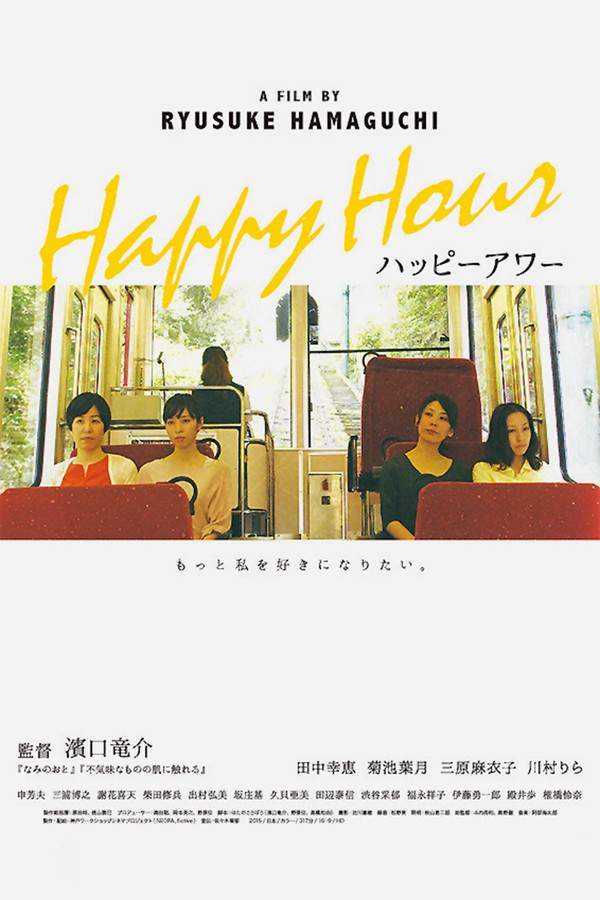
Happy Hour (2016) movie poster

Timeline

Happy Hour (2016) Timeline Explained – Every Event in Order

Release, runtime and language
2016 · 5 h 17 m · Portuguese
Directed by
Ryûsuke Hamaguchi
Starring
Sachie Tanaka, Hazuki Kikuchi, Maiko Mihara, Rira Kawamura, Hiromi Demura, Shoko Fukunaga

Four women, three married and one divorced, find comfort in their open and honest friendship. However, their bond is tested when one of them unexpectedly vanishes after a difficult experience. The remaining three women then embark on a deeply moving journey, exploring the complexities of their relationships and facing the uncertain paths that lie ahead for each of them.

On this page (5)
  1. 1 Events in order (14)
  2. 2 Timeline questions answered
  3. 3 Movie threads
  4. 4 Movies like Happy Hour
  5. 5 Every angle

14 events in order · contains spoilers

Happy Hour Timeline: Events in Chronological Order

Every key event of Happy Hour (2016) in order, scene by scene, with when and where it takes place. Use it to untangle flashbacks, time jumps and parallel storylines, to refresh your memory before the sequel or to find the exact scene you are thinking of.

  1. Jun's confession at Ukai's seminar

    At a New Age seminar in Kobe led by Ukai, Jun casually admits she has been having an affair and plans to divorce her husband. The confession rattles the four friends and prompts them to reassess their own lives and the foundations of their friendship.

    Where
    Kobe, seminar venue
  2. Jun's court appearance and emotional abuse admission

    In court, Jun concedes that Kohei did not physically abuse her, but says their marriage was emotionally and psychologically damaging. The hearing worsens when a tape reveals her infidelities, undercutting her portrayal as a victim and complicating the divorce case.

    Where
    Court, Kobe
  3. Kohei reveals Jun's pregnancy

    After the court session, Kohei discloses to the friends that Jun is pregnant with his child. The news adds tension to the group and further complicates the prospects of Jun's divorce.

    Where
    With friends in Kobe
  4. Jun flees by ferry to pursue divorce

    When progress stalls, Jun escapes to a ferry destination to be separated from Kohei long enough to trigger a divorce. Her disappearance leaves the group concerned and wondering about her safety.

    Where
    Ferry terminal
  5. Jun's shelter for divorcing women

    Jun is later described as being in a shelter that supports women trying to divorce their husbands. The place marks a temporary start to her uncertain future and distance from her friends.

    Where
    Shelter for women seeking divorce
  6. Akari's friction with Yuzuki at work

    Akari challenges a younger colleague, Yuzuki, showing little tolerance for mistakes. The tension underscores Akari's guarded approach to relationships and shows her reluctance to form close bonds at work.

    Where
    Hospital/workplace
  7. Akari breaks her leg after a fall

    During a tense moment at work, Akari reprimands Yuzuki and then suffers a fall down the stairs, breaking her leg. The accident forces her to slow down and reassess her life away from the office.

    Where
    Workplace/near hospital
  8. Art event, Ukai walk-out, and romantic entanglements

    At Fumi's art event, Ukai walks out before the scheduled interview with Kozue. Akari follows him to a club, where she meets Hinako, Ukai's sister; Hinako and Akari share a kiss, and Akari also kisses Ukai when he interrupts.

    Where
    Art event; nightclub
  9. Sakurako informs Daiki about Jun and the lovers' past; Daiki plans to run away

    Sakurako reveals to Daiki that Jun was the catalyst for her and Yoshihiko's affair, reshaping Daiki's view of his mother and his parents' past. He decides to run away with his girlfriend, but she stands him up, and Daiki ends up at the ferry where he encounters Jun and thanks her for his birth.

    Where
    Daiki's home; ferry
  10. Sakurako begins an affair; Yoshihiko's stoic reaction

    Sakurako starts a new affair and tells Yoshihiko about it. He reacts with quiet detachment, acknowledging the rift but remaining emotionally distant; a turning point in their marriage as problems mount.

    Where
    Sakurako's home
  11. Kozue and Takuya's tension; Kohei's interview changes dynamics

    During Kozue's short story reading, Kohei steps in as interviewer after Ukai walks out, altering how the group views Kohei and Jun's marriage. Kozue suggests the others are projecting their feelings onto Kohei, which strains friendships and heightens jealousy.

    Where
    Dinner with friends; reading event
  12. Takuya's and Kozue's closeness; Fumi's confrontation

    Kozue confesses her feelings for Takuya and spends the night with him after a dinner; Fumi confronts Takuya the next morning and breaks up. The revelation deepens Fumi's insecurities about her own marriage.

    Where
    On the road home or hotel; in the city
  13. Takuya's car accident and coma

    Shortly after the breakup, Takuya is involved in a serious car accident and is rushed to Akari's hospital, where he falls into a coma. The accident compounds the trauma among the group and leaves Fumi heartbroken.

    Where
    Akari's hospital
  14. Hospital rooftop talk and plans for another trip

    Fumi and Akari share a candid moment on the hospital roof, where they promise to make up and plan another trip with Sakurako and Jun. The scene reframes their friendship and hints at healing through shared experiences.

    Where
    Hospital rooftop

Last updated: October 09, 2025 at 16:13

Was this helpful?

Timeline questions answered

Happy Hour Timeline Explained: Your Questions Answered

When does it happen, and why in that order? The questions people ask about the chronology of Happy Hour (2016): time jumps, flashbacks, cause and effect between scenes and the correct order of events, each answered with spoilers.

Q1

Why does Jun disappear at the end of the film?

Jun escapes on a ferry to create enough physical distance from Kohei so that their marriage can be legally dissolved through abandonment. She ultimately goes to a shelter that supports women who are divorcing their husbands. Her disappearance is both a practical legal maneuver and a way to escape the emotional suffocation she described in court.

Foreshadowing: Jun's earlier confession at Ukai's seminar about seeking personal happiness foreshadows her willingness to take drastic action to free herself.

  • jun disappearance
  • ferry
  • divorce
  • kohei
  • shelter
Q2

Why is Jun's pregnancy significant to the divorce proceedings?

Kohei reveals Jun's pregnancy in court, which complicates the divorce because it introduces questions about custody, child support, and the nature of their relationship. The pregnancy also undermines Jun's portrayal of the marriage as entirely loveless, since she was willing to have a child with Kohei at some point.

Foreshadowing: Jun mentions in court that Kohei's lack of interest in sex prevented her from pursuing her dream of having a baby, hinting at the complex emotional dynamics that led to the pregnancy.

  • jun pregnancy
  • kohei
  • court hearing
  • divorce
Q3

Why does Akari kiss Hinako and then Ukai at the art event?

Akari follows Ukai to a club after he walks out of the art event, where she meets Hinako, his sister. The conversation with Hinako, who is also struggling with emotional issues, triggers Akari's own suppressed feelings. She kisses Hinako as a moment of emotional release, and when Ukai interrupts, she kisses him too, showing how her guarded exterior cracks under unexpected human connection.

Foreshadowing: Earlier scenes showing Akari's strict emotional control and her friction with Yuzuki at work establish her pattern of suppressing vulnerability, making this emotional breakdown more significant.

  • akari kiss
  • hinako
  • ukai
  • emotional release
  • art event
Q4

Why does Sakurako start an affair after Daiki's situation?

Sakurako's decision to have an affair stems from years of emotional neglect and the humiliation of being forced to deliver money for her son's girlfriend's abortion. When Yoshihiko orders her to apologize to the girl's family, it represents another instance where her own feelings are secondary. The affair becomes her way of claiming personal happiness, similar to Jun's journey, though Sakurako chooses to confess to her husband.

Foreshadowing: Mitsu's warning about Daiki's relationship and the subsequent crisis reveal the cracks in Sakurako's marriage that have been building throughout the film.

  • sakurako affair
  • yoshihiko
  • daiki
  • abortion
  • marriage crisis
Q5

What causes Takuya's car accident after the breakup?

Takuya gets into a serious car accident shortly after Fumi breaks up with him when she discovers his affair with Kozue. The accident leaves him in a coma, and he is taken to Akari's hospital. While the film doesn't explicitly state the cause, the timing suggests the emotional turmoil of the breakup contributed to the accident.

Foreshadowing: The tension at Kozue's reading event, where Kohei steps in as interviewer after Ukai leaves, hints at the unstable emotional state of the group leading up to these events.

  • takuya accident
  • coma
  • fumi
  • kozue
  • hospital
Q6

Why does Fumi blame herself for Takuya's accident?

Fumi feels guilty because she ended her relationship with Takuya after discovering his affair with Kozue, and shortly afterward, he was in a car accident. On the hospital rooftop, she admits to Akari that she blames herself for the pain around Takuya, believing her breakup may have contributed to his accident.

Foreshadowing: Fumi's earlier insecurities about her marriage and her jealousy of Kozue build toward this moment of self-blame.

  • fumi guilt
  • takuya coma
  • self-blame
  • hospital rooftop
Q7

What is the shelter where Jun goes at the end of the film?

Jun goes to a shelter that supports women who are seeking to divorce their husbands. The shelter represents a place of temporary refuge and independence, where women can escape unhappy marriages and rebuild their lives. Kohei reveals this location to the friends, indicating he knows Jun is safe but choosing not to pursue her.

Foreshadowing: Jun's court testimony about emotional and psychological suffocation in her marriage establishes why she would seek such a supportive environment.

  • jun shelter
  • divorce support
  • women shelter
  • independence
Q8

Why does Akari's relationship with Yuzuki change after her leg injury?

After Akari breaks her leg following her confrontation with Yuzuki at work, she is forced to slow down and reassess her life. The accident removes her from the work environment where she could maintain emotional distance. When she returns, her encounters with Hinako and Ukai have already begun opening her up, allowing her to reconnect with Yuzuki with warmth rather than her previous distance.

Foreshadowing: The moment Akari breaks her leg directly follows her harsh treatment of Yuzuki, making her subsequent change more meaningful.

  • akari yuzuki
  • hospital relationship
  • coworker
  • emotional change
Q9

Why does Yoshihiko react so stoically when Sakurako confesses her affair?

Yoshihiko remains emotionally distant and stoic when Sakurako tells him about her affair, simply acknowledging it and leaving for work. His reaction reflects the emotional distance that has characterized their marriage. However, the film shows him breaking down in tears on his walk to work, revealing that his calm exterior conceals deep pain.

Foreshadowing: Earlier scenes showing Yoshihiko's focus on work and his emotional distance establish his pattern of avoiding confrontation.

  • yoshihiko reaction
  • sakurako confession
  • emotional distance
  • marriage
Q10

What impact does the New Age seminar have on the four women?

Ukai's seminar serves as the catalyst for Jun's confession about her affair and divorce plans, which shocks the other three women. The seminar forces all four friends to reassess their own lives and the foundations of their friendships, prompting the emotional unraveling and reconfiguration that follows throughout the film.

Foreshadowing: The film's structure uses this seminar as the inciting incident that sets all the character journeys in motion.

  • ukai seminar
  • kobe
  • confession
  • new age
  • character catalyst
Q11

Why does Fumi end her relationship with Takuya?

Fumi breaks up with Takuya after discovering that he spent the night with Kozue, a young writer he works with. Kozue had confessed her feelings for Takuya after a dinner, and Fumi's suspicions were confirmed. The affair triggers Fumi's deep insecurities about her marriage, which she had long suspected was more about appearances than genuine connection.

Foreshadowing: Fumi's earlier anxiety about Kozue and her suspicion that Takuya was emotionally distant foreshadow this confrontation.

  • fumi breakup
  • takuya kozue
  • affair
  • marriage insecurity
Q12

Why does Daiki try to run away with his girlfriend?

Daiki decides to run away with his girlfriend after learning that Jun was the catalyst for his parents' affair, which reshapes his understanding of his mother's past. However, his girlfriend stands him up at the ferry, and instead, Daiki encounters Jun and thanks her for his birth and for helping shape his life, bringing closure to that relationship.

Foreshadowing: Sakurako's revelation about Jun being the reason for her affair directly triggers Daiki's desire to leave.

  • daiki run away
  • ferry
  • girlfriend
  • jun
  • teenage rebellion
Q13

What is the significance of the women planning another trip at the end?

The women decide to plan another trip together after all the turmoil, representing a renewed commitment to their friendship despite their individual struggles. Jun is still absent, Sakurako's marriage is strained, Fumi's husband is in a coma, but the group chooses solidarity over isolation. This ending provides a thread of hopeful connection amid unresolved pain.

Foreshadowing: Earlier in the film, a trip organized by Jun helps rekindle and re-contextualize their friendship, establishing travel as a symbol of their bond.

  • trip planning
  • friendship renewal
  • solidarity
  • ending hope

Movie threads

More Movies Like Happy Hour, by Mood & Story

Curated lists built around what makes Happy Hour tick: the same mood, the same kind of story or the same emotional payoff. Each list explains why these movies belong together.

Movies about complex female friendship like Happy Hour

Stories exploring the deep, supportive, and sometimes painful ties between women. If you liked the deep exploration of female bonds in Happy Hour, this collection features similar movies about complex female friendship. Discover dramas and character studies where women's relationships are tested by adulthood struggles, offering intimate and emotionally resonant stories.

  • intimate
  • emotionally raw
  • contemplative
  • resilient
  • somber
  • reflective
  • Tone: melancholic, intimate, emotionally raw
  • Pacing: slow, character-driven
Why these movies?

The story pattern: Narratives in this thread typically follow a group of women or a close-knit female duo as they navigate personal and shared crises. The plot is often character-driven, unfolding through quiet conversations and significant life events that reveal the strength and fragility of their connection.

Why they belong together: Movies are grouped here for their shared focus on the nuanced, authentic portrayal of female relationships. They share a contemplative mood, emotionally heavy themes, and a narrative style that prioritizes character interiority and relational dynamics over fast-paced action.

Slow-burn melancholic dramas like Happy Hour

Character studies where emotional pain unfolds gradually, leading to personal reckoning. Fans of the contemplative, melancholic pace of Happy Hour will find similar slow-burn dramas here. These movies feature emotionally heavy journeys, complex character studies, and mixed endings, perfect for viewers who enjoy thoughtful, immersive storytelling.

  • melancholic
  • contemplative
  • slow burn
  • somber
  • reflective
  • emotionally dense
  • Tone: melancholic, contemplative, somber
  • Pacing: slow, observational, lingering
Why these movies?

The story pattern: The narrative pattern involves a gradual unfolding of emotional truth, often without dramatic climaxes. Characters spend much of the story in a state of reflection or quiet crisis, with the plot advancement secondary to the exploration of their inner lives and nuanced relationships.

Why they belong together: These films are united by a specific blend of slow pacing, melancholic tone, and complex emotional weight. They create a similarly immersive, reflective viewing experience where the audience is invited to sit with the characters' subtle pains and quiet moments of realization.

If you liked this

Movies Like Happy Hour

Similar movies to Happy Hour: the same genre, themes or kind of story. Each one comes with its own plot summary, timeline and ending explained.

Browse all movie summaries

Every angle

Happy Hour (2016) Explained: Plot, Timeline & Characters

Everything about Happy Hour in one place: what happens in the plot summary, the timeline in chronological order, the characters and meaning and a spoiler-free summary. What's After the Movie adds the cast, box office and post-credit scenes.

Coming soon on iOS and Android

The Plot Explained Movie Summary App

Plot summaries, endings explained and timelines on your phone. Catch up on any movie in minutes, save your favorites and never miss a twist again.

Be the first to know when we launch. Your email stays private, always.

Learn more about the app