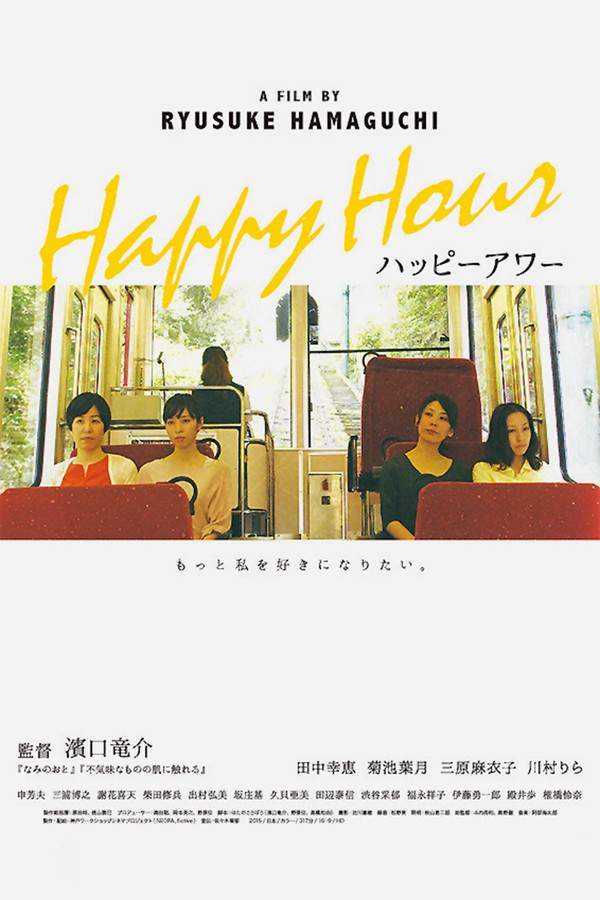
The film follows the lives and loves of four middle-class, thirty-seven-year-old women who are friends and who live in Kobe: unemployed Jun, housewife Sakurako, divorced nurse Akari, and married arts administrator Fumi. After attending a seminar led by a New Age communications guru, Ukai, Jun casually reveals that she has been having an affair with a younger man and plans to divorce her husband. The others are shocked, some more hurt than others, by her secrecy. Over time, especially during a trip Jun organizes, they rekindle and re-contextualize their friendship. The three friends attend Jun's court hearing to support her; the experience reshapes their perceptions of their own lives and relationships in a web of intertwined stories that blur the line between their private battles and the public face of adulthood.
Jun is a free-spirited, highly independent woman who has chosen to pursue personal happiness even as she confronts a failing marriage. She is married to a biologist, Kohei, who opposes the divorce and believes he can persuade her to stay. In court, Jun concedes that Kohei never hit her, but argues that their marriage was emotionally and psychologically stifling. She explains that she did her best to be a good wife, yet Kohei’s emotional distance and his lack of interest in sex kept her from pursuing the dream of having a baby. Her honesty in the courtroom doesn’t win sympathy; the tapes reveal her infidelity and her entanglement with a younger man, making her seem less like a victim and more like a woman who chose to break away. Kohei, meanwhile, reveals that she is pregnant, a twist that complicates the divorce proceedings. As tensions rise, Jun’s attempts to provoke Kohei into violence fail, and Kohei makes it clear he will continue pursuing the divorce. Eventually, Jun escapes on a ferry to an unknown destination, hoping distance will force a dissolution of the marriage. Jun vanishes for the remainder of the film, and Kohei reveals that she has sought shelter in a place that supports women who are divorcing their husbands.
Akari is the toughest, most no-nonsense member of the group, a nurse who chafes at work alongside a younger, less experienced colleague, Yuzuki. She guards her emotions closely, yet she pours energy into nurturing her friends. Her path toward a meaningful relationship proves difficult; a doctor at the hospital she works at tests the waters with interest, but she rebuffs him. At an art event hosted by Fumi, Akari encounters a spontaneous moment when a star of the show, Kozue, draws Ukai away, and Hinako, Ukai’s sister, crosses paths with Akari. A later, pivotal moment transpires when Hinako and Akari share a heartfelt conversation that leads to a spontaneous kiss between Hinako and Akari, followed by Akari kissing Ukai when he interrupts them. This cascade of encounters shakes Akari’s guarded stance and shifts her connections with Yuzuki back at work; she begins to reconnect with her colleague with warmth rather than distance. Akari ultimately returns to her duties, and her relationship with Yuzuki evolves into a more supportive, if still cautious, dynamic.
Sakurako is the most emotional of the quartet, married to overworked salaryman Yoshihiko, and they share a teenage son, Daiki, while living under the same roof as Yoshihiko’s mother, Mitsu. Mitsu warns them about Daiki’s relationship with a girl, but the warning proves prophetic when Daiki reveals that he needs money for the girl’s abortion. Yoshihiko orders Sakurako to deliver the money and to apologize to the girl’s family, a request that humiliates Sakurako and tests their partnership. Mitsu, stepping in, helps to bridge the widening gap between Sakurako and Yoshihiko, and Daiki’s revelation about his father’s and mother’s bonds deepens Sakurako’s struggle to protect her family while seeking her own happiness. Daiki later tries to run away with his girlfriend on the ferry, but the girl stands him up; he arrives to say goodbye to Jun, thanking her for his birth and for helping shape his life. Back home, Sakurako’s disappointment with Yoshihiko grows into something more self-directed: she embarks on an affair of her own. When she confesses to Yoshihiko that she slept with another man, he remains distant and stoic, leaving for work as she carries on with the day, which culminates in a moment of quiet, unspoken pain as Yoshihiko breaks down in tears on his walk to work.
Fumi is deeply anxious about her marriage to Takuya, an editor who works with Kozue, a young writer whose presence stirs insecurities in Fumi. The underlying tension intensifies as Fumi suspects that their union is more about appearances than shared trust. The dinner with Kohei and Kozue exposes how others may misread Jun’s feelings and how Kozue herself feels entitled to claim Takuya’s attention. Kozue bluntly suggests that the other friends are projecting their own emotions onto Kohei and that they do not truly understand Jun’s situation. The tension peaks when Takuya’s affection for Kozue becomes evident, prompting Fumi to end the relationship. Takuya apologizes and leaves, but a car accident soon after leaves him in a coma and under the care of Akari in the hospital. Fumi experiences a painful mix of guilt and fear as she sits by his side; the event forces her to confront the fragility of her marriage. After a quiet moment on a hospital roof with Akari, where Fumi admits that she blames herself for the pain around Takuya, she decides to join the others in planning another trip together, a step toward rebuilding the bonds of their friendship and looking toward the future.
The film uses the intertwined lives of these four women to explore how friendship can illuminate difficult choices, and how the pursuit of personal happiness often comes with emotional costs. As each woman navigates heartbreak, resilience, and evolving desires, the group’s bond is tested and ultimately redefined. The climactic thread of Jun’s unresolved absence and the ongoing impact of the court case serve as a catalyst for both individual growth and a renewed sense of solidarity among the friends. In the end, they choose to lean on one another and to plan another shared journey, signaling that while their paths may diverge, their connection remains a central, guiding force in their lives.