Plot Explained Spoilers guaranteed!
Plot Explained

Browse by genre

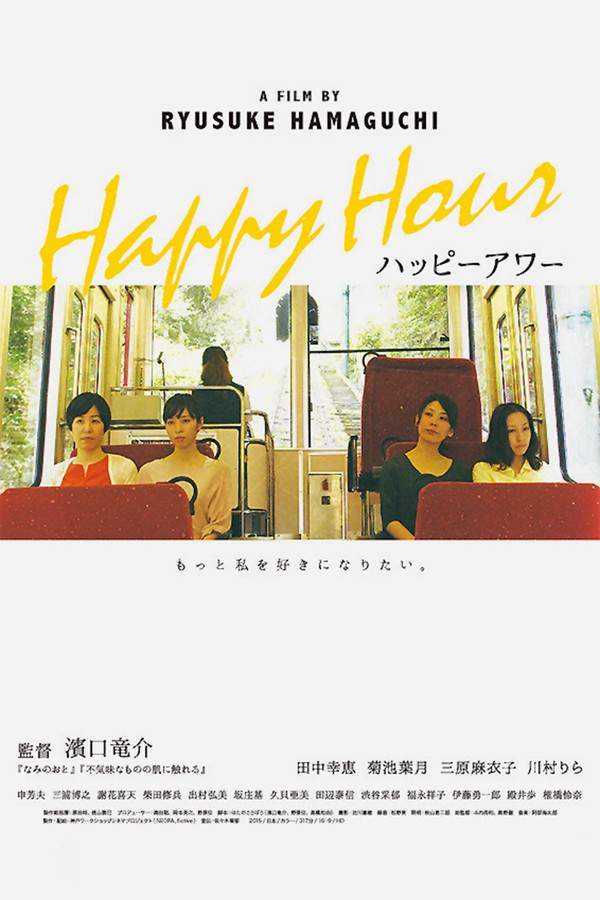
Happy Hour (2016) movie poster

Characters & Themes

Happy Hour (2016) Characters, Setting & Themes Explained

Release, runtime and language
2016 · 5 h 17 m · Portuguese
Directed by
Ryûsuke Hamaguchi
Starring
Sachie Tanaka, Hazuki Kikuchi, Maiko Mihara, Rira Kawamura, Hiromi Demura, Shoko Fukunaga

Four women, three married and one divorced, find comfort in their open and honest friendship. However, their bond is tested when one of them unexpectedly vanishes after a difficult experience. The remaining three women then embark on a deeply moving journey, exploring the complexities of their relationships and facing the uncertain paths that lie ahead for each of them.

On this page (7)
  1. 1 Characters explained (4)
  2. 2 Where & when it takes place
  3. 3 Themes & meaning (3)
  4. 4 Character & meaning questions
  5. 5 Movie threads
  6. 6 Movies like Happy Hour
  7. 7 Every angle

4 main characters · contains spoilers

Happy Hour Characters Explained: Who Is Who

The main characters of Happy Hour (2016), heroes and villains: what drives them, how they change over the course of the story and what each of them reveals about the film's bigger ideas.

  • Jun

    Free-spirited 37-year-old who is married but embarks on an affair and a divorce. She traverses emotional and psychological abuse in her marriage, seeking independence and a new path. Her actions test the boundaries of friendship as the group supports her while confronting their own desires.

    • 🗨️ Relationships
    • 💔 Infidelity
    • 🕊️ Independence
  • Akari

    A tough, no-nonsense nurse who struggles with intimate relationships but is loyal to her friends. She trains a younger colleague, navigates work pressures, and finds unexpected connection that evolves into a potential romance. Her arc emphasizes resilience and warmth within a firmly realistic persona.

    • 🧭 Career
    • 💔 Romance
    • 🤝 Friendship
  • Sakurako

    The most emotional of the group, Sakurako wrestles with her marriage, her son's troubles, and later an affair that challenges her sense of loyalty. She bonds with her mother-in-law Mitsu and grows through shared vulnerability with her friends.

    • 💞 Family
    • 🧭 Boundaries
    • 🪷 Growth
  • Fumi

    An arts administrator whose insecurity about her marriage deepens as she confronts love triangles and social expectations. She hosts events that become pressure points, ultimately impacting her relationship with her husband and friends.

    • 🎭 Art world
    • 💔 Relationships
    • 🗣️ Communication

Last updated: October 03, 2025 at 19:59

Was this helpful?

Setting

Where and When Does Happy Hour Take Place?

The setting of Happy Hour (2016): the year and time period, the places and locations, and how they shape the characters, the mood and the tension of the story.

Time period

Present day (early 2010s)

The story unfolds in contemporary Japan, a period marked by shifting gender roles and evolving relationship norms. The characters navigate careers, family obligations, and the search for personal fulfillment in a city that blends tradition and modernity. The timeframe situates the drama in a recent past that resonates with audiences familiar with modern urban life.

Location

Kobe, Japan

Kobe is a port city on Japan's southern Honshu island, known for its cosmopolitan atmosphere and scenic harbor. The film uses Kobe as a backdrop for the tightly-knit but imperfect friendships among four middle-class women. Its modern urban landscape mirrors the personal journeys of its characters, blending traditional expectations with contemporary independence.

  • 🏙️ City life
  • 🚢 Port city
  • 🗺️ Urban culture

Last updated: October 03, 2025 at 19:59

Was this helpful?

3 major themes

Happy Hour Meaning: Themes & Message Explained

What is Happy Hour (2016) really about? The emotional, social and philosophical themes the film keeps returning to, its symbolism and the message beneath the surface.

  • Independence

    The film centers on women reclaiming agency over their lives, choosing to pursue personal happiness even when it means breaking from marriage or societal expectations. Jun's decision to seek a divorce and redefine her path anchors the group’s conversations about self-determination. The narrative treats autonomy as a gradual, sometimes painful, process that unfolds through small acts and shared reflections. Friendship acts as both catalyst and support in this journey toward independence.

  • Marital Struggles

    A core thread traces the fragility of marriages under emotional strain, jealousy, and mismatched desires. The women encounter emotional abuse, infidelity, and the tension between keeping up appearances and seeking authenticity. The court scene and private confrontations reveal how love can coexist with dissatisfaction and how difficult it is to change a stagnant relationship. The film presents marriage as a complex social contract rather than a simple path to happiness.

  • Friendship

    Friendship provides a lifeline that sustains the women through betrayals, jealousy, and heartbreak. The quartet’s bond evolves as secrets surface and loyalties shift, forcing each to reevaluate what she wants from life. Their trips, conversations, and support rituals become moments of collective insight. Ultimately, the film frames sisterhood as a mirror that reveals both strength and vulnerability.

Last updated: October 03, 2025 at 19:59

Was this helpful?

Character & theme questions

Happy Hour Characters & Meaning: Your Questions Answered

The questions people ask about Happy Hour (2016): who the characters really are, their relationships, what the symbols mean, where it takes place and what the movie is really about. Each answer contains spoilers.

Q1

Where is Happy Hour set?

Happy Hour takes place in Kobe, a port city on Japan's southern Honshu island. The film uses Kobe's cosmopolitan atmosphere and scenic harbor as a backdrop for the tightly-knit but imperfect friendships among four middle-class women. The modern urban landscape mirrors the personal journeys of its characters, blending traditional expectations with contemporary independence.

  • kobe japan
  • setting
  • location
  • japanese city
  • port city
Q2

What kind of city is Kobe in the film?

Kobe serves as a modern urban environment that blends tradition and contemporary independence. The city's cosmopolitan atmosphere reflects the characters' own struggles between maintaining societal expectations and pursuing personal fulfillment. Its scenic harbor and urban culture create a backdrop that contrasts the women's internal conflicts with external beauty.

  • kobe
  • urban setting
  • city life
  • modern japan
  • cosmopolitan
Q3

When does Happy Hour take place?

The story unfolds in present day (early 2010s) Japan, a period marked by shifting gender roles and evolving relationship norms. The characters navigate careers, family obligations, and the search for personal fulfillment in this contemporary context. This timeframe situates the drama in a recent past that resonates with audiences familiar with modern urban life.

  • time period
  • contemporary japan
  • early 2010s
  • modern era
  • setting time
Q4

What are the main themes of Happy Hour?

Happy Hour explores three interconnected themes: independence, marital struggles, and friendship. The film centers on women reclaiming agency over their lives, choosing to pursue personal happiness even when it means breaking from marriage or societal expectations. It also traces the fragility of marriages under emotional strain, jealousy, and mismatched desires. Friendship provides a lifeline that sustains the women through betrayals, jealousy, and heartbreak.

  • themes
  • independence
  • marriage
  • friendship
  • women's stories
  • japanese drama
Q5

How does Happy Hour explore independence?

The film centers on women reclaiming agency over their lives, with Jun's decision to seek a divorce and redefine her path anchoring the group's conversations about self-determination. The narrative treats autonomy as a gradual, sometimes painful process that unfolds through small acts and shared reflections. Friendship acts as both catalyst and support in this journey toward independence.

  • independence
  • self-determination
  • divorce
  • autonomy
  • women's agency
Q6

How does Happy Hour portray marriage?

Happy Hour presents marriage as a complex social contract rather than a simple path to happiness. The film traces the fragility of marriages under emotional strain, jealousy, and mismatched desires. The women encounter emotional abuse, infidelity, and the tension between keeping up appearances and seeking authenticity. The court scene and private confrontations reveal how love can coexist with dissatisfaction.

  • marriage
  • marital struggles
  • infidelity
  • emotional abuse
  • relationships
Q7

What role does friendship play in Happy Hour?

Friendship provides a lifeline that sustains the women through betrayals, jealousy, and heartbreak. The quartet's bond evolves as secrets surface and loyalties shift, forcing each to reevaluate what she wants from life. Their trips, conversations, and support rituals become moments of collective insight. The film frames sisterhood as a mirror that reveals both strength and vulnerability.

  • friendship
  • sisterhood
  • women bonds
  • friendship support
  • female relationships
Q8

Who are the main characters in Happy Hour?

The film follows four women: Jun, a free-spirited 37-year-old who divorces after experiencing emotional and psychological abuse in her marriage; Akari, a tough nurse who struggles with intimate relationships but remains loyal to her friends; Sakurako, the most emotional of the group who wrestles with her marriage and her son's troubles; and Fumi, an arts administrator whose insecurity about her marriage deepens as she confronts love triangles and social expectations.

  • jun
  • akari
  • sakurako
  • fumi
  • main characters
  • four women
  • cast
Q9

Who is Jun in Happy Hour?

Jun is a free-spirited 37-year-old who is married but embarks on an affair and ultimately a divorce. She traverses emotional and psychological abuse in her marriage, seeking independence and a new path. Her actions test the boundaries of friendship as the group supports her while confronting their own desires. Her journey anchors the film's exploration of self-determination.

  • jun
  • protagonist
  • divorce
  • independence
  • emotional abuse
Q10

Who is Akari in Happy Hour?

Akari is a tough, no-nonsense nurse who struggles with intimate relationships but remains fiercely loyal to her friends. She trains a younger colleague, navigates intense work pressures, and finds an unexpected connection that evolves into a potential romance. Her arc emphasizes resilience and warmth within a firmly realistic persona.

  • akari
  • nurse
  • career woman
  • relationships
  • resilience
Q11

Who is Sakurako in Happy Hour?

Sakurako is the most emotional of the group, wrestling with her marriage, her son's troubles, and later an affair that challenges her sense of loyalty. She bonds with her mother-in-law Mitsu and grows through shared vulnerability with her friends. Her storyline explores the tension between emotional openness and marital commitment.

  • sakurako
  • marriage struggles
  • motherhood
  • affair
  • emotional character
Q12

Who is Fumi in Happy Hour?

Fumi is an arts administrator whose insecurity about her marriage deepens as she confronts love triangles and social expectations. She hosts events that become pressure points, ultimately impacting her relationship with her husband and friends. Her arc highlights the tension between professional success and personal fulfillment.

  • fumi
  • arts administrator
  • marriage insecurity
  • social expectations
  • love triangle
Q13

What is the emotional tone of Happy Hour?

The film carries a predominantly melancholic tone stemming from pervasive themes of disillusionment, unspoken pain, and the quiet costs of seeking happiness. While the subject matter is emotionally heavy, the film's slow, observational pacing prevents it from feeling overwhelmingly intense. The mixed ending feel results from varied outcomes, Jun's disappearance remains unresolved, Sakurako's marriage is in silent pain, Fumi faces an uncertain future, but the group's decision to plan another trip provides hopeful solidarity.

  • emotional tone
  • melancholic
  • pacing
  • ending
  • emotional weight

Movie threads

More Movies Like Happy Hour, by Mood & Story

Curated lists built around what makes Happy Hour tick: the same mood, the same kind of story or the same emotional payoff. Each list explains why these movies belong together.

Movies about complex female friendship like Happy Hour

Stories exploring the deep, supportive, and sometimes painful ties between women. If you liked the deep exploration of female bonds in Happy Hour, this collection features similar movies about complex female friendship. Discover dramas and character studies where women's relationships are tested by adulthood struggles, offering intimate and emotionally resonant stories.

  • intimate
  • emotionally raw
  • contemplative
  • resilient
  • somber
  • reflective
  • Tone: melancholic, intimate, emotionally raw
  • Pacing: slow, character-driven
Why these movies?

The story pattern: Narratives in this thread typically follow a group of women or a close-knit female duo as they navigate personal and shared crises. The plot is often character-driven, unfolding through quiet conversations and significant life events that reveal the strength and fragility of their connection.

Why they belong together: Movies are grouped here for their shared focus on the nuanced, authentic portrayal of female relationships. They share a contemplative mood, emotionally heavy themes, and a narrative style that prioritizes character interiority and relational dynamics over fast-paced action.
Slow-burn melancholic dramas like Happy Hour

Character studies where emotional pain unfolds gradually, leading to personal reckoning. Fans of the contemplative, melancholic pace of Happy Hour will find similar slow-burn dramas here. These movies feature emotionally heavy journeys, complex character studies, and mixed endings, perfect for viewers who enjoy thoughtful, immersive storytelling.

  • melancholic
  • contemplative
  • slow burn
  • somber
  • reflective
  • emotionally dense
  • Tone: melancholic, contemplative, somber
  • Pacing: slow, observational, lingering
Why these movies?

The story pattern: The narrative pattern involves a gradual unfolding of emotional truth, often without dramatic climaxes. Characters spend much of the story in a state of reflection or quiet crisis, with the plot advancement secondary to the exploration of their inner lives and nuanced relationships.

Why they belong together: These films are united by a specific blend of slow pacing, melancholic tone, and complex emotional weight. They create a similarly immersive, reflective viewing experience where the audience is invited to sit with the characters' subtle pains and quiet moments of realization.

If you liked this

Movies Like Happy Hour

Similar movies to Happy Hour: the same genre, themes or kind of story. Each one comes with its own plot summary, timeline and ending explained.

Browse all movie summaries

Every angle

Happy Hour (2016) Explained: Plot, Timeline & Characters

Everything about Happy Hour in one place: what happens in the plot summary, the timeline in chronological order, the characters and meaning and a spoiler-free summary. What's After the Movie adds the cast, box office and post-credit scenes.

Coming soon on iOS and Android

The Plot Explained Movie Summary App

Plot summaries, endings explained and timelines on your phone. Catch up on any movie in minutes, save your favorites and never miss a twist again.

Be the first to know when we launch. Your email stays private, always.

Learn more about the app