Plot Explained Spoilers guaranteed!
Plot Explained

Browse by genre

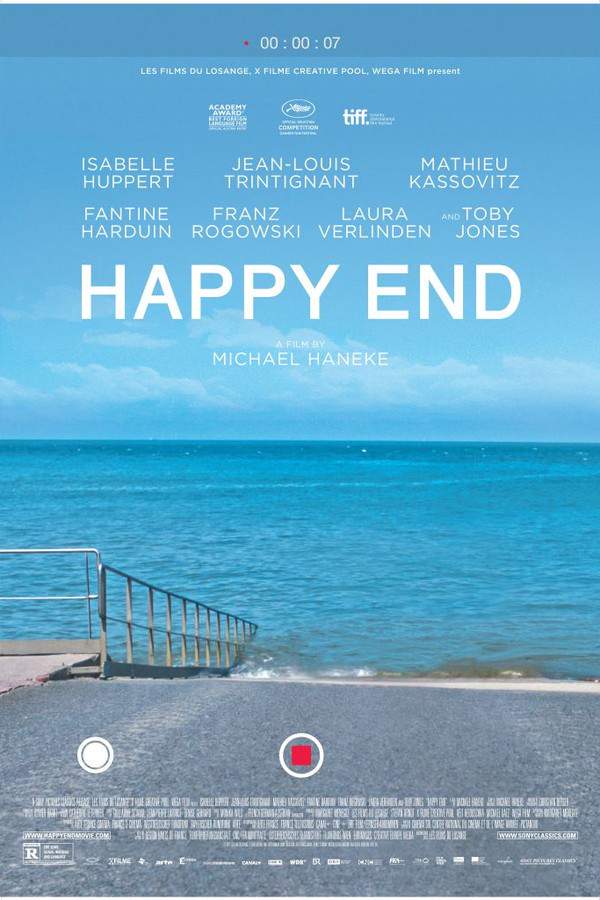
Happy End (2017) movie poster

Plot Summary

Happy End (2017) Plot Summary Explained

Release, runtime and language
2017 · 107 min · French
Echo score 65
Loading streaming availability…
Directed by
Michael Haneke
Starring
Toby Jones, Jean-Louis Trintignant, Isabelle Huppert, Aurélia Petit, Franz Rogowski, Laura Verlinden
Budget
$12M

A middle-class family living in Calais experiences a series of personal challenges, seemingly unaware of the difficult circumstances faced by those around them. Just beyond their home lies a crowded refugee camp, a stark reminder of the precariousness of hope and the shared vulnerability of humanity. The film explores themes of privilege, empathy, and the complexities of modern life.

On this page (6)
  1. 1 Where to watch
  2. 2 What happens: full plot
  3. 3 Plot questions answered
  4. 4 Movie threads
  5. 5 Movies like Happy End
  6. 6 Every angle
Loading streaming availability…

Full plot summary · contains spoilers

What Happens in Happy End: Full Plot Summary

The whole story of Happy End (2017) explained, from the opening scene to the final frame: every key event, every twist and what it all adds up to. Read it as a quick recap before the sequel, to check a scene you missed, or to finally understand what really happened.

The story opens with a series of unsettling clips secretly recorded on a smartphone by a teenager named Eve Laurent, played by Fantine Harduin. Through these videos and overlaid text messages, Eve expresses a deep-seated resentment toward her mother, labeling her as selfish and uncaring. Her descent into darkness is first illustrated when she feeds a sedative to her pet hamster, resulting in its death. The sequence culminates in a chilling final clip showing Eve's mother unconscious, accompanied by Eve's admission that she had poisoned her mother with sedatives as well.

The narrative then shifts to security camera footage capturing a violent accident at a construction site. This firm is owned by the formidable Anne Laurent, played by Isabelle Huppert. Anne is depicted during a family dinner at their expansive mansion in Calais, where the family dynamics are strained and complex. Present at the table is her father, Georges Laurent, played by Jean-Louis Trintignant, who is suffering from the debilitating effects of dementia; her son, Pierre, played by Franz Rogowski, who struggles with a severe drinking problem and works for the family business; and her brother, Thomas Laurent, played by Mathieu Kassovitz, a surgeon, who is accompanied by his wife, Anaïs, played by Laura Verlinden. It is revealed that the construction accident has left a worker critically injured and unlikely to survive.

While her mother remains hospitalized, Eve moves in with her father's side of the family. She quickly becomes suspicious that her father is unfaithful. While spending time at the beach, Eve overhears Thomas talking on his cellphone to another woman, leading her to confront him and ask if he still truly loves Anaïs.

Meanwhile, the external pressures on the family mount. Pierre travels to an apartment building in the banlieue, where he is intercepted and brutally beaten by a young man. This attacker is later identified as the son of the worker injured at the construction site. Terrified and wounded, Pierre flees the mansion to hide in a vacant apartment, where he is eventually discovered by Anne. A heated argument ensues; Anne berates Pierre for his alcoholism and his lack of professionalism at the firm. She coldly informs him that if he had reported the assault to the police, the family would have had a stronger leverage in their legal dispute with the injured worker's family. This ruthlessness is further evidenced when Anne and her lawyer meet with the victim's family, offering a financial settlement while subtly threatening them with the legal repercussions of the physical attack on Pierre. In an attempt to humiliate his mother during a crowded party at the mansion, Pierre refers to one of the housemaids as a "slave" in front of their guests.

As the tragedy deepens, Eve's mother falls into a coma due to the poisoning. The family believes this was a suicide attempt, and consequently, Eve is taken in by her estranged father, Thomas. Using her technical skills, Eve hacks into Thomas's computer, uncovering a series of emails and chat logs that reveal he is engaged in a sadomasochistic sexual relationship with a female musician. Overwhelmed, Eve attempts to end her own life by consuming the remaining sedatives she had stolen. She survives the attempt, and while recovering in a hospital bed, she confronts Thomas when he asks why she did it. She exposes his infidelity and accuses him of being incapable of love—not for her mother, not for Anaïs, and not for her. Thomas is left completely speechless. Shortly thereafter, Eve's mother passes away from the effects of the poison.

The patriarch, Georges Laurent, is consumed by depression due to his frailty and dementia. He had previously attempted suicide and, in a desperate act, drives his car directly into a tree. Now confined to a wheelchair due to multiple bone fractures, Georges attempts to secure a gun or lethal medication through his longtime barber, but the barber refuses to assist him. In the wake of Eve's suicide attempt, Thomas asks Georges to speak with the girl. When Eve refuses to explain her actions, Georges shares a dark secret from his own past: he reveals that when his own wife became terminally ill and suffered immensely, he eventually smothered her to end her pain. In response, Eve confesses that after her father left her mother, she was sent to a youth camp where she was prescribed sedatives. Instead of taking them, she secretly slipped the medication into the food of a girl she disliked. When the poisoning was discovered, she was sent home. When Georges asks if she feels any regret, she initially says she does not, before claiming that she does.

The film reaches its climax during a lavish party at a beach restaurant celebrating Anne's engagement. Pierre arrives late, bringing several refugees from the Calais Jungle with him. As he attempts to introduce these outsiders to the high-society crowd, Anne steps in to stop him. When Pierre pushes her aside, Anne reacts by breaking his finger, forcing him to cease his disruption. Amidst this chaos, Georges asks Eve to wheel him away from the party. Moving unnoticed, he instructs her to push him down a slipway toward the ocean. Once they reach the water's edge, Georges wheels himself into the surf until the water reaches his neck. Eve begins recording the entire scene on her smartphone. The final shot of the movie is viewed through the lens of the phone: Georges is almost entirely submerged in the water just as Thomas and Anne rush down the slipway to save him, with Anne casting a look of absolute shock back at Eve.
Last updated: October 18, 2026 at 17:29

Was this helpful?

Plot questions answered

Happy End Plot Explained: Your Questions Answered

The questions people ask most about Happy End (2017): what happens in the confusing scenes, why the characters do what they do, the twists, hidden details and what the ending means. Each answer contains spoilers.

Q1

Why did Eve poison her mother?

Eve harbors deep resentment toward her mother, whom she describes in filmed text messages as selfish and uncaring. She had been prescribed sedatives at a youth camp and kept some of them, eventually feeding them first to her hamster and then slipping them into her mother's meals. After her mother falls into a coma and dies, everyone around her mistakenly believes the poisoning was a suicide attempt, allowing Eve's act to remain hidden.

Foreshadowing: Eve's earlier act of slipping sedatives into another girl's food at a youth camp, revealed only later in the film, hints at her willingness to use medication to harm people around her.

  • eve poisoning
  • mother in coma
  • sedatives
  • happy end haneke
Q2

Who beat up Pierre and why?

Pierre is confronted and badly beaten by a young man in an apartment building in the banlieue. The attacker is later identified as the son of the construction worker who was fatally injured at a construction site owned by Pierre's mother Anne. The assault is presented as retaliation for the workplace accident that the family blames on Anne's firm.

  • pierre beating
  • construction worker son
  • banlieue
  • anne's firm
Q3

Why does Anne handle the dispute with the injured worker's family the way she does?

Anne meets the injured worker's family with her lawyer and offers them money, but she also uses Pierre's beating as leverage, subtly warning that the worker's son could face criminal charges for assault. She criticizes Pierre for not reporting the attack to police because that report would have strengthened her family's legal position. Her approach reveals a willingness to weaponize Pierre's victimhood in order to settle the construction liability dispute on favorable terms.

  • anne lawyer negotiation
  • pierre assault
  • construction liability
  • worker's family
Q4

What does Eve discover about Thomas on his computer?

After her mother falls into a coma, Eve is taken in by her estranged father Thomas. She hacks into his computer and uncovers e-mails and chat messages showing that he is involved in a sadomasochistic sexual relationship with a female musician. This discovery shatters her already fragile relationship with Thomas and directly triggers her suicide attempt.

Foreshadowing: Eve's earlier pointed question to Thomas at the beach about whether he loves Anaïs already signals that she suspects him of being unfaithful.

  • thomas affair
  • sadomasochistic relationship
  • eve hacks computer
  • musician
Q5

Why does Eve try to kill herself?

Eve swallows the remaining sedatives she had pocketed after poisoning her mother. The act is partly a cry for attention and partly an expression of rage at being rejected by her father Thomas. When he visits her in the hospital and asks why she did it, she confronts him with what she found on his computer and accuses him of being incapable of loving her mother, Anaïs, or herself, leaving him speechless.

  • eve suicide attempt
  • sedatives
  • thomas confrontation
  • hospital scene
Q6

Why does Georges keep trying to commit suicide?

Georges Laurent suffers from advancing dementia and physical frailty, which have left him deeply depressed and dependent on his family. He has already tried to kill himself once by driving his car into a tree late at night, an attempt that left him in a wheelchair with multiple bone breaks. Later, he asks his longtime barber to help him obtain a gun or medication so he can try again, but the barber refuses.

  • georges dementia
  • suicide attempts
  • car crash
  • barber refused
Q7

What do Georges and Eve confess to each other?

After Eve's suicide attempt, Thomas asks Georges to talk to her. Georges reveals that when his wife became terminally ill and suffered terribly, he smothered her to end her pain. Eve in turn tells him that at a youth camp she slipped her prescribed sedatives into the food of another girl she disliked, and when the poisoning was discovered she was sent home. When Georges asks if she regrets it, she first says she does not, then claims she does, leaving her true feelings deliberately unclear.

  • georges confession
  • eve poisoning camp
  • smothered wife
  • sedatives
Q8

Why does Pierre bring refugees to Anne's engagement party?

Pierre has a history of publicly humiliating his mother Anne, including calling one of the housemaids a 'slave' in front of guests at a previous gathering. Arriving late to Anne's engagement party at a beach restaurant with several refugees from the Calais Jungle and presenting them to the crowd is a deliberate provocation. In the context of a wealthy Calais family living next to a refugee camp yet refusing to acknowledge the crisis, Pierre's gesture is meant to force his mother to confront what she would rather ignore.

Foreshadowing: Pierre's earlier 'slave' stunt at the mansion party establishes his pattern of using Anne's social events to publicly shame her.

  • pierre refugees
  • calais jungle
  • anne engagement party
  • public humiliation
Q9

Why does Anne break Pierre's finger at the party?

When Pierre begins presenting the refugees to the guests at her engagement party, Anne steps in to stop him. He pushes her aside, but she responds by physically breaking his finger, an act of decisive violence that ends the spectacle. The moment crystallizes Anne's instinct to crush any disruption of her carefully managed bourgeois surface, even at the cost of injuring her own son.

  • anne breaks pierre finger
  • engagement party confrontation
  • physical violence
Q10

What happens in the final scene with Georges and the sea?

During the engagement party, Georges quietly asks Eve to wheel him out unnoticed and push him down a slipway toward the water. At the edge of the sea he rolls himself forward until the water reaches his neck. Eve films the scene on her smartphone, and the last images of Happy End are seen through the lens of her phone as Thomas and Anne rush down the slipway toward the almost fully submerged Georges. Anne glances back at Eve in shock, and the film cuts before anyone reaches him, leaving his death unresolved.

Foreshadowing: Georges's earlier car crash and his failed attempt to get a gun through his barber establish his determination to die, which this final act fulfills.

  • georges sea
  • final scene
  • slipway
  • eve filming
  • ending
Q11

Why does Eve film everything on her smartphone?

Eve's compulsive smartphone filming creates the frame through which the film both opens and closes, turning her into a detached observer of her own family's disintegration. The device mirrors the surveillance camera footage of the construction accident seen earlier and reinforces the film's cold, voyeuristic view of bourgeois complicity. It also makes Eve complicit in the suffering she records, particularly in the final scene where she films Georges's drowning instead of intervening.

Foreshadowing: The secret clips that open Happy End already establish Eve's habit of recording intimate family moments, which she then extends to her grandfather's death.

  • eve smartphone filming
  • voyeurism
  • surveillance
  • complicity
  • haneke

Movie threads

More Movies Like Happy End, by Mood & Story

Curated lists built around what makes Happy End tick: the same mood, the same kind of story or the same emotional payoff. Each list explains why these movies belong together.

Movies like Happy End about bourgeois moral blindness and quiet complicity

Wealthy families drift through dysfunction while suffering unfolds just beyond their doorstep. If you liked Happy End, these movies like Happy End explore similar stories of privileged families who remain willfully detached from the suffering around them. Expect intimate domestic drama, slow pacing, and unflinching portraits of class inequality, where empathy fails and moral blindness becomes the central tension of the film.

  • oppressive
  • morally unsettling
  • class inequality
  • voyeuristic
  • cold detached
  • nihilistic
  • Tone: bleak, cold, detached
  • Pacing: slow and observational
Why these movies?

The story pattern: These stories typically center on a comfortable household whose members pursue personal dramas, affairs, and small cruelties while a wider human catastrophe plays out just outside their awareness. Narrative tension builds from contrast rather than action, as small family conflicts mirror or ignore larger systemic ones. Characters rarely learn or change, and endings often refuse redemption, leaving viewers to sit with discomfort and complicity rather than resolution.

Why they belong together: They are grouped together because they share a cold detached tone, a focus on bourgeois or upper-class settings, and an unflinching examination of privilege, empathy, and moral failure. Pacing tends to be slow and observational, with heavy emotional weight, ambiguous or bleak endings, and content that addresses inequality, death, and the ethics of looking away. The result is films that feel draining, restrained, and morally unsettling in a similar register.

Movies like Happy End with cold detached observational style and unrelenting bleakness

Detached, clinical films that refuse to comfort the viewer. If you liked Happy End and its relentless, voyeuristic style, these similar bleak dramas use slow long takes and clinical detachment to dissect dysfunction and death. Expect high intensity, heavy themes, minimal humor, and ambiguous or unresolved endings that prioritize discomfort and moral unease over resolution.

  • cold detached
  • voyeuristic
  • unsettling
  • oppressive
  • restrained
  • morbid
  • Tone: bleak, oppressive, nihilistic
  • Pacing: slow burn, deliberate
Why these movies?

The story pattern: Films in this thread tend to unfold through intersecting domestic storylines where death, suicide, illness, or violence recur without dramatic punctuation. Long takes and static compositions force the viewer to watch rather than react, and the camera itself often feels complicit, recording what characters cannot face. Character arcs are usually stripped of redemptive beats, and the narrative ends not with closure but with a final image that lingers uncomfortably, refusing to console.

Why they belong together: They share Haneke-like sensibilities: a high intensity emotional weight, slow pacing, complex or layered narratives, and a bleak or ambiguous ending feel. Their mood tags lean cold, oppressive, voyeuristic, morbid, and restrained. They are films where the act of watching becomes part of the content, and where empathy is tested rather than rewarded.

If you liked this

Movies Like Happy End

Similar movies to Happy End: the same genre, themes or kind of story. Each one comes with its own plot summary, timeline and ending explained.

Browse all movie summaries

Every angle

Happy End (2017) Explained: Plot, Timeline & Characters

Everything about Happy End in one place: what happens in the plot summary, the timeline in chronological order, the characters and meaning and a spoiler-free summary. What's After the Movie adds the cast, box office and post-credit scenes.

Coming soon on iOS and Android

The Plot Explained Movie Summary App

Plot summaries, endings explained and timelines on your phone. Catch up on any movie in minutes, save your favorites and never miss a twist again.

Be the first to know when we launch. Your email stays private, always.

Learn more about the app