













Plot Explained Spoilers guaranteed!
Plot Explained

Browse by genre

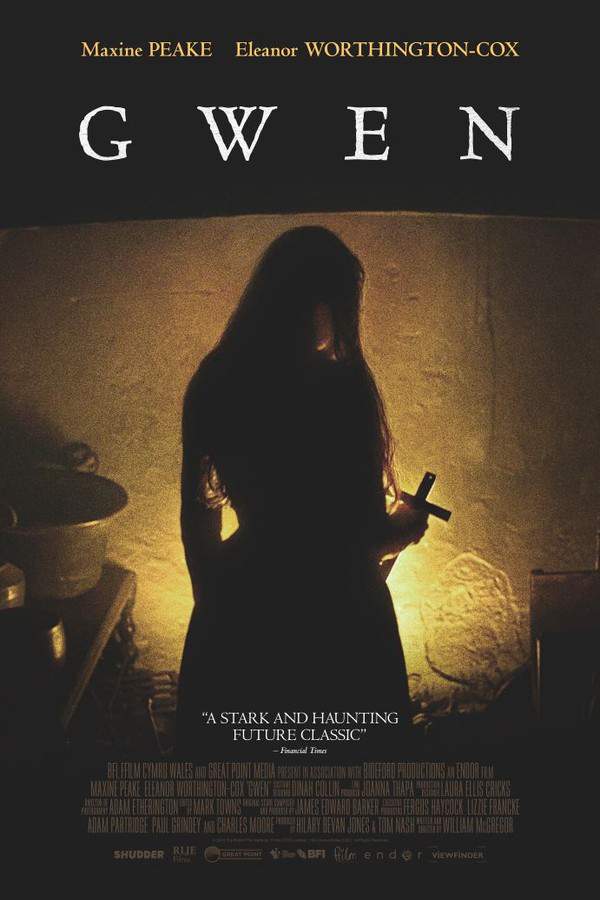
Gwen (2019) movie poster

Ending Explained

Gwen (2019) Ending Explained – Final Scene & Meaning

Release, runtime and language
2019 · 84 min · English
Echo score 70
JustWatch #23,373 7
Directed by
William McGregor
Starring
Maxine Peake, Mark Lewis Jones, Richard Elfyn, Dyfrig Evans, Eleanor Worthington-Cox, Gwion Glyn
Budget
$2M

Set in 19th-century Snowdonia, Wales, this film follows a young woman struggling to keep her family together. Her mother suffers from a mysterious illness, and her father is largely absent. Facing the threat of a mining company and a growing sense of dread, the family finds themselves increasingly isolated. As a mysterious force takes hold, Gwen and her loved ones become the target of suspicion and fear from the local community.

On this page (7)
  1. 1 Where to watch
  2. 2 What happens at the end
  3. 3 Final events in order
  4. 4 Ending questions answered
  5. 5 Movie threads
  6. 6 Movies like Gwen
  7. 7 Every angle

Where to watch

Where to Watch Gwen (2019)

Where can you watch Gwen? Stream, rent or buy it in the US, including on AMC+, Philo and Shudder: current JustWatch availability with up-to-date prices.

Streaming availability powered by JustWatch

Ending explained · contains spoilers

What Happens at the End of Gwen?

How Gwen (2019) ends, what the final scene means, which earlier moments set it up and how to read the ending if the film leaves it open. The full ending explained, with every spoiler.

Gwen Stacy ends up forming her own team of Spider-People to help rescue Miles Miles from danger after the chaos caused by The Spot and the multiverse's instability. Her team is made up of various Spider-Man variants introduced throughout the series, including Peter B. Parker, Spider-Punk, Peni Parker, Spider-Man Noir, Spider-Ham, Pavitr Prabhakar, and Spider-Byte. This diverse group is assembled using a special device that Gwen receives, allowing her to travel across the multiverse. Their mission is to locate Miles on Earth-42, save him from being held hostage by a different version of himself, and then return to prevent his father’s death at the hands of The Spot.

This team-up is vital because The Spot, who was initially perceived as a minor villain, becomes incredibly powerful—posing a serious threat not just in animation but across all Spider-Man stories—by the end of the film. Gwen’s team plays a crucial role in the narrative, especially in terms of enabling Miles’ survival and potentially altering the course of the multiverse. The team’s composition hints that it may expand further in future installments, possibly including live-action Spider-Man actors or other versions introduced in the wider franchise.

Gwen’s leadership and her team’s efforts underscore her importance in the story’s continued development, as her actions directly contribute to setting up future conflicts and alliances. The film’s ending suggests that her team will be central in the next chapter, helping Miles to correct the multiverse’s chaos and ultimately shaping the future of the Spider-Verse saga. Her role as a leader reflects her growth from a side character to a key figure in the ongoing battle to preserve the multiverse’s integrity.

Last updated: June 25, 2025 at 08:59

Was this helpful?

The last 4 events

How Gwen Ends: The Final Events in Order

The last events of Gwen (2019) in chronological order, the run-up to the ending explained above. The complete timeline has all 14 events, scene by scene.

Open the full timeline
  1. Confrontation with Intruder

    One fateful night, as a man approaches their farmhouse wielding a dagger, both Gwen and her mother are forced to defend themselves. In an act of desperation, they fight back and manage to kill the intruder.

    Where
    Gwen's Home
  2. Destruction of Their Home

    With the quarry men arriving to overpower them, Gwen's mother orders the girls to flee for their lives. Despite their attempt to escape, the quarry men set fire to their home, leading to the tragic loss of everything they've known.

    Where
    Gwen's Farm
  3. Fleeing into the Hills

    Gwen and Mari escape into the nearby hills, witnessing the flames consuming their home. As Mari questions their next steps, Gwen resolves to seek out their father, leaving uncertainty and fear lingering in the air.

    Where
    Hills
  4. A New Journey Begins

    With their old life in ashes, Gwen and Mari set off on a quest to find their father. Filled with determination, they venture into the unknown, symbolizing hope amid despair and the bond of sisterhood.

Ending questions answered

Gwen Ending: Your Questions Answered

The questions people ask most about the ending of Gwen (2019): what the final scene means, how the twist works, what happens to each character and how to read the ending. Each answer contains spoilers.

Q1

What happens to Gwen's mother in the ending?

Gwen's mother is burned alive in the final act of the film. The family home is also destroyed, leaving the children without a parent or shelter. Her death is treated without any redemptive framing, reinforcing the film's bleak tone.

Foreshadowing: Early scenes establish the mother as being consumed by her mysterious illness, making her eventual death feel inevitable as the community's hostility grows.

  • gwen
  • mother
  • burned
  • death
  • illness
  • ending
Q2

Why does the local community turn against Gwen's family?

The community's suspicion grows as a series of ritualistic aggressions escalates around the farm, including animal hearts nailed to doors, mutilated livestock, poisoned crops, and social shunning at the market. Combined with industrial pressure from a mining company and an atmosphere of dread, the family becomes an easy target for the village's collective fear.

Foreshadowing: The market shunning is introduced early as a quiet form of exclusion, which gradually intensifies into active persecution.

  • community
  • suspicion
  • ritual
  • persecution
  • village
  • fear
Q3

Is the supernatural force in Gwen actually real?

The film deliberately leaves the supernatural element unresolved. Animal mutilations, poisoned crops, and a growing sense of dread suggest something beyond ordinary malice, but the movie never confirms whether these events stem from witchcraft, folklore, or the community's projection of guilt. This ambiguity is central to the film's bleak, slow-burn horror.

Foreshadowing: From the opening scenes, a sense of dread is established without clear explanation, signaling that the horror will remain atmospheric rather than literal.

  • supernatural
  • witchcraft
  • ambiguity
  • folklore
  • dread
Q4

What does the destruction of the family home symbolize?

The burning of the home represents the complete collapse of the family's place within rural Wales. With the father absent, the mother dead, and the house gone, the children are stripped of every anchor that connected them to their community. It also marks the victory of industrial power over traditional rural life.

Foreshadowing: The mining company's encroachment on the land is established early as a slow, inevitable threat to the family's livelihood.

  • home
  • burning
  • destruction
  • symbolism
  • industrial
  • rural
Q5

Where is Gwen's father throughout the story?

Gwen's father is largely absent, leaving the family vulnerable to both economic and supernatural threats. His absence is never explained or resolved, and at the end of the film the children are left to wander in search of him. This abandonment underscores the family's isolation and the failure of patriarchal protection in a society that is already hostile to them.

Foreshadowing: His absence is established in early scenes as a quiet but constant pressure the family must endure on their own.

  • father
  • absence
  • abandonment
  • family
  • patriarch
Q6

What role does the mining company play in the family's downfall?

The mining company represents the industrial forces crushing rural Welsh life in the 19th century. Its encroachment strips the family of economic stability and makes them easy targets for a community eager to blame outsiders. The company's threat is never directly confronted, only absorbed into the family's slow destruction.

Foreshadowing: The mining presence is introduced early as a looming, impersonal threat rather than an active antagonist.

  • mining
  • company
  • industrial
  • rural
  • poverty
  • threat
Q7

Do Gwen and her siblings find safety at the end?

No. The ending offers no rescue or salvation. With their mother dead and home destroyed, Gwen and the other children are left to wander in search of their absent father. There is no warmth, community support, or hopeful resolution, which reinforces the film's bleak emotional weight.

Foreshadowing: The children's growing awareness of danger in early scenes foreshadows their ultimate exposure to it without protection.

  • children
  • safety
  • ending
  • wandering
  • bleak
  • hopeless
Q8

What is the meaning behind the bleak ending of Gwen?

The bleak ending is a statement about how rural poverty, gendered oppression, and industrial power leave the vulnerable with no escape. By refusing redemption and leaving the supernatural unresolved, the film argues that some forms of suffering are systemic rather than personal, and that no protagonist action could have prevented the outcome.

Foreshadowing: The film's slow, ritualistic escalation of aggressions from the very beginning signals that the narrative is moving toward an inescapable tragedy.

  • meaning
  • bleak
  • ending
  • oppression
  • poverty
  • theme
Q9

What does the mother's mysterious illness represent?

The mother's mysterious illness functions as both a literal and symbolic affliction. On one level it is a private tragedy; on another, it marks the family as different and feeds the community's suspicion. Her slow decline mirrors the family's gradual destruction, making her death feel like the natural collapse of a household already under siege.

Foreshadowing: The illness is introduced in early scenes as a quiet, unexplained burden that slowly worsens.

  • illness
  • mother
  • mystery
  • symbolism
  • family
Q10

Why does the film end without any hope or redemption?

Gwen is structured as a folk horror film in which the horror is social and systemic rather than something a hero can defeat. Offering hope would undermine its critique of how rural communities and industrial forces crush individuals who cannot fight back. The bleak resolution forces viewers to sit with the injustice rather than be comforted by it.

Foreshadowing: The unrelenting tone of dread from the opening scenes prepares the viewer for a conclusion that offers no relief.

  • hope
  • redemption
  • bleak
  • folk horror
  • social
  • critique

Movie threads

More Movies Like Gwen, by Mood & Story

Curated lists built around what makes Gwen tick: the same mood, the same kind of story or the same emotional payoff. Each list explains why these movies belong together.

Rural folk horror like in Gwen

Atmospheric horror built on superstition, isolation, and rituals that close in around the vulnerable. If you liked Gwen and want more movies like it, this thread gathers slow burn folk horror set in remote rural landscapes. Expect eerie atmosphere, ritualistic violence, superstition clashing with ordinary life, and bleak endings where the land and its old ways win. Perfect for fans of oppressive historical horror with heavy emotional weight and no easy answers.

  • folk horror
  • rural dread
  • slow burn
  • eerie
  • oppressive
  • ritualistic
  • Tone: bleak, ominous
  • Pacing: slow burn
Why these movies?

The story pattern: These stories typically follow one or two protagonists who become increasingly unwelcome in their own community. The plot advances through a series of escalating, often inexplicable aggressions: mutilated animals, poisoned crops, whispered accusations, violent rituals that blur the line between social persecution and genuine supernatural force. A central character, often a young woman or marked outsider, must survive both human cruelty and an ancient, unknowable presence. The story rarely resolves cleanly: the supernatural threat stays ambiguous, and the human cost is total.

Why they belong together: These films share Gwen's commitment to atmosphere over action, building dread through visual composition, silence, and the steady erosion of safety. They rely on rural isolation, period or pre-industrial settings, and a deep sense that the land carries old wounds. Endings tend to be bleak or ambiguous, refusing the catharsis of conventional horror. The folk horror tradition draws from national mythologies across Britain, Scandinavia, Eastern Europe, and Indigenous cultures, so each film feels rooted in a specific place and history.

Bleak historical family stories like in Gwen

Period stories of families crushed by poverty, illness, and forces beyond their control. Looking for movies like Gwen that focus on a family falling apart in a past era? This thread collects heavy period dramas where poverty, illness, and social cruelty leave no room for hope. Ideal for viewers who want slow, devastating stories about mothers, daughters, and ordinary people crushed by the world around them, with bleak endings and no redemption in sight.

  • bleak
  • family tragedy
  • historical
  • poverty
  • mother daughter
  • devastating
  • Tone: bleak, mournful
  • Pacing: slow and patient
Why these movies?

The story pattern: A small family, often a mother and her children, sometimes a single parent holding things together, struggles against forces they cannot name or defeat. The plot unfolds through small, accumulating tragedies: a sick parent, an absent spouse, an empty larder, a community turning hostile. Historical context provides the inescapable weight: industrial change, rigid class systems, gendered oppression, or grinding rural poverty. The emotional arc moves from determined endurance through slow dread to total loss, with no catharsis and rarely any villain to blame, just an indifferent or openly hostile world.

Why they belong together: These films share Gwen's bleakness and its refusal to offer comfort. They treat the family unit as something sacred and fragile, then dismantle it in full view of the audience. The historical setting adds moral weight: viewers understand the characters had no safety net, no welfare, no escape route. Pacing is slow and observational, with long passages of daily labor and quiet suffering. Emotional weight is heavy, violence (when present) is unflinching, and endings tend toward devastation rather than resolution.

If you liked this

Movies Like Gwen

Similar movies to Gwen: the same genre, themes or kind of story. Each one comes with its own plot summary, timeline and ending explained.

Browse all movie summaries

Every angle

Gwen (2019) Explained: Plot, Ending, Timeline & Characters

Everything about Gwen in one place: what happens in the plot summary, the timeline in chronological order, the characters and meaning, the ending explained and a spoiler-free summary. What's After the Movie adds the cast, box office and post-credit scenes.

Coming soon on iOS and Android

The Plot Explained Movie Summary App

Plot summaries, endings explained and timelines on your phone. Catch up on any movie in minutes, save your favorites and never miss a twist again.

Be the first to know when we launch. Your email stays private, always.

Learn more about the app