Plot Explained Spoilers guaranteed!
Plot Explained

Browse by genre

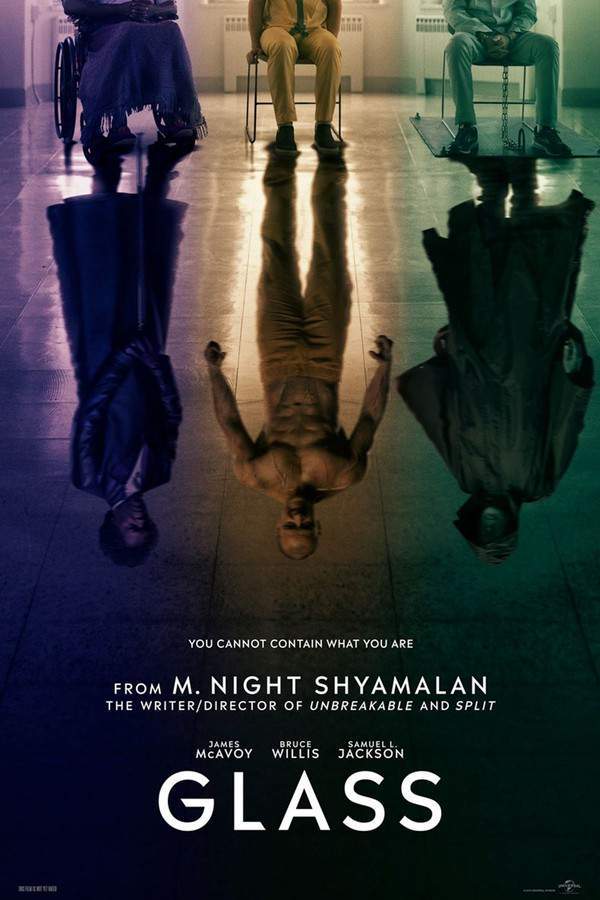
Glass (2019) movie poster

Ending Explained

Glass (2019) Ending Explained – Final Scene & Meaning

Release, runtime and language
2019 · 129 min · English
Echo score 55
Loading streaming availability…
Directed by
M. Night Shyamalan
Starring
Samuel L. Jackson, Bruce Willis, Anya Taylor-Joy, Raul I Torres, Charles W Harris III, Sarah Paulson
Budget
$20M

In a suspenseful thriller, vigilante David Dunn seeks justice while evading authorities in Philadelphia. His extraordinary abilities lead him to a dangerous confrontation with the Beast, a formidable figure struggling with a fractured psyche and immense strength. They are connected to Elijah Price, a brilliant but psychologically complex man harboring dark secrets. As their paths collide, long-held mysteries are revealed, threatening to unravel their lives and expose a larger, unsettling truth.

On this page (7)
  1. 1 Where to watch
  2. 2 What happens at the end
  3. 3 Final events in order
  4. 4 Ending questions answered
  5. 5 Movie threads
  6. 6 Movies like Glass
  7. 7 Every angle
Loading streaming availability…

Ending explained · contains spoilers

What Happens at the End of Glass?

How Glass (2019) ends, what the final scene means, which earlier moments set it up and how to read the ending if the film leaves it open. The full ending explained, with every spoiler.

In the end, the film reveals that Mr. Glass's entire plan was a carefully orchestrated stunt to bring superpowered beings into the public eye. His death and the subsequent release of videos exposing his "superpowers" serve as a final act of heroism, intentionally designed as a kind of ultimate reveal—an origin story for a world suddenly aware of superhuman abilities. Elijah’s end, marked by his confession that the showdown was an origin story, underscores this idea: it’s the beginning of a new universe, where society must confront the reality of superpowers and reconsider what they believe. The deaths of David, Kevin, and Elijah are deeply symbolic, each meeting their respective fates in ways fitting their origins—David drowns, Kevin is shot in his weaker state, and Elijah succumbs to his physical disabilities—highlighting that society, unwilling to accept these heroes, ultimately rejects them.

Meanwhile, a secret organization called the Clover group has been pulling the strings behind the scenes, trying to keep superpowers hidden by convincing people they are illusions or mental illnesses. Their plan is not to kill these heroes but to make sure they believe they are ordinary, which ultimately fails as the trio fully embraces their powers and the truth. The story closes on a world now aware of superhuman potential, challenging existing beliefs and opening the door to an uncertain future. Although the film concludes this chapter definitively, it leaves room for new stories, with the old organization Largely discredited and the world on the verge of a paradigm shift—setting the stage for a universe where superheroes are a reality, even if their existence remains a secret to most. The movie's ending thus serves as both a culmination of Elijah’s lifelong quest and a new beginning for a universe forever changed.

Last updated: June 25, 2025 at 09:00

Was this helpful?

The last 4 events

How Glass Ends: The Final Events in Order

The last events of Glass (2019) in chronological order, the run-up to the ending explained above. The complete timeline has all 15 events, scene by scene.

Open the full timeline
  1. Extreme Measures by Dr. Staple

    In a shocking turn of events, Dr. Staple employs lethal methods to erase the existence of the superhumans. She drowns David, believing that eliminating him will maintain her control over the narrative of normalcy.

    Where
    Flooded Pothole
  2. Tragic Ends for Elijah and Kevin

    As the chaos unfolds, both Elijah and Kevin meet their tragic ends, seemingly sealed away from the world. However, it becomes clear that their story is far from over, setting the stage for potential revelations.

  3. Elijah's Final Revelation

    Unbeknownst to Dr. Staple, Elijah had set up a live stream that broadcasts their tale of superhuman existence to the world. This act aims to unveil the truth behind their existence, igniting a movement that questions the common understanding of humanity.

  4. Legacy of Superhumans

    In the aftermath, Joseph, Casey, and Mrs. Price choose to spread the truth about superhumans, forever altering the narrative of their existence. Their decisions propel the legacy of these extraordinary individuals onto the public stage.

Ending questions answered

Glass Ending: Your Questions Answered

The questions people ask most about the ending of Glass (2019): what the final scene means, how the twist works, what happens to each character and how to read the ending. Each answer contains spoilers.

Q1

Why did Mr. Glass sacrifice himself at the end?

Mr. Glass orchestrated his own death as the final move in his master plan. He intentionally provoked the confrontation with David Dunn and The Beast, knowing he would die, so that the videos of all three superpowered individuals fighting would be released to the public. His death was meant to prove the existence of superhumans to the world.

Foreshadowing: Earlier scenes show Mr. Glass manipulating events from within the psychiatric facility, hinting at a larger scheme.

  • mr glass
  • sacrifice
  • death
  • plan
  • finale
Q2

What was Mr. Glass's real plan in the movie?

Mr. Glass spent his entire life orchestrating events to prove superhumans exist. He created The Beast by manipulating Kevin Crumb's multiple personalities, arranged for David Dunn to become a vigilante, and then brought all three superpowered individuals together in one location. The final showdown was staged so their abilities would be captured on video and released worldwide, revealing the truth about superhumans.

Foreshadowing: Mr. Glass's backstory reveals he has planned this since childhood, when he first discovered his own superhuman intellect.

  • mr glass
  • plan
  • mastermind
  • superhumans
  • conspiracy
Q3

What happened to David Dunn at the end of Glass?

David Dunn dies at the end. While fighting The Beast in a parking garage, the structure collapses and David is trapped underwater in his car. Unable to escape and weakened, he drowns. His death mirrors his origin as a man who survived a deadly train crash, the very crash that introduced his superhuman abilities.

Foreshadowing: The film establishes that water is David's vulnerability throughout, as seen in earlier scenes where he avoids large bodies of water.

  • david dunn
  • death
  • drowning
  • fate
  • final scene
Q4

Did Kevin (The Beast) survive the ending of Glass?

Kevin Wendell Crumb does not survive. After being shot by the Clover organization and left in a weakened state, he is killed during the final confrontation. His death fits the pattern of his origin, his most dominant personality, The Beast, was born from trauma and abuse, and he meets his end as a broken individual rather than the powerful entity he was.

Foreshadowing: Kevin's multiple personalities were established as fragmented and unstable throughout the film, suggesting his inability to maintain control.

  • kevin
  • the beast
  • death
  • final fight
  • personality
Q5

What is the Clover organization in Glass?

The Clover is a secret organization that has spent decades concealing the existence of superpowered individuals. Their method is not murder but psychological manipulation, they work to convince superhumans that their abilities are delusions or mental illnesses. By making the heroes doubt their own reality, they keep superpowers hidden from society. The organization is discredited by the end when the truth is revealed.

Foreshadowing: Dr. Staple's influence over the patients suggests a larger institutional agenda beyond individual treatment.

  • clover
  • organization
  • secret
  • cover-up
  • conspiracy
Q6

Why does the ending refer to the showdown as an origin story?

Mr. Glass explicitly states that the entire confrontation was designed as an 'origin story', the beginning of a new universe where superhumans are known to exist. Just as comic book heroes have origin stories that explain their emergence, this moment marks humanity's first collective knowledge that superpowered beings are real. The deaths of the three superhumans become the catalyst for a paradigm shift in human understanding.

Foreshadowing: The film frequently references comic book tropes and superhero mythology, framing itself as a deconstruction of the genre.

  • origin story
  • universe
  • superhumans
  • meaning
  • ending explained
Q7

Why do the three main characters die in ways that reflect their origins?

Each character's death connects symbolically to how they gained their abilities or identity. David Dunn, who survived a fatal train crash that awakened his powers, drowns, the opposite of his survival. Kevin, whose Beast personality emerged from childhood trauma and abuse, is killed while in a vulnerable, broken state. Elijah Price, born with fragile bones and physical disabilities, succumbs to those very limitations. The deaths suggest society's rejection of these extraordinary individuals.

Foreshadowing: The film's structure mirrors comic book narratives where heroes often face tragic ends that echo their beginnings.

  • symbolism
  • deaths
  • origins
  • tragic ending
  • patterns
Q8

Why does society reject the superpowered trio in Glass?

The film suggests humanity rejects what it cannot understand or control. The Clover organization represents society's preference to believe superpowers are delusions rather than accept that extraordinary individuals exist among them. Even after the videos are released, the world is left on the verge of a paradigm shift but not fully transformed, the truth exists, but most people still view it as uncertain or impossible.

Foreshadowing: Dr. Staple's constant efforts to convince the patients their abilities are imaginary reflect society's broader denial.

  • society
  • rejection
  • superhumans
  • acceptance
  • truth
Q9

What happens to the truth about superpowers at the end of Glass?

Mr. Glass's plan succeeds, the videos of all three superpowered individuals are released to the public. The world now knows superhumans exist, even if most people still view it as uncertain. The Clover organization is discredited, and humanity stands at the threshold of a new reality where superheroes are no longer fictional. The ending is bittersweet: the heroes are dead, but their truth lives on.

Foreshadowing: The final scene with Mr. Glass's confession confirms the videos will be released, ensuring his legacy.

  • truth
  • video
  • revealed
  • superpowers
  • public
Q10

Is Glass ending hopeful or tragic?

The ending is bittersweet rather than purely hopeful or tragic. The three superhumans all die, which is unquestionably a tragedy. However, their deaths accomplish what Mr. Glass spent his life planning, the truth about superpowers is finally revealed to the world. Their sacrifice creates the possibility for a new universe where superhumans are no longer hidden. The legacy of David, Kevin, and Elijah lives on through the videos, suggesting their existence was not in vain.

Foreshadowing: The dark tone throughout the film suggests tragedy was inevitable, but the final revelation offers a glimmer of purpose.

  • ending
  • bittersweet
  • hopeful
  • tragic
  • meaning

Movie threads

More Movies Like Glass, by Mood & Story

Curated lists built around what makes Glass tick: the same mood, the same kind of story or the same emotional payoff. Each list explains why these movies belong together.

Claustrophobic Psychological Thrillers like Glass

Stories where reality is questioned within oppressive, confined spaces. If you liked the tense, institution-set mind games of Glass, explore more movies like it. These films trap characters—and viewers—in psychologically oppressive environments, blurring the line between delusion and reality in similar thrillers and mysteries.

  • claustrophobic
  • psychological
  • suspenseful
  • oppressive
  • paranoid
  • anxious
  • Tone: dark, tense, oppressive
  • Pacing: variable, methodical build to explosive peaks
Why these movies?

The story pattern: Narratives typically unfold within a confined setting that limits escape, both physically and mentally. Characters are forced to confront their own psyches or a manipulative antagonist, leading to a slow unraveling of what is real and what is constructed, often culminating in a violent or tragic revelation.

Why they belong together: Movies are grouped here for their shared oppressive atmosphere, focus on psychological manipulation, and the use of confined spaces to generate intense, sustained suspense. They explore themes of identity, perception, and mental fragility under pressure.

Grounded and Tragic Superhero Stories like Glass

Stories that explore the human cost and psychological toll of extraordinary abilities. For viewers who enjoyed the realistic, psychologically complex take on superhumans in Glass. Discover more movies that deconstruct superhero myths, focusing on tragic villains, vulnerable heroes, and the bleak consequences of their powers in dramatic and thrilling settings.

  • tragic
  • philosophical
  • existential
  • psychological
  • heavy
  • dramatic
  • Tone: dark, philosophical, tragic
  • Pacing: variable, balancing character drama with action
Why these movies?

The story pattern: The plot follows characters whose abilities are a source of suffering rather than triumph. Their journeys are marked by existential crises, moral ambiguity, and often tragic endings. The conflict is as much internal—a battle for identity and sanity—as it is external.

Why they belong together: These films are connected by their shared goal of grounding superhuman concepts in harsh reality. They prioritize character drama and psychological depth over spectacle, resulting in emotionally heavy stories with bittersweet or bleak conclusions.

If you liked this

Movies Like Glass

Similar movies to Glass: the same genre, themes or kind of story. Each one comes with its own plot summary, timeline and ending explained.

Browse all movie summaries

Every angle

Glass (2019) Explained: Plot, Ending, Timeline & Characters

Everything about Glass in one place: what happens in the plot summary, the timeline in chronological order, the characters and meaning, the ending explained and a spoiler-free summary. What's After the Movie adds the cast, box office and post-credit scenes.

Coming soon on iOS and Android

The Plot Explained Movie Summary App

Plot summaries, endings explained and timelines on your phone. Catch up on any movie in minutes, save your favorites and never miss a twist again.

Be the first to know when we launch. Your email stays private, always.

Learn more about the app