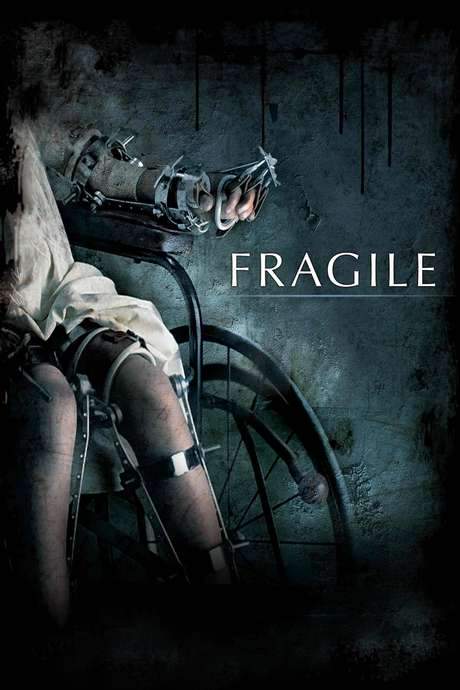
On the Isle of Wight, a sudden train accident on the Island Line overwhelms St. James’s, the principal hospital, which is already running at capacity. Mercy Falls, a smaller and older facility, is slated for closure, yet a number of patients—especially the children from the ward—must stay put until beds open up elsewhere. In this tense setting, the ward’s fragile balance is shown to be more than medical: it becomes a battleground between memory, grief, and a haunting presence that may be closer to death than anyone realizes.
The night nurse in Mercy Falls is temporarily replaced by Amy Nicholls, who quickly forms a protective bond with one patient in particular, Maggie. Maggie, an orphan battling severe cystic fibrosis, grinds through fear with a stubborn brightness, and she reveals to Amy that a girl named Charlotte haunts the abandoned upper ward. According to local lore, Charlotte is an urban legend that only a few children have seen in the past twenty years. Maggie speculates that Charlotte is connected to her own deteriorating health, claiming that the ghost is the source of the ward’s whispered danger. When Simon, another child on the floor, awakens in agony with a broken femur and no memory of how it happened, the hospital’s mysterious atmosphere thickens.
Amy reaches out to the departing night nurse’s memory and learns that Susan died in an accident, a revelation that deepens the sense of unresolved tragedy within Mercy Falls. Two local psychics caution that Charlotte can only be perceived by those who are approaching death, a detail that begins to crystallize the film’s eerie logic and motive. As the children drift in and out of a fairy-tale frame—watching Sleeping Beauty as a form of solace—Maggie asserts that true love’s kiss possesses a peculiar power, a motif that foreshadows the story’s emotional turn.
Amy combs through the ward’s files and discovers a grim pattern: every child who mentioned Charlotte has died. This leads her to a troubling hypothesis: Maggie herself may be near death. The danger intensifies when Roy, Mercy Falls’s operations manager, is slain by Charlotte, who induces a catastrophic nosebleed and then violently hurls him through a window. The horror is not only spectral; it is immediate and physical, destabilizing the hospital’s already fragile structure.
Driven by fear and determination, Amy ascends to the second floor by way of a hidden trapdoor. There she uncovers an old photograph showing a girl in a wheelchair with a nurse and a film reel—the image is labeled “Charlotte and Mandy, 1959.” As a tall, gaunt figure with leg braces materializes in front of a metal door, Maggie intervenes, sacrificing her own comfort to shield Amy by dropping her cherished blanket, “Mr. Sleepy.” The film Amy and Robert Marcus view reveals a medical history: the girl’s bone fragility, diagnosed as osteogenesis imperfecta, had driven doctors to devise orthotic braces in a bid to strengthen her bones. The revelation reframes Charlotte as the vengeful ghost of a child who suffered under an obsessed nurse rather than a purely malevolent spirit. Amy interpretations shift: Charlotte’s anger was born from a traumatic medical history, and the real victim’s name, once hidden, appears to be Mandy.
As the truth comes into focus, the upstairs ward’s closure is exposed as a crime of passion and obsession rather than a simple administrative decision. The nurse responsible for the girl’s torment—driven to a desperate ending—sought solace in the girl’s braces and, in a final, fatal act, leapt to her own death. A file recovered by Amy names the patient as Mandy, with Charlotte serving as the jealous, lingering specter tied to that tragedy. The hospital’s halls begin to crumble under Charlotte’s rage while staff from St. James’s rush to evacuate the children.
In the escalating chaos, a glimmer of hope remains: a patient Maggie’s love and a doctor’s expertise may co-exist to turn the tide. As Amy and [Robert Marcus] work to stabilize the situation, the two confront the dual mysteries of the ward—the historical crime and the ghostly presence. The hospital’s collapse culminates in a perilous escape sequence as Amy fights to reach the trapdoor with Maggie in tow. The floor buckles, and Amy’s leg is impaled by a piece of metal, staining the escape with blood. They leap through the trapdoor, and Maggie collapses from her illness as the danger finally peaks.
In a moment of apparent defeat, the medical team steps back while a ghostly act of mercy unfolds: Maggie’s spirit appears and grants Amy a kiss—a symbol of pure love that echoes the earlier Sleeping Beauty reference. With this otherworldly kiss, Amy’s heart restarts, and she wakes in a different hospital room with [Robert Marcus] at her side. The final image lingers on Maggie’s smiling ghost, seated beside Amy’s bed, reaffirming the child’s enduring presence and the power of love to pierce even the thickest darkness.
> "she" is coming
The narrative leaves viewers with a quiet, unresolved note of hope: the living and the dead continue to share the same spaces, and the memory of Maggie remains a guiding light for Amy Nicholls as she recovers, watched over by the ghost who loved her most.