Year: 2011
Runtime: 85 mins
Language: English
Director: John Langridge
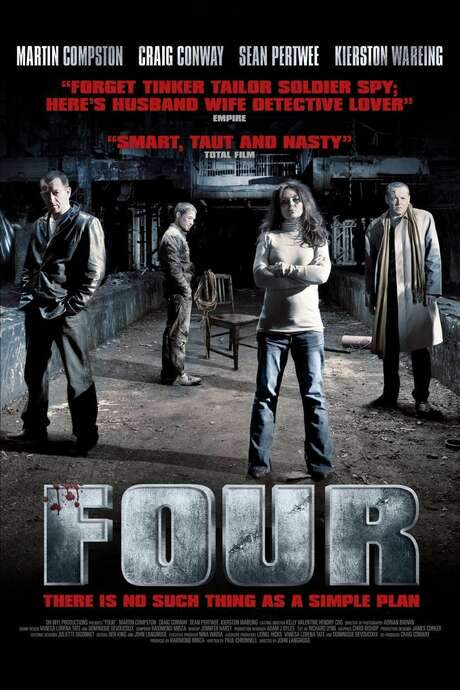
A man devises a seemingly straightforward scheme: abduct his wife's lover, bring him to an isolated warehouse, inflict limited pain and intense terror, then hire a detective to handle the dirty work while he stays untouched. He quickly discovers that nothing is ever simple.
Find where to stream, rent, or buy Four (2011) in the US with current JustWatch availability, up-to-date pricing, and platform listings for subscription, rental, and digital purchase options.
Warning: spoilers below!
Haven’t seen Four yet? This summary contains major spoilers. Bookmark the page, watch the movie, and come back for the full breakdown. If you're ready, scroll on and relive the story!
Trace every key event in Four (2011) with our detailed, chronological timeline. Perfect for unpacking nonlinear stories, spotting hidden connections, and understanding how each scene builds toward the film’s climax. Whether you're revisiting or decoding for the first time, this timeline gives you the full picture.
Last updated: October 01, 2025 at 10:21
Find frequently asked questions about the Four (2011) timeline, including chronological order, nonlinear jumps, cause-and-effect links, and scene sequence clarifications. This timeline FAQ helps explain when key events happen, how moments connect, and why the story unfolds in that specific order.
The detective deliberately orchestrated the entire scheme to frame the husband. He knew his own wife was having an affair with the lover and used the husband's plan as cover. By kidnapping his own wife, he ensured she would be present at the warehouse where he could manipulate events to blame the husband for everything.
The detective suggests expanding the plan to include the wife before any explanation of why he would know where she is.
The woman is not the husband's wife at all. She is the detective's own wife, who was secretly the lover's real partner. She was deliberately placed in the warehouse as part of a conspiracy between the detective and his wife to set up the husband and the lover.
The detective insists on including the wife in the plan without explaining why he knows where to find her.
The wife kills the lover to eliminate him as a witness and to strengthen her frame job. By killing her own partner and planting the weapon with the men's fingerprints, she ensures the police will believe the husband and detective committed the murder while staging the scene to look like their crime.
The wife's defiant behavior shifts to aggression once she obtains the iron bar.
After killing the lover with an iron bar, the wife plants the weapon in a way that transfers the men's fingerprints onto it. She positions herself as a traumatized victim while ensuring the crime scene appears to show the husband and detective as the perpetrators of a violent confrontation gone wrong.
The detective earlier notes that fear and control can make people do unpredictable things.
The husband is manipulated by the detective's logic that punishing only the lover is insufficient. The detective argues that the lesson won't stick unless both parties face consequences. The husband, driven by jealousy and wanting the affair to end, agrees to the expanded plan without questioning the detective's motives.
The husband twists his wedding ring while watching the lover get beaten, showing his emotional state compromises his judgment.
The detective's true motive was revenge against his unfaithful wife and her lover, while simultaneously framing a stranger for the crime. He used the husband's desire for revenge as a cover for his own conspiracy, ensuring he would appear as merely a hired thug rather than the mastermind.
The detective shows unusual interest in the details of the wife's capture and insists on handling things a specific way.
The lover genuinely did not know the woman he was involved with was married. He believed he was in a relationship with a single woman. This ignorance is why he pleads desperately that he meant no harm and didn't know about any marriage, which angers the detective even more.
The lover repeatedly insists he didn't know about the marriage during interrogation.
The wife kills the lover with an iron bar, then strategically positions the weapon to transfer fingerprints from the husband and detective. When police arrive, they find the wife as the apparent victim and the two men as the apparent perpetrators. The wife successfully frames both men for murder while appearing as a traumatized survivor.
The wife bargains for a cigarette and threatens to go to police if released, showing her awareness of how to manipulate the narrative.
The wife was never a true victim, she was conspiring with her husband throughout. Once she obtains the iron bar, she attacks the lover (her own partner) and then orchestrates the crime scene to frame the men. Her defiance during captivity was calculated to buy time and manipulate the husband's emotions.
The wife remains unusually calm and defiant despite being kidnapped, hinting at her true intentions.
Discover curated groups of movies connected by mood, themes, and story style. Browse collections built around emotion, atmosphere, and narrative focus to easily find films that match what you feel like watching right now.
Stories where a simple plan for vengeance spirals into chaos and self-destruction.If you liked the way Four deconstructed a simple revenge plot, you'll enjoy these movies where vengeance backfires spectacularly. This collection features thrillers and dramas where carefully laid plans fall apart, leading to unexpected consequences, moral crises, and bleak endings. Find movies like Four that explore the futility of control.
The narrative typically follows a protagonist who initiates a plan for retribution, believing themselves to be in complete control. However, the plot introduces complications—mistaken identities, hidden agendas, or their own psychological flaws—that cause the plan to veer dangerously off course, often ending in a fate worse than what they initially sought to rectify.
These films are grouped by their shared focus on the theme of revenge and its unintended consequences. They share a dark tone, a steady pacing that builds tension as the plan collapses, and a complex narrative structure that forces the audience to constantly re-evaluate the situation, much like the experience in Four.
High-tension stories set in isolated locations where mental games become deadly.Fans of the tense, confined warehouse setting in Four will appreciate these claustrophobic psychological thrillers. Discover movies with similar high intensity, anxious moods, and narratives where characters are trapped in isolated locations, playing dangerous psychological games. Find your next watch if you liked the suffocating atmosphere of Four.
The narrative is defined by its setting: a limited space like a warehouse, a single room, or an isolated facility. Conflict arises from the forced proximity of characters, often involving captivity, interrogation, or a power struggle. The story unfolds through psychological manipulation and revelations that occur within the confines of this oppressive environment.
These movies share a potent mix of a claustrophobic setting, high psychological intensity, and a dark, unsettling tone. The pacing is typically steady, building dread without release, and the emotional weight is heavy, focusing on themes of power, control, and survival in a confined hellscape.
Don't stop at just watching - explore Four in full detail. From the complete plot summary and scene-by-scene timeline to character breakdowns, thematic analysis, and a deep dive into the ending - every page helps you truly understand what Four is all about. Plus, discover what's next after the movie.
Read a complete plot summary of Four, including all key story points, character arcs, and turning points. This in-depth recap is ideal for understanding the narrative structure or reviewing what happened in the movie.
Discover the characters, locations, and core themes that shape Four. Get insights into symbolic elements, setting significance, and deeper narrative meaning - ideal for thematic analysis and movie breakdowns.