Year: 2011
Runtime: 85 mins
Language: English
Director: John Langridge
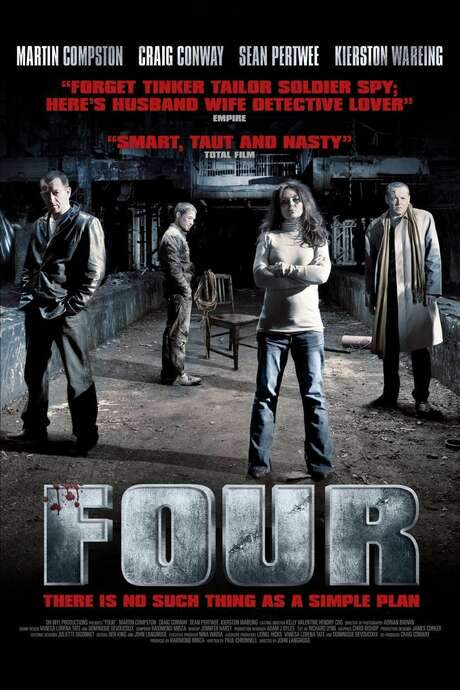
A man devises a seemingly straightforward scheme: abduct his wife's lover, bring him to an isolated warehouse, inflict limited pain and intense terror, then hire a detective to handle the dirty work while he stays untouched. He quickly discovers that nothing is ever simple.
Find where to stream, rent, or buy Four (2011) in the US with current JustWatch availability, up-to-date pricing, and platform listings for subscription, rental, and digital purchase options.
Warning: spoilers below!
Haven’t seen Four yet? This summary contains major spoilers. Bookmark the page, watch the movie, and come back for the full breakdown. If you're ready, scroll on and relive the story!
Explore the full timeline and setting of Four (2011). Follow every major event in chronological order and see how the environment shapes the story, characters, and dramatic tension.
Last updated: October 01, 2025 at 09:38
Meet the key characters of Four (2011), with detailed profiles, motivations, and roles in the plot. Understand their emotional journeys and what they reveal about the film’s deeper themes.
Last updated: October 01, 2025 at 09:38
Explore the central themes of Four (2011), from psychological, social, and emotional dimensions to philosophical messages. Understand what the film is really saying beneath the surface.
Last updated: October 01, 2025 at 09:38
Browse frequently asked questions about Four (2011) focused on characters, relationships, themes, symbols, setting, and story context. This movie info FAQ gives spoiler-aware explanations for character arcs, world details, and thematic interpretation so readers can better understand what the film is really about.
The abandoned warehouse serves as the primary setting because its stark, cold, industrial corridors create an isolating environment where loyalties can crumble under pressure. The echoey space amplifies tension during the abduction and interrogation scenes, making the psychological torment feel more claustrophobic and immediate. This location also contrasts sharply with the upscale office shown earlier, highlighting the stark divide between the characters' public corporate lives and their private, brutal actions.
The office scene early in the film hints at the corporate world behind the personal betrayals that later unfold in the warehouse.
The film is set in modern day, using present-day dynamics of infidelity, fear, and coercion rather than anchoring to any specific historical period. The contemporary setting makes the characters' actions and motivations feel immediate and relatable, while the contrast between the modern office environment and the grim warehouse heightens the sense of moral decay.
The film centers on how power is exercised through fear, manipulation, and coercion. The husband uses the detective as a tool to punish perceived betrayal, while the detective himself uses threats and interrogation to bend others to his will. The twist involving the wife tests who truly commands the situation, exposing the vulnerability beneath authority. The theme explores how fragile control really is when multiple parties are vying for dominance.
The husband's initial plan to stay untouched while the detective handles the dirty work sets up the illusion of control that later unravels.
Betrayal threads through every relationship in the film: marital infidelity between the wife and lover, professional deception involving the detective's illegal actions, and the contrived vendetta orchestrated by the husband. Trust dissolves as secrets are weaponized and loyalties shift under pressure. The characters' actions reveal how far people will go to protect their status or reputation, with each betrayal spiraling into more violent consequences.
Deception and misidentification drive the plot, showing how appearances can mask dangerous truths. The detective's plan spirals as motives blur and the true relationships emerge. The narrative plays with who is really in control of their own story, culminating in a twist that reveals the wife was the lover of the other man all along. This misdirection deconstructs the initial premise and forces a reinterpretation of character motivations throughout.
The wife's role appears straightforward at first but gradually reveals complexities that challenge initial assumptions.
The husband is motivated by control and reputation. As a smartly dressed businessman, he orchestrates the abduction of his wife's lover to punish what he sees as betrayal, using the detective as a blunt instrument while he stays untouched. His plan is built on maintaining his public image while暗中 (secretly) manipulating events behind the scenes. However, his control crumbles as the twist reveals the personal stakes behind his public display of anger, and he ultimately walks away as others fall deeper into his scheme.
The wife is a feisty and assertive woman who becomes the pivot of the entire plot. Initially appearing to be the target of the husband's vengeance, she is later discovered to be the lover of the other man involved. Rather than remaining a passive victim, she challenges those who try to manipulate her and ultimately uses the situation to frame both her husband and the detective. She represents both victimhood and provocateur, embodying the film's exploration of power dynamics where the seemingly powerless character turns the tables.
The detective is a confident, methodical investigator who orchestrates the violent scenario, initially reveling in his perceived skill and control. He represents the film's moral gray area, where professional pride clashes with ruthless action. His plan unravels when he discovers the wife is the wrong person and his own complicity is exposed through the twist. He embodies the theme of how power can corrupt those who believe they are in control.
The lover is the man having an affair with the wife, portrayed as fearful and confused under pressure. He denies knowledge of the marriage when pressed and becomes a pawn in the escalating confrontation between the husband and detective. His fate turns on the brutal dynamics between the other three players, and he serves as a catalyst for the unfolding violence rather than an agent of his own destiny.
Brutal acts escalate from intimidation to deadly confrontation, forcing characters to confront the results of their choices. The violence serves to expose moral compromise and accountability, showing how each character's actions have consequences they cannot escape. The ending sees the violent schemes unravel into a calculated cover-up, with a character's cold-blooded triumph through further violence. This reinforces the bleak theme that violence begets more violence, leaving no sense of justice or hope.
Discover curated groups of movies connected by mood, themes, and story style. Browse collections built around emotion, atmosphere, and narrative focus to easily find films that match what you feel like watching right now.
Stories where a simple plan for vengeance spirals into chaos and self-destruction.If you liked the way Four deconstructed a simple revenge plot, you'll enjoy these movies where vengeance backfires spectacularly. This collection features thrillers and dramas where carefully laid plans fall apart, leading to unexpected consequences, moral crises, and bleak endings. Find movies like Four that explore the futility of control.
The narrative typically follows a protagonist who initiates a plan for retribution, believing themselves to be in complete control. However, the plot introduces complications—mistaken identities, hidden agendas, or their own psychological flaws—that cause the plan to veer dangerously off course, often ending in a fate worse than what they initially sought to rectify.
These films are grouped by their shared focus on the theme of revenge and its unintended consequences. They share a dark tone, a steady pacing that builds tension as the plan collapses, and a complex narrative structure that forces the audience to constantly re-evaluate the situation, much like the experience in Four.
High-tension stories set in isolated locations where mental games become deadly.Fans of the tense, confined warehouse setting in Four will appreciate these claustrophobic psychological thrillers. Discover movies with similar high intensity, anxious moods, and narratives where characters are trapped in isolated locations, playing dangerous psychological games. Find your next watch if you liked the suffocating atmosphere of Four.
The narrative is defined by its setting: a limited space like a warehouse, a single room, or an isolated facility. Conflict arises from the forced proximity of characters, often involving captivity, interrogation, or a power struggle. The story unfolds through psychological manipulation and revelations that occur within the confines of this oppressive environment.
These movies share a potent mix of a claustrophobic setting, high psychological intensity, and a dark, unsettling tone. The pacing is typically steady, building dread without release, and the emotional weight is heavy, focusing on themes of power, control, and survival in a confined hellscape.
Don't stop at just watching - explore Four in full detail. From the complete plot summary and scene-by-scene timeline to character breakdowns, thematic analysis, and a deep dive into the ending - every page helps you truly understand what Four is all about. Plus, discover what's next after the movie.
Read a complete plot summary of Four, including all key story points, character arcs, and turning points. This in-depth recap is ideal for understanding the narrative structure or reviewing what happened in the movie.
Track the full timeline of Four with every major event arranged chronologically. Perfect for decoding non-linear storytelling, flashbacks, or parallel narratives with a clear scene-by-scene breakdown.