Year: 2011
Runtime: 85 mins
Language: English
Director: John Langridge
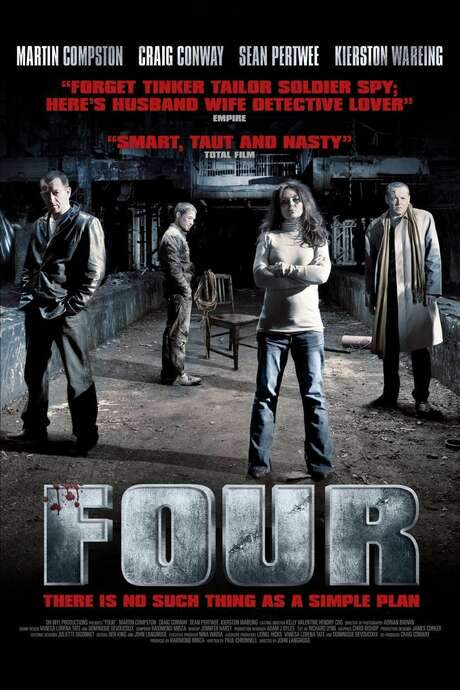
A man devises a seemingly straightforward scheme: abduct his wife's lover, bring him to an isolated warehouse, inflict limited pain and intense terror, then hire a detective to handle the dirty work while he stays untouched. He quickly discovers that nothing is ever simple.
Find where to stream, rent, or buy Four (2011) in the US with current JustWatch availability, up-to-date pricing, and platform listings for subscription, rental, and digital purchase options.
Warning: spoilers below!
Haven’t seen Four yet? This summary contains major spoilers. Bookmark the page, watch the movie, and come back for the full breakdown. If you're ready, scroll on and relive the story!
Read the complete plot breakdown of Four (2011), including all key story events, major twists, and the ending explained in detail. Discover what really happened, and what it all means.
In a grim, suspenseful opening, Lover is dragged to an abandoned warehouse, bound to a chair, hooded, and subjected to a brutal, measured beating. The scene is stark and clinical, punctuated by the muffled sounds of fists and the echo of gruff instructions, as the man tries to piece together why he’s been chosen and what he’s done to incur such a fate. Meanwhile, back in a sleek, well-appointed office, a sharp-dressed Husband sits at his desk, twisting his wedding ring and watching the memory of his own betrayed trust flicker in his eyes. He has invited this brutal confrontation as a way to police a betrayal that has torn at the fabric of his marriage, and he is prepared to see it through to the bitter end.
The revelation comes with a cold, hard clarity: the kidnapped man has been involved with the Wife, the wife of the man who stands before him, and the motive behind the kidnapping is to punish the lover for breaking the bonds of fidelity. The Detective explains that a simple beating won’t suffice; if the lover is to learn his lesson, the wife must also be dealt with, and the plan expands to include her as well. The detective’s justification is steeped in a bleak logic: fear, control, and the unsettling belief that the private lives of others deserve harsh, punitive tuning heads into a moral grey zone where lines blur and consequences multiply. The detective then carries out the next shocking step: he abducts the Wife and confines her in another room, turning the warehouse into a stage where two separate acts of coercion unfold side by side.
As the husband and the detective wheel the restrained lover into the main room, the two men alternate between taunts, terse interrogations, and blows that punctuate the air with breaths of panic and rage. The lover remains terrified and confused, insisting that he knew nothing of any marriage involved and that he never meant to hurt anyone—an answer that only stirs the detective’s temper further. The tension heightens as the hood over the lover’s head is finally lifted, revealing the toll of fear and the fragility of memory under threat. With the room emptied except for the two men, the detective imparts a grim, intimate piece of guidance to the husband: keep the hood on the wife, disguise your voice, and continue the psychological siege to cement the message of domination.
The husband, increasingly unsettled by the hidden geometry of what’s happening, moves into the room where his supposed wife is kept, finding her hooded and bound in a way that makes him pause. He hurls insults and threats, but she remains defiant, and when a desperate urge to strike overrules him, he considers using an iron bar. Before he can act, the hood is torn away, and the man who stood as his wife’s husband—yet appears to be an entirely different person to him—stands before him. The woman who faces him is a stranger in every meaningful sense: bold, unafraid, and quickly probing to uncover who this man really is and why the detective, who boasted about his ruthless efficiency, could have abducted the wrong person.
The narrative then circles back to the other room, where the lover pleads for release, insisting he didn’t know his partner was married and that he isn’t the enemy here. The detective’s temper snaps back into place, and the man’s pleas only fan the flames of a situation that has grown far beyond a simple moral showdown. The husband’s nerves fray further as a failed lighter and a failing attempt at normal conversation underline the surreal, almost operatic nature of the night’s events. The Wife proposes a tense bargain—a cigarette if she’s untied—and a threat that, if released, she will not hesitate to go to the police and tell a story that could ruin him. The husband agrees to untie her, a move that becomes pivotal as the power balance shifts once more.
In a shocking sequence of revelations, it becomes clear that the captive wife is not simply a victim of a misguided plan but the detective’s own spouse, and the lover is her partner in a complicated web of infidelity that the detective anticipated and acted upon. As the lover’s drug stash is scattered and the offending drug inventory is exposed, the dynamics of blame and loyalty tilt unexpectedly. The husband realizes that he is not the primary target of the conspiracy; this is a private matter among the detective, his wife, and the wife’s lover, and the husband’s role is more about witnessing the fallout than controlling the outcome. The room erupts in a furious chorus of accusations, anger, and the raw nerves of jealousy laid bare.
The tension erupts in a brutal, final act of violence as the wife reappears, bleeding from a head wound, and rises to confront the detective who had orchestrated so much chaos. In a devastating turn, the wife strikes back with a ferocity that leaves no room for doubt: the lover is killed by an improvised blow, and the woman uses the iron bar to transfer the crime, effectively laying the fingerprints on the weapon that condemn the men who thought they controlled her fate. The wife then crouches by the dead man’s side, playing the role of devastated observer while secretly ensuring that the authorities will see the victims as the culprits of a treacherous triangle. The police arrive to a scene that has already redefined loyalty, power, and the meaning of justice, and the woman—bloodied, unsentimental, and resolute—ensures that the detectives, husbands, and lovers all learn a brutal truth about how far people will go to protect the intimate fiction they call their own.
Last updated: October 01, 2025 at 10:21
Explore frequently asked questions about Four (2011) with spoiler-rich answers covering the full plot summary, major story beats, character motivations, hidden details, and ending meaning. This movie summary FAQ helps explain confusing scenes, plot twists, and narrative decisions in clear, searchable detail.
The detective deliberately orchestrated the entire scheme to frame the husband. He knew his own wife was having an affair with the lover and used the husband's plan as cover. By kidnapping his own wife, he ensured she would be present at the warehouse where he could manipulate events to blame the husband for everything.
The detective suggests expanding the plan to include the wife before any explanation of why he would know where she is.
The woman is not the husband's wife at all. She is the detective's own wife, who was secretly the lover's real partner. She was deliberately placed in the warehouse as part of a conspiracy between the detective and his wife to set up the husband and the lover.
The detective insists on including the wife in the plan without explaining why he knows where to find her.
The wife kills the lover to eliminate him as a witness and to strengthen her frame job. By killing her own partner and planting the weapon with the men's fingerprints, she ensures the police will believe the husband and detective committed the murder while staging the scene to look like their crime.
The wife's defiant behavior shifts to aggression once she obtains the iron bar.
After killing the lover with an iron bar, the wife plants the weapon in a way that transfers the men's fingerprints onto it. She positions herself as a traumatized victim while ensuring the crime scene appears to show the husband and detective as the perpetrators of a violent confrontation gone wrong.
The detective earlier notes that fear and control can make people do unpredictable things.
The husband is manipulated by the detective's logic that punishing only the lover is insufficient. The detective argues that the lesson won't stick unless both parties face consequences. The husband, driven by jealousy and wanting the affair to end, agrees to the expanded plan without questioning the detective's motives.
The husband twists his wedding ring while watching the lover get beaten, showing his emotional state compromises his judgment.
The detective's true motive was revenge against his unfaithful wife and her lover, while simultaneously framing a stranger for the crime. He used the husband's desire for revenge as a cover for his own conspiracy, ensuring he would appear as merely a hired thug rather than the mastermind.
The detective shows unusual interest in the details of the wife's capture and insists on handling things a specific way.
The lover genuinely did not know the woman he was involved with was married. He believed he was in a relationship with a single woman. This ignorance is why he pleads desperately that he meant no harm and didn't know about any marriage, which angers the detective even more.
The lover repeatedly insists he didn't know about the marriage during interrogation.
The wife kills the lover with an iron bar, then strategically positions the weapon to transfer fingerprints from the husband and detective. When police arrive, they find the wife as the apparent victim and the two men as the apparent perpetrators. The wife successfully frames both men for murder while appearing as a traumatized survivor.
The wife bargains for a cigarette and threatens to go to police if released, showing her awareness of how to manipulate the narrative.
The wife was never a true victim, she was conspiring with her husband throughout. Once she obtains the iron bar, she attacks the lover (her own partner) and then orchestrates the crime scene to frame the men. Her defiance during captivity was calculated to buy time and manipulate the husband's emotions.
The wife remains unusually calm and defiant despite being kidnapped, hinting at her true intentions.
Discover curated groups of movies connected by mood, themes, and story style. Browse collections built around emotion, atmosphere, and narrative focus to easily find films that match what you feel like watching right now.
Stories where a simple plan for vengeance spirals into chaos and self-destruction.If you liked the way Four deconstructed a simple revenge plot, you'll enjoy these movies where vengeance backfires spectacularly. This collection features thrillers and dramas where carefully laid plans fall apart, leading to unexpected consequences, moral crises, and bleak endings. Find movies like Four that explore the futility of control.
The narrative typically follows a protagonist who initiates a plan for retribution, believing themselves to be in complete control. However, the plot introduces complications—mistaken identities, hidden agendas, or their own psychological flaws—that cause the plan to veer dangerously off course, often ending in a fate worse than what they initially sought to rectify.
These films are grouped by their shared focus on the theme of revenge and its unintended consequences. They share a dark tone, a steady pacing that builds tension as the plan collapses, and a complex narrative structure that forces the audience to constantly re-evaluate the situation, much like the experience in Four.
High-tension stories set in isolated locations where mental games become deadly.Fans of the tense, confined warehouse setting in Four will appreciate these claustrophobic psychological thrillers. Discover movies with similar high intensity, anxious moods, and narratives where characters are trapped in isolated locations, playing dangerous psychological games. Find your next watch if you liked the suffocating atmosphere of Four.
The narrative is defined by its setting: a limited space like a warehouse, a single room, or an isolated facility. Conflict arises from the forced proximity of characters, often involving captivity, interrogation, or a power struggle. The story unfolds through psychological manipulation and revelations that occur within the confines of this oppressive environment.
These movies share a potent mix of a claustrophobic setting, high psychological intensity, and a dark, unsettling tone. The pacing is typically steady, building dread without release, and the emotional weight is heavy, focusing on themes of power, control, and survival in a confined hellscape.
Don't stop at just watching - explore Four in full detail. From the complete plot summary and scene-by-scene timeline to character breakdowns, thematic analysis, and a deep dive into the ending - every page helps you truly understand what Four is all about. Plus, discover what's next after the movie.
Track the full timeline of Four with every major event arranged chronologically. Perfect for decoding non-linear storytelling, flashbacks, or parallel narratives with a clear scene-by-scene breakdown.
Discover the characters, locations, and core themes that shape Four. Get insights into symbolic elements, setting significance, and deeper narrative meaning - ideal for thematic analysis and movie breakdowns.