





Plot Explained Spoilers guaranteed!
Plot Explained

Browse by genre

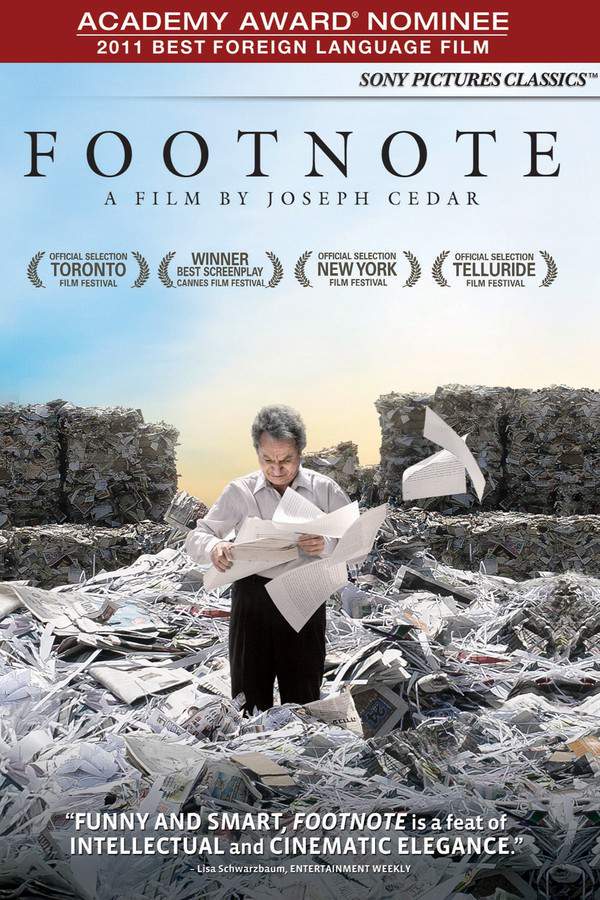
Footnote (2012) movie poster

Timeline

Footnote (2012) Timeline Explained – Every Event in Order

Release, runtime and language
2012 · 103 min · Hebrew
Directed by
Joseph Cedar
Starring
Aliza Rosen, Lior Ashkenazi, Shlomo Bar-Aba

A poignant drama centered on the complicated relationship between two Talmudic scholars, Eliezer and Uriel Shkolnik. Their bond is tested when Eliezer receives Israel’s highest honor, unexpectedly revealing deep insecurities and sparking a crisis of ambition. Uriel is forced to confront his own loyalties and the complexities of their shared history as the recognition threatens to unravel their connection.

On this page (6)
  1. 1 Where to watch
  2. 2 Events in order (12)
  3. 3 Timeline questions answered
  4. 4 Movie threads
  5. 5 Movies like Footnote
  6. 6 Every angle

Where to watch

Where to Watch Footnote (2012)

Where can you watch Footnote? Stream, rent or buy it in the US, including on Amazon Video, Apple TV Store and Fandango At Home: current JustWatch availability with up-to-date prices.

Streaming availability powered by JustWatch

12 events in order · contains spoilers

Footnote Timeline: Events in Chronological Order

Every key event of Footnote (2012) in order, scene by scene, with when and where it takes place. Use it to untangle flashbacks, time jumps and parallel storylines, to refresh your memory before the sequel or to find the exact scene you are thinking of.

  1. Old-school purist vs rising star

    Eliezer Shkolnik is a stubborn philologist whose traditional methods clash with the newer approaches his son uses. He remains unpopular and unrecognized, frustrated that his lifelong research seems to yield little acknowledgment. He witnesses Uriel's charisma and growing popularity among students and the public, highlighting the rift between father and son.

    When
    present day
    Where
    Hebrew University of Jerusalem
  2. Uriel's ascent and recognition

    Uriel becomes a charismatic figure at the university, beloved by students and the general public. His work earns him election to the Israel Academy of Sciences and Humanities, signaling institutional validation. The success of his career sharpens the contrast with his father's obscurity and bitterness.

    When
    present day
    Where
    Israel Academy of Sciences and Humanities / Hebrew University, Jerusalem
  3. Israel Prize laureate news reaches Eliezer

    Eliezer receives a phone call from the Minister of Education's office announcing that he has been elected this year's Israel Prize laureate. The moment marks the pinnacle of official recognition for the old-school scholar. The sense of triumph is tinged with the anxiety of how this will affect his relationship with his son.

    When
    the day of the call
    Where
    Eliezer's home/office
  4. Urgent meeting uncovers a surprising error

    The following day, Uriel is summoned to an urgent Israel Prize committee meeting and learns, to his shock, that the prize was meant for his father, not him. He confronts the committee, arguing that an error must be corrected. In a heated moment, he shoves committee head Grossman, revealing the depth of his frustration and stakes in the outcome.

    When
    the day after Eliezer's prize notification
    Where
    Israel Prize committee meeting room
  5. Uriel confesses the pattern of support

    Uriel relents and asks to break the news to his father personally, but he also reveals that he has submitted his father's name for the Israel Prize year after year. He accuses Grossman of manipulating the recognition in Eliezer's favor. The revelation exposes a long-running family-driven attempt to secure the prize.

    When
    the same day
    Where
    Committee meeting room
  6. Conditions set by the prize committee

    Grossman agrees to salvage the situation but imposes two conditions: Uriel must write the committee's recommendation, and he can never be a candidate for the prize himself. The terms leave Uriel both shocked and resigned to relinquishing his own potential prize in order to help his father.

    When
    post-meeting
    Where
    Israel Prize committee office
  7. Uriel drafts the recommendation; Haaretz interview unfolds

    Uriel begins drafting the official recommendation, choosing words carefully to shape the outcome. At the same time, Eliezer is interviewed by Haaretz, where he challenges the legitimacy of Uriel's research and the new methods in a public forum. The publication cements public debate over merit and recognition.

    When
    after the meeting
    Where
    National Library / Haaretz interview location
  8. Haaretz piece fuels tension; secret remains hidden

    The Haaretz interview goes to print, provoking anger in Uriel while he maintains silence about the underlying truth. Eliezer's public recognition grows, yet the private truth about the prize's origin remains concealed within the family. The quiet secret begins to weigh on the household.

    When
    after the interview
    Where
    Newspaper office/print edition
  9. Mother becomes keeper of the secret

    Uriel slips a whispered confession to his mother, asking her to keep the truth hidden. She agrees to carry the secret, avoiding disclosure to others for the time being. The family maintains a fragile balance as the public narrative continues outward.

    When
    in the following days
    Where
    Home
  10. Eliezer uncovers the author behind the recommendation

    During preparations for a television appearance, Eliezer notices an unfamiliar Talmudic expression in the prize committee's recommendation and cross-checks its published uses. He concludes the text must have been written by Uriel. He also reconstructs his phone conversation with the Minister of Education, realizing she addressed him by his last name, thinking she was speaking to his son.

    When
    on the day of the TV appearance
    Where
    Eliezer's study
  11. The day of the prize ceremony arrives

    Eliezer and his wife arrive at the Jerusalem International Convention Center, each weighed down by tension and distraction. Eliezer is visibly stressed as he readies himself for a ceremony that could redefine his career and his relationship with Uriel. The atmosphere is thick with anticipation and unresolved conflict.

    When
    the day of the prize ceremony
    Where
    Jerusalem International Convention Center
  12. The film ends at the threshold of recognition

    As the laureates are about to be called, the movie stops, leaving the outcome unresolved. The audience is left with the question of who will be lauded and how the truth behind the prize will finally come to light. The tension between father and son remains an open question, fueling reflection on merit, recognition, and family.

    When
    the moment before the laureates are announced
    Where
    Jerusalem International Convention Center

Last updated: October 09, 2025 at 16:25

Was this helpful?

Timeline questions answered

Footnote Timeline Explained: Your Questions Answered

When does it happen, and why in that order? The questions people ask about the chronology of Footnote (2012): time jumps, flashbacks, cause and effect between scenes and the correct order of events, each answered with spoilers.

Q1

Why does Uriel agree to let his father keep the Israel Prize?

Uriel agrees to let his father receive the prize because he discovers that his father has never published anything of lasting significance - his only claim to fame is a passing footnote in someone else's work. Additionally, the committee imposes two conditions: Uriel must draft the recommendation himself, and he can never become a candidate for the prize in the future. Despite this personal sacrifice, Uriel accepts because he cannot bear to devastate his father by revealing the truth after years of secretly submitting his father's name for the award.

Foreshadowing: The film earlier shows Uriel submitting his father's name for the prize every year, hinting at his deep-seated desire to see his father recognized.

  • uriel shkolnik
  • israel prize
  • father son sacrifice
  • academic recognition
Q2

What mistake did the Israel Prize committee make with the award?

The committee accidentally called Eliezer to inform him he had won the prize, when in fact the award was meant for his son Uriel. The error occurred because Uriel's name had been submitted alongside his father's over the years, and the committee confused the two recipients during the announcement process.

Foreshadowing: Earlier scenes establish that Uriel has been secretly submitting his father's name for the prize, which contributed to the administrative confusion.

  • israel prize mistake
  • committee error
  • eliezer shkolnik
  • uriel shkolnik
Q3

How does Eliezer figure out the truth about the prize?

While preparing for his television appearance, Eliezer notices a rare Talmudic expression in the prize committee's recommendation. As a meticulous philologist, he cross-checks the phrase against published uses and realizes it was written by his son Uriel. He also reconstructs his earlier phone conversation with the Minister of Education, recalling that she addressed him by his last name, as if she believed she was speaking to Uriel.

Foreshadowing: The film shows Eliezer's meticulous attention to textual detail throughout, making his discovery feel earned and consistent with his character.

  • eliezer discovers truth
  • text analysis
  • talmudic expression
  • recommendation letter
Q4

Why does Uriel shove Prof. Grossman during the committee meeting?

Uriel shoves committee head Prof. Grossman because Grossman dismisses Eliezer's work as insignificant and suggests that his only real achievement is a footnote in someone else's celebrated research. This directly attacks Uriel's father, whom he has spent years advocating for secretly. The confrontation escalates when Uriel realizes the committee intends to take back the prize that was supposed to honor his father's lifetime of work.

Foreshadowing: Earlier scenes establish the tension between Eliezer and Grossman as rivals who published similar findings, with Grossman publishing just before Eliezer.

  • uriel grossman confrontation
  • israel prize committee
  • emotional outburst
Q5

Why does Uriel submit his father's name for the Israel Prize every year?

Uriel submits his father's name annually because he wants his father to receive the recognition that has eluded him throughout his career. Despite their complicated relationship and Eliezer's old-fashioned methods, Uriel hopes the prize will validate his father's lifetime of work and ease his bitterness. However, Uriel suspects Prof. Grossman of actively working against Eliezer's chances, which adds another layer of frustration to the situation.

Foreshadowing: This pattern is revealed when Uriel confesses to the committee, explaining the long-running family effort to secure recognition for Eliezer.

  • uriel submits father name
  • israel prize
  • family loyalty
  • academic recognition
Q6

What conditions does the prize committee impose on Uriel?

Prof. Grossman offers to salvage the situation with two conditions: Uriel must write the committee's recommendation letter himself, effectively crafting the case for his father's award. Additionally, Uriel can never become a candidate for the Israel Prize himself. These terms effectively end Uriel's own chances at receiving the honor while forcing him to engineer his father's success.

Foreshadowing: The conditions reflect Grossman's earlier dismissal of Eliezer's work and create the moral dilemma that defines the film's climax.

  • committee conditions
  • uriel sacrifice
  • recommendation letter
  • israel prize rules
Q7

What causes tension after Eliezer's Haaretz interview?

During his Haaretz interview, Eliezer publicly questions the legitimacy of his son's research methods and contributions to the field, undermining Uriel's work despite Uriel's success and popularity. The article angers Uriel, who must swallow his frustration while keeping the secret about the prize. The interview represents Eliezer's bitterness manifesting as public criticism of the very son who has achieved what he could not.

Foreshadowing: The scene highlights the complex father-son dynamic, where competition and resentment coexist with familial loyalty.

  • haaretz interview
  • eliezer criticism
  • uriel
  • public debate
  • academic methods
Q8

Why does Uriel's mother agree to keep the prize secret?

Uriel's mother agrees to keep the secret because she wants to protect her husband from the devastating truth that his lifetime of work is considered insignificant. She has lived with Eliezer's bitterness and unfulfilled ambitions for decades, and she understands that revealing the truth would shatter him. She becomes the quiet keeper of the family secret, maintaining the fragile peace.

Foreshadowing: Earlier scenes show her observing the tension between father and son, aware of the dynamics but remaining silent.

  • mother secret
  • family
  • eliezer wife
  • protection
  • truth
Q9

What is the significance of the footnote in the movie's title?

The title refers to Prof. Grossman's remark that Eliezer's only real claim to fame is a passing footnote in someone else's celebrated work. This encapsulates Eliezer's entire career - a lifetime of scholarly effort reduced to a minor reference. The footnote also represents the film's themes of academic recognition, legacy, and how scholars are remembered (or forgotten) in their field.

Foreshadowing: The irony is that Eliezer receives the highest honor despite this footnote being the extent of his recognized contribution.

  • footnote meaning
  • title significance
  • academic legacy
  • grossman remark
Q10

Why does the film end before the prize ceremony?

The film ends at the threshold of the ceremony to preserve the moral ambiguity at its core. By refusing to show who is ultimately called as laureate, the film leaves viewers to grapple with the question of whether recognition should go to merit or to pity. The unresolved ending forces the audience to consider the costs of intergenerational ambition and whether the prize would bring happiness or further complicate the father-son relationship.

Foreshadowing: The entire film builds toward this moment of truth, and the choice to stop before resolution emphasizes that the emotional stakes matter more than the outcome.

  • film ending
  • prize ceremony
  • ambiguity
  • unresolved
  • moral question
Q11

Why does Uriel keep the truth hidden from his father?

Uriel keeps the truth hidden because he fears devastating his father, who has spent decades yearning for this recognition. After learning that his father's work is considered insignificant, Uriel cannot bring himself to shatter the dream that has sustained Eliezer through years of academic frustration. His silence stems from a mix of compassion and the complexity of their relationship - he wants his father to feel valued, even if the means of achieving that feeling is built on a deception.

Foreshadowing: Uriel's earlier decision to submit his father's name repeatedly shows his pattern of protecting his father's emotional needs.

  • uriel silence
  • truth hidden
  • father son relationship
  • protection
  • deception

Movie threads

More Movies Like Footnote, by Mood & Story

Curated lists built around what makes Footnote tick: the same mood, the same kind of story or the same emotional payoff. Each list explains why these movies belong together.

Films About Intellectual Rivalries Like Footnote

Stories where professional competition forces impossible ethical choices. Explore movies with narrative patterns like Footnote, where academic or professional rivalries create intense moral dilemmas. If you enjoyed the complex father-son dynamic and the ethical quandaries in Footnote, you'll find similar stories of ambition, jealousy, and unspoken conflict here.

  • cerebral
  • anxious
  • unsettling
  • claustrophobic
  • melancholic
  • quiet
  • Tone: tense, melancholic
  • Pacing: slow, deliberate
Why these movies?

The story pattern: These narratives typically unveil a coveted honor or achievement that pits colleagues or family members against each other. The central conflict isn't physical but psychological and ethical, forcing characters to choose between their ambitions and their principles, often leading to a deeply ambiguous or bittersweet conclusion.

Why they belong together: Movies in this thread share a focus on cerebral tension, claustrophobic professional settings, and the heavy emotional weight of moral choices. They are united by a slow, deliberate pacing that allows the psychological stakes to build, culminating in a crisis that questions the very meaning of success and legacy.

Movies About Complicated Family Dynamics Like Footnote

Dramas where unspoken histories and resentments slowly fracture familial bonds. Discover films that explore complex family relationships similar to those in Footnote. If you were drawn to the nuanced portrayal of father-son conflict, unspoken resentment, and the burden of legacy, this collection features other quiet, tense dramas about the secrets that divide families.

  • melancholic
  • unsettling
  • quiet
  • cerebral
  • anxious
  • claustrophobic
  • Tone: melancholic, tense
  • Pacing: slow burn, character-focused
Why these movies?

The story pattern: The narrative pattern involves a long-simmering conflict between family members, often parents and children, that is brought to a head by an external event—like an award, a secret revealed, or a return home. The journey is internal, focusing on the characters' struggle with loyalty, jealousy, and the painful weight of their shared history.

Why they belong together: These films are grouped by their shared mood of melancholic unease, their slow-burn pacing that emphasizes character study, and their medium emotional weight derived from relatable familial strife. They create a claustrophobic atmosphere where dialogue is sparse but every glance carries meaning.

If you liked this

Movies Like Footnote

Similar movies to Footnote: the same genre, themes or kind of story. Each one comes with its own plot summary, timeline and ending explained.

Browse all movie summaries

Every angle

Footnote (2012) Explained: Plot, Timeline & Characters

Everything about Footnote in one place: what happens in the plot summary, the timeline in chronological order, the characters and meaning and a spoiler-free summary. What's After the Movie adds the cast, box office and post-credit scenes.

Coming soon on iOS and Android

The Plot Explained Movie Summary App

Plot summaries, endings explained and timelines on your phone. Catch up on any movie in minutes, save your favorites and never miss a twist again.

Be the first to know when we launch. Your email stays private, always.

Learn more about the app