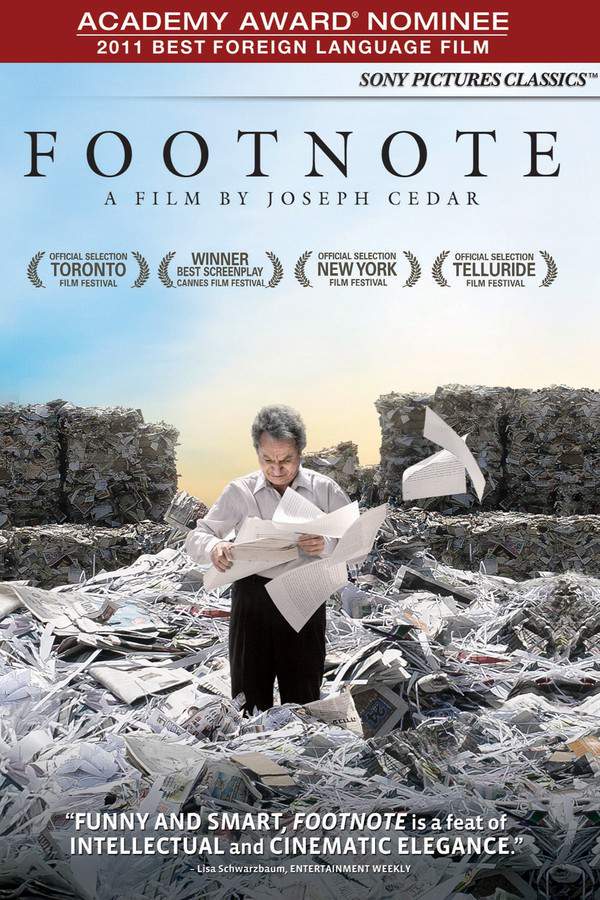
Footnote

Footnote

Year: 2012

Runtime: 103 min

Language: Hebrew

Director: Joseph Cedar

Drama

A poignant drama centered on the complicated relationship between two Talmudic scholars, Eliezer and Uriel Shkolnik. Their bond is tested when Eliezer receives Israel’s highest honor, unexpectedly revealing deep insecurities and sparking a crisis of ambition. Uriel is forced to confront his own loyalties and the complexities of their shared history as the recognition threatens to unravel their connection.

Warning: spoilers below!

Haven’t seen Footnote yet? This summary contains major spoilers. Bookmark the page, watch the movie, and come back for the full breakdown. If you're ready, scroll on and relive the story!

Footnote (2012) – Full Plot Summary & Ending Explained

Read the complete plot breakdown of Footnote (2012), including all key story events, major twists, and the ending explained in detail. Discover what really happened—and what it all means.

Eliezer Shkolnik, Shlomo Bar-Aba, is a meticulous philologist who dedicates his career to the textual tradition of the Jerusalem Talmud. He and his son Uriel, Lior Ashkenazi, are both professors in the Talmudic Research department at the Hebrew University of Jerusalem. Uriel stands out as a charismatic academic, beloved by students and the public alike, and his rising profile brings him public recognition when he is elected as a member of the Israel Academy of Sciences and Humanities. The contrast between father and son is stark: Eliezer remains stubbornly old-school, a purist in his research methods who is widely seen as unpopular, unrewarded, and trapped in the shadow of a rival scholar, Prof. Yehuda Grossman, who published similar findings just before him. Eliezer’s yearning is simple and aching—he dreams of the prestigious Israel Prize, hoping it will finally validate a lifetime of work that has largely gone unrecognized.

Then a surprising call arrives. Eliezer learns that he has been named this year’s laureate, and the news is poised to alter everything. The next day, Uriel is summoned to an urgent meeting with the Israel Prize committee and is told, to his shock, that the announcement was a mistake: it is he, not his father, who should receive the prize. The committee suggests a path to fix the situation, but Uriel hesitates, knowing that confessing the truth to his father could devastate him. He asks to handle the revelation himself, and in the tense exchange with the committee’s head, Prof. Grossman, Uriel loses his temper momentarily and shoves him. After the outburst, he retreats, intent on delivering the news to his father in person.

Uriel then reveals a painful truth: he has been submitting his father’s name for the Israel Prize every year, and he suspects Grossman of actively stymieing Eliezer’s chances. Grossman counters that Eliezer never published anything of lasting significance, and his only real “claim to fame” is a passing footnote in someone else’s celebrated work. Faced with this imbalance, Uriel agrees to a deal: the Prize will go to Eliezer, but with two conditions—Uriel must draft the committee’s recommendation, and he may never become a candidate himself. The decision weighs heavily on him, yet he accepts.

Meanwhile, Eliezer is interviewed by the newspaper Haaretz about his achievements and, perhaps unintentionally, casts doubt on his son’s methods and contributions. The article unsettles Uriel, who is angry but chooses to keep the secret. He eventually confides the truth to his mother, who remains the quiet keeper of the family secret. The tension intensifies when Eliezer, preparing for a television appearance, notices a rare and telling Talmudic expression in the wording of the committee’s recommendation. He rushes back to his study to scrutinize the phrase, cross-checking its published uses, and slowly realizes that the text appeared to be authored by his son. He reconstructs the earlier phone conversation with the Minister of Education, noticing that she addressed him by his last name, as if speaking to his son, further suggesting that the minister believed she was speaking to Uriel.

On the day of the prize ceremony, Eliezer and his wife make their way to the Jerusalem International Convention Center to prepare for the event. The atmosphere is thick with stress and distraction as the family awaits the moment when the laureates are announced. The film closes on a charged, unresolved note, stepping into the moment just before the official call to the stage.

This portrait, built with careful fidelity to its characters and their rifts, invites readers to weigh recognition, merit, and the costs of intergenerational ambition in an academic world where tradition and innovation collide. The film’s quiet intensity rests as much on the personal dynamics between a father and son as on the public ceremony that could redefine their legacies.
Last Updated: October 09, 2025 at 16:25

Mobile App Preview

Coming soon on iOS and Android

The Plot Explained Mobile App

From blockbusters to hidden gems — dive into movie stories anytime, anywhere. Save your favorites, discover plots faster, and never miss a twist again.

Sign up to be the first to know when we launch. Your email stays private — always.

Explore Movie Threads

Discover curated groups of movies connected by mood, themes, and story style. Browse collections built around emotion, atmosphere, and narrative focus to easily find films that match what you feel like watching right now.

Films About Intellectual Rivalries Like Footnote

Stories where professional competition forces impossible ethical choices.Explore movies with narrative patterns like Footnote, where academic or professional rivalries create intense moral dilemmas. If you enjoyed the complex father-son dynamic and the ethical quandaries in Footnote, you'll find similar stories of ambition, jealousy, and unspoken conflict here.

cerebralanxiousunsettlingclaustrophobicmelancholicquietthought-provoking

Narrative Summary

These narratives typically unveil a coveted honor or achievement that pits colleagues or family members against each other. The central conflict isn't physical but psychological and ethical, forcing characters to choose between their ambitions and their principles, often leading to a deeply ambiguous or bittersweet conclusion.

Why These Movies?

Movies in this thread share a focus on cerebral tension, claustrophobic professional settings, and the heavy emotional weight of moral choices. They are united by a slow, deliberate pacing that allows the psychological stakes to build, culminating in a crisis that questions the very meaning of success and legacy.

Movies About Complicated Family Dynamics Like Footnote

Dramas where unspoken histories and resentments slowly fracture familial bonds.Discover films that explore complex family relationships similar to those in Footnote. If you were drawn to the nuanced portrayal of father-son conflict, unspoken resentment, and the burden of legacy, this collection features other quiet, tense dramas about the secrets that divide families.

melancholicunsettlingquietcerebralanxiousclaustrophobicbittersweet

Narrative Summary

The narrative pattern involves a long-simmering conflict between family members, often parents and children, that is brought to a head by an external event—like an award, a secret revealed, or a return home. The journey is internal, focusing on the characters' struggle with loyalty, jealousy, and the painful weight of their shared history.

Why These Movies?

These films are grouped by their shared mood of melancholic unease, their slow-burn pacing that emphasizes character study, and their medium emotional weight derived from relatable familial strife. They create a claustrophobic atmosphere where dialogue is sparse but every glance carries meaning.

Unlock the Full Story of Footnote

Don't stop at just watching — explore Footnote in full detail. From the complete plot summary and scene-by-scene timeline to character breakdowns, thematic analysis, and a deep dive into the ending — every page helps you truly understand what Footnote is all about. Plus, discover what's next after the movie.

Footnote Timeline

Track the full timeline of Footnote with every major event arranged chronologically. Perfect for decoding non-linear storytelling, flashbacks, or parallel narratives with a clear scene-by-scene breakdown.

Footnote Timeline

Characters, Settings & Themes in Footnote

Discover the characters, locations, and core themes that shape Footnote. Get insights into symbolic elements, setting significance, and deeper narrative meaning — ideal for thematic analysis and movie breakdowns.

Characters, Settings & Themes in Footnote

Footnote Spoiler-Free Summary

Get a quick, spoiler-free overview of Footnote that covers the main plot points and key details without revealing any major twists or spoilers. Perfect for those who want to know what to expect before diving in.

Footnote Spoiler-Free Summary

More About Footnote

Visit What's After the Movie to explore more about Footnote: box office results, cast and crew info, production details, post-credit scenes, and external links — all in one place for movie fans and researchers.

More About Footnote

Similar Movies to Footnote

Discover movies like Footnote that share similar genres, themes, and storytelling elements. Whether you’re drawn to the atmosphere, character arcs, or plot structure, these curated recommendations will help you explore more films you’ll love.