Plot Explained Spoilers guaranteed!
Plot Explained

Browse by genre

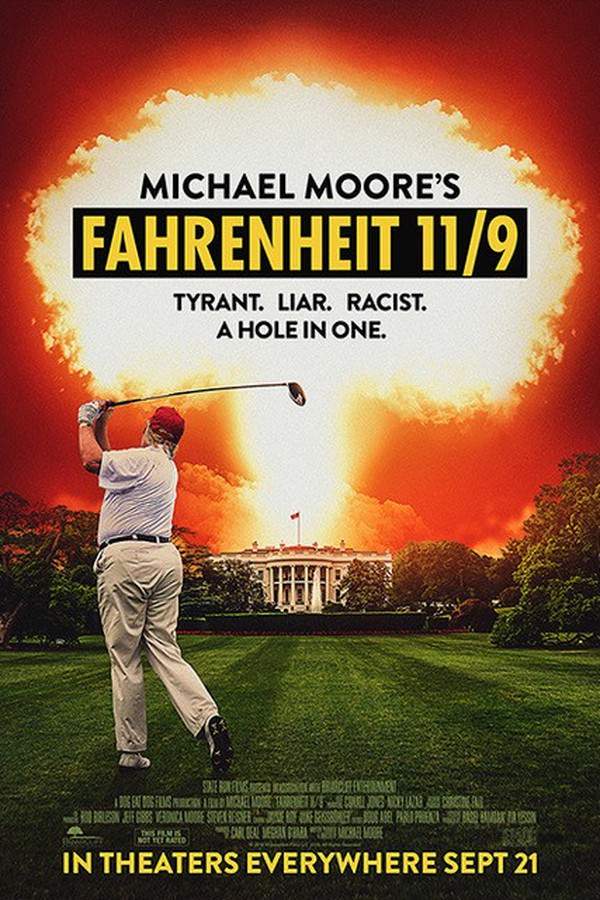
Fahrenheit 11/9 (2018) movie poster

Timeline

Fahrenheit 11/9 (2018) Timeline Explained – Every Event in Order

Release, runtime and language
2018 · 128 min · English
Echo score 60
Loading streaming availability…
Directed by
Michael Moore
Starring
Alexandria Ocasio-Cortez, Steve Bannon, Donald Trump, George W. Bush, Joy Behar, Joe Biden
Budget
$5M

Michael Moore examines the repercussions of Donald Trump’s presidency as he journeys across the United States. He highlights the experiences of citizens grappling with a nation facing significant political and social challenges, including issues with voting systems and government decisions. The film explores tragic events such as the shooting at Parkland and the water crisis in Flint, revealing the widespread effects of the Trump era on communities and individuals.

On this page (6)
  1. 1 Where to watch
  2. 2 Events in order (15)
  3. 3 Timeline questions answered
  4. 4 Movie threads
  5. 5 Movies like Fahrenheit 11/9
  6. 6 Every angle
Loading streaming availability…

15 events in order · contains spoilers

Fahrenheit 11/9 Timeline: Events in Chronological Order

Every key event of Fahrenheit 11/9 (2018) in order, scene by scene, with when and where it takes place. Use it to untangle flashbacks, time jumps and parallel storylines, to refresh your memory before the sequel or to find the exact scene you are thinking of.

  1. The Flint Water Crisis Begins

    Moore examines the 2014 Flint water crisis, which he believes is connected to and inspired by Trump's rise. An appointee of then Republican Michigan Governor Rick Snyder changed the city's water source from Lake Huron to the Flint River. This decision led to toxic levels of lead contaminating the water supply.

    When
    2014
    Where
    Flint, Michigan
  2. Trump's Campaign Starts as a 'Hoax'

    The documentary opens with the claim that Trump's 2016 presidential campaign started out as a hoax, merely to get more media coverage than Gwen Stefani. Trump was reportedly upset that Stefani was being paid more to appear on The Voice than he was on The Apprentice. What began as a supposed publicity stunt would soon spiral into a genuine bid for the presidency.

    When
    2015
    Where
    New York City
  3. NBC Cuts Ties with Trump

    Trump's racist remarks towards Mexicans and Chinese people, along with his belittling of America's current political policies on national television, led NBC to cut their ties with him. The network severed its relationship with the celebrity businessman over his inflammatory statements. At this point, it appeared his television career might be over.

    When
    2015
  4. The Campaign Turns Serious

    Despite NBC dropping him, Trump had gained a large following of supporters during his provocative campaign. This groundswell of backing prompted him to go ahead with his presidential campaign for real. In an ironic twist, NBC began covering Trump again once his candidacy gained momentum.

    When
    2015-2016
  5. Clinton's Unexpected Loss

    The 2016 United States presidential election culminates in the unexpected loss of Hillary Clinton. Donald Trump defies predictions to win the presidency, stunning the nation. The documentary frames this moment as the beginning of a new and troubling political era.

    When
    November 2016
    Where
    United States
  6. Obama's Disappointing Visit to Flint

    Moore criticizes outgoing President Barack Obama for his visit to Flint during the water crisis. The people of Flint expected to receive federal help following the presidential visit. However, Moore argues that Obama's trip did not live up to the expectations of the suffering residents.

    When
    2016
    Where
    Flint, Michigan
  7. The Era of the Trump Administration

    The documentary explores the presidency of Donald Trump and asks two central questions: how the U.S. progressed to the Trump presidency, and how to 'get out' of the era of the Trump administration. The distributor describes the film as a provocative and comedic look at the times in which we live. Moore dissects the forces that made Trump's rise possible.

    When
    2017
    Where
    Washington, D.C.
  8. Stoneman Douglas High School Shooting

    Moore focuses on the 2018 Stoneman Douglas High School shooting in Parkland, Florida, as a pivotal tragedy of the Trump era. The devastating attack on students and teachers reignited the national debate over gun violence. The shooting becomes a catalyst for a new wave of youth political activism.

    When
    2018
    Where
    Parkland, Florida
  9. March for Our Lives

    In response to the Parkland shooting, the March for Our Lives protest sweeps across the United States, calling for gun control measures. Moore highlights the movement as a sign of resistance and civic engagement. He also criticizes politicians who receive campaign donations from the National Rifle Association.

    When
    2018
    Where
    United States
  10. Parallels with Hitler and the Nazis

    Moore draws provocative comparisons between Trump's rise to power and that of Adolf Hitler and the Nazi Party. He parallels the Reichstag fire with the September 11 attacks as events exploited for political purposes. He also compares Hitler's speeches blaming different ethnicities, religions, and sexual orientations for Germany's problems to some of Trump's comments.

  11. Racial Violence Inspired by Trump

    The documentary showcases then-recent instances of unprovoked racial violence across the country. Moore states that these acts were inspired by Trump's rhetoric and presidency. The incidents serve as troubling evidence of the atmosphere taking hold during this period.

  12. Voices of a New Political Generation

    The film features cameos of left-wing activist politicians like Alexandria Ocasio-Cortez and Rashida Tlaib. These rising stars represent a new wave of progressive leadership emerging in response to the Trump era. Their inclusion signals Moore's hope for political renewal.

  13. Moore's Cinematic Track Record

    To support his argument, Moore cites his previous documentaries: Roger and Me, Bowling for Columbine, and Capitalism: A Love Story. Notably, Trump himself stated in an interview with Roseanne Barr that he enjoyed Roger and Me. These films trace Moore's decades-long critique of American capitalism and power.

  14. The Constitution Fails Ordinary Americans

    In the conclusion of the film, Moore contends that the United States Constitution no longer protects normal Americans from the wealthy and powerful of American society. He argues that the American Dream is now nothing more than a mere dream. The promises once made to citizens have been hollowed out in favor of the elite.

  15. A Country 'Starting Anew'

    Moore argues that after presidents like Ronald Reagan, Bill Clinton, George W. Bush, and Barack Obama, the country needed to see a president like Trump in order to wake up to reality. He believes the United States has become a country not worth saving in its current form, but one that must start anew. The film closes with this defiant call for fundamental transformation rather than restoration.

Last updated: October 18, 2026 at 17:28

Was this helpful?

Timeline questions answered

Fahrenheit 11/9 Timeline Explained: Your Questions Answered

When does it happen, and why in that order? The questions people ask about the chronology of Fahrenheit 11/9 (2018): time jumps, flashbacks, cause and effect between scenes and the correct order of events, each answered with spoilers.

Q1

Why does Moore claim Trump's 2016 presidential campaign started as a hoax?

The documentary opens by arguing that Fahrenheit 11/9 Trump's 2016 run was never meant to be a serious political bid. According to Moore, Trump was reportedly frustrated that NBC was paying Gwen Stefani more to appear on The Voice than he received for hosting The Apprentice. The campaign, in this framing, was originally designed as leverage to demand more attention and money from NBC, before spiraling into a genuine candidacy once it attracted a large base of supporters.

Foreshadowing: The opening Gwen Stefani anecdote establishes the media-economics thesis that recurs throughout the rest of Fahrenheit 11/9.

  • trump campaign hoax
  • publicity stunt
  • gwen stefani
  • nbc apprentice
Q2

How does Flint's water crisis connect to Donald Trump's rise in the documentary?

Moore frames the 2014 Flint water crisis as one of the governmental failures that made Trump's victory possible. An appointee of Republican Michigan Governor Rick Snyder switched Flint's water source from Lake Huron to the Flint River, exposing residents to toxic lead levels. Fahrenheit 11/9 presents this disaster as proof that ordinary Americans had already been abandoned by their government long before Trump took office, laying the groundwork for his appeal.

  • flint water crisis
  • lead poisoning
  • rick snyder
  • michigan government failure
Q3

Why did NBC cut ties with Trump and then resume covering his campaign?

NBC severed its relationship with Trump after his racist remarks about Mexicans and Chinese people and his belittling of American political policies on national television. However, once Trump announced his presidential bid and began drawing large crowds, NBC resumed covering him because his candidacy became commercially valuable for ratings. Fahrenheit 11/9 uses this reversal to argue that media incentives, not journalistic principles, shaped Trump's ascent.

  • nbc
  • the apprentice
  • media coverage
  • trump racism
Q4

What is Moore's criticism of Obama's visit to Flint?

Moore argues that President Barack Obama's 2016 visit to Flint was performative rather than substantive. Residents had hoped the presidential visit would bring meaningful federal help for the lead-contaminated water, but Moore contends that Obama left without delivering real relief. The disappointment is used in Fahrenheit 11/9 to show that even Democratic leadership failed the communities most in need of government action.

  • obama flint visit
  • federal help
  • michael moore criticism
  • lead water
Q5

How does Moore connect the Parkland shooting to the Trump era?

Fahrenheit 11/9 treats the 2018 Stoneman Douglas High School shooting in Parkland, Florida as a tragedy that was enabled by the political climate of the Trump presidency. Moore ties the attack to politicians funded by the National Rifle Association who blocked gun control measures for years. The subsequent March for Our Lives movement is presented as a youth-led backlash against both the violence and the political inaction that allowed it to continue.

  • parkland shooting
  • stoneman douglas
  • march for our lives
  • gun control
Q6

What specific parallels does the documentary draw between Trump and Hitler?

Moore draws a direct line between Trump's political rise and that of Adolf Hitler and the Nazi Party in 1930s Germany. He highlights Hitler's speeches scapegoating Jews, other minorities, and LGBTQ+ Germans as structurally similar to Trump's targeting of various groups in America. The parallel is presented in Fahrenheit 11/9 to argue that demagogues historically exploit economic anxiety and blame marginalized communities to consolidate power.

  • trump hitler parallel
  • nazi rise
  • scapegoating
  • demagogue comparison
Q7

Why does Moore compare the Reichstag fire to the September 11 attacks?

Moore frames the 1933 burning of the Reichstag and the September 11, 2001 attacks as two separate crises that leaders exploited to consolidate power and erode civil liberties. Both events, in his telling, allowed governments to push legislation and expand executive authority that benefited political elites rather than ordinary citizens. Fahrenheit 11/9 uses the comparison to argue that manipulating public fear after tragedy is a recurring pattern in modern political history.

  • reichstag fire
  • 9/11 attacks
  • political exploitation
  • executive power
Q8

Why does the film criticize politicians who take NRA donations?

Moore argues that campaign contributions from the National Rifle Association have prevented meaningful gun control legislation despite repeated mass shootings. He frames the NRA's financial influence as a central reason why tragedies like Parkland were allowed to happen without policy change. This critique supports his broader Fahrenheit 11/9 thesis that ordinary Americans are outmatched by powerful lobbying groups funded by wealthy interests.

  • nra donations
  • gun lobby
  • politicians
  • campaign contributions
Q9

What does Moore mean when he says the Constitution no longer protects ordinary Americans?

Moore contends that the U.S. Constitution has been hollowed out so that it no longer shields working-class Americans from the wealthy and politically connected. He cites unpunished corporate misconduct, the unaddressed Flint water crisis, and inaction on gun violence as evidence that constitutional protections exist on paper only. In Fahrenheit 11/9, the Constitution is framed as a tool that now serves elites rather than the people it was written to protect.

  • constitution
  • ordinary americans
  • american dream
  • elite power
Q10

Why does Moore conclude that America is "not worth saving"?

In the closing of Fahrenheit 11/9, Moore argues that the United States in its current form is "not worth saving" and must instead be "started anew." He traces decades of leadership under Reagan, Clinton, Bush, and Obama as having systematically deepened inequality and protected corporate power. The phrase is meant to reject incremental reform and call for fundamental structural change rather than a return to a previous political era.

  • america not worth saving
  • starting anew
  • structural change
  • michael moore thesis
Q11

How does Moore trace Trump's rise back to previous presidents like Reagan and Bush?

Moore argues that Trump's victory was the predictable outcome of policies stretching back to Ronald Reagan and continuing through Bill Clinton, George W. Bush, and Barack Obama. In Fahrenheit 11/9, each administration is presented as having deepened corporate power, weakened labor protections, and normalized corruption in Washington. Trump is framed less as the cause of America's problems and more as the symptom of decades of policy that prioritized the wealthy.

  • reagan
  • clinton
  • bush
  • obama
  • path to trump
  • policy failures
Q12

Why does Moore open the documentary with the Gwen Stefani comparison?

The opening comparison between Trump and Gwen Stefani establishes Moore's central argument that Trump's campaign was driven by media economics rather than political conviction. Trump supposedly resented that NBC paid Stefani more for The Voice than he earned on The Apprentice, which prompted his presidential run as leverage for higher pay and better press. This anecdote sets up Fahrenheit 11/9's broader critique of how celebrity culture and ratings-driven media created the conditions for Trump's rise.

  • gwen stefani
  • the voice
  • the apprentice
  • nbc pay dispute
Q13

What instances of racial violence does Moore attribute to Trump's rhetoric?

Fahrenheit 11/9 showcases then-recent incidents of unprovoked racial violence across the United States and directly links them to Trump's inflammatory public statements. Moore argues that by repeatedly attacking immigrants, minorities, and other marginalized groups, Trump created what amounts to a permission structure for hate crimes. The footage is presented as evidence that the political climate of his presidency had tangible, violent consequences for vulnerable communities.

  • racial violence
  • hate crimes
  • trump rhetoric
  • white supremacist attacks
Q14

Why are Alexandria Ocasio-Cortez and Rashida Tlaib featured in the film?

Alexandria Ocasio-Cortez and Rashida Tlaib are featured in Fahrenheit 11/9 as representatives of a new generation of progressive politicians emerging in response to the Trump era. Moore includes their cameos to suggest that grassroots movements and insurgent candidates could push back against the political and corporate failures he documents. Their appearances offer a cautious note of hope at the end of an otherwise bleak documentary.

  • alexandria ocasio-cortez
  • rashida tlaib
  • progressive politicians
  • new generation

Movie threads

More Movies Like Fahrenheit 11/9, by Mood & Story

Curated lists built around what makes Fahrenheit 11/9 tick: the same mood, the same kind of story or the same emotional payoff. Each list explains why these movies belong together.

Outrage documentaries like Fahrenheit 11/9

Provocative documentaries that expose power, corruption, and institutional rot with furious clarity. If you liked Fahrenheit 11/9, you'll love these fearless political documentaries that use satire and investigative grit to expose corruption, demand accountability, and shake comfortable consensus. Perfect for viewers searching for movies like Fahrenheit 11/9 that channel urgent outrage into compelling, provocative storytelling on similar political themes.

  • provocative
  • incendiary
  • outraged
  • confrontational
  • urgent
  • satirical
  • Tone: dark, satirical, indignant
  • Pacing: variable, montage-driven
Why these movies?

The story pattern: Films in this thread typically build a mosaic of evidence through interviews, archival footage, and pointed narration, layering one injustice atop another to construct an unignorable thesis. The narrative arc moves from exposé to indictment, often climaxing in a call to action or a bleak verdict on the state of institutions, and rarely offers easy resolution.

Why they belong together: They share a confrontational stance toward power, a willingness to name names, and a tonal blend of dark comedy and genuine sorrow. What unites them is the pacing rhythm of satirical interludes puncturing sobering testimony, and an ending that leaves the viewer stirred, unsettled, and politically awake.
Movies about institutional failure like Fahrenheit 11/9

Heavy stories that portray a nation cracking under corruption, violence, and broken promises. If Fahrenheit 11/9 left you shaken, explore these powerful dramas and documentaries tackling American institutional decay, gun violence, environmental injustice, and democratic crisis. Essential viewing for anyone searching for movies like Fahrenheit 11/9 that unflinchingly examine political corruption and societal collapse.

  • heavy
  • somber
  • bleak
  • disturbing
  • confrontational
  • urgent
  • Tone: dark, somber, bleak
  • Pacing: variable, reflective to urgent
Why these movies?

The story pattern: Stories often intercut multiple intersecting crises to argue a sweeping thesis, moving between communities suffering real consequences and the systems that failed them. Character arcs belong less to individuals and more to cities, voters, and victims of policy, building cumulative weight toward an ending that refuses easy redemption.

Why they belong together: Grouped for their shared preoccupation with systemic rather than personal failure, and for their unflinching willingness to depict tragedy without softening the frame. They reward viewers who want emotionally heavy, complex stories where the subject matter itself drives the structure.

If you liked this

Movies Like Fahrenheit 11/9

Similar movies to Fahrenheit 11/9: the same genre, themes or kind of story. Each one comes with its own plot summary, timeline and ending explained.

Browse all movie summaries

Every angle

Fahrenheit 11/9 (2018) Explained: Plot, Timeline & Characters

Everything about Fahrenheit 11/9 in one place: what happens in the plot summary, the timeline in chronological order, the characters and meaning and a spoiler-free summary. What's After the Movie adds the cast, box office and post-credit scenes.

Coming soon on iOS and Android

The Plot Explained Movie Summary App

Plot summaries, endings explained and timelines on your phone. Catch up on any movie in minutes, save your favorites and never miss a twist again.

Be the first to know when we launch. Your email stays private, always.

Learn more about the app