Plot Explained Spoilers guaranteed!
Plot Explained

Browse by genre

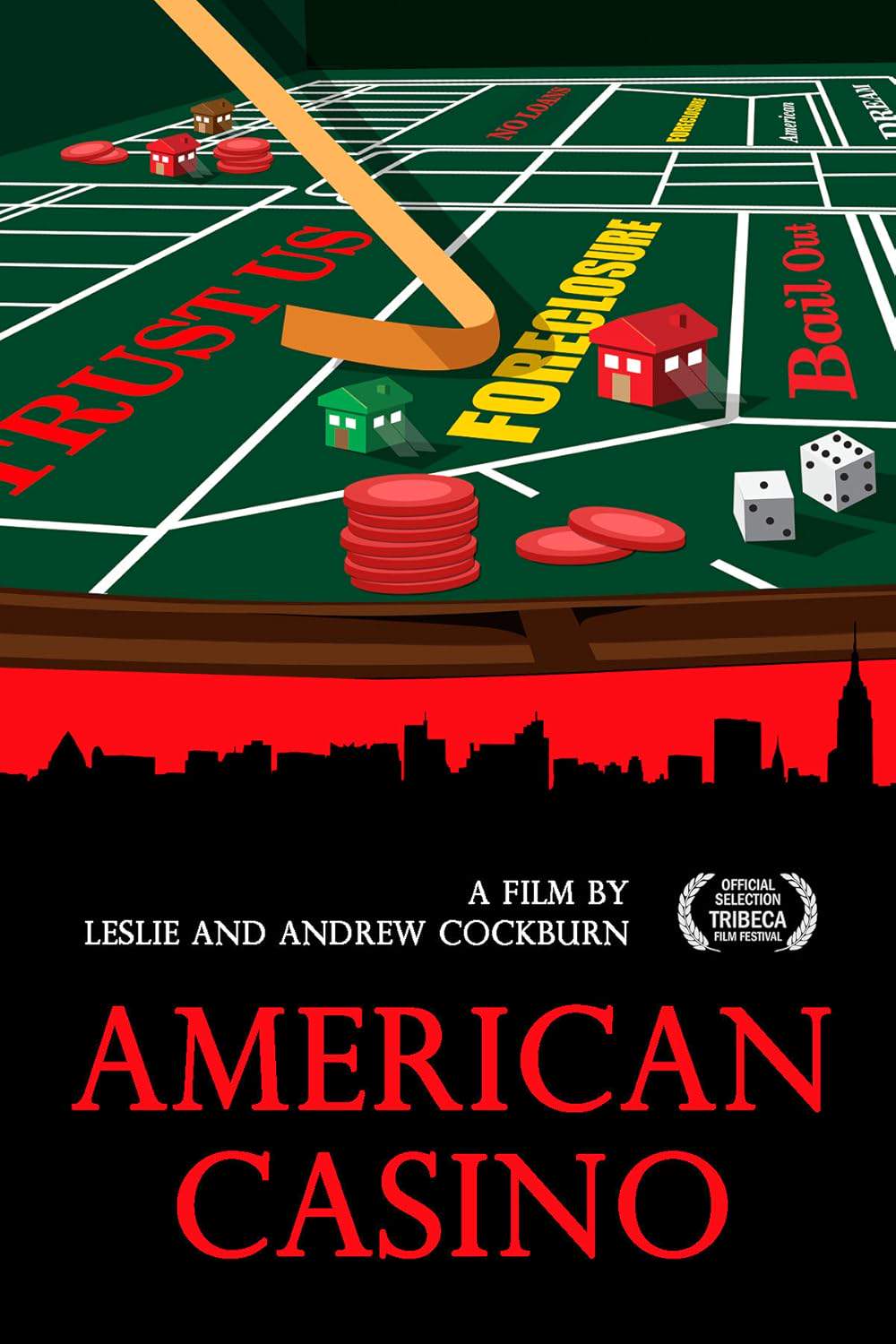
American Casino (2009) movie poster

Plot Summary

American Casino (2009) Plot Summary Explained

Release, runtime and language
2009 · 89 min · English
Directed by
Leslie Cockburn

This documentary examines the alarming collapse of the financial system and the disappearance of over $12 trillion. It reveals the devastating impact of the crisis, focusing on communities like Riverside, California, which faced economic ruin. Once a thriving city, it’s now struggling with the consequences, including abandoned properties and widespread hardship, highlighting the human cost of the financial meltdown.

On this page (5)
  1. 1 What happens: full plot
  2. 2 Plot questions answered
  3. 3 Movie threads
  4. 4 Movies like American Casino
  5. 5 Every angle

Full plot summary · contains spoilers

What Happens in American Casino: Full Plot Summary

The whole story of American Casino (2009) explained, from the opening scene to the final frame: every key event, every twist and what it all adds up to. Read it as a quick recap before the sequel, to check a scene you missed, or to finally understand what really happened.

In We All Lost, the gripping narrative unfolds as award-winning financial reporter Mark Pittman shares a striking observation: "I don’t think most people really understood that they were in a casino." This film meticulously reveals the elaborate scheme that led to the disappearance of over $8 trillion of our money, likening it to a high-stakes game in the American casino.

The narrative introduces us to real individuals from Baltimore, showcasing their personal stories rather than the stereotypical spendthrifts often associated with Wall Street. Among them are a dedicated high school teacher, a compassionate therapist, and a committed church minister. All were seduced by the allure of the American Dream, only to later uncover a harsh reality. The film sheds a poignant light on how African Americans and other minorities became prime targets for subprime loans, a devastating decision that set the stage for countless financial tragedies. According to the Federal Reserve, these individuals were four times more likely to be sold subprime loans compared to their white counterparts.

As we delve deeper, we meet various players in this financial catastrophe. A banker reveals how he crafted complex securities, calling them "fourth dimensional", which were sold to unsuspecting buyers. Meanwhile, a senior executive from a Wall Street ratings agency candidly shares how he was pressured to speculate on the value of billion-dollar securities. A mortgage loan salesman exposes the uncomfortable truth of inflating borrowers' incomes to secure loans. Lastly, a billionaire recounts a chilling gamble where he bet on the misfortune of others, ending up with a staggering $500 million profit from the ordeal.

The film paints a stark picture of the collateral damage inflicted as the global financial system teeters on the brink of collapse. With lawmakers looking on in bewilderment, struggling to rein in the Wall Street moguls, we witness the casino's grim conclusion. The camera takes us to Riverside, California, a desolate landscape marred by foreclosures, where abandoned homes devolve into havens for rats and methamphetamine labs, fostering an environment where disease-riddled mosquitoes thrive in the stagnant waters of broken dreams.

Filmed meticulously over a twelve-month period in 2008, American Casino immerses viewers into a perilous game that our grandchildren will likely wish to avoid at all costs.
Last updated: October 25, 2024 at 10:26

Was this helpful?

Plot questions answered

American Casino Plot Explained: Your Questions Answered

The questions people ask most about American Casino (2009): what happens in the confusing scenes, why the characters do what they do, the twists, hidden details and what the ending means. Each answer contains spoilers.

Q1

Why were African Americans more likely to receive subprime loans?

The film reveals that African Americans and other minorities were deliberately targeted for subprime loans, being four times more likely to receive them compared to white borrowers. This was a systemic practice where lenders specifically marketed predatory loans to minority communities, exploiting the promise of the American Dream. The Federal Reserve data cited in the film confirms this stark disparity, showing that racial discrimination was built into the lending industry's business model during the housing boom.

Foreshadowing: The film sets up this disparity early by introducing real people from Baltimore who were seduced by the promise of homeownership.

  • subprime loans
  • African Americans
  • predatory lending
  • racial discrimination
  • housing crisis
Q2

What were 'fourth dimensional' securities?

Fourth dimensional securities were complex financial products created by bankers that combined multiple mortgages into investment packages. The term was used to describe how these securities bundled countless subprime mortgages together, making them nearly impossible to value accurately. These products were designed to appear safe and stable while actually containing massive hidden risk, and they were sold to unsuspecting investors who trusted the ratings assigned to them.

Foreshadowing: This concept is introduced early when Mark Pittman likens the financial system to a casino, setting up the idea that the rules were rigged.

  • fourth dimensional securities
  • complex securities
  • mortgage backed securities
  • financial products
Q3

How did over $8 trillion disappear from the financial system?

The $8 trillion vanished through an elaborate scheme involving complex securities, fraudulent lending practices, and Wall Street speculation. Mortgage loan originators inflated borrowers' incomes to qualify them for loans they couldn't afford, then sold these bad loans to be packaged into securities. Ratings agencies were pressured to give these toxic assets AAA ratings, while hedge funds and billionaires bet against them. When the housing market collapsed, the entire pyramid scheme collapsed with it, wiping out trillions in value.

Foreshadowing: The film establishes early on that most people didn't understand they were in a casino, hinting at how the money disappeared through opaque mechanisms.

  • 8 trillion
  • financial collapse
  • money disappeared
  • housing market crash
  • securitization
Q4

Why did ratings agencies give false ratings to risky securities?

A senior executive from a Wall Street ratings agency explains in the film that he was pressured to speculate on the value of billion-dollar securities rather than honestly assess their risk. The pressure came from the fact that rating agencies were paid by the banks creating these securities, creating a fundamental conflict of interest. When banks threatened to take their business elsewhere, analysts were pressured to inflate ratings regardless of the actual risk, ensuring a steady flow of business.

Foreshadowing: This explains why the securities were able to be sold so widely - their AAA ratings made them appear safe to institutional investors.

  • ratings agencies
  • AAA rating
  • conflict of interest
  • Wall Street
  • mortgage securities
Q5

What happened to Riverside, California after the financial collapse?

Riverside, California became one of the most visible symbols of the financial crisis fallout. The film shows abandoned homes overrun by rats and converted into methamphetamine labs. Stagnant water in foreclosed swimming pools created breeding grounds for disease-riddled mosquitoes. The once-thriving community was left devastated by waves of foreclosures, illustrating the direct human cost of the financial disaster that unfolded on Wall Street.

Foreshadowing: The film foreshadows this devastation earlier when it shows how ordinary people were convinced to take on mortgages they couldn't afford.

  • Riverside California
  • foreclosures
  • abandoned homes
  • housing crisis
  • community impact
Q6

How did a billionaire profit $500 million from the crisis?

A billionaire featured in the film describes a chilling gamble where he bet against the mortgage-backed securities that he knew were doomed to fail. He essentially purchased insurance that would pay out if the underlying loans defaulted. When the housing market collapsed and millions of homeowners defaulted, this bet paid off massively, generating $500 million in profit from others' misfortune. This represents the stark contrast between the financial elite who could hedge their bets and ordinary homeowners who lost everything.

Foreshadowing: This moment connects back to Mark Pittman's opening observation about being in a casino - the billionaire was literally gambling on the collapse.

  • billionaire profit
  • 500 million
  • bet against
  • housing market crash
  • hedge fund
Q7

Why were ordinary people lured into risky mortgages?

The film features real people from Baltimore - a high school teacher, therapist, and church minister - who were all pursuing the traditional American Dream of homeownership. Lenders targeted these aspirations by making mortgages seem accessible and affordable, while hiding the true costs and risks. These weren't the stereotypical irresponsible spenders often blamed for the crisis; they were hardworking individuals who trusted the financial system and believed homeownership was within their reach, only to discover they had been sold loans they couldn't sustain.

Foreshadowing: The film establishes early that most people didn't understand they were in a casino, suggesting the deck was stacked against ordinary borrowers from the start.

  • American Dream
  • homeownership
  • ordinary people
  • Baltimore
  • predatory lending
Q8

What was income inflation in mortgage lending?

Income inflation was a widespread practice where mortgage loan salespeople would inflate borrowers' stated incomes to help them qualify for larger loans than they could actually afford. A mortgage loan salesman in the film exposes this practice, explaining that artificially boosting income numbers on loan applications was routine. This directly contributed to the crisis by placing millions of homeowners in mortgages they were never financially capable of maintaining, ensuring defaults were inevitable when circumstances changed.

Foreshadowing: This practice explains how so many unqualified borrowers got approved for mortgages in the first place.

  • income inflation
  • mortgage fraud
  • loan applications
  • predatory lending
  • subprime mortgages
Q9

Why were lawmakers unable to prevent the financial collapse?

The film depicts lawmakers appearing bewildered as they struggled to understand the complex financial instruments driving the crisis. Many lacked the technical expertise to recognize the systemic risk building in the financial system. Meanwhile, Wall Street interests wielded significant political influence to block meaningful regulation. The narrative shows legislators essentially watching helplessly as the crisis unfolded, unable or unwilling to rein in the practices that were creating the housing bubble.

Foreshadowing: The film establishes early that this was a game with hidden rules that most people - including those in power - didn't understand.

  • lawmakers
  • regulation
  • congress
  • financial reform
  • government response
Q10

Why is the documentary titled 'American Casino'?

The title comes from Mark Pittman's observation in the opening of the film: 'I don't think most people really understood that they were in a casino.' The documentary uses this casino metaphor to explain that the financial system had become a massive gambling operation where ordinary Americans were unknowingly placing their financial futures at stake, while Wall Street professionals controlled the odds. The film argues that the entire system - from subprime lending to complex securities to regulatory failure - functioned like an elaborate casino where the house always won.

Foreshadowing: This quote appears in the very first moments of the film and frames the entire narrative.

  • American Casino
  • title meaning
  • Mark Pittman
  • casino metaphor
  • financial system
Q11

What is the human cost of the financial crisis shown in the film?

The documentary shows the human cost through the lens of communities like Riverside, California and real families in Baltimore who lost everything. Beyond the statistics, viewers see abandoned properties becoming hazards, families displaced from homes, and the devastation of communities that had once embodied the American Dream. The film argues that while the financial system collapsed mathematically, the real impact was measured in human suffering - lost homes, shattered savings, and broken trust in the economic system.

Foreshadowing: The film builds toward this realization by first explaining the mechanics, then showing the devastating consequences.

  • human cost
  • foreclosures
  • community devastation
  • financial crisis impact
  • American Dream

Movie threads

More Movies Like American Casino, by Mood & Story

Curated lists built around what makes American Casino tick: the same mood, the same kind of story or the same emotional payoff. Each list explains why these movies belong together.

Gripping systemic exposés like American Casino

Documentaries that reveal how large systems fail, causing real human suffering. If you appreciated the deep dive into systemic failure in American Casino, explore more movies like it. This thread features documentaries and dramas that uncover the mechanisms behind large-scale collapses, revealing the human cost of corruption and institutional breakdown.

  • exposé
  • gripping
  • devastating
  • anxious
  • somber
  • ominous
  • Tone: dark, stark, disillusioned
  • Pacing: steady, methodical
Why these movies?

The story pattern: Stories in this thread typically unfold by explaining a complex system, introducing the key players (both perpetrators and victims), and then chronicling the inevitable collapse. The narrative arc is one of discovery and revelation, often ending with a bleak acknowledgment of the lasting damage and the systems' resilience against change.

Why they belong together: Movies are grouped here for their shared focus on exposing systemic failures, their methodical and complex narrative structure, and their dark, heavy tone that balances intellectual inquiry with deep emotional impact.

Movies about economic despair similar to American Casino

Stories grounded in the harsh realities of economic hardship and social decay. For viewers who were gripped by the economic ruin portrayed in American Casino, this thread collects similar movies that explore financial collapse and its human toll. Find films with a bleak tone and heavy emotional weight that document the real-world impact of economic systems.

  • devastating
  • anxious
  • somber
  • gripping
  • stark
  • harsh
  • Tone: bleak, somber, anxious
  • Pacing: steady, grounded
Why these movies?

The story pattern: The narrative pattern is one of decline and endurance. Characters or communities start from a point of stability or aspiration, only to be gradually worn down by forces beyond their control. The conflict is often against an impersonal system, leading to a sense of powerlessness and a bleak resolution.

Why they belong together: These films share a dark, bleak tone, a high emotional weight centered on anxiety and despair, and a common setting in economically devastated worlds. The pacing is often steady, building a somber and realistic portrait of hardship.

If you liked this

Movies Like American Casino

Similar movies to American Casino: the same genre, themes or kind of story. Each one comes with its own plot summary, timeline and ending explained.

Browse all movie summaries

Every angle

American Casino (2009) Explained: Plot, Timeline & Characters

Everything about American Casino in one place: what happens in the plot summary, the timeline in chronological order, the characters and meaning and a spoiler-free summary. What's After the Movie adds the cast, box office and post-credit scenes.

Coming soon on iOS and Android

The Plot Explained Movie Summary App

Plot summaries, endings explained and timelines on your phone. Catch up on any movie in minutes, save your favorites and never miss a twist again.

Be the first to know when we launch. Your email stays private, always.

Learn more about the app