Year: 2016
Runtime: 102 min
Language: English
Director: Gavin Hood
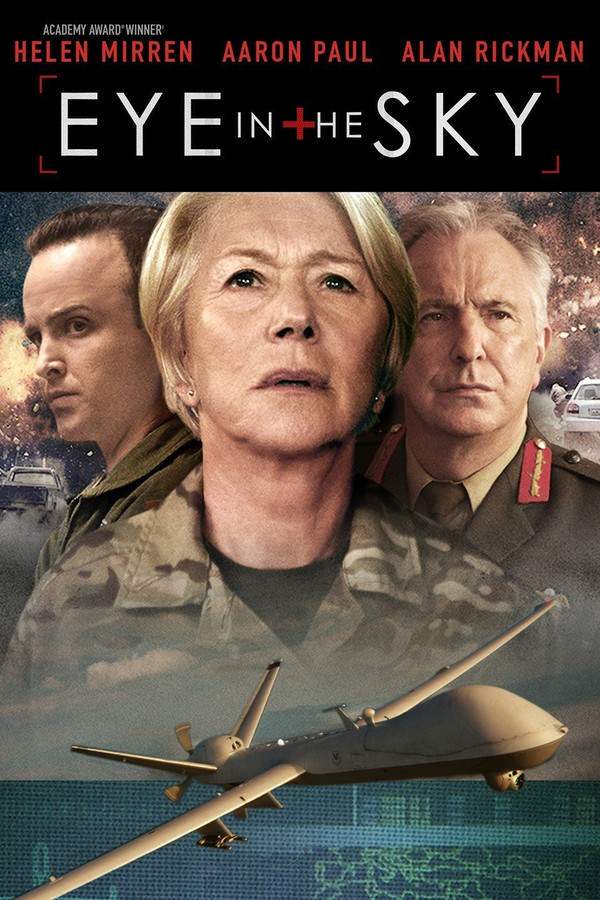
During a counterterrorism operation in Kenya, a British intelligence team identifies terrorists planning a deadly attack. As the team prepares to strike with a drone, a sudden development places an innocent civilian in the target zone. Colonel Katherine Powell must weigh the potential loss of life against the risk of an imminent terrorist strike, sparking a tense ethical dilemma and a global crisis involving multiple governments.
Warning: spoilers below!
Haven’t seen Eye in the Sky yet? This summary contains major spoilers. Bookmark the page, watch the movie, and come back for the full breakdown. If you're ready, scroll on and relive the story!
Read the complete plot breakdown of Eye in the Sky (2016), including all key story events, major twists, and the ending explained in detail. Discover what really happened—and what it all means.
Colonel Katherine Powell [Helen Mirren] wakes up to word that an undercover British/Kenyan operative has been killed by the Al-Shabaab network, setting off a tense, multi-layered response staged from Northwood Headquarters. From this command center, she leads a mission aimed at capturing three of the ten highest‑level Al-Shabaab leaders who are gathered in a safe house in Nairobi, a plan that threads together a multinational team, high‑tech surveillance, and delicate political calculus.
A global collaboration forms the backbone of the operation. A diverse, digitally connected team coordinates the capture through a web of live video and audio feeds, while an unmanned aerial system keeps watch from above: a USAF MQ-9 Reaper drone, controlled from Creech Air Force Base in Nevada by Second Lieutenant Steve Watts [Aaron Paul]. The drone work is complemented by on‑the‑ground intelligence from undercover Kenyan field agents, including Jama Farah [Barkhad Abdi], who use tiny, cutting‑edge cameras—ornithopters and insectothopter devices—to link ground facts with aerial data. Kenyan special forces lie in wait nearby, primed to execute the arrest if the targets come out.
At the same time, a sophisticated facial recognition array at Joint Intelligence Center Pacific in Hawaii helps identify the targets as they surface in the threat picture. Back in the UK, the mission operates under the umbrella of a COBRA meeting, which includes British Lieutenant General Frank Benson [Alan Rickman], two senior ministers, and a ministerial under‑secretary, all weighing the option of how to proceed.
As the intelligence accumulates, Farah discovers a dangerous twist: the three high‑level targets are arming two suicide bombers, signaling an imminent attack on a civilian target. Powell faces a critical pivot: the mission shifts from a capture operation to a kill mission. She asks Watts to prepare a precise Hellfire missile strike on the building, while seeking the counsel of the British Army legal team. The legal advisor cautions that formal approval from higher authorities is required, complicating the chain of command.
Benson and the COBRA members hesitate, and the question is pushed up the line to the UK Foreign Secretary, who happens to be abroad on a trade mission in Singapore. The Foreign Secretary defers to the United States, where the Secretary of State immediately deems the American suicide bomber an enemy of the state, yet the UK side insists on due diligence to minimize civilian harm. The tension intensifies as the clock ticks and the political debate intensifies across both sides of the Atlantic.
Amidst this, Alia [Phoebe Fox], a neighbor who lives near the target building and helps her mother by selling bread, becomes a focal point in the risk calculations. The military and political minds argue about whether it is permissible to launch a strike in a country that is not at war with the US or UK, legally and morally justifiable given the potential for collateral damage. Watts, watching the live feed, sees the more immediate risk in the image of a small girl outside the building and they seek to delay firing until there is a clearer sign that Alia has moved away.
Farah’s cover is jeopardized when he is tasked with buying Alia’s bread to clear her path, and although he succeeds briefly, his plan blows his cover and he must retreat without completing the objective. Powell pushes for a decision, directing her risk‑assessment officer to find parameters that yield a lower civilian‑death figure of 45 percent, then re‑evaluates to a broader 45–65 percent range. The officer is pressured to confirm only the lower figure before the information is passed up the chain, and the strike is eventually authorized.
The countdown culminates in a missile strike on the target site. Watts fires, and the blast destroys the building and injures Alia, though one conspirator survives the attack. A second missile is ordered to finish the job, arriving as Alia’s parents rush to her side. They carry her toward a hospital, but she is pronounced dead.
Back in the London situation room, the under‑secretary lashes Benson for making a kill decision from the relative safety of a chair, prompting a sharp counterpoint: Benson reminds her that he has stood on the ground through multiple bombings and, in a hard‑won moment of resolve, delivers a line that resonates with the cost of war: “Never tell a soldier that he does not know the cost of war.”
Last Updated: October 09, 2025 at 16:23
Discover curated groups of movies connected by mood, themes, and story style. Browse collections built around emotion, atmosphere, and narrative focus to easily find films that match what you feel like watching right now.
High-stakes moral debates unfold in real time within the confines of a control center.Explore movies like Eye in the Sky, where the tension is fueled by real-time ethical debates in high-tech command centers. These films trap you in a single location with characters who must make impossible choices under extreme pressure, resulting in a gripping and morally challenging experience.
Narratives in this thread are often confined and unfold in real or near-real time. The plot is driven by an urgent crisis, forcing a group of characters to debate the ethical ramifications of their limited options. The structure is linear and focused, with tension escalating as deadlines loom and new information complicates the decision.
Movies are grouped here for their shared setting, real-time pacing, and core focus on a single, high-stakes ethical debate. They create a claustrophobic, intellectually charged, and intensely suspenseful atmosphere where dialogue is the primary source of conflict.
Stories that expose the cold, bureaucratic, and morally compromising reality of contemporary conflict.If you liked Eye in the Sky, discover similar films that tackle the difficult questions of modern warfare. These stories explore drone strikes, surveillance, and chain-of-command dilemmas, presenting a bleak and thought-provoking look at the human cost of high-tech military operations.
These narratives often follow a procedural structure, revealing how complex systems and red tape can paralyze or corrupt moral judgment. The protagonist is typically a well-intentioned individual caught within a vast military or intelligence apparatus, forced to confront the devastating human consequences of their abstract, mission-oriented actions.
These films are united by their thematic focus on the impersonal nature of contemporary combat, the moral ambiguity of remote-controlled violence, and the heavy emotional weight of decisions made far from the battlefield. They share a bleak, confrontational tone and prioritize ideological conflict over physical action.
Don't stop at just watching — explore Eye in the Sky in full detail. From the complete plot summary and scene-by-scene timeline to character breakdowns, thematic analysis, and a deep dive into the ending — every page helps you truly understand what Eye in the Sky is all about. Plus, discover what's next after the movie.
Track the full timeline of Eye in the Sky with every major event arranged chronologically. Perfect for decoding non-linear storytelling, flashbacks, or parallel narratives with a clear scene-by-scene breakdown.
Discover the characters, locations, and core themes that shape Eye in the Sky. Get insights into symbolic elements, setting significance, and deeper narrative meaning — ideal for thematic analysis and movie breakdowns.
Get a quick, spoiler-free overview of Eye in the Sky that covers the main plot points and key details without revealing any major twists or spoilers. Perfect for those who want to know what to expect before diving in.
Visit What's After the Movie to explore more about Eye in the Sky: box office results, cast and crew info, production details, post-credit scenes, and external links — all in one place for movie fans and researchers.
Discover movies like Eye in the Sky that share similar genres, themes, and storytelling elements. Whether you’re drawn to the atmosphere, character arcs, or plot structure, these curated recommendations will help you explore more films you’ll love.
Eye in the Sky (2016) Scene-by-Scene Movie Timeline
Eye in the Sky (2016) Movie Characters, Themes & Settings
Eye in the Sky (2016) Spoiler-Free Summary & Key Flow
Movies Like Eye in the Sky – Similar Titles You’ll Enjoy
Zero Dark Thirty (2012) Complete Plot Breakdown
The Kill Team (2019) Film Overview & Timeline
Official Secrets (2019) Full Summary & Key Details
Plane (2023) Movie Recap & Themes
The Objective (2009) Plot Summary & Ending Explained
Good Kill (2015) Ending Explained & Film Insights
Drone (2017) Story Summary & Characters
Eye of the Needle (1981) Plot Summary & Ending Explained
Fire in the Sky (1993) Film Overview & Timeline
Eagle Eye (2008) Ending Explained & Film Insights
Drone (2015) Full Movie Breakdown
97 Minutes (2023) Ending Explained & Film Insights
Black Bag (2025) Complete Plot Breakdown
Air Strike (2003) Spoiler-Packed Plot Recap
Airliner Sky Battle (2020) Movie Recap & Themes