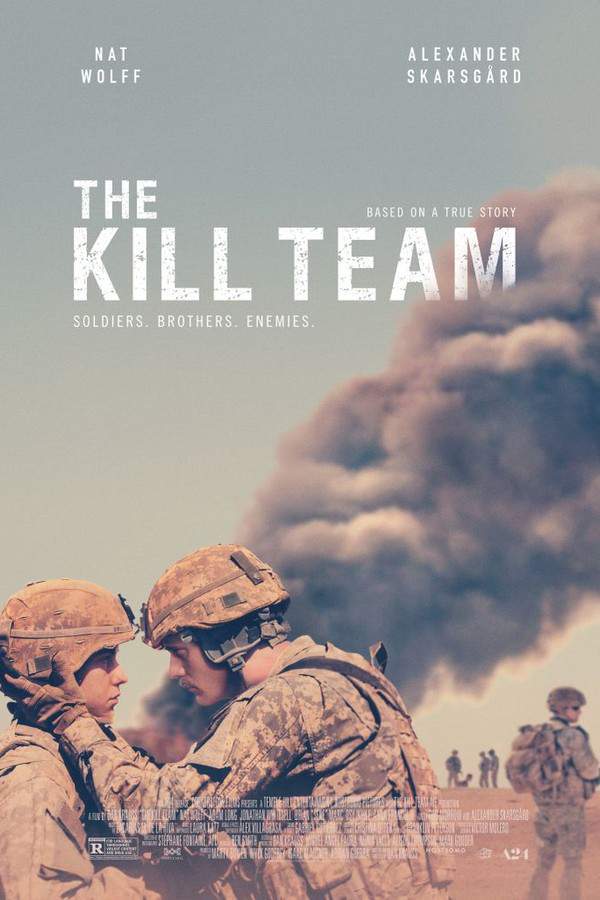
In 2009, Nat Wolff portrays Andrew Briggman, a young soldier serving with Bravo Company in the harsh environs of Afghanistan. The unit’s rhythm is disrupted when Staff Sergeant Deeks [Alexander Skarsgård] takes over as platoon leader after the death of Staff Sergeant Wallace in an IED attack during a village raid. Deeks makes a blunt vow to his men: they will track down and punish those responsible for the recent surge of American casualties, and Briggman becomes a crucial part of this mission by providing a dated and locational record of IED incidents.
From the outset, Briggman’s sense of right and wrong begins to clash with the orders and tactics of the new leadership. The platoon captures a wounded man suspected of planting an IED on a road, and Briggman refuses Deeks’ instruction to harm him, choosing instead to question the morality of violence and the costs of their mission. This moment plants seeds of doubt that will fester as the unit proceeds with a string of raids on civilian villages. Each raid intensifies the moral weight on Briggman, who is forced to weigh orders against his own sense of humanity.
During the very first raid, Briggman hears a gunshot and discovers a boy lying dead on the ground. The official account claims the boy tried to attack the soldiers with a grenade, but Briggman remains skeptical. He is moved to communicate with his father about what he witnessed, sending a message that hints at a growing disillusionment with the war’s toll. The emotional strain of what he perceives leads to tensions back at base, and the matter quickly becomes a matter of record when his father contacts the Criminal Investigation Division (CID) to question Deeks’ actions.
In the aftermath, Briggman is summoned to a tense briefing with his comrades, and Deeks accuses Marquez of reporting the death to CID. The conflict within the platoon surfaces through heated exchanges and the undercurrents of fear and professional obligation. Briggman’s father’s involvement escalates as the CID’s scrutiny becomes more pronounced, and a sense of inevitable conflict begins to pervade the unit’s atmosphere.
The second raid pushes Briggman further toward the edge. He witnesses Rayburn execute an unarmed man and plant an AK-47 on him, a chilling display that starkly contrasts with Briggman’s earlier beliefs about restraint and justice. Panicked, Briggman documents the incident for his father, who continues to press for accountability. Briggman’s attempt to inspect Deeks’ office for a cache of weapons is thwarted, and Deeks makes it clear that Briggman’s dissent will not be tolerated. The emotional pressure culminates in a moment of vulnerability as Briggman calls his father to describe the perilous position he finds himself in, breaking down as he explains the danger of their situation.
The third raid marks a devastating turn. The team captures an elderly civilian who remains silent, and Deeks orders Rayburn and Briggman to execute him, attempting to stage the scene as if the man had attacked with a grenade. Briggman, for the first time in his combat service, fires the fatal shot. The act drags the unit further into a moral morass, and the boys’ celebration back at base is tempered by Briggman’s trauma. His sense of guilt intensifies as Rayburn is summoned by CID for further questioning, and Briggman realizes that his own future may hinge on his ability to tell the truth.
Haunted by what he has done, Briggman contemplates a desperate end in Deeks’ office, unable to bear the weight of the actions he has witnessed and participated in. Yet the moment of reckoning is unavoidable. Briggman and Deeks are questioned by the CID, and Briggman, accompanied by his parents, is given the opportunity to speak openly about everything he knows and has experienced. The narrative leaves room for reflection on accountability, the costs of combat, and the long shadow cast by a single night of violence.
In the closing credits, the film grounds its dramatic arc in real events, revealing that in 2010 five U.S. Army soldiers were charged in connection with civilian killings. Specialist Adam Winfield (depicted as Briggman in the film) pleaded guilty to involuntary manslaughter and received a three-year sentence. He provided testimony against Staff Sergeant Gibbs (the film’s Deeks), who was sentenced to life imprisonment. The credits underscore the harsh truth at the center of the story: the line between duty and killing can blur in the heat of war, and the consequences reach far beyond the battlefield.
Through Briggman's experience, the film examines how ordinary soldiers can become entangled in a web of orders, loyalties, and moral decisions under extreme stress. It portrays a journey from initial resolve to disillusionment, and finally to a painful confrontation with the consequences of violence. The performances, particularly in the moments of confrontation, offer a stark, unflinching look at how war can erode a soldier’s sense of right and wrong, leaving a lasting impact on individuals and families alike.