Plot Explained Spoilers guaranteed!
Plot Explained

Browse by genre

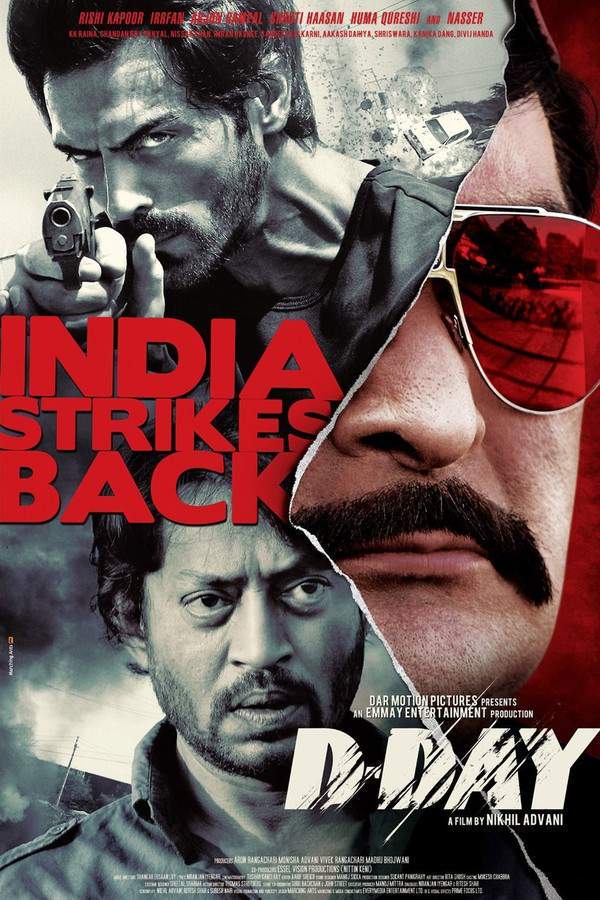
D-Day (2013) movie poster

Plot Summary

D-Day (2013) Plot Summary Explained

Release, runtime and language
2013 · 153 min · Hindi
JustWatch #29,471 1
Directed by
Nikhil Advani
Starring
Irrfan Khan, Huma Qureshi, Nasser, Arjun Rampal, Rishi Kapoor, Shruti K. Haasan

A seasoned operative and his unconventional team embark on a dangerous mission to infiltrate Pakistan and capture a high-profile target. As the operation faces unexpected challenges and goes wrong, the team finds themselves fighting for survival against overwhelming odds. The intense thriller follows their desperate struggle to complete their objective and escape.

On this page (6)
  1. 1 Where to watch
  2. 2 What happens: full plot
  3. 3 Plot questions answered
  4. 4 Movie threads
  5. 5 Movies like D-Day
  6. 6 Every angle

Where to watch

Where to Watch D-Day (2013)

Where can you watch D-Day? Stream, rent or buy it in the US, including on Brew, Fawesome and Tubi TV: current JustWatch availability with up-to-date prices.

Streaming availability powered by JustWatch

Full plot summary · contains spoilers

What Happens in D-Day: Full Plot Summary

The whole story of D-Day (2013) explained, from the opening scene to the final frame: every key event, every twist and what it all adds up to. Read it as a quick recap before the sequel, to check a scene you missed, or to finally understand what really happened.

Secret Agent Wali Khan, portrayed by Irrfan Khan, has dedicated nine years to a covert operation under the oversight of the Indian Research and Analysis Wing's Chief, Ashwini Rao (Nassar). His mission centers on monitoring Iqbal Seth, also known as Goldman, played by Rishi Kapoor, the notorious head of the D-Company syndicate operating out of Karachi.

The film intricately unfolds Wali's day-to-day life as he navigates the challenges of living incognito in a foreign land. While posing as a barber, he forges genuine connections with the locals, including his family, yet remains acutely aware that all could vanish at any moment due to the whims of his assignments. During his tenure, he forms a bond with Khurram, an aide to Iqbal, who frequents his barbershop. Through this connection, Wali discovers that Iqbal is planning his nephew's wedding at the Baituz Zahab Hotel and intends to attend, presenting a pivotal opportunity for Wali.

Additionally, the narrative introduces a skilled team assembled by R.A.W. just nine days prior to the operation. This includes Captain Rudra Pratap Singh (Arjun Rampal), an ex-Indian Army officer, along with Zoya Rehman (Huma Qureshi), an explosives expert, and Aslam, a Mumbai thief. Their objective is to infiltrate Pakistan and support Wali in capturing Goldman during his son's wedding—a significant event that defies Inter-Services Intelligence protocols.

Tensions rise as Wali's team sets foot in the hotel amid an arrangement involving ISI officers and a Pakistani general, who express concern over Iqbal's attendance. Despite these warnings, Iqbal is unyielding in his decision to partake in the celebration. As Wali prepares for this critical mission, he plans to send his family to the UK, ensuring their safety while promising to join them shortly.

The chaos heightens when shopping for weaponry leads to Wali being recognized by Khurram, resulting in a violent confrontation that ends with Khurram inadvertently struck down by a bus. On the day of the wedding, just as Wali's family attempts to depart for the UK, a massive volcanic eruption halts all flights. In desperation, Wali makes extreme choices, including setting fire to his family home, supposedly to eliminate any evidence linking them to his covert activities. This act, combined with whispers of an impending attack, puts his wife in peril as the ISI targets her for interrogation.

As the operation unfolds, Wali's team enacts their carefully constructed plan to infiltrate the hotel and confront Iqbal. However, an unexpected gunfight erupts with Iqbal's security. Wali sustains a serious injury, and the team is forced to retreat, leaving Iqbal behind. The tension escalates as Iqbal orders a crackdown on Karachi to capture the four agents.

In a critical moment, the Indian Prime Minister demands accountability from Ashwini, leading to commands to ensure the agents are not captured alive. In a frenzied market attack, Wali and his team narrowly escape, showcasing their resourcefulness. However, panic ensues when Aslam is captured, prompting a daring rescue led by Rudra.

As the stakes rise, the group decides to press on, intent on completing their mission to take down Iqbal. They arrive at the Nikah ceremony at Iqbal's residence, only to discover that the ISI plans to eliminate him, labeling him a liability. In a shocking twist, Wali, Rudra, and Zoya launch a counter-operation, leading to an intense shootout that ultimately allows them to capture Goldman.

As the climax approaches, Iqbal’s desperate offer to set Wali's family free tests Wali’s resolve. The situation spirals when Wali accidentally shoots Rudra while distracted by Iqbal's manipulative plea. In a final act of cunning, Wali devises a plan to secure both his family and Iqbal, leading to a tense meeting with the ISI.

With his team following their orders, Wali orchestrates a daring escape. Just as they cross back into India, Rudra brings a chilling closing to the saga by executing Goldman, reinforcing his role as a symbol of the "new India." The film comes to an unexpected yet thought-provoking conclusion, leaving viewers reflecting on the complex web of loyalty, duty, and the harsh realities of espionage.
Last updated: November 04, 2024 at 06:33

Was this helpful?

Plot questions answered

D-Day Plot Explained: Your Questions Answered

The questions people ask most about D-Day (2013): what happens in the confusing scenes, why the characters do what they do, the twists, hidden details and what the ending means. Each answer contains spoilers.

Q1

Why does Wali Khan set fire to his own house?

Wali sets fire to his home to destroy any evidence linking his family to his covert identity as an Indian agent. With his cover blown after being recognized by Khurram and with flights cancelled due to the volcanic eruption, he feared the ISI would trace his family and use them against him. By burning the house, he tries to eliminate traces of his double life, though this desperate act ultimately puts his wife in even greater danger as the ISI begins searching for her.

Foreshadowing: Earlier scenes establish Wali's constant awareness that his cover could be compromised at any moment, making him willing to sacrifice his personal life for operational security.

  • Wali Khan
  • house fire
  • ISI
  • cover blown
  • evidence
Q2

How does Khurram die and why does it matter?

Khurram is killed when he accidentally falls into the path of a moving bus during a violent confrontation with Wali in the market. This death matters because Khurram was an aide to Iqbal Seth and his unexpected elimination removed a potential threat to Wali's cover. However, it also created complications as Khurram's disappearance drew attention and raised suspicions about the circumstances surrounding his death.

Foreshadowing: Wali's relationship with Khurram was always risky, as any close contact with Iqbal's inner circle could lead to exposure.

  • Khurram
  • bus accident
  • Iqbal Seth
  • cover compromised
Q3

Why does the volcanic eruption change the mission?

The volcanic eruption on the wedding day cancels all flights, preventing Wali's family from escaping to the UK as he had planned. This forces his family to remain in Pakistan, vulnerable to ISI interrogation and use as leverage against him. The eruption also adds to the mounting pressure on Wali, contributing to his desperate decision to burn his own home and ultimately affecting his judgment during the mission.

Foreshadowing: Wali's earlier decision to send his family away was meant to remove his weakness, making their unexpected trapping in Pakistan a critical plot twist.

  • volcanic eruption
  • flights cancelled
  • family trapped
  • Pakistan
Q4

Why does the Indian Prime Minister demand the agents not be captured alive?

The Prime Minister demands accountability after the operation goes wrong and the agents are exposed in Pakistan. With the mission already compromised and the agents caught in hostile territory, the government decides they cannot be allowed to be captured by Pakistani intelligence, as this would cause a major international incident and expose India's involvement. The order reflects the brutal reality of covert operations where failed missions must be protected at any cost.

Foreshadowing: The high-stakes nature of infiltrating Pakistan was established early, showing that the operation's failure would have serious political consequences.

  • Prime Minister
  • capture alive
  • political fallout
  • R.A.W.
  • India
Q5

Why does Rudra execute Iqbal Seth at the end?

Rudra executes Iqbal (Goldman) just as they cross back into India, acting against Wali's plan to bring the syndicate leader back for interrogation. This execution symbolizes Rudra's belief in delivering immediate justice rather than following bureaucratic procedures. It also represents his vision of a new India that takes decisive action against threats like the D-Company, regardless of political protocols. The shocking act ends the mission on a bitter note, showing the moral complexity of espionage.
Foreshadowing: Rudra's character as an ex-Army officer with a direct approach was established when he led the team, showing he prioritizes results over process.

  • Rudra
  • Iqbal Seth
  • execution
  • Goldman
  • D-Company
  • new India
Q6

How does the ISI plan to eliminate Iqbal Seth?

The ISI decides to eliminate Iqbal Seth during his own Nikah ceremony at his residence, labeling him a liability due to the political complications his presence creates with Indian intelligence. When Wali and his team discover this plan, they launch a counter-operation to capture Goldman first, leading to an intense shootout. The ISI's attempt to silence Iqbal adds another layer of complexity as the Indian agents must not only complete their mission but also outmaneuver Pakistani intelligence.

Foreshadowing: Earlier warnings from ISI officers about Iqbal's attendance at the wedding established the tension between Pakistani authorities and the D-Company leader.

  • ISI
  • eliminate Iqbal
  • Nikah ceremony
  • Pakistan
  • Goldman
Q7

Why does Wali accidentally shoot Rudra?

Wali accidentally shoots Rudra when he becomes distracted by Iqbal's manipulative plea to free his family. Iqbal uses this moment of psychological warfare, exploiting Wali's concern for his loved ones to create an opening. The accidental shooting demonstrates how Iqbal's leverage over Wali's family creates a critical vulnerability in the operation, affecting Wali's focus and judgment at a crucial moment.

Foreshadowing: Iqbal's final offer to release Wali's family was designed specifically to exploit this emotional weakness, building on the tension created by the family being trapped in Pakistan.

  • Wali shoots Rudra
  • Iqbal manipulation
  • family leverage
  • distraction
Q8

Why is the nine-day preparation timeline significant?

The team is assembled just nine days before the operation, giving them minimal time to prepare for a high-risk infiltration into Pakistan. This compressed timeline creates pressure and forces the team to act with limited intelligence and coordination. The rushed preparation contributes to the challenges they face, as more time would have allowed for better contingency planning and cover establishment.

Foreshadowing: The urgency of the nine-day window establishes the film's fast-paced nature and the improvised nature of the mission.

  • nine days
  • R.A.W.
  • team assembly
  • preparation
  • timeline
Q9

Why does Iqbal offer to free Wali's family?

Iqbal offers to release Wali's family as a final bargaining chip when cornered, attempting to manipulate Wali into sparing him or creating a distraction. This desperate move shows Iqbal's cunning nature even in defeat, he tries to exploit Wali's emotional attachment to his family. The offer puts Wali in an impossible position, testing his loyalty between his family and his mission objectives.

Foreshadowing: Iqbal's control over Wali's family through ISI connections was established when the ISI began targeting them for interrogation.

  • Iqbal
  • free family
  • bargain
  • hostage
  • manipulation
Q10

Why is the Baituz Zahab Hotel crucial to the operation?

The Baituz Zahab Hotel is where Iqbal Seth's nephew's wedding takes place, presenting the only opportunity to capture the D-Company leader in one location. The wedding is a significant event that defies normal ISI protocols, making it both a strategic opportunity and a security challenge. The hotel becomes the primary target for Wali's team, who plan to infiltrate the venue during the celebration to apprehend Goldman.
Foreshadowing: Wali's relationship with Khurram provided the crucial intelligence about the wedding venue and timing.

  • Baituz Zahab Hotel
  • wedding
  • Iqbal Seth
  • infiltration
  • target
Q11

Why does the ISI target Wali's wife for interrogation?

After Wali's cover is blown and his house is burned, the ISI begins searching for his wife, viewing her as a potential source of information about his real identity and contacts. The ISI uses her as leverage, believing she either knows details about his covert activities or can lead them to other agents. This threat to his family forces Wali into increasingly desperate actions to protect them.

Foreshadowing: Wali's decision to send his family away was driven by this very fear of them becoming targets.

  • ISI
  • wife
  • interrogation
  • threaten
  • family
  • capture
Q12

What goes wrong during the hotel infiltration?

The operation at the hotel goes wrong when an unexpected gunfight erupts with Iqbal's security personnel. During the confrontation, Wali sustains serious injuries and the team is forced to retreat without capturing Goldman. This failure triggers the Prime Minister's demand for accountability and leads to the desperate chase through Karachi, where the team must fight for survival while trying to complete their mission.

Foreshadowing: The presence of ISI officers at the hotel already indicated heightened security and potential complications.

  • gunfight
  • hotel
  • infiltration
  • Wali injured
  • retreat
  • failure

Movie threads

More Movies Like D-Day, by Mood & Story

Curated lists built around what makes D-Day tick: the same mood, the same kind of story or the same emotional payoff. Each list explains why these movies belong together.

Covert Mission Thrillers like D-Day

High-stakes operations where the danger is as much from the environment as the enemy. If you liked the tense, high-stakes infiltration of D-Day, you'll find similar excitement in these movies. This list features films where operatives must navigate hostile territory, facing constant danger and moral compromise in their desperate race to complete their mission.

  • tense
  • claustrophobic
  • gritty
  • suspenseful
  • desperate
  • anxious
  • Tone: tense, gritty, desperate
  • Pacing: fast, driven by operational urgency
Why these movies?

The story pattern: Stories in this thread are defined by a clear, high-risk objective that must be accomplished within a hostile environment. The narrative follows the operational challenges, betrayals, and tactical dilemmas that arise, often forcing characters into extreme moral choices as their carefully laid plans unravel. The journey is one of survival as much as success.

Why they belong together: Movies here are grouped by their shared focus on the visceral experience of a covert operation. They create a similar mood of anxiety and claustrophobia through gritty settings, fast-paced action, and the constant threat of discovery, offering a consistent vibe of desperate professionalism under fire.

Movies with Bittersweet Endings like D-Day

Stories where success is achieved, but at a profound personal or moral price. Fans of D-Day's emotionally heavy and morally complex conclusion will appreciate these films. They share a pattern where the central goal is met, but the journey leaves deep scars, resulting in a powerful, bittersweet feeling that lingers long after the credits roll.

  • bittersweet
  • heavy
  • morally complex
  • somber
  • thought-provoking
  • grim
  • Tone: bittersweet, heavy, morally complex
  • Pacing: variable, often building to a sobering climax
Why these movies?

The story pattern: The narrative pattern involves a clear goal that is pursued with relentless focus. However, the path to achieving it is fraught with ethical dilemmas and personal sacrifices that fundamentally change the characters. The conclusion delivers on the plot's objective but undercuts it with the emotional and moral cost, creating a layered and thought-provoking resolution.

Why they belong together: These films are connected by their shared emotional trajectory and concluding tone. They deliver a similar viewing experience by balancing narrative closure with emotional openness, leaving the audience to ponder the true price of victory. The heavy emotional weight and bittersweet feel create a coherent group.

If you liked this

Movies Like D-Day

Similar movies to D-Day: the same genre, themes or kind of story. Each one comes with its own plot summary, timeline and ending explained.

Browse all movie summaries

Every angle

D-Day (2013) Explained: Plot, Timeline & Characters

Everything about D-Day in one place: what happens in the plot summary, the timeline in chronological order, the characters and meaning and a spoiler-free summary. What's After the Movie adds the cast, box office and post-credit scenes.

Coming soon on iOS and Android

The Plot Explained Movie Summary App

Plot summaries, endings explained and timelines on your phone. Catch up on any movie in minutes, save your favorites and never miss a twist again.

Be the first to know when we launch. Your email stays private, always.

Learn more about the app