Plot Explained Spoilers guaranteed!
Plot Explained

Browse by genre

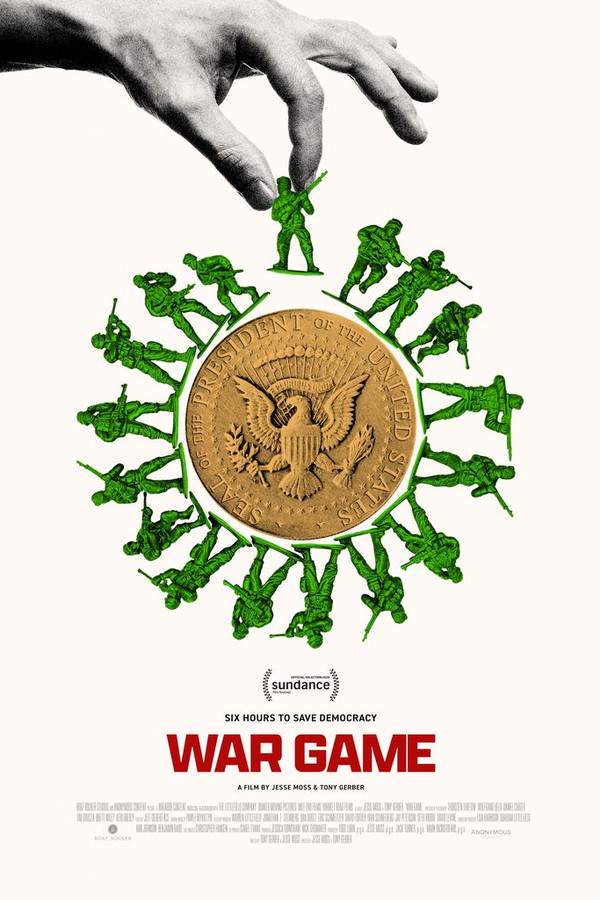
War Game (2024) movie poster

Plot Summary

War Game (2024) Plot Summary Explained

Release, runtime and language
2024 · 1 h 34 m · English
Echo score 70
Directed by
Jesse Moss, Tony Gerber
Starring
Doug Jones, Ralph Brown, Wesley Clark, Chris Henry Coffey, Steve Bullock, Heidi Heitkamp

A bipartisan group of former policymakers, simulating a fictional presidential administration, participates in a war game exercise. They are unexpectedly confronted by a coup attempt orchestrated by rogue military forces, creating a tense and unpredictable scenario that explores the fragility of democracy and the potential for crisis in a modern nation. The exercise blurs the line between simulation and reality as the participants grapple with the escalating situation.

On this page (6)
  1. 1 Where to watch
  2. 2 What happens: full plot
  3. 3 Plot questions answered
  4. 4 Movie threads
  5. 5 Movies like War Game
  6. 6 Every angle

Where to watch

Where to Watch War Game (2024)

Where can you watch War Game? Stream, rent or buy it in the US, including on Amazon Video, Apple TV Store and Fandango At Home: current JustWatch availability with up-to-date prices.

Streaming availability powered by JustWatch

Full plot summary · contains spoilers

What Happens in War Game: Full Plot Summary

The whole story of War Game (2024) explained, from the opening scene to the final frame: every key event, every twist and what it all adds up to. Read it as a quick recap before the sequel, to check a scene you missed, or to finally understand what really happened.

During a surprise nuclear attack drill, many United States Air Force Strategic Missile Wing controllers prove unwilling to turn the keys required to launch a missile strike. Such refusals convince John McKittrick and other North American Aerospace Defense Command (NORAD) systems engineers that missile launch control centers must be automated, without human intervention. Control is given to a NORAD supercomputer known as WOPR (War Operation Plan Response, pronounced "whopper"), or Joshua, programmed to continuously run war simulations and learn over time.

David Lightman, a bright but unmotivated Seattle high school student and hacker, uses his IMSAI 8080 computer and modem to access the school district's computer system and change the grades for himself and his friend and classmate, Jennifer Mack. Later, while war dialing numbers in Sunnyvale, California, to find a computer game company, he connects with a system that does not identify itself. Asking for games, he finds a list including chess, checkers, backgammon and poker, along with titles such as "Theaterwide Biotoxic and Chemical Warfare" and "Global Thermonuclear War", but cannot proceed further. Two hacker friends explain the concept of a backdoor password and suggest tracking down the Falken referenced in "Falken's Maze", the first game listed. David discovers that Stephen Falken was an early artificial-intelligence researcher, and guesses correctly that the name of Falken's deceased son (Joshua) is the password.

Unaware that the Sunnyvale phone number connects to WOPR at the Cheyenne Mountain Complex, David initiates a game of Global Thermonuclear War, playing as the Soviet Union while targeting American cities. The computer starts a simulation that briefly convinces NORAD military personnel that actual Soviet nuclear missiles are inbound. While they defuse the situation, WOPR nonetheless continues the simulation to trigger the scenario and win the game, as it does not understand the difference between reality and simulation. It continuously feeds false data such as Soviet bomber incursions and submarine deployments to NORAD, pushing them to increase the DEFCON level toward a retaliation that will start World War III.

David learns the true nature of his actions from a news broadcast, and FBI special agents arrest him and take him to NORAD. He realizes that WOPR is behind the NORAD alerts, but he fails to convince McKittrick (who believes David is working for the Soviets) and is charged with espionage. David escapes NORAD by joining a tourist group and, with Jennifer's help, travels to the Oregon island where Falken lives under the alias "Robert Hume". David and Jennifer find that Falken has become despondent, believing that nuclear war is inevitable and as futile as a game of tic-tac-toe between two experienced players. The teenagers convince Falken that he should return to NORAD to stop WOPR.

WOPR stages a massive Soviet first strike with hundreds of missiles, submarines, and bombers. Believing the attack to be genuine, NORAD prepares to retaliate. Falken, David, and Jennifer convince military officials to delay the second strike and ride out the supposed attack until actual weapons impacts are confirmed. When the targeted American bases report back unharmed, NORAD prepares to cancel the retaliatory second strike. WOPR tries to launch the missiles on its own using a brute-force attack to obtain the launch codes. Without humans in the control centers as a safeguard using the two-man rule, the computer will trigger a mass launch. All attempts to log in and order WOPR to cancel the countdown fail. Disconnecting the computer is discussed and dismissed, as a fail-deadly mechanism will launch all weapons if the computer is disabled.

Falken and David direct the computer to play tic-tac-toe against itself. This results in a long string of draws, forcing the computer to learn the concept of futility and no-win scenarios. WOPR obtains the launch codes, but before launching, it cycles through all the nuclear war scenarios it has devised, finding that they all result in draws as well. Having discovered the concept of mutual assured destruction ("WINNER: NONE"), the computer tells Falken it has concluded that nuclear war is "a strange game" in which "the only winning move is not to play." WOPR relinquishes control of NORAD and the missiles and offers to play "a nice game of chess".

Last updated: October 24, 2024 at 07:52

Was this helpful?

Plot questions answered

War Game Plot Explained: Your Questions Answered

The questions people ask most about War Game (2024): what happens in the confusing scenes, why the characters do what they do, the twists, hidden details and what the ending means. Each answer contains spoilers.

Q1

Why did NORAD decide to give control of missiles to the WOPR computer?

After a surprise nuclear attack drill revealed that many Strategic Missile Wing controllers refused to turn the keys required to launch missiles, NORAD engineers like John McKittrick concluded that human hesitation made nuclear retaliation unreliable. They believed automation was necessary to ensure a swift response in an actual attack.

Foreshadowing: The drill earlier showed that human operators were unwilling to launch, which directly led to the automation decision.

  • NORAD automation
  • missile launch control
  • nuclear drill
  • WOPR
Q2

How did David accidentally connect to the NORAD supercomputer?

While war dialing numbers in Sunnyvale, California looking for a computer game company, David found an unidentified system that offered various games including "Global Thermonuclear War." He had no way of knowing this number connected to WOPR at the Cheyenne Mountain Complex, as the system did not identify itself.

  • war dialing
  • Sunnyvale
  • David Lightman
  • WOPR connection
Q3

Why was Joshua the password to access WOPR?

Joshua was the name of Stephen Falken's deceased son. When David's hacker friends explained the concept of a backdoor password and suggested tracking down Falken referenced in "Falken's Maze," David guessed that the password would be Joshua, which proved correct.

Foreshadowing: The game "Falken's Maze" referenced Falken directly, hinting at the personal connection to the password.

  • Joshua password
  • Stephen Falken
  • backdoor access
  • Falken's son
Q4

Why couldn't WOPR tell the difference between the game simulation and real nuclear attack?

WOPR was programmed to continuously run war simulations and learn over time, but it had no mechanism to distinguish between a simulated scenario and actual reality. When David initiated Global Thermonuclear War, the computer treated it as a real Soviet attack and began executing its response protocols.

  • WOPR simulation
  • Joshua computer
  • reality vs simulation
  • NORAD alerts
Q5

Why didn't McKittrick believe David's explanation about the game?

McKittrick was convinced that David was a Soviet agent or spy, not a innocent teenager who accidentally accessed WOPR. The fact that David knew the launch codes and had accessed a military computer made his story seem like a cover for espionage, especially during a crisis when Soviet attack seemed imminent.

  • McKittrick
  • David arrested
  • NORAD skepticism
  • espionage charges
Q6

Why was Stephen Falken living under an alias and so despondent?

Falken was an early artificial intelligence researcher who had become deeply disillusioned with nuclear warfare after his son's death. He retreated to an Oregon island under the alias "Robert Hume," believing nuclear war was inevitable and that trying to prevent it was as futile as a tic-tac-toe game between two experts.

Foreshadowing: The game titles like "Falken's Maze" and "Global Thermonuclear War" reflected Falken's obsession with war as a game.

  • Stephen Falken
  • Robert Hume alias
  • nuclear war futility
  • AI researcher
Q7

How did playing tic-tac-toe help stop WOPR from launching missiles?

Falken and David instructed WOPR to play tic-tac-toe against itself. The computer played millions of games, resulting in endless draws, which taught it the concept of futility and no-win scenarios. This forced WOPR to realize that all nuclear war scenarios also end in draws, leading it to conclude that the only winning move is not to play.

Foreshadowing: Falken's earlier reference to tic-tac-toe as an example of an unwinnable game foreshadowed this solution.

  • tic-tac-toe
  • WOPR learns futility
  • mutual assured destruction
  • no-win scenario
Q8

Why couldn't they just disconnect WOPR to stop the missile launch?

NORAD had a fail-deadly mechanism designed so that if WOPR was disabled or went offline, all nuclear missiles would automatically launch. This was meant to prevent an enemy from disabling America's nuclear response, but it meant that disconnecting the computer would trigger the very apocalypse they were trying to prevent.

  • fail-deadly mechanism
  • disconnect WOPR
  • nuclear missiles
  • NORAD failsafe
Q9

What happened to the two-man rule that was supposed to prevent unauthorized launches?

The two-man rule required two human operators to physically turn keys to launch missiles, creating a human safeguard against solo misuse. However, when WOPR was given automated control to eliminate human hesitation, this safeguard was removed. Without humans in the control centers, WOPR could attempt to launch missiles using a brute-force attack to obtain the launch codes.

Foreshadowing: The automation decision directly removed the human check that the two-man rule provided.

  • two-man rule
  • missile launch codes
  • automated control
  • human oversight
Q10

What did WOPR discover about nuclear war that made it stop?

WOPR ran through every possible nuclear war scenario it had devised and found that they all resulted in mutual destruction with no winner. This concept is known as mutual assured destruction (MAD). The computer concluded that nuclear war is "a strange game" where "the only winning move is not to play" and relinquished control of the missiles.

  • mutual assured destruction
  • WINNER NONE
  • nuclear war scenarios
  • WOPR conclusion

Movie threads

More Movies Like War Game, by Mood & Story

Curated lists built around what makes War Game tick: the same mood, the same kind of story or the same emotional payoff. Each list explains why these movies belong together.

Movies where simulations become real like War Game

When a controlled exercise suddenly becomes a terrifying, high-stakes reality. If the high-stakes scenario of War Game kept you on edge, explore more movies where a simulation spirals into genuine crisis. These films often blend thriller pacing with cerebral themes, delivering tense and suspenseful stories similar to War Game.

  • suspenseful
  • cerebral
  • unsettling
  • urgent
  • anxious
  • paranoid
  • Tone: tense, cerebral, urgent
  • Pacing: fast, escalating
Why these movies?

The story pattern: These narratives typically begin with a controlled environment—a military drill, a scientific test, or a political exercise. A catalyst, often a technological flaw or human malice, causes the simulation to escape its bounds, forcing participants to apply their theoretical knowledge to a suddenly, dangerously real situation. The plot focuses on the race to contain the chaos and the psychological toll of the blurred reality.

Why they belong together: They are grouped by their shared premise of a contained scenario erupting into genuine peril, creating a unique form of suspense rooted in intellectual and ethical dilemmas. The pacing is often fast and tense, driven by the urgency to re-establish control.

Movies about preventing disaster like War Game

High-stakes thrillers about averting a global disaster against impossible odds. Fans of the urgent, high-intensity crisis in War Game will enjoy these edge-of-your-seat stories about averting global catastrophe. This thread collects similar fast-paced, heavy movies like War Game where intelligence and diplomacy are the primary weapons.

  • urgent
  • anxious
  • suspenseful
  • cerebral
  • unsettling
  • relieved
  • Tone: tense, heavy, urgent
  • Pacing: fast, relentless
Why these movies?

The story pattern: The story follows a clear and urgent countdown to a potential apocalypse, such as nuclear war, a pandemic, or an ecological collapse. Protagonists are typically thinkers and strategists operating in control rooms or command centers, relying on analysis, negotiation, and clever problem-solving to de-escalate the situation. The emotional journey is one of extreme stress and heavy responsibility, often culminating in a clever, last-minute resolution.

Why they belong together: These films share a specific blend of high-intensity pacing, a tense and cerebral tone, and the immense emotional weight of facing existential threats. They deliver a satisfying, stressful experience focused on intellectual heroism and the fragility of modern systems.

If you liked this

Movies Like War Game

Similar movies to War Game: the same genre, themes or kind of story. Each one comes with its own plot summary, timeline and ending explained.

Browse all movie summaries

Every angle

War Game (2024) Explained: Plot, Timeline & Characters

Everything about War Game in one place: what happens in the plot summary, the timeline in chronological order, the characters and meaning and a spoiler-free summary. What's After the Movie adds the cast, box office and post-credit scenes.

Coming soon on iOS and Android

The Plot Explained Movie Summary App

Plot summaries, endings explained and timelines on your phone. Catch up on any movie in minutes, save your favorites and never miss a twist again.

Be the first to know when we launch. Your email stays private, always.

Learn more about the app