Plot Explained Spoilers guaranteed!
Plot Explained

Browse by genre

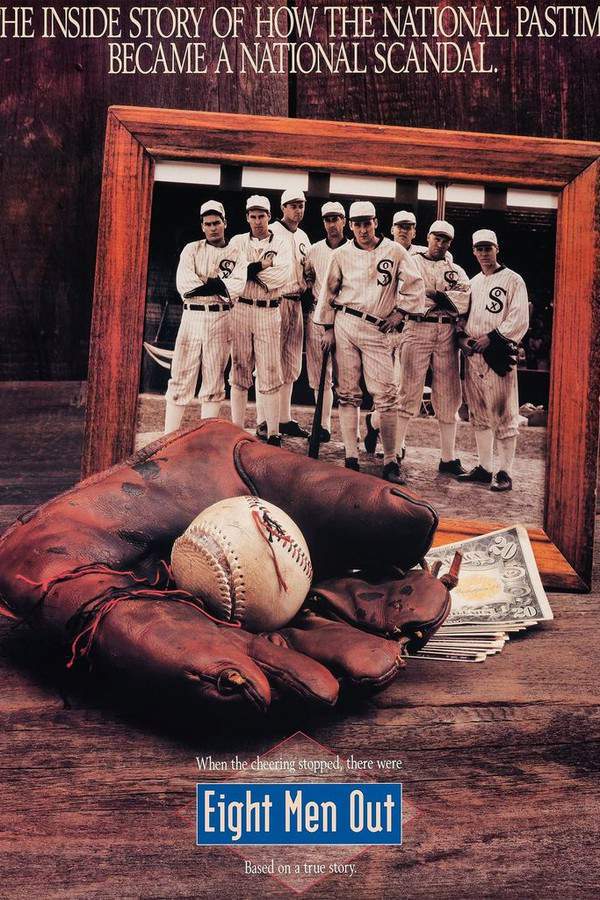
Eight Men Out (1988) movie poster

Plot Summary

Eight Men Out (1988) Plot Summary Explained

Release, runtime and language
1988 · 119 min · English
Loading streaming availability…
Directed by
John Sayles
Starring
Clifton James, John Cusack

During the 1919 World Series, the Chicago White Sox were approached by gamblers who offered them a substantial sum to throw the games against the Cincinnati Reds. This temptation sparked a crisis of conscience within the team, pitting their integrity and reputation against the lure of a financial reward. As the scandal unfolds, the events threaten to destroy the sport of baseball and tarnish the legacy of the players involved in the "Black Sox Scandal."

On this page (6)
  1. 1 Where to watch
  2. 2 What happens: full plot
  3. 3 Plot questions answered
  4. 4 Movie threads
  5. 5 Movies like Eight Men Out
  6. 6 Every angle
Loading streaming availability…

Full plot summary · contains spoilers

What Happens in Eight Men Out: Full Plot Summary

The whole story of Eight Men Out (1988) explained, from the opening scene to the final frame: every key event, every twist and what it all adds up to. Read it as a quick recap before the sequel, to check a scene you missed, or to finally understand what really happened.

As the 1919 season comes to a thrilling conclusion, the Chicago White Sox bask in the glory of their American League pennant victory, featuring an impressive lineup of exceptional talent. However, the team's owner, Charles Comiskey, proves to be a miser, neglecting to reward his players for their remarkable achievements. Amidst this environment of discontent, gamblers "Sleepy Bill" Burns and Billy Maharg set their sights on the team's star pitcher, Eddie Cicotte, who had been poised to achieve an extraordinary 29-7 win-loss record along with a remarkable earned run average of 1.82.

Cicotte's decision to engage with the gamblers arises from Comiskey's refusal to fulfill a promised $10,000 bonus if he could reach the 30-win milestone. Team manager Kid Gleason further complicates matters by benching Cicotte for two weeks, citing an unexplained need for him to rest before the World Series against the Cincinnati Reds.

As tensions escalate, a faction of players, including Chick Gandil, Swede Risberg, and Lefty Williams, are manipulated into throwing the series by Burns and Maharg. Meanwhile, the talented and charismatic "Shoeless Joe" Jackson gets unwittingly entangled in the scheme, his naïveté rendering him incapable of fully grasping the seriousness of the fix.

In contrast, Buck Weaver stands firm against corruption, remaining committed to winning at any cost. As the series commences, Cicotte's first act of defiance is to hit Reds leadoff hitter Morrie Rath with his second pitch, signaling to Arnold Rothstein that their plan is operational.

Cicotte's unfortunate start in Game 1 results in five runs over four innings, culminating in an embarrassing Sox loss of 9-1. As the series proceeds, both Williams and Gandil, along with their teammates, make glaring errors, further deteriorating team morale as payouts promised by the gamblers fail to materialize, leading many to question their integrity and choices.

Amid growing suspicion, journalists Ring Lardner and Hugh Fullerton scrutinize the Sox's performance while Gleason remains optimistic about his players' integrity. The White Sox find a brief glimmer of hope as rookie pitcher Dickie Kerr leads them to victory in Game 3, yet the atmosphere remains tense.

As the series unfolds, Cicotte continues to struggle, ultimately leading to a crushing defeat in Game 5. Though they manage a thrilling extra-inning win in Game 6, manager Gleason's decision to bench Cicotte for Game 7 is challenged by the embattled pitcher, who seeks redemption for his past performances. In the end, despite some individual successes—including Jackson's home run—the Sox succumb to the Reds with a final score of 5-3.

The aftermath of the Series is swift and severe. Journalist Fullerton publishes a harsh critique, igniting an investigation into the alleged fixing of the tournament. This leads to confessions from Cicotte and Jackson in 1920, resulting in charges against all eight implicated players. Although they are acquitted, they face a lifetime ban from baseball at the hands of newly appointed commissioner Kenesaw Mountain Landis.

As history unfolds, we find Weaver in 1925 amid the peaceful hills of New Jersey, reflecting on his past as he witnesses Jackson taking the field again under an assumed identity. Though the air is thick with suspicion among fans, Weaver's response remains resolute as he defiantly shields his former teammate from scrutiny, invoking the legacy of the 1919 World Series.

The closing title card serves as a haunting reminder of the consequences faced by the eight players, their once-bright prospects dimmed by the shadow of scandal. Weaver’s own fight for vindication ultimately ends with his death in 1956, marking the close of an era and sealing the fate of a chapter in history forever tainted by ambition’s corrupting allure.
Last updated: November 19, 2024 at 18:36

Was this helpful?

Plot questions answered

Eight Men Out Plot Explained: Your Questions Answered

The questions people ask most about Eight Men Out (1988): what happens in the confusing scenes, why the characters do what they do, the twists, hidden details and what the ending means. Each answer contains spoilers.

Q1

Why did the Chicago White Sox throw the 1919 World Series?

The White Sox threw the 1919 World Series primarily because owner Charles Comiskey refused to pay promised bonuses to his players. Pitcher Eddie Cicotte was especially incensed when Comiskey denied him a $10,000 bonus for reaching 30 wins, despite his exceptional 29-7 record. Gamblers Sleepy Bill Burns and Billy Maharg exploited this discontent, offering substantial money to several players who felt undervalued by the team owner.

Foreshadowing: Comiskey's miserly reputation is established early, setting the moral compromise in motion.

  • charles composkey bonus
  • eddie cicotte 30 wins
  • black sox motivation
  • gamblers bribes
Q2

Why was Buck Weaver banned from baseball if he didn't throw the games?

Buck Weaver was banned from baseball despite maintaining his innocence because Commissioner Kenesaw Mountain Landis imposed a zero-tolerance policy on any association with gambling or game-fixing. Though Weaver refused to participate in the fix and remained committed to winning, his knowledge of the scheme and failure to report it to authorities was enough for Landis to deem him complicit. The commissioner wanted to restore public trust in baseball's integrity at any cost.

Foreshadowing: Weaver's firm stance against corruption is established early, making his eventual ban more tragic.

  • buck weaver lifetime ban
  • kenesaw mountain landis
  • black sox verdict
  • weaver innocence
Q3

What did Shoeless Joe Jackson know about the fix?

Shoeless Joe Jackson was largely unaware of the full extent of the fix due to his naïveté. While he was caught up in the scheme and received some money, the film portrays him as incapable of fully grasping the seriousness of what was happening. He played poorly at times but was not an active participant in planning the fix like Cicotte, Gandil, Risberg, and Williams were.

Foreshadowing: Jackson's innocent demeanor and simple love of baseball contrast sharply with the cynical motivations of the other players.

  • shoeless joe jackson knowledge
  • black sox involvement
  • jackson naive
  • 1919 world series fix
Q4

Why did Eddie Cicotte hit Morrie Rath with his second pitch in Game 1?

Eddie Cicotte hit Reds leadoff hitter Morrie Rath with his second pitch as a signal to gambler Arnold Rothstein that the fix was in progress. This intentional hit was the predetermined signal indicating the players had agreed to throw the series. It was a deliberate act to prove to the gamblers that Cicotte was committed to their plan.

Foreshadowing: The opening scene of Game 1 is heavy with tension as viewers await the predetermined signal.

  • eddie cicotte morrie rath
  • intentional hit signal
  • arnold rothstein
  • game 1 fix signal
Q5

Why did Charles Comiskey refuse to pay Eddie Cicotte his bonus?

Charles Comiskey refused to pay Eddie Cicotte his promised $10,000 bonus for reaching 30 wins because of his notorious miserliness. Despite Cicotte achieving a remarkable 29-7 record with a 1.82 ERA, Comiskey found a technicality to avoid payment. This betrayal was the primary motivation that led Cicotte to entertain the gamblers' offer, creating the opening for the fix to be organized.

Foreshadowing: Comiskey's stinginess is established immediately as the root cause of the team's discontent.

  • charles composkey bonus
  • eddie cicotte 30 wins
  • owner greed
  • white sox owner
Q7

Why did Kid Gleason bench Eddie Cicotte before the World Series?

Kid Gleason benched Eddie Cicotte for two weeks before the World Series, claiming Cicotte needed rest. While the summary cites an unexplained need for rest, this decision further inflamed Cicotte's resentment toward the organization. Gleason's choice to bench his star pitcher may have inadvertently pushed Cicotte closer to the gamblers, as he felt both the owner and his manager had wronged him.

Foreshadowing: Gleason's decision creates additional tension in an already fractured clubhouse.

  • kid gleason benching
  • eddie cicotte rest
  • world series preparation
  • manager decisions
Q8

Why did rookie Dickie Kerr win Games 3 and 6 for the White Sox?

Rookie pitcher Dickie Kerr won Games 3 and 6 because he was not involved in the fixing scheme and genuinely tried to win. Unlike the compromised players who deliberately performed poorly, Kerr played with integrity and skill, leading the White Sox to their only victories in the series. His success highlighted the contrast between honest players and those participating in the fix.

Foreshadowing: Kerr's emergence as a clean pitcher offers a brief glimmer of hope amid the corruption.

  • dickie kerr rookie pitcher
  • game 3 victory
  • game 6 win
  • white sox honest player
Q9

Why did the White Sox lose the 1919 World Series to the Reds?

The White Sox lost the 1919 World Series because they were deliberately throwing the games as part of the fix. Players like Cicotte, Williams, and Gandil made glaring errors and poor performances as instructed. However, the plan began to unravel when the gamblers failed to deliver promised payouts, creating internal conflict and inconsistent play that ultimately resulted in an 8-5 series loss to Cincinnati.

Foreshadowing: The mounting errors and internal strife during the series lead naturally to defeat.

  • white sox lose 1919 series
  • cincinnati reds victory
  • series score 5-3
  • fix consequences
Q10

What happens in the 1925 scene with Buck Weaver and Shoeless Joe Jackson?

In 1925, Buck Weaver is seen in New Jersey observing Shoeless Joe Jackson playing baseball under an assumed identity. Though fans still suspect Jackson's involvement in the fix, Weaver resolutely defends his former teammate, invoking the legacy of the 1919 World Series. This scene shows Weaver's continued loyalty to Jackson despite the scandal that ended both their careers.

Foreshadowing: The epilogue contrasts the peaceful present with the tarnished past.

  • buck weaver 1925
  • shoeless joe jackson 1925
  • new jersey scene
  • weaver defends jackson
Q11

Who was Arnold Rothstein in the Black Sox scandal?

Arnold Rothstein was the mastermind gambler behind the Black Sox fix. While Sleepy Bill Burns and Billy Maharg initially approached the players, Rothstein was the major money backing the scheme. When Cicotte signaled the fix by hitting Morrie Rath, it was specifically to alert Rothstein that the plan was operational. Rothstein's financial backing and reputation made him the true architect of the fix.

Foreshadowing: Rothstein's presence looms over the entire scheme from the shadows.

  • arnold rothstein black sox
  • gambler master
  • fix funding
  • 1919 world series gambling

Movie threads

More Movies Like Eight Men Out, by Mood & Story

Curated lists built around what makes Eight Men Out tick: the same mood, the same kind of story or the same emotional payoff. Each list explains why these movies belong together.

Moral dilemmas in historical dramas like Eight Men Out

Historical dramas where one fateful decision leads to irreversible disgrace. For viewers who liked the ethical quandaries and historical weight of Eight Men Out, this list features movies about real-life figures facing moral crossroads. These similar historical dramas and biopics delve into themes of corruption, integrity, and the heavy price of scandal.

  • historical
  • somber
  • regretful
  • moral conflict
  • gloomy
  • disillusioned
  • Tone: melancholic, somber, regretful
  • Pacing: steady, methodical
Why these movies?

The story pattern: Narratives in this thread typically follow a chronological, steady-paced unraveling of a scandal or ethical breach. The story builds from temptation to decision, then to exposure and consequence, focusing heavily on the internal conflict of the characters and the irreversible damage to their reputations.

Why they belong together: Movies are grouped here for their shared focus on true or historically-grounded stories of moral failure, their melancholic tone, and their heavy emotional weight centered on regret and the permanence of disgrace.

Ensemble dramas with a tragic tone like Eight Men Out

Character-driven stories where a group's collective failure leads to downfall. If you admired the way Eight Men Out built tension around a team's collective dilemma, you'll find similar movies here. These character-driven ensemble films explore how groups navigate ethical pressures, leading to bleak or bittersweet conclusions for all involved.

  • ensemble cast
  • tense
  • somber
  • moral decay
  • gloomy
  • anxious
  • Tone: melancholic, tense, somber
  • Pacing: steady, character-driven
Why these movies?

The story pattern: The narrative pattern involves multiple central characters whose individual arcs are interwoven around a central conflict. The story examines how groupthink, peer pressure, or shared temptation leads to a cascading series of poor choices, resulting in the downfall of the entire ensemble.

Why they belong together: These films share a specific structure: a steady-paced, character-focused plot with moderate complexity due to the ensemble, a consistently melancholic or tense mood, and a finale that feels sad or bleak for the entire group.

If you liked this

Movies Like Eight Men Out

Similar movies to Eight Men Out: the same genre, themes or kind of story. Each one comes with its own plot summary, timeline and ending explained.

Browse all movie summaries

Every angle

Eight Men Out (1988) Explained: Plot, Timeline & Characters

Everything about Eight Men Out in one place: what happens in the plot summary, the timeline in chronological order, the characters and meaning and a spoiler-free summary. What's After the Movie adds the cast, box office and post-credit scenes.

Coming soon on iOS and Android

The Plot Explained Movie Summary App

Plot summaries, endings explained and timelines on your phone. Catch up on any movie in minutes, save your favorites and never miss a twist again.

Be the first to know when we launch. Your email stays private, always.

Learn more about the app