



Plot Explained Spoilers guaranteed!
Plot Explained

Browse by genre

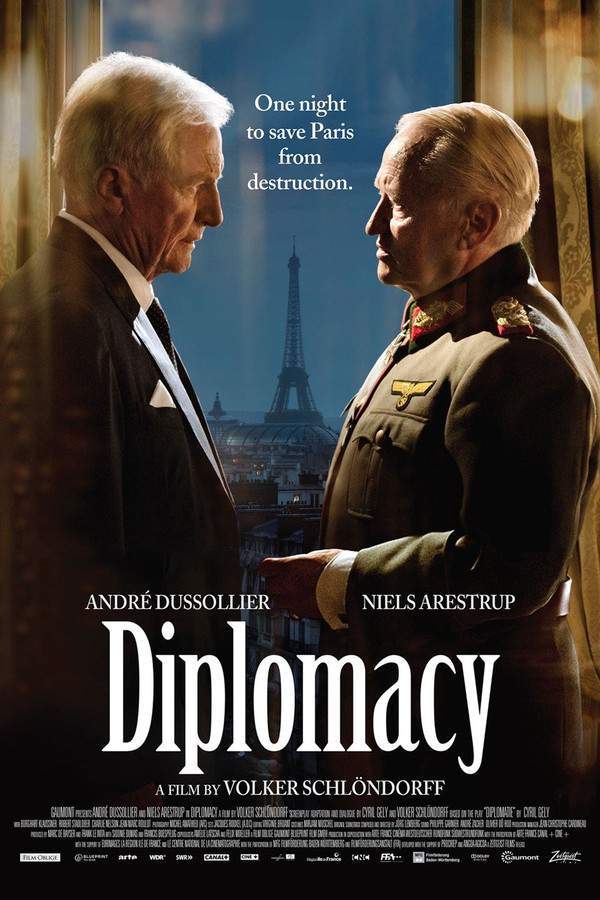
Diplomacy (2014) movie poster

Timeline

Diplomacy (2014) Timeline Explained – Every Event in Order

Release, runtime and language
2014 · 84 min · French
JustWatch #28,742 3
Directed by
Volker Schlöndorff

In 1944, as Paris faces imminent defeat, General Dietrich von Choltitz receives an order from Hitler to destroy the city. Mines are strategically placed around significant landmarks, and the German commander is prepared to carry out the devastating command. However, Swedish Consul General Raoul Nordling intervenes, initiating a tense negotiation with the general in a desperate attempt to convince him to defy Hitler and save Paris from obliteration.

On this page (6)
  1. 1 Where to watch
  2. 2 Events in order (12)
  3. 3 Timeline questions answered
  4. 4 Movie threads
  5. 5 Movies like Diplomacy
  6. 6 Every angle

Where to watch

Where to Watch Diplomacy (2014)

Where can you watch Diplomacy? Stream, rent or buy it in the US, including on Chai Flicks, OVID and Kanopy: current JustWatch availability with up-to-date prices.

Streaming availability powered by JustWatch

12 events in order · contains spoilers

Diplomacy Timeline: Events in Chronological Order

Every key event of Diplomacy (2014) in order, scene by scene, with when and where it takes place. Use it to untangle flashbacks, time jumps and parallel storylines, to refresh your memory before the sequel or to find the exact scene you are thinking of.

  1. Hitler orders Paris' destruction

    With Allied forces closing in on Paris, Adolf Hitler commands General Dietrich von Choltitz to raze the city. He mobilizes engineering units to demolish iconic landmarks and even flood sections of the Seine, under Lieutenant Hegger and with input from a captured Parisian engineer named M. Lanvin. Targets include the Eiffel Tower, the Louvre, Place de la Concorde, Notre Dame, and Les Invalides.

    When
    Summer 1944
    Where
    Paris, France
  2. Nordling infiltrates the German command at the Hotel Meurice

    Swedish consul Raoul Nordling sneaks into the German command post at the Hotel Meurice via a secret staircase. He argues that destroying Paris will cost innocent lives and erode German credibility as the city relies on French support. Despite his plea, Choltitz remains unmoved, determined to carry out his orders.

    When
    Summer 1944
    Where
    Hotel Meurice, Paris
  3. Choltitz's resolve and the Sippenhaft warning

    Choltitz is faced with Nordling's plea and the looming threat of reckoning for his actions. He acknowledges Hitler's Sippenhaft policy, which punishes the families of disobedient officers. The general insists he will fulfill his duty regardless of personal risk.

    When
    Summer 1944
    Where
    General's office, Paris
  4. Parisians revolt against German patrols

    As the standoff continues, Parisians take to the streets in revolt against the German patrols. Fighting erupts across the city, testing the occupiers' grip on Paris. The uprising adds moral pressure on the German command to reconsider.

    When
    Summer 1944
    Where
    Paris, France
  5. Nordling presents a moral choice about family

    Nordling proposes that the French Resistance could evacuate Choltitz's family to spare them from the coming carnage. He admits that he could not choose between saving his own family and saving Paris if placed in Choltitz's position. He suggests that choosing Paris would win him lasting recognition as a hero.

    When
    Summer 1944
    Where
    Hotel Meurice, Paris
  6. Choltitz relents and halts the demolition

    Moved by Nordling's argument and the broader impulse to preserve the city, Choltitz cancels the planned demolition of Paris. The decision signals a turning point, even as the occupation still casts a shadow over the city. The fate of Paris rests on this moment of restraint.

    When
    Summer 1944
    Where
    Paris, France
  7. The last-ditch attempt and Lanvin's intervention

    Lt Hegger makes a final attempt to trigger the destruction despite the cancellation. Lanvin, the captured Parisian engineer, shoots Hegger to stop the plan. With the device neutralized, the city remains intact.

    When
    Summer 1944
    Where
    Paris, France
  8. Germany's defeat and Choltitz's imprisonment

    After the fall of Nazi Germany, Choltitz serves a two-year prison sentence for his actions during the Siege of Sevastopol. The punishment reflects the postwar reckoning with occupied-hero narratives. His case becomes a focal point in debates over duty and morality.

    When
    1945–1947
    Where
    Germany
  9. Nordling is honored, then passes the medal to Choltitz

    Nordling is awarded a medal for persuading Choltitz, but he declines to keep it and presents it to the man who saved Paris. He frames Choltitz as the real hero of the story, elevating his courage above reputation. The gesture underlines the film's emphasis on duty over personal glory.

    When
    1945
    Where
    Germany/Paris
  10. Choltitz's legacy and the postwar memory

    In the aftermath, Choltitz's decision to spare Paris earns him nuanced recognition, while Nordling's role is celebrated as well. The film highlights how one officer's restraint altered the course of history. History remembers both men for their acts under pressure.

    When
    Postwar
    Where
    Paris, France
  11. Paris endures; iconic landmarks survive

    With Paris spared from destruction, its iconic landmarks survive the war and become symbols of resilience. The city begins to recover amid the ongoing recollection of occupation and liberation. The outcome underscores the stakes of wartime decisions.

    When
    Postwar
    Where
    Paris, France
  12. The heroism of restraint over fire and fury

    The final note contrasts heroic restraint with brutal orders, emphasizing that courage can take the form of choosing life over destruction. Nordling and Choltitz's duet of moral choices becomes the film's central message. The audience is left with a lasting sense of memory, gratitude, and the complexity of heroism.

    When
    Postwar
    Where
    Paris, France

Last updated: October 09, 2025 at 16:23

Was this helpful?

Timeline questions answered

Diplomacy Timeline Explained: Your Questions Answered

When does it happen, and why in that order? The questions people ask about the chronology of Diplomacy (2014): time jumps, flashbacks, cause and effect between scenes and the correct order of events, each answered with spoilers.

Q1

Why did General Choltitz agree to spare Paris?

Choltitz agreed to spare Paris after Nordling proposed that the French Resistance could evacuate Choltitz's family to safety. Nordling also argued that choosing to save Paris would win Choltitz lasting historical recognition as a hero rather than a destroyer of one of the world's greatest cities.

Foreshadowing: Earlier, Choltitz had mentioned that Hitler was watching him closely after his promotion, creating personal pressure.

  • choltitz
  • paris saved
  • hitler orders
  • general surrender
Q2

What is Sippenhaft and why did it matter?

Sippenhaft was a Nazi policy that punished the families of officers who disobeyed orders. Choltitz explained that this policy was issued specifically when Hitler's attention was focused on him after his promotion, meaning his family would have suffered if he defied the destruction order.

  • sippenhaft
  • nazi policy
  • family punishment
  • choltitz family
Q3

How did Raoul Nordling get into the German command post?

Nordling entered the Hotel Meurice through a secret staircase that was originally built for a famous courtesan. This hidden entrance allowed him to slip into General Choltitz's office undetected.

  • raoul nordling
  • hotel Meurice
  • secret staircase
  • infiltration
Q4

Why did Lanvin shoot Lieutenant Hegger?

Lanvin, the captured Parisian engineer who had been helping the Germans place explosives, shot Lt. Hegger when Hegger attempted to trigger the demolition despite Choltitz's order to halt it. By stopping Hegger, Lanvin ensured Paris would remain intact.

  • lanvin
  • hegger
  • explosives
  • paris saved
  • shooting
Q5

What happened to General Choltitz after the war?

After Germany surrendered, Choltitz served a two-year prison sentence for his actions during the Siege of Sevastopol, a separate WWII battle. He was not punished for sparing Paris, in fact, his decision earned him nuanced recognition in postwar memory.

  • choltitz imprisonment
  • postwar
  • sentence
  • sevastopol
Q6

Why did Nordling give his medal to Choltitz?

Nordling was awarded a medal for persuading Choltitz to spare Paris, but he chose to give it to the general. Nordling recognized Choltitz as the true hero, the one who actually risked everything by refusing to destroy the city, while he himself had only been an outside negotiator.

  • nordling medal
  • choltitz hero
  • recognition
  • gratitude
Q7

What were the targets for destruction in Paris?

The German engineering teams planned to demolish Paris's most iconic landmarks: the Eiffel Tower, the Louvre, Place de la Concorde, Notre Dame Cathedral, and Les Invalides. They also intended to flood sections of the Seine River.

  • eiffel tower
  • louvre
  • notre dame
  • destruction targets
  • explosives
Q8

Why was a Swedish consul able to negotiate with the German commander?

Sweden remained neutral during WWII, and as Swedish Consul General, Raoul Nordling had diplomatic access that allowed him to move through occupied Paris. His practical arguments focused on the human cost and German credibility, giving him a platform to plead directly with Choltitz.

  • swedish consul
  • raoul nordling
  • diplomacy
  • neutrality
Q9

Would Paris have been completely destroyed if Choltitz had followed orders?

Choltitz's orders called for the destruction of Paris's most iconic landmarks using strategically placed mines. The plan aimed to erase the city's memory and identity. While not every building would have been destroyed, the cultural and historical loss would have been catastrophic for millions of Parisians.

  • destruction plan
  • paris landmarks
  • war crimes
  • mines
Q10

Is Diplomacy based on a true story?

Yes, Diplomacy is based on the real historical events of August 1944 when Swedish Consul General Raoul Nordling negotiated with German General Dietrich von Choltitz to prevent the destruction of Paris. The film dramatizes their conversations in the Hotel Meurice.

  • true story
  • historical accuracy
  • raoul nordling
  • dietrich von choltitz

Movie threads

More Movies Like Diplomacy, by Mood & Story

Curated lists built around what makes Diplomacy tick: the same mood, the same kind of story or the same emotional payoff. Each list explains why these movies belong together.

Tense Historical Negotiations Movies like Diplomacy

Fictionalized accounts of pivotal moments where dialogue decides the fate of nations. This section features movies like Diplomacy, where a high-stakes, conversation-based confrontation drives the plot. If you enjoyed the urgent, intellectual battle to save Paris, you'll find similar tension in these historical dramas centered on pivotal talks and ethical dilemmas under pressure.

  • tense
  • claustrophobic
  • suspenseful
  • urgent
  • moral conflict
  • historic
  • Tone: tense, urgent, weighty
  • Pacing: steady, deliberate
Why these movies?

The story pattern: These stories typically unfold in a limited setting, often a single room, over a short, pressurized timeframe. The narrative tension stems from a battle of wits and ideologies, as characters with opposing goals and immense power negotiate a outcome that will alter the course of history, focusing on persuasion, moral arguments, and the weight of command.

Why they belong together: This thread groups films that share a core structure of a high-tension, intellectual conflict set against a well-known historical backdrop. They prioritize dialogue over action, ethical dilemmas over physical combat, and generate suspense from the monumental consequences of a single conversation.

Claustrophobic Moral Drama Movies like Diplomacy

Intense character studies where confined spaces amplify difficult philosophical choices. Explore more chamber dramas like Diplomacy, where the entire story hinges on a tense moral argument in a confined space. If you liked the intimate, high-pressure negotiation that decided Paris's fate, you'll appreciate these films that use limited settings to explore heavy ethical dilemmas and character-defining choices.

  • claustrophobic
  • tense
  • moral dilemma
  • philosophical
  • dialogue-heavy
  • psychological
  • Tone: tense, heavy, philosophical
  • Pacing: steady, deliberate, character-driven
Why these movies?

The story pattern: The narrative is built around a sustained, escalating dialogue between two or more characters with opposing viewpoints. The confined setting creates a pressure cooker atmosphere, stripping away distractions and focusing entirely on the intellectual and emotional clash. The journey is internal, charting the shifting allegiances and crumbling convictions of the characters as they grapple with an impossible decision.

Why they belong together: These films are connected by their formal structure and thematic focus. They share a claustrophobic mood, a steady, dialogue-heavy pacing, and a deep investment in a single, heavy moral quandary. The experience is less about external plot twists and more about the internal drama of a soul in conflict.

If you liked this

Movies Like Diplomacy

Similar movies to Diplomacy: the same genre, themes or kind of story. Each one comes with its own plot summary, timeline and ending explained.

Browse all movie summaries

Every angle

Diplomacy (2014) Explained: Plot, Timeline & Characters

Everything about Diplomacy in one place: what happens in the plot summary, the timeline in chronological order, the characters and meaning and a spoiler-free summary. What's After the Movie adds the cast, box office and post-credit scenes.

Coming soon on iOS and Android

The Plot Explained Movie Summary App

Plot summaries, endings explained and timelines on your phone. Catch up on any movie in minutes, save your favorites and never miss a twist again.

Be the first to know when we launch. Your email stays private, always.

Learn more about the app