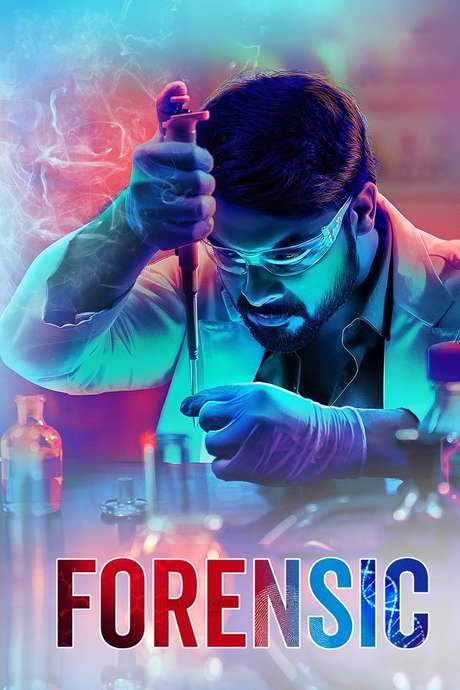
2003 unfolds in Kolkata with Probir Roy Chowdhury, Prosenjit Chatterjee, a renowned serial-killings expert who is notoriously ill-tempered and blunt. He narrowly dodged suspension in 1999 thanks to a special allowance granted because of his stance against custodial deaths. At work, Amit Kumar Srivastav, Rajesh Sharma, his colleague, counsels him to keep a tighter rein on his temper. In a smoky bar, Probir crosses paths with a young, energetic, and hot-tempered inspector, Bijoy Poddar, Anirban Bhattacharya, who soon becomes his uneasy ally in a city-wide hunt.
Kolkata becomes the stage for a string of grisly serial killings, each mirroring the ten avatars of Vishnu. The victims are influential figures, all accused of crimes or corruption, and the killer’s method hints at a calculated mythology-driven philosophy. The Kolkata Police assign Probir to take the lead, while Poddar—whose fascination with serial killings runs deep—joins the probe at Probir’s request. The two men plunge into a mystery that blends murder with ancient myth, trying to decipher a motive tied to a distorted sense of justice.
As the investigation unfolds, Poddar’s backstory emerges: he was born in a Kalighat brothel and is implied to be the lookalike half-brother of Paltan from Dwitiyo Purush, while he tutors children from red-light areas, a detail that adds a troubling layer to his character. The body count continues to rise—ranging from a promoter and a mafia-linked businessman to a doctor accused of negligence and a criminal lawyer who once saved a terrorist—and the police struggle to gain traction.
A pivotal breakthrough comes when a young psychiatrist, Moitreyee Ghatak, Jaya Ahsan, reaches out to Probir and Poddar, claiming to know the killer’s identity. One of her patients, Biswaroop Bardhan, Jisshu Sengupta, is a man with a severe god complex who believes himself Kalki, the tenth avatar of Vishnu. Biswaroop justifies the killings as a moral cleansing, targeting those he deems evil. This revelation sharpens the hunt, and the two detectives, together with Moitreyee, deepen their efforts to understand Biswaroop’s psychology and the driving myth behind the murders.
Meanwhile, Poddar and Moitreyee form a close bond as she assists the police with Biswaroop’s case, much to Probir’s chagrin. Probir’s personal history—his wife and son were murdered years earlier—has left him broken, deranged, and alcoholic, a wound that colors every interaction and decision. In a controversial turn, Probir contemplates using Moitreyee as bait to trap Biswaroop, mocking her in the process, and Poddar denounces him as sadistic. After a heated confrontation, Moitreyee’s insistence on a more nuanced approach leads to a fragile reconciliation between Probir and Poddar.
With another murder on the books—a sleazy teacher—the investigation stalls, and the two men clash again over a potentially dangerous tactic that could put Moitreyee at risk. Despite Poddar’s misgivings, Moitreyee agrees to the plan, and the police keep a wary vigil as the killer contacts her. One night, Bijoy leaves Moitreyee at her home, and Biswaroop arrives, accusing her of betraying him and exposing his identity to the police. Probir and Poddar rush back to intervene, only to find Biswaroop holding Moitreyee at gunpoint.
Biswaroop reveals the depths of his fanaticism, detailing his father’s brutal murder by a businessman and the impact it had on him. He declares that his mission to morally cleanse society will continue, and that the police are among his intended targets. In a brutal struggle, Probir taunts him as not an avatar but pure evil, and Biswaroop lunges with an axe—yet Probir manages to free himself and fires a concealed pistol, ending Biswaroop’s rampage.
In a staggering twist, Moitreyee is revealed to be Biswaroop’s sister. During a vacation following the formalities of royal witness, Moitreyee confesses to Poddar how the brutal murder of her father and her own rape by the businessman had driven Biswaroop to seek revenge. The siblings had plotted to murder the promoter to cover the businessman’s killing, a plan designed to resemble a sequence of righteous executions that would thwart the investigators. Moitreyee, aware of her brother’s fixation on myth, had orchestrated the killings to shield them from suspicion.
The revelation shatters Poddar, who feels he was merely a pawn used by Moitreyee. As Probir files the final reports, he senses something is wrong and struggles to reach Poddar, but Moitreyee’s guilt and fear drive her to seek help from the police. Overwhelmed by despair, she climbs to a cliff and dies, leaving Poddar powerless to intervene. When Probir finally retrieves Poddar, it’s too late; the case closes in cold, sympathetic terms, and Poddar returns to his routine with a bottle in hand.
The film closes with a sense of unfinished business in 2004: Poddar, still haunted by Moitreyee’s loss, is shown continuing to confront a new serial killer case in Kolkata, signaling that the city’s dark undercurrents and the pursuit of truth go on, long after the headlines fade.