Plot Explained Spoilers guaranteed!
Plot Explained

Browse by genre

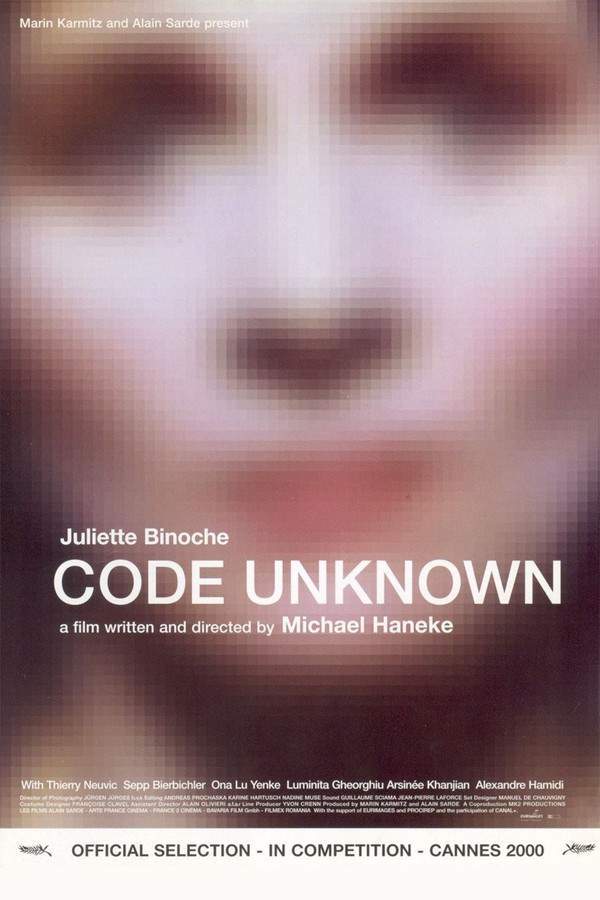
Code Unknown (2000) movie poster

Characters & Themes

Code Unknown (2000) Characters, Setting & Themes Explained

Release, runtime and language
2000 · 118 mins · French
Directed by
Michael Haneke
Starring
Juliette Binoche, Aïssa Maïga, Thierry Neuvic, Nathalie Richard, Bruno Todeschini, Florence Loiret Caille

Love speaks its own language. A minor incident triggers a chain reaction that brings five lives together in Paris. Anne, an actress, is linked to her boyfriend Georges, a Kosovo war photographer. Georges’ brother Jean searches for the code to Georges’ flat. Their paths cross a Romanian immigrant and a deaf teacher, showing how fates intertwine.

On this page (7)
  1. 1 Characters explained (7)
  2. 2 Where & when it takes place
  3. 3 Themes & meaning (4)
  4. 4 Character & meaning questions
  5. 5 Movie threads
  6. 6 Movies like Code Unknown
  7. 7 Every angle

7 main characters · contains spoilers

Code Unknown Characters Explained: Who Is Who

The main characters of Code Unknown (2000), heroes and villains: what drives them, how they change over the course of the story and what each of them reveals about the film's bigger ideas.

  • Anne Laurent (Juliette Binoche)

    An actress who rehearses for films and projects scenes of terror and humor into real life, blurring the line between performance and reality. Her interactions reveal a sensitivity to others' pain while she often remains emotionally distant, navigating a web of misunderstandings and ambiguous connections. She moves through Paris with a curiosity that both exposes and complicates the lives around her.

    • 🎭 Drama
    • 🧭 Identity
    • 🗣️ Communication
  • Georges (Thierry Neuvic)

    Anne’s boyfriend who has left his father’s farm and is troubled by civilian life after being in Kosovo. He spends time photographing people on the train and appears emotionally adrift, embodying the era’s trauma. His return from conflict contrasts with the everyday reactions of others, highlighting how memory and war shape perception.

    • 🎭 Drama
    • 🪖 War
    • 🧭 Identity
  • Jean (Alexandre Hamidi)

    A young man seeking his brother Georges and staying at Anne’s apartment. His casual actions—such as leaving with pastry remnants—interact with more serious tensions around homelessness and violence, illustrating how ordinary behavior can collide with larger social issues.

    • 🎭 Drama
    • 🧭 Identity
    • 🗣️ Misunderstanding
  • Amadou (Ona Lu Yenke)

    A man whose life intersects with violence and arrest, later appearing as an instructor in a group drumming setting. His experiences reflect the vulnerable positions of migrants and marginalized individuals within urban spaces. He embodies resilience amid social scrutiny and conflict.

    • 🎭 Drama
    • 🌍 Displacement
    • 🥁 Culture
  • Maria (Luminița Gheorghiu)

    A Romanian woman who has known homelessness and hardship, she returns to Paris after a period in Romania. Her past interactions with wealthier individuals contrast with the demeaning treatment she sometimes receives, underscoring themes of dignity and vulnerability in urban capitalism.

    • 🎭 Drama
    • 🧭 Migration
    • 🕊️ Dignity
  • Aminate (Maimouna Hélène Diarra)

    Amadou’s mother who expresses distress as police ransack their home and arrest her son. Her perspective anchors the film’s portrayal of family bonds amid threat and uncertainty, highlighting maternal concern and resilience.

    • 🎭 Drama
    • 🛡️ Family
    • 👪 Resilience
  • Bauer (Josef Bierbichler)

    Georges’ father living in poverty within a farm town. He speaks of his disappeared younger son Jean and reveals a stubborn, unresolved sorrow about family, home, and the fragility of connection across generations.

    • 🎭 Drama
    • 🏡 Family
    • 🗺️ Rural life

Last updated: October 03, 2025 at 14:30

Was this helpful?

Setting

Where and When Does Code Unknown Take Place?

The setting of Code Unknown (2000): the year and time period, the places and locations, and how they shape the characters, the mood and the tension of the story.

Time period

late 1990s

The events unfold in a contemporary late-1990s setting, with references to regional conflict and migrant presence in Europe. The Parisian urban milieu juxtaposed with rural and border contexts situates the characters within a tense, transitional era. The period accentuates themes of memory, perception, and upheaval.

Location

Paris, Kosovo, Romania, farm town

The narrative traverses a bustling Parisian street and a distant farm town, reflecting contrasts between urban life and rural poverty. It also shifts to Romania as a backdrop for a homeless character's past, highlighting displacement and migration. Together, these locations anchor the interconnected stories and the social tensions they reveal.

  • 🏙️ Paris
  • 🗺️ Kosovo
  • 🌍 Romania
  • 🏞️ Farm town

Last updated: October 03, 2025 at 14:30

Was this helpful?

4 major themes

Code Unknown Meaning: Themes & Message Explained

What is Code Unknown (2000) really about? The emotional, social and philosophical themes the film keeps returning to, its symbolism and the message beneath the surface.

  • Communication

    The film centers on how people fail to understand each other across language and social borders. Sign language, spoken words, and misreads create misunderstandings that propel the characters into conflict or confusion. The act of speaking and interpreting becomes a motif for truth and ambiguity. Scenes of miscommunication drive much of the drama and ambiguity.

  • Displacement

    Characters navigate forces of displacement: homelessness, migration, and the search for belonging. Maria’s homelessness in Paris and her Romanian background reflect the fragility of survival in a sprawling city. The film links personal displacement to broader social and political currents, including policing and deportation. The sense of exile threads through multiple story strands.

  • Urban Alienation

    Parisian life is depicted as a site of detachment where individuals drift between encounters and indifference. Anne rehearses scenes of fear and humor, while others drift through trains, markets, and apartments without meaningful connection. The city functions as a backdrop that amplifies isolation and curiosity about others' lives. The characters often confront the emptiness behind bustling urban rhythms.

  • Reality vs. Image

    The boundary between reality and fiction dissolves as characters perform, reinterpret, or misread events. Anne’s acting blurs with her real experiences, echoing the film’s central question of what is true. The recurring motif of performance—whether in cinema, signs, or daily life—challenges the viewer to distinguish perception from fact. Ambiguity invites multiple interpretations of each moment.

Last updated: October 03, 2025 at 14:30

Was this helpful?

Character & theme questions

Code Unknown Characters & Meaning: Your Questions Answered

The questions people ask about Code Unknown (2000): who the characters really are, their relationships, what the symbols mean, where it takes place and what the movie is really about. Each answer contains spoilers.

Q1

Where is most of the film set?

Most of the film takes place in Paris, specifically on bustling Parisian streets. The urban environment serves as a backdrop that amplifies isolation and anonymity, contrasting with other locations in the story.

Foreshadowing: The opening scenes establish Paris as a place where strangers brush past each other without connection.

  • paris
  • urban setting
  • city
  • france
Q2

When does the story take place?

The film is set in the late 1990s, a period marked by regional conflicts and increased migration in Europe. This era provides context for themes of displacement and the social tensions surrounding immigrants and refugees.

  • 1990s
  • time period
  • era
  • contemporary
Q3

How does the Kosovo conflict relate to the story?

Georges, Anne's boyfriend, has returned from Kosovo where he worked as a war photographer. His experiences in the conflict have left him emotionally adrift, and his trauma contrasts sharply with the everyday life he now navigates in Paris.

  • kosovo
  • war
  • georges
  • conflict
Q4

What is the main theme of communication in the film?

The film explores how people fail to understand each other across language and social barriers. Sign language, spoken words, and misreads create misunderstandings that drive characters into conflict. The act of speaking and interpreting becomes a motif for truth and ambiguity.

  • communication
  • misunderstanding
  • language
  • sign language
Q5

How does the film address displacement and migration?

Characters navigate forces of displacement through homelessness, migration, and the search for belonging. Maria's homelessness in Paris and her Romanian background reflect the fragility of survival in a sprawling city. The film links personal displacement to broader social and political currents including policing and deportation.

  • displacement
  • migration
  • homelessness
  • immigrants
  • romania
Q6

How is Parisian life depicted in the film?

Parisian life is shown as a site of detachment where individuals drift between encounters and indifference. Characters move through trains, markets, and apartments without meaningful connection. The city functions as a backdrop that amplifies isolation and curiosity about others' lives, often confronting the emptiness behind bustling urban rhythms.

  • urban life
  • alienation
  • paris
  • isolation
  • detachment
Q7

What does the film say about reality versus performance?

The boundary between reality and fiction dissolves as characters perform, reinterpret, or misread events. Anne's acting blurs with her real experiences, echoing the film's central question of what is true. The recurring motif of performance challenges viewers to distinguish perception from fact.

  • reality
  • performance
  • acting
  • perception
  • truth
Q8

Who is Anne and what is her role in the story?

Anne Laurent is an actress played by Juliette Binoche who rehearses for films and projects scenes of terror and humor into real life, blurring the line between performance and reality. She moves through Paris with curiosity that exposes and complicates the lives around her while often remaining emotionally distant.

  • anne
  • juliette binoche
  • actress
  • performance
Q9

What is Georges' background and emotional state?

Georges is Anne's boyfriend who has left his father's farm and returned from Kosovo where he worked as a war photographer. He spends time photographing people on the train and appears emotionally adrift, embodying the era's trauma and highlighting how memory and war shape perception.

  • georges
  • war photographer
  • Kosovo
  • trauma
Q10

Who is Maria and what defines her character?

Maria is a Romanian woman who has experienced homelessness and hardship in Paris. She returns to Paris after a period in Romania, and her past interactions with wealthier individuals contrast with the demeaning treatment she sometimes receives, underscoring themes of dignity and vulnerability in urban capitalism.

  • maria
  • romanian
  • homelessness
  • dignity
Q11

Who is Amadou and what happens to him in the film?

Amadou is a man whose life intersects with violence and arrest. He later appears as an instructor in a group drumming setting. His experiences reflect the vulnerable positions of migrants and marginalized individuals within urban spaces, embodying resilience amid social scrutiny.

  • amadou
  • migrant
  • arrest
  • drummer
  • marginalized
Q12

Who is Bauer and what is his importance?

Bauer is Georges' father living in poverty within a farm town. He speaks of his disappeared younger son Jean and reveals a stubborn, unresolved sorrow about family, home, and the fragility of connection across generations. He represents the rural poverty that contrasts with Parisian urban life.

  • bauer
  • father
  • farm
  • georges
  • family
Q13

How do the different locations in the film connect?

The narrative traverses a bustling Parisian street and a distant farm town, reflecting contrasts between urban life and rural poverty. It also shifts to Romania as a backdrop for a homeless character's past, highlighting displacement and migration. Together, these locations anchor the interconnected stories and the social tensions they reveal.

  • locations
  • paris
  • romania
  • farm
  • contrast
  • setting

Movie threads

More Movies Like Code Unknown, by Mood & Story

Curated lists built around what makes Code Unknown tick: the same mood, the same kind of story or the same emotional payoff. Each list explains why these movies belong together.

Movies with interwoven city stories like Code Unknown

Stories where the fates of strangers in a city collide and connect. If you liked the fragmented, connecting narratives of Code Unknown, explore other movies that weave together the lives of strangers in a city. These humanist dramas reveal the subtle forces of social inequality and chance encounters that shape modern urban existence.

  • observational
  • fragmented
  • contemplative
  • humanist
  • urban
  • uneasy
  • Tone: melancholic, observational
  • Pacing: slow, deliberate
Why these movies?

The story pattern: These films present multiple, parallel storylines that initially seem separate but gradually reveal connections through brief encounters or shared spaces. The narrative doesn't follow a single protagonist, but rather explores a collective experience, often ending ambiguously to reflect the ongoing nature of urban life.

Why they belong together: They are grouped together by their unique narrative structure—the mosaic—which creates a specific observational and contemplative feel. They share a common interest in themes of alienation, miscommunication, and the quiet impact of social systems on individual lives.

Quiet humanist dramas similar to Code Unknown

Patient, character-driven films that find poetry in everyday hardships. For viewers who appreciated the quiet, observational style of Code Unknown, this list features movies with a similar melancholic and humanist feel. These are slow-paced, character-focused stories that explore themes of communication, isolation, and the weight of social indifference without sensationalism.

  • contemplative
  • quiet
  • melancholic
  • humanist
  • restrained
  • observational
  • Tone: melancholic, restrained
  • Pacing: slow, observational
Why these movies?

The story pattern: The narrative journey is internal and emotional rather than driven by external events. Scenes linger on moments of silence, misunderstanding, or quiet realization. Conflict is often subdued, arising from systemic forces or personal isolation, and resolutions are typically ambiguous, reflecting the complexities of real life.

Why they belong together: They share a specific blend of tone (melancholic), pacing (slow), and a humanist perspective that treats characters with empathy and restraint. This creates a coherent viewing experience defined by its thoughtful, poetic, and quietly powerful approach to serious themes.

If you liked this

Movies Like Code Unknown

Similar movies to Code Unknown: the same genre, themes or kind of story. Each one comes with its own plot summary, timeline and ending explained.

Browse all movie summaries

Every angle

Code Unknown (2000) Explained: Plot, Timeline & Characters

Everything about Code Unknown in one place: what happens in the plot summary, the timeline in chronological order, the characters and meaning and a spoiler-free summary. What's After the Movie adds the cast, box office and post-credit scenes.

Coming soon on iOS and Android

The Plot Explained Movie Summary App

Plot summaries, endings explained and timelines on your phone. Catch up on any movie in minutes, save your favorites and never miss a twist again.

Be the first to know when we launch. Your email stays private, always.

Learn more about the app