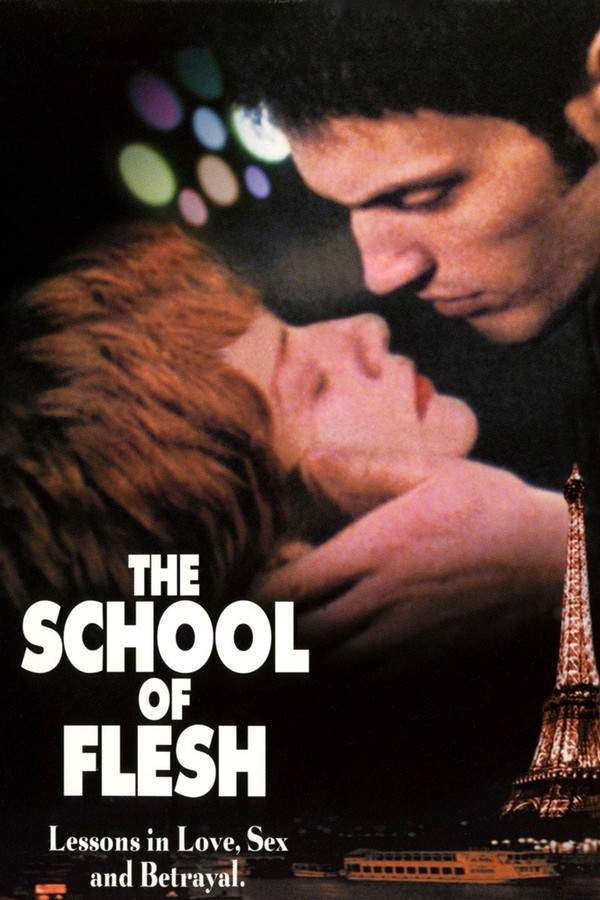
Mathieu Faber is a wealthy, middle-aged Frenchman whose romance with Conchita—a young flamenco dancer from Seville—spirals into a volatile, often brutal affair. The film winds around memory, with much of the story unfolding as a flashback recounted by the man himself aboard a train from Seville to Paris, where he tries to distance himself from his provocative companion. As the train prepares to depart, he spots a bruised and bandaged Conchita pursuing him, and in a moment of petty stubbornness pours a bucket of water over her head, certain this will deter her—but she boards anyway, relentless and determined.
The scene soon attracts the attention of the other passengers—a mother and her daughter, a judge who happens to be a friend of Mathieu’s cousin, and a psychologist who is a dwarf—who wonder aloud about the motive behind his chilly treatment. In response, Mathieu threads a confession: the pair’s relationship has unfolded against a backdrop of terrorist bombings and shootings carried out by left-wing groups, a climate that seems to feed their volatile dynamic.
Conchita, who insists she is 18 but often appears older, lures Mathieu with sexual promises while withholding consummation. She toys with him in a series of provocations: at times offering closeness, at others retreating behind a disciplined, almost game-like restraint. At one moment she lies with him wearing a tightly laced canvas corset that he cannot untie, rendering intimacy impossible. At another, he discovers her concealing a younger man in her room, a discovery that deepens the sense of unpredictability that defines their bond. Their relationship flickers between ardor and anger, pushing Mathieu to the brink as they drift apart and then collide back together again.
The cycle intensifies when Mathieu finally finds Conchita dancing nude for tourists in a Seville nightclub. He experiences a flash of anger, then a surprising forgiveness, and even a covering act of generosity as he purchases her a house. Yet the domestic peace remains fragile. After moving in, Conchita refuses to let him through the gate, her words dripping with a strange mixture of hatred and longing. She then appears to begin a sexual liaison with a young man in full view of Mathieu, who walks away, unable to witness the act he is asked to accept as real. That night, a violent disruption follows as his car is hijacked and he is held at gunpoint.
Conchita later tries to reconcile, insisting that the scandalous encounter was staged and that her supposed “lover” is actually a homosexual friend. This explanation is met with violence when Mathieu strikes her, leaving her bruised and bandaged—again bearing the marks of the tumult that shadows their every exchange.
Among the train’s passengers, a sense of patient complicity seems to settle over the story, as if they accept the tale’s odd logic. Conchita reappears from her hiding place and, in a final twist of misfortune, dumps a bucket of water on Mathieu. Yet the pair appear to reconcile once more as they walk the streets of Madrid, arm in arm and seemingly content.
The narrative then shifts to a Paris mall where loudspeakers announce a chilling alliance of extremist groups intent on sowing chaos, countered by right-wing factions seeking to respond with force. As the couple continues along, a seamstress repairing a bloody nightgown in a shop window punctuates their argument with a stark visual. Within moments, a bomb explodes—an event that interrupts their walk and leaves their fate ambiguous, yet ominously suggests the end of the volatile romance that defined their every moment together.