Plot Explained Spoilers guaranteed!
Plot Explained

Browse by genre

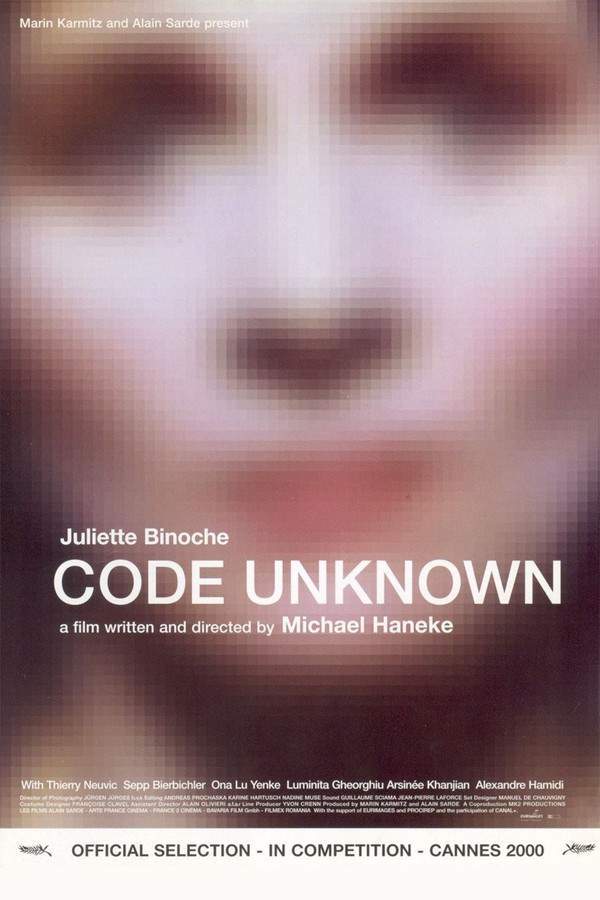
Code Unknown (2000) movie poster

Timeline

Code Unknown (2000) Timeline Explained – Every Event in Order

Release, runtime and language
2000 · 118 mins · French
Directed by
Michael Haneke
Starring
Juliette Binoche, Aïssa Maïga, Thierry Neuvic, Nathalie Richard, Bruno Todeschini, Florence Loiret Caille

Love speaks its own language. A minor incident triggers a chain reaction that brings five lives together in Paris. Anne, an actress, is linked to her boyfriend Georges, a Kosovo war photographer. Georges’ brother Jean searches for the code to Georges’ flat. Their paths cross a Romanian immigrant and a deaf teacher, showing how fates intertwine.

On this page (5)
  1. 1 Events in order (15)
  2. 2 Timeline questions answered
  3. 3 Movie threads
  4. 4 Movies like Code Unknown
  5. 5 Every angle

15 events in order · contains spoilers

Code Unknown Timeline: Events in Chronological Order

Every key event of Code Unknown (2000) in order, scene by scene, with when and where it takes place. Use it to untangle flashbacks, time jumps and parallel storylines, to refresh your memory before the sequel or to find the exact scene you are thinking of.

  1. Opening scene: deaf children play sign-language charades

    A group of deaf children play a game of charades using French sign language. A young girl acts out gestures of fear, slowly stepping backward toward a wall as she tries to protect herself. The other children struggle to guess what she is conveying, hinting at the film's theme of hidden meanings and miscommunication.

    When
    Opening scene
  2. Anne meets Jean on a Paris street

    Anne walks through a Paris street and runs into Jean, who is seeking his brother Georges in Kosovo. She tells him Georges is away, and Jean asks to stay at Anne's apartment. The encounter sets in motion a web of intersecting lives.

    When
    Daytime
    Where
    Paris
  3. Pastry throw and confrontation

    Jean leaves with the keys but throws a pastry at Maria, a Romanian homeless woman. Amadou confronts Jean and demands an apology. A police altercation ensues, Amadou is arrested, Jean is released, and Maria is escorted to the airport for deportation.

    When
    Afternoon
    Where
    Paris street
  4. Amadou's mother speaks to police

    Back at home, Amadou's mother discusses her distress with the police as they ransack the apartment and arrest her son. She laments the injustice she perceives and worries for her family. The scene highlights the tension between the characters' private struggles and state authority.

    When
    Evening
    Where
    Amadou's home
  5. Amadou on a date and public accusation

    After his release, Amadou goes on a date, attempting to move past the incident. In the same restaurant, Anne informs her friends that Amadou attacked Jean without cause. The moment blends personal relationships with public suspicion and rumor.

    When
    Evening
    Where
    Restaurant
  6. Amadou leads a group drumming session

    Amadou is later seen participating in a group drumming performance as an instructor. The rhythmic gathering offers a counterpoint to the earlier conflict and shows another facet of his character. The scene emphasizes community and the healing potential of music.

    When
    Later
    Where
    Community space
  7. Anne rehearses scenes for films

    Anne rehearses for different films, effectively acting out scenes of terror and humor that blur the line between reality and fiction. Her craft foregrounds the film's meditation on perception and storytelling. The practice mirrors the characters' own performances within their lives.

    When
    Daytime
    Where
    Anne's home
  8. The crying girl in the apartment

    At home, while ironing, Anne hears her neighbors and a young girl crying loudly, sounding like physical beatings. The sound deepens the sense of danger and ambiguity surrounding the girl and whether she is the deaf child from the game. The moment expands the film's web of interwoven private traumas.

    When
    Night
    Where
    Anne's apartment
  9. Georges returns from Kosovo

    Georges arrives back from Kosovo, overwhelmed by civilian life after the war. He is haunted by memories and seems detached, spending time photographing people on the train and pondering his imprisonment. The return contrasts his internal turmoil with the external world.

    When
    Return from Kosovo
    Where
    Paris
  10. Grocery store conversation about the screaming child

    In a grocery store, Anne recounts the story of the screaming child to Georges, who remains apathetic. He resists engaging with the emotional weight of the tale and instead fixates on his own preoccupations. The exchange highlights differing responses to trauma.

    When
    Shopping trip
    Where
    Grocery store
  11. Georges' train-time reflections

    Georges spends days observing and photographing people on the train, haunted by his wartime imprisonment. The train's motion becomes a metaphor for his unsettled mind and the pull between memory and present life. He remains distant from the others as his thoughts linger on the past.

    When
    Days after Kosovo return
    Where
    Train
  12. Funeral for petite Françoise

    Anne attends the funeral of petite Françoise, the girl whose screaming she heard earlier. She does not confront the grieving parents, and the film leaves open whether this child is the deaf girl from the sign-language game. The scene adds to the film's theme of unresolved guilt and ambiguous connections.

    When
    After the scream
    Where
    Funeral
  13. Farm-town visit and Jean's disappearance

    Anne and Georges visit Georges' father in a farm town. The father, living in poverty, says that his younger son Jean has disappeared but refuses to actively search for him. The confession deepens the sense of family strain and the fragility of connection.

    When
    Visit
    Where
    Farm town
  14. Maria's arc: from Romania to Paris

    In Romania, Maria reconnects with family in a run-down apartment and recounts sending money to a gypsy woman, followed by worry that she might have contracted a disease. Later, back in Paris as a homeless woman, she continues to seek money on the streets, illustrating persistent hardship. The arc ties her journey across continents to the film's broader themes of survival and dignity.

    When
    In Romania; later in Paris
    Where
    Romania and Paris
  15. Ending sign-language gesture

    The film ends with an untranslated sign-language gesture from a different child, echoing the opening game's mystery. The final moment leaves audiences with a lingering question about communication and understanding across the stories.

    When
    End

Last updated: October 09, 2025 at 16:42

Was this helpful?

Timeline questions answered

Code Unknown Timeline Explained: Your Questions Answered

When does it happen, and why in that order? The questions people ask about the chronology of Code Unknown (2000): time jumps, flashbacks, cause and effect between scenes and the correct order of events, each answered with spoilers.

Q1

Why does Jean throw pastry at the homeless Romanian woman?

Jean throws the remnants of his pastry at Maria, a Romanian homeless woman, as a casual act of contempt and disregard. This moment establishes Jean's dismissive attitude toward those he perceives as beneath him and sets in motion the confrontation that follows. The act is meant to show his cruelty and the way privileged characters in the film treat marginalized individuals.

  • jean
  • maria
  • pastry
  • homeless
  • confrontation
Q2

Why is Amadou arrested when he was just defending Maria?

Amadou confronts Jean and demands an apology for the pastry throwing, but the situation escalates when police arrive. Despite defending Maria's dignity, Amadou is arrested while Jean is released. This highlights the film's exploration of how authority often targets those who stand up for themselves or others, particularly when they are from marginalized backgrounds. The arrest underscores the systemic injustice faced by immigrants and minorities.

  • amadou
  • arrest
  • police
  • maria
  • injustice
  • deportation
Q3

Why is Maria escorted to the airport for deportation?

After the confrontation on the Paris street, Maria is escorted to the airport and deported. As a Romanian homeless woman without legal status, she has no recourse against this treatment. The film shows how quickly authorities can remove those deemed undesirable, stripping them of dignity and any chance to contest their expulsion. This event illustrates the vulnerability of undocumented immigrants.

  • maria
  • deportation
  • airport
  • romanian
  • homeless
Q4

Why does Anne publicly accuse Amadou of attacking Jean?

In a restaurant, Anne tells her friends that Amadou is the man who attacked Jean without cause. This accusation spreads through their social circle despite Amadou having been the one who was actually defending Maria's honor. Anne's public accusation reflects how quickly rumor and misunderstanding can damage someone's reputation, particularly when the accused is already marginalized.

  • anne
  • amadou
  • accusation
  • rumor
  • social circle
Q5

What happened to the deaf girl who acted out fear in the opening charades game?

The opening scene shows deaf children playing charades, with a young girl acting out gestures of fear as she backs toward a wall. Later, Anne hears a child screaming in her apartment building, and she attends the funeral of a girl named petite Françoise. The film leaves deliberately ambiguous whether this deaf girl and the screaming child are the same person, or whether the girl survived. This uncertainty reinforces the theme of unresolved meaning and the difficulty of understanding others.

Foreshadowing: The opening scene with the deaf girl acting out fear directly foreshadows the later screaming incident and funeral.

  • deaf girl
  • charades
  • fear
  • screaming
  • funeral
  • petire françoise
Q6

Why is Georges so haunted after returning from Kosovo?

Georges returns from Kosovo a changed man, haunted by what he witnessed as a war photographer. He is overwhelmed by civilian life after the war and spends time photographing strangers on trains while contemplating his own imprisonment during the conflict. His trauma manifests as detachment and obsession with observing others, suggesting he struggles to reconcile the violence he documented with ordinary life.

  • georges
  • kosovo
  • trauma
  • war photographer
  • return
  • imprisonment
Q7

What was the screaming child incident in Anne's apartment?

While ironing at home, Anne hears a young girl crying loudly in the apartment walls, the sound resembling physical beatings. This incident connects to the opening scene with the deaf children and deepens the film's atmosphere of hidden danger and ambiguous trauma. Anne later recounts the story in a grocery store, but Georges remains apathetic, fixated on his own preoccupations. The girl's identity remains unclear, whether she is the same deaf child from the opening or someone else entirely.

Foreshadowing: The opening charades game, where children struggle to understand the deaf girl's gestures, foreshadows this moment of unclear communication and hidden suffering.

  • crying
  • child
  • screaming
  • apartment
  • anne
  • trauma
Q8

Why won't Georges' father actively search for his missing son Jean?

When Anne and Georges visit Georges' father in his farm town, the father reveals that Jean has disappeared but states he will not actively search for him. This refusal reflects the family's fractured state and the father's stubborn sense of duty amid poverty. It suggests a resigned acceptance of loss or perhaps deeper family conflicts that remain unspoken, fitting the film's themes of missed connections and quiet hardships.

  • georges father
  • jean
  • missing
  • search
  • farm town
  • family
Q9

What is the significance of Anne's acting rehearsals?

Anne rehearses scenes for different films, acting out both terror and humor with a looseness that blurs the line between reality and fiction. These sequences highlight how she, as an actress, performs different versions of herself, mirroring how all the characters in the film perform within their own lives. The rehearsals underscore the film's meditation on perception, storytelling, and the masks people wear.

  • anne
  • rehearsal
  • acting
  • performance
  • reality
  • fiction
Q10

What does the final untranslated sign language gesture mean?

The film ends with an untranslated sign language gesture from a different child than the one in the opening. This final wordless moment echoes the film's theme of communication failure and the persistent mystery of understanding others. By refusing to translate the gesture, the film leaves audiences with a lingering question about what remains unspoken and unknowable across all the interwoven stories.

Foreshadowing: The ending gesture directly echoes the opening charades scene, where children struggled to guess the deaf girl's meaning.

  • sign language
  • ending
  • gesture
  • translation
  • ambiguous
  • communication
Q11

What is the significance of Amadou leading a group drumming performance?

After his arrest and the public accusation from Anne, Amadou resurfaces as an instructor leading a group drumming performance. This scene offers a moment of communal rhythm and healing amid the misunderstandings that have defined his arc. The drumming represents a form of non-verbal communication and connection that transcends the verbal conflicts and accusations that have harmed him, showing another facet of his character beyond the confrontational incident.

  • amadou
  • drumming
  • community
  • healing
  • performance
Q12

Why does Maria give money to a gypsy woman and wash her hands?

In Romania, Maria gives money to a gypsy woman and then washes her hands repeatedly out of fear of contamination, an act that reveals her internal prejudices and the complex attitudes even marginalized people hold toward others. Later, in Paris, a well-dressed man offers her money and then draws back, leaving her to continue begging. These moments illustrate the cycle of poverty and the indignities faced by those who depend on others' charity, which can be given or withdrawn without explanation.

  • maria
  • romanian
  • gypsy
  • money
  • prejudice
  • poverty

Movie threads

More Movies Like Code Unknown, by Mood & Story

Curated lists built around what makes Code Unknown tick: the same mood, the same kind of story or the same emotional payoff. Each list explains why these movies belong together.

Movies with interwoven city stories like Code Unknown

Stories where the fates of strangers in a city collide and connect. If you liked the fragmented, connecting narratives of Code Unknown, explore other movies that weave together the lives of strangers in a city. These humanist dramas reveal the subtle forces of social inequality and chance encounters that shape modern urban existence.

  • observational
  • fragmented
  • contemplative
  • humanist
  • urban
  • uneasy
  • Tone: melancholic, observational
  • Pacing: slow, deliberate
Why these movies?

The story pattern: These films present multiple, parallel storylines that initially seem separate but gradually reveal connections through brief encounters or shared spaces. The narrative doesn't follow a single protagonist, but rather explores a collective experience, often ending ambiguously to reflect the ongoing nature of urban life.

Why they belong together: They are grouped together by their unique narrative structure—the mosaic—which creates a specific observational and contemplative feel. They share a common interest in themes of alienation, miscommunication, and the quiet impact of social systems on individual lives.


Quiet humanist dramas similar to Code Unknown

Patient, character-driven films that find poetry in everyday hardships. For viewers who appreciated the quiet, observational style of Code Unknown, this list features movies with a similar melancholic and humanist feel. These are slow-paced, character-focused stories that explore themes of communication, isolation, and the weight of social indifference without sensationalism.

  • contemplative
  • quiet
  • melancholic
  • humanist
  • restrained
  • observational
  • Tone: melancholic, restrained
  • Pacing: slow, observational
Why these movies?

The story pattern: The narrative journey is internal and emotional rather than driven by external events. Scenes linger on moments of silence, misunderstanding, or quiet realization. Conflict is often subdued, arising from systemic forces or personal isolation, and resolutions are typically ambiguous, reflecting the complexities of real life.

Why they belong together: They share a specific blend of tone (melancholic), pacing (slow), and a humanist perspective that treats characters with empathy and restraint. This creates a coherent viewing experience defined by its thoughtful, poetic, and quietly powerful approach to serious themes.

If you liked this

Movies Like Code Unknown

Similar movies to Code Unknown: the same genre, themes or kind of story. Each one comes with its own plot summary, timeline and ending explained.

Browse all movie summaries

Every angle

Code Unknown (2000) Explained: Plot, Timeline & Characters

Everything about Code Unknown in one place: what happens in the plot summary, the timeline in chronological order, the characters and meaning and a spoiler-free summary. What's After the Movie adds the cast, box office and post-credit scenes.

Coming soon on iOS and Android

The Plot Explained Movie Summary App

Plot summaries, endings explained and timelines on your phone. Catch up on any movie in minutes, save your favorites and never miss a twist again.

Be the first to know when we launch. Your email stays private, always.

Learn more about the app