Plot Explained Spoilers guaranteed!
Plot Explained

Browse by genre

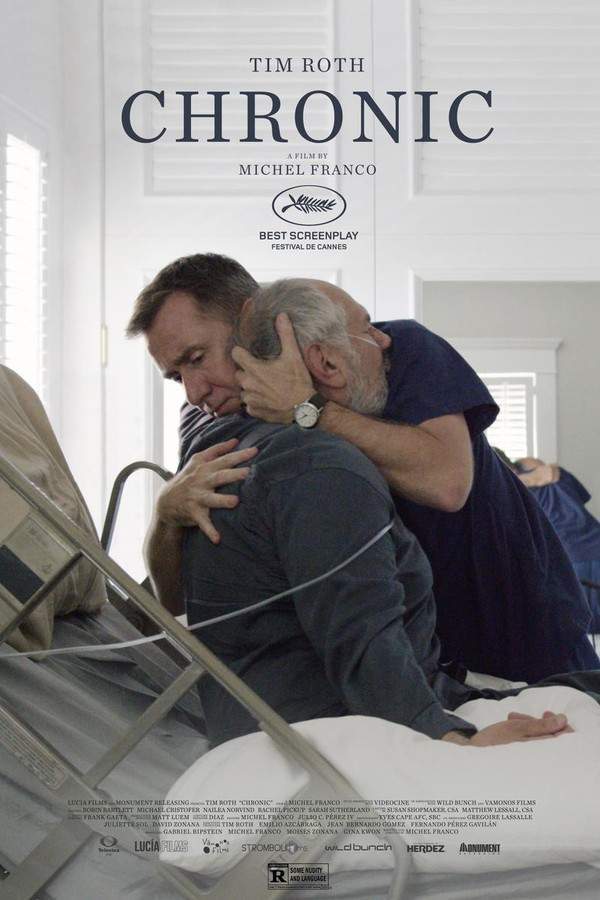
Chronic (2016) movie poster

Timeline

Chronic (2016) Timeline Explained – Every Event in Order

Release, runtime and language
2016 · 93 min · English
Loading streaming availability…
Directed by
Michel Franco

A compassionate nurse named David, portrayed by Tim Roth, finds purpose and connection while caring for terminally ill patients. However, he battles his own struggles with chronic depression and carries a heavy burden of guilt and remorse. Seeking solace in his work, David attempts to mask his inner turmoil, but must eventually confront his troubled past to find a path toward healing and redemption.

On this page (6)
  1. 1 Where to watch
  2. 2 Events in order (13)
  3. 3 Timeline questions answered
  4. 4 Movie threads
  5. 5 Movies like Chronic
  6. 6 Every angle
Loading streaming availability…

13 events in order · contains spoilers

Chronic Timeline: Events in Chronological Order

Every key event of Chronic (2016) in order, scene by scene, with when and where it takes place. Use it to untangle flashbacks, time jumps and parallel storylines, to refresh your memory before the sequel or to find the exact scene you are thinking of.

  1. David starts following Nadia

    David sits in his car outside a house as a young woman leaves, gets into her car, and drives off. He follows her, beginning his covert interest in the woman who will later be revealed as Nadia Wilson. This moment sets the tone of his obsessive behavior.

    When
    opening scene
    Where
    outside a house
  2. David discovers Nadia's online identity

    Later, David is seen looking at photos of Nadia Wilson on Facebook, revealing that his interest in the woman is more than casual stalking. The social media glimpse foreshadows a deeper personal connection that will reveal itself later in the story. Nadia is the woman he has been following.

    When
    later
  3. David cares for his AIDS patient Sarah

    David works as a nurse and tends to Sarah, who is dying of AIDS. He bathes and dresses her, manages her daily activities, and creates space for her to rest while handling the practicalities of caregiving. His tenderness frames his character during this early caregiving phase.

    When
    early in the story
    Where
    hospice
  4. Sarah dies and David confronts loss

    David enters the room where Sarah has died and cleans and dresses her for the final time. He attends her funeral and keeps his emotions in check when her niece asks to discuss her aunt, which he declines. The goodbye underscores the personal toll of his caregiving work.

    When
    after death
    Where
    funeral
  5. David talks with a newly engaged woman in a bar

    In a bar, David chats with a recently engaged young woman. He reveals that he was married for 21 years and that his wife, also named Sarah, died of AIDS. The conversation adds depth to his backstory and his capacity for connection and secrecy.

    When
    after Sarah's death
    Where
    bar
  6. David is reassigned to John the architect

    David is assigned to care for John, an elderly stroke victim and architect who grows fond of his caregiver. John allows him to watch porn on his laptop, and David buys architecture books and presents John with a house picture as a birthday gift. The relationship reveals a troubling dynamic that foreshadows later conflicts.

    When
    after reassignment
    Where
    John's home
  7. Fired after the harassment suit surfaces

    Robert calls David to the agency, where he learns that John’s family is suing the agency for sexual harassment. The suit centers on John watching porn and an erection during bathing. David denies the charges but acknowledges that he worked extra shifts because of his attachment to John. John’s daughter then asks him to leave.

    When
    after John's care
    Where
    agency
  8. Nadia is revealed to be David's daughter

    It is revealed that David had a young son who died and that the girl he had been following, Nadia, is actually his daughter who is studying medicine in college. This twist reframes his prior fixation and ties his personal grief to the present.

    When
    later in the story
  9. David reconnects with Nadia and his ex wife

    David meets his daughter Nadia and his ex wife, who has remarried but is now divorced after four years. The reunion brings his private history into the foreground and shifts his emotional focus.

    When
    after Nadia reveal
  10. David begins work with Martha the cancer patient

    Isaac, David's friend and former boss, arranges a job for him with Martha, who has cancer and needs support for chemotherapy appointments. She tells him she knows about the sexual harassment suit but hires him anyway. David supports her through treatment as her condition worsens.

    When
    after Nadia's reveal
    Where
    Martha's home
  11. Martha asks for help dying; she fires him

    As Martha's cancer spreads, she lies to her daughter that the cancer is in remission and asks David to help her die; he refuses and she fires him. He later returns to her house and injects her, contributing to her death, and calls Isaac to report that she died of cardiac arrest.

    When
    after firing
    Where
    Martha's home
  12. David cares for Greg, then faces a final fate

    David takes on Greg, a 16 year old boy who uses a wheelchair, for a one week assignment. He discusses Greg with Nadia and later takes Greg to the park, where the boy swears at him, illustrating mounting personal strain. His life spirals toward a tragedy as he is killed soon after.

    When
    during the assignment
    Where
    Greg's home and park
  13. David is killed while running

    David jogs outdoors while his life unravels, and he is struck dead by a car as he glances toward oncoming traffic. The sudden accident ends his troubled arc and underscores the film's themes of inevitability and consequence.

    When
    end of story
    Where
    outdoors

Last updated: October 09, 2025 at 16:20

Was this helpful?

Timeline questions answered

Chronic Timeline Explained: Your Questions Answered

When does it happen, and why in that order? The questions people ask about the chronology of Chronic (2016): time jumps, flashbacks, cause and effect between scenes and the correct order of events, each answered with spoilers.

Q1

Why does David start following Nadia at the beginning of the film?

David is following Nadia because she is his estranged daughter, not a stranger. He discovers her on Facebook as Nadia Wilson and quietly observes her, maintaining distance while dealing with the guilt of their broken relationship. His following her represents his unspoken connection to his past and his struggle to reconnect with the child he lost emotional access to.

  • nadia
  • daughter
  • following
  • david
Q2

Why does David tell the woman in the bar that his wife died of AIDS?

David lies about his wife to create emotional distance in the conversation. The woman he speaks with is recently engaged and happy, so David constructs a sad backstory to match the mood of the interaction. This lie also reflects his tendency to hide his true self, the real Sarah was his patient, not his wife, and he continues to carry the weight of that deception.

  • sarah
  • lie
  • bar
  • wife
  • aids
Q3

Why was David fired from caring for John?

David was fired after John's family filed a sexual harassment suit against the care agency. The suit claimed John watched porn on his laptop with David's assistance and had an erection during bathing. While David denies any inappropriate conduct, he admits his emotional attachment led him to work extra shifts. John's daughter subsequently asks David to stop visiting.

  • john
  • fired
  • harassment suit
  • architect
Q4

What happened to David's son?

David had a young son who died from a terminal illness. This tragedy is the source of David's profound grief and guilt, driving his obsessive need to care for terminally ill patients. The loss of his son explains his deep emotional attachment to his work and his inability to fully connect with his living daughter, Nadia.

  • son
  • death
  • terminal illness
  • grief
  • nadial
Q5

Why does David agree to help Martha die after initially refusing?

Martha asks David to help her die when her cancer spreads and she can no longer bear the pain. David initially refuses and she fires him, but he later returns and administers a lethal injection, ending her life. His decision appears driven by compassion worn down by repeated loss, he cannot save his patients, but he can end their suffering. He later reports her death as cardiac arrest.

  • martha
  • euthanasia
  • injection
  • cancer
  • death
Q6

Why does David become so emotionally attached to his patients?

David's attachment stems from unresolved grief over his son's death and guilt over his estrangement from Nadia. He channeled these feelings into nursing terminally ill patients, finding purpose in caring for people facing the same fate his son endured. His attachments are both his coping mechanism and his undoing, leading to burnout and poor judgment.

  • attachment
  • grief
  • patients
  • son
  • depression
Q7

What is the significance of David's death at the end of the film?

David dies suddenly while jogging, struck by a car. This ending mirrors the deaths of his patients, sudden, without warning, and leaving unresolved emotional arcs. It underscores the film's bleak themes of inevitability and cyclical loss. David, who spent years tending to others' deaths, meets his own abrupt end, finding a kind of parallel fate to those he cared for.

  • death
  • accident
  • ending
  • jogging
  • fate
Q8

Why does David buy architecture books for John and give him a house picture?

David buys architecture books to connect with John on a personal level, learning about John's past as an architect. He gives John a picture of a house John designed as a birthday gift, showing his genuine effort to build rapport with patients. However, this emotional investment becomes problematic when John's family uses it as evidence of David's inappropriate attachment.

  • architecture
  • john
  • books
  • birthday
  • gift
Q9

Why does Nadia reconnect with David after learning the truth about him?

Nadia eventually meets with David and his ex-wife after discovering he is her father. The reunion occurs after years of estrangement, prompted by David's persistent presence in her life through his quiet observation. This meeting represents a tentative step toward healing, though the film leaves their relationship's future uncertain.

  • nadia
  • daughter
  • reunion
  • ex-wife
  • family
Q10

Why does David clean and dress Sarah's body after she dies?

David enters Sarah's room after her death to clean and dress her one final time, treating this act as an intimate goodbye. This gesture demonstrates his dedication to providing dignity in death, just as he did in life. It also reflects his need to complete the caregiving cycle, underscoring his belief that his role extends until the very end.

  • sarah
  • death
  • cleaning
  • funeral
  • dignity
Q11

Why does Martha lie to her daughter about her cancer being in remission?

Martha tells her daughter the cancer is in remission to spare her the emotional pain of knowing the truth as she dies. This lie allows Martha to maintain a sense of normalcy and protect her daughter from the devastating reality. It also creates the condition where Martha asks David for help dying, wanting to spare her daughter the longer, more painful process of terminal cancer.

  • martha
  • daughter
  • lie
  • cancer
  • remission
Q12

Why does David work extra shifts caring for John despite the workload?

David admits to working extra shifts because of his emotional attachment to John. This attachment goes beyond professional obligation, reflecting David's pattern of forming intense bonds with patients. His boss Robert uses this admission as evidence of his poor judgment when firing him, though David maintains he did nothing inappropriate.

  • extra shifts
  • john
  • attachment
  • robert
  • fired

Movie threads

More Movies Like Chronic, by Mood & Story

Curated lists built around what makes Chronic tick: the same mood, the same kind of story or the same emotional payoff. Each list explains why these movies belong together.

Movies about caregivers with heavy burdens like Chronic

Intimate stories of those who care for others while hiding their own pain. For viewers who appreciated the somber portrayal of caregiving in Chronic, this list features movies with similar character-driven stories. If you liked watching David navigate his professional duty and personal despair, you'll find these quiet, emotionally heavy dramas about nurses, family members, and other caretakers compelling.

  • somber
  • introspective
  • lonely
  • heavy
  • tragic
  • quiet
  • Tone: melancholic, somber
  • Pacing: slow, deliberate
Why these movies?

The story pattern: Narratives in this thread often follow a quiet, character-centered arc. The protagonist's routine of caring for others (often the ill or dying) serves as a backdrop for exploring their internal struggles. The plot is frequently less about external events and more about the slow, painful process of confronting past trauma and enduring grief.

Why they belong together: These films are grouped by their shared focus on the caregiver's perspective, a melancholic and introspective tone, and a heavy emotional weight derived from themes of loss and duty. They create a specific, reflective mood built on quiet moments and unspoken sorrow.


Bleak dramas about guilt and remorse like Chronic

Character-driven dramas where profound guilt leads to a bleak, ambiguous end. If the unresolved, heavy feeling of guilt and the bleak ending of Chronic resonated with you, explore these similarly themed movies. This collection features character-driven stories about individuals haunted by their past, leading to somber and emotionally complex conclusions that mirror the experience of the film.

  • bleak
  • tragic
  • heavy
  • guilt-ridden
  • somber
  • psychological
  • Tone: melancholic, bleak
  • Pacing: slow, psychological
Why these movies?

The story pattern: The pattern involves a protagonist marked by a specific, haunting regret (often involving family). Their current actions are a direct, sometimes subconscious, response to this guilt. The story unfolds slowly, revealing the past in fragments, and culminates in an ending that reflects the inescapable nature of their pain, rather than providing a tidy resolution.

Why they belong together: Movies in this thread share a strong connective tissue through their central theme of debilitating guilt, a melancholic to bleak tone, and conclusions that deny simple redemption. They deliver a powerful, heavy emotional experience focused on psychological realism and the lingering effects of trauma.

If you liked this

Movies Like Chronic

Similar movies to Chronic: the same genre, themes or kind of story. Each one comes with its own plot summary, timeline and ending explained.

Browse all movie summaries

Every angle

Chronic (2016) Explained: Plot, Timeline & Characters

Everything about Chronic in one place: what happens in the plot summary, the timeline in chronological order, the characters and meaning and a spoiler-free summary. What's After the Movie adds the cast, box office and post-credit scenes.

Coming soon on iOS and Android

The Plot Explained Movie Summary App

Plot summaries, endings explained and timelines on your phone. Catch up on any movie in minutes, save your favorites and never miss a twist again.

Be the first to know when we launch. Your email stays private, always.

Learn more about the app