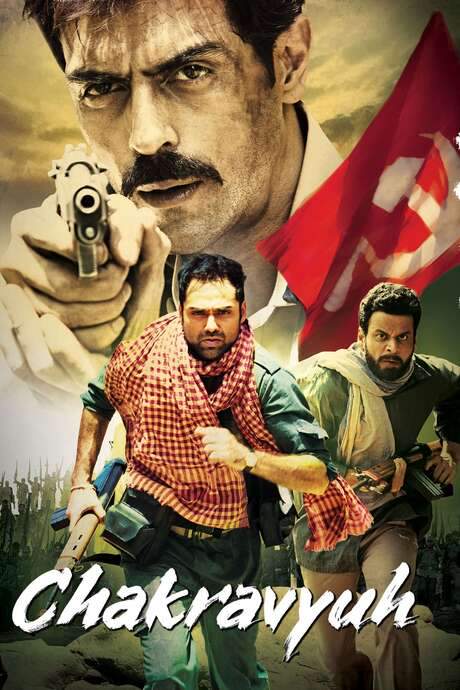
Chakravyuh traces the entwined lives of two best friends, Adil Khan, Arjun Rampal, and Kabir, Abhay Deol, as they tread the fine line between duty and conscience in a region where conflict has become a way of life. Adil, a highly decorated police officer, is dispatched to the troubled town of Nandighat after a brutal massacre leaves 84 officers dead. The operation is spearheaded by a seasoned colleague, KK, whose fate turns on a single, devastating realization: the trap was set, and the Maoists were ready for the police at every turn. The weight of this collapse lands squarely on Adil’s shoulders, testing his resolve as he begins to see the depth of the challenge before him.
The shadowy world of the insurgents centers on the enigmatic Rajan, the ruthless leader who commands a growing chorus of disaffected locals. Rajan’s network has learned to outpace the efforts of the state, enforcing a parallel system of courts, protection money, and local discipline that keeps the people dependent on the Naxal movement. In this volatile landscape, the Rajan group gains a powerful ally in Mahanta, a corporate magnate intent on carving out a massive steel enterprise in the region. The industrialist, Prashanth Mahanta—the Chairman of the Mahanta Group Industries—represents the push-and-pull between development and displacement, a pressure point at the heart of the conflict that pits big business against the needs of those who dwell on the land.
Adil’s personal life gives the story its warmer, more intimate center. His wife, Rhea Menon, an IPS officer in her own right, deepens the moral tension as she watches Adil wrestle with impossible choices. The couple stands at the crossroads where love and profession collide, offering a quieter lens on the violence that surrounds them. As the crackdown on Naxal activity intensifies, Adil finds himself inching closer to the truth that the forces he fights against are not simply faceless enemies; they are a reflection of a deeper struggle within Indian society—one where land, resources, and power are constantly contested.
Into this charged atmosphere enters Kabir, a restless, loyal friend whose own past has kept him on the margins of the police world. Kabir’s plan is audacious: infiltrate Rajan’s inner circle and become Adil’s informer, using the inside information to dismantle the Maoist network from within. The partnership works, and Adil’s raids grow more successful—an enormous arms cache is seized, two top national leaders are killed, and Rajan is captured. It seems the alliance between Adil and Kabir is delivering the victory the state seeks. Yet Kabir’s undercover ascent also reveals a human truth that the battlefield rarely makes visible: the rural poor, unprotected and neglected, bear the brunt of development’s neglect. The land is taken, forests are cleared, and water is diverted to serve larger commercial ambitions, all while the promised benefits never reach those who suffer the consequences.
As Kabir moves deeper into the Naxal ranks, his interactions with activists—such as Juhi and others who share their pain and their hope—become more intense. Juhi, a devoted revolutionary with a soft heart, forms a complicated bond with Kabir, while the broader movement’s grip tightens. The ground trembles further when the mining dream revives, and the Mahanta group escalates its efforts to relocate villages for a colossal Rs 15,000 crore steel plant. Adil, unwilling to play along with the exploitation tied to the project, clashed with the corporate interests and finds himself sidelined by higher-ups who want the operation to move forward.
In Rajan’s absence, leadership within the Naxals becomes a contest, and Kabir is chosen to helm the resistance. Juhi sacrifices herself during a police raid in a bid to shield Kabir, a moment that intensifies the rift between Kabir’s new loyalties and Adil’s adherence to the law. Kabir’s growing alignment with the activists deepens the moral ambiguity: he sees the consequences of the government’s hardness and begins to question whether the system he once served can ever truly protect the vulnerable people of Nandighat. Juhi’s ordeal—an act of brutality that highlights the violence endemic to the cycle—serves as a turning point that cements Kabir’s new path and complicates Adil’s judgment.
The conflict crescendos as the Mahanta plant project gains momentum and the state’s machinery tightens its grip on the region. Kabir orchestrates a daring strike against Mahanta’s headquarters, capturing the group head and demanding Rajan’s release in exchange. Adil counters by embedding a tracker in Rajan before proceeding with the exchange, a move intended to undermine Kabir’s fragile coalition. Kabir, aware of the tracker’s presence, uses it to lure Adil away from the insurgents, and the pursuit continues with tragic consequences. Juhi reappears in the narrative at a critical moment, but she is fatally shot as the pursuit unfolds, underscoring the human cost of the escalating violence.
The final confrontation unfolds with a grim inevitability. Adil corners Kabir, and when Kabir reaches for his gun, Adil fires. The act seals a brutal truth that neither man can escape: in a landscape defined by competing claims over land, power, and protection, the line between ally and adversary can blur beyond recognition. Chakravyuh is a cinematic meditation on loyalty, ideology, and the price of pursuing justice in a world where the stakes are measured not just in lives saved or lost, but in the survival of communities scrutinized by a system that too often prioritizes speed, profit, and order over the needs of the people at its margins.