Year: 1987
Runtime: 94 mins
Language: English
Director: Colin Eggleston
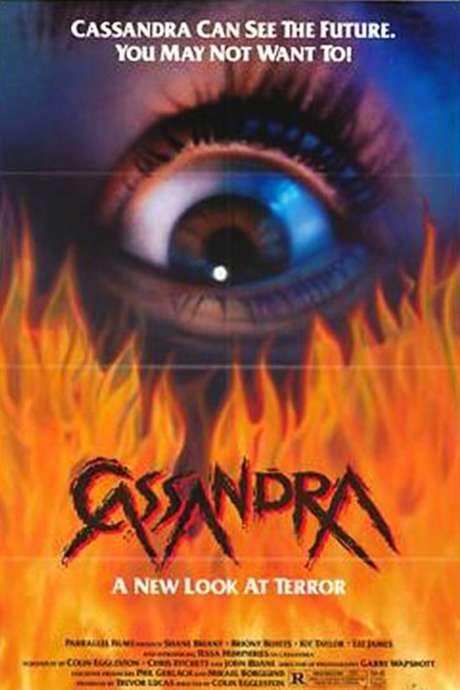
Gifted with prophetic visions, Cassandra sees unsettling glimpses of the future. When she begins experiencing vivid, disorienting flashes of a memory in which her brother appears to commit a murder, she confronts her parents' reassurances that everything is fine, forcing her to question the reality of her gifts and the hidden truths within her family.
Warning: spoilers below!
Haven’t seen Cassandra yet? This summary contains major spoilers. Bookmark the page, watch the movie, and come back for the full breakdown. If you're ready, scroll on and relive the story!
Read the complete plot breakdown of Cassandra (1987), including all key story events, major twists, and the ending explained in detail. Discover what really happened—and what it all means.
Cassandra [Tessa Humphries] is a young woman haunted by a series of disturbing nightmares in which a woman commits suicide at the command of a demonic little boy, and the house is set ablaze. The visions feel more than dreams, and Cassandra grows convinced that the boy is actually her long-lost twin brother, Warren, a secret rooted in suppressed memories from their childhood. Her parents, Stephen [Shane Briant] and Helen [Briony Behets], firmly deny this interpretation, insisting there is no twin and urging her to move past the troubling images. Yet Cassandra cannot shake the sense that something crucial has been buried in the past, and the stakes feel personal and terrifying as the precursors of fire keep returning in her sleep.
Her investigation deepens when she discovers a photograph of a woman named Jill, who turns out to be her father’s sister. The image raises unsettling questions about family history and intent, and Cassandra begins to suspect that her parents may be concealing more than just a harmless family story. The mystery compounds when she travels to the family beach house to confront Stephen about what she has unearthed, only to learn that he has been cheating on her mother with one of his models. The confrontation shatters the illusion of a peaceful family life and sends Cassandra spiraling toward a reckoning she never anticipated.
Seeking solace with her boyfriend Robert [Lee James], Cassandra experiences a vision in which the model is murdered. The nightmare proves eerily real, and suddenly Cassandra finds herself under suspicion as the killer’s presence closes in on the family. A police investigation and mounting fear culminate in a brutal sequence: the killer murders Stephen, and Helen is left to grapple with fear and guilt as she becomes the target of further terror. In the wake of these events, Helen confesses to the police that Cassandra did have a twin brother—one who was institutionalized after Jill’s death—and reveals a startling truth: she is not Cassandra’s mother but her paternal aunt, and Jill is the real mother, as Stephen and Jill had been involved in an incestuous relationship that produced the twins. The revelation reorders everything Cassandra thought she understood about her lineage and the forces that have haunted her life.
With the truth laid bare, Cassandra returns to the old family home where Jill died, hoping to confront the shadows of the past. There she encounters Robert, who shocks her by revealing that he is actually Warren. Warren’s motive is rooted in a desire to sever the cycle of abuse and secrecy—he claims to have killed their parents to prevent the family from repeating the same wrongs and intends to finish the job by targeting Helen and Cassandra. Cassandra fights for her life, escaping long enough to shoot Robert/Warren and to set the house ablaze in a desperate bid to end the family curse once and for all. In a pivotal moment, she shares a psychic bond with her brother, confirming that while some nightmares were echoes of history, the fire nightmare was a prophecy being fulfilled in the present.
As the flames roar and the smoke clears, Cassandra attempts to reclaim some sense of normalcy, but the film leaves a chilling note: Warren’s presence lingers at the edge of her reality. A shadowy figure appears in Cassandra’s bedroom mirror, and when she reaches toward it, the mirror shatters. The last image suggests that the cycle of fear, guilt, and violence may not be truly over, and that the memory of the twins—and the power they hold over Cassandra—continues to loom in her life. The story unfolds with a sense of unresolved tension, a warning that some pasts refuse to stay buried and that some nightmares, even when defeated, carry a lingering, shattering echo.
Last Updated: October 09, 2025 at 14:14
Discover curated groups of movies connected by mood, themes, and story style. Browse collections built around emotion, atmosphere, and narrative focus to easily find films that match what you feel like watching right now.
Stories where a character's sanity is undermined by those closest to them.If you liked the psychological torment of Cassandra, you'll find more movies like it here. These films focus on characters whose reality is questioned by trusted figures, creating a deep sense of unease and paranoia. Explore similar stories of manipulation and the fight to reclaim one's sanity.
Narratives in this thread typically follow a character, often a woman, who perceives a hidden threat or truth that no one else acknowledges. Allies become adversaries as they are gaslit into doubting their own senses. The core conflict is internal—a battle for mental sovereignty—while the external threat remains ambiguous and deeply personal.
These movies are grouped by their shared focus on psychological manipulation and the erosion of reality. They create a specific, claustrophobic form of horror where the enemy is not a monster but the denial of one's own experience, resulting in a consistently tense and unsettling viewing experience.
Dark explorations of horrific truths festering within a family's history.Discover more movies like Cassandra that delve into the horror of family secrets. These films explore cursed lineages, repressed memories, and the terrifying truths that lie beneath a seemingly normal family surface. If you were captivated by the hereditary trauma in Cassandra, this thread is for you.
The narrative pattern involves a protagonist returning to or investigating their family home, only to peel back layers of denial and lies. The discovery often recontextualizes their entire identity and reveals a hidden history of violence or taboo acts. The climax typically involves a confrontation with the literal or metaphorical ghosts of the past, leading to an ambiguous or bleak resolution.
These films share a core theme of discovering that one's identity is built upon a foundation of horror. They blend psychological dread with gothic sensibilities, focusing on the inescapable nature of inherited trauma and the claustrophobic atmosphere of a family hiding monstrous truths.
Don't stop at just watching — explore Cassandra in full detail. From the complete plot summary and scene-by-scene timeline to character breakdowns, thematic analysis, and a deep dive into the ending — every page helps you truly understand what Cassandra is all about. Plus, discover what's next after the movie.
Track the full timeline of Cassandra with every major event arranged chronologically. Perfect for decoding non-linear storytelling, flashbacks, or parallel narratives with a clear scene-by-scene breakdown.
Discover the characters, locations, and core themes that shape Cassandra. Get insights into symbolic elements, setting significance, and deeper narrative meaning — ideal for thematic analysis and movie breakdowns.
Get a quick, spoiler-free overview of Cassandra that covers the main plot points and key details without revealing any major twists or spoilers. Perfect for those who want to know what to expect before diving in.
Visit What's After the Movie to explore more about Cassandra: box office results, cast and crew info, production details, post-credit scenes, and external links — all in one place for movie fans and researchers.
Discover movies like Cassandra that share similar genres, themes, and storytelling elements. Whether you’re drawn to the atmosphere, character arcs, or plot structure, these curated recommendations will help you explore more films you’ll love.
Cassandra (1987) Scene-by-Scene Movie Timeline
Cassandra (1987) Movie Characters, Themes & Settings
Cassandra (1987) Spoiler-Free Summary & Key Flow
Movies Like Cassandra – Similar Titles You’ll Enjoy
The Captive (2002) Movie Recap & Themes
Cassadaga (2013) Spoiler-Packed Plot Recap
Nocturne (2017) Spoiler-Packed Plot Recap
Nightmares (1980) Ending Explained & Film Insights
Stigma (1980) Complete Plot Breakdown
Mortuary (1982) Complete Plot Breakdown
Curtains (1983) Plot Summary & Ending Explained
Necromancer (1988) Complete Plot Breakdown
Deadly Dreams (1988) Movie Recap & Themes
Sex, Demons and Death (1975) Complete Plot Breakdown
Fright (1971) Story Summary & Characters
Creep (1995) Ending Explained & Film Insights
Schizo (1976) Story Summary & Characters
Libido (1965) Ending Explained & Film Insights
Night of the Sinner (2009) Film Overview & Timeline