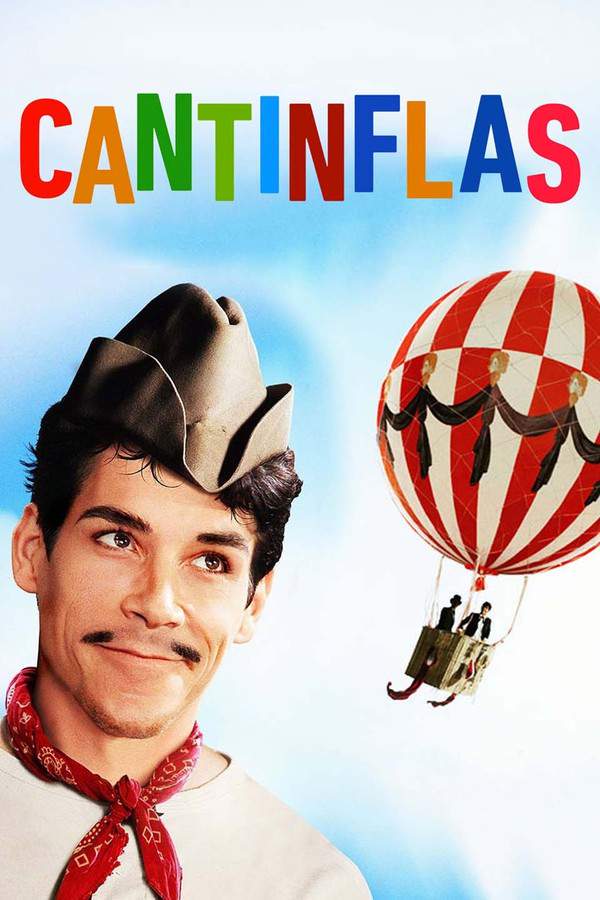
The film unfolds in a non-linear narrative, weaving between the pre-production of Around the World in 80 Days in 1955 and significant moments from the life of Mario Moreno, known as Cantinflas, spanning from 1931 to 1955. In 1955, producer Mike Todd encounters challenges as he attempts to court notable actors and performers globally for his film, facing obstacles due to budget constraints that prevent him from adequately compensating the talent.
Rewind to 1931, where we find Mario Moreno, an impoverished man surviving out of a suitcase while taking on various odd jobs. He finds employment as a janitor at a small stage company, and despite his earlier failures as a boxer and bullfighter, he is eventually encouraged by his boss to step onto the stage. His initial performance, involving blackface dancing, does not go well, as the audience responds with ridicule and projectiles aimed at him. However, a twist occurs when, after trying to leave in humiliation, he engages in an argument with an audience member, leading him to showcase his unique conversational style, referred to as Cantinfleando in Spanish. This improvisational approach captivates the crowd, earning him their applause and affection.
As his career begins to take shape, his boss's daughter develops feelings for him, leading to an awkward moment when she attempts to seduce him, resulting in his embarrassment and dismissal from the scene. Destiny intervenes when Estanislao Shilinsky, an influential audience member connected to the Mexico City theater scene, discovers him outside and offers him a position in his theater.
In Mexico City, Mario's career blossoms as he begins performing in comedy shows at Shilinsky's establishment and soon finds love in Valentina Ivanovna, a fellow performer. This romance is not without tension, as Mario frequently insists on improvising his lines, asserting that the written dialogue does not fit his character. An unexpected encounter with a heckler in 1933 leads to Mario adopting the name Cantinflas after the phrase, "en qué Cantina inflas?" becomes part of his routine. He and Valentina marry, and following this, he receives offers to perform in increasingly prestigious shows.
Fast forward to 1955, where Todd faces scheduling challenges and is compelled to fly to Mexico City to meet with Moreno. He witnesses Moreno's bravery in the bullfighting arena and presents him with the script for Around the World in 80 Days. Moreno, however, rebuffs Todd's offer, adhering to his principle of not collaborating with studios, albeit promising to read the script.
In 1935, despite working at a more upscale theater alongside fellow performer Manuel Medel, Moreno grows frustrated when his name is not featured in promotional materials. Nevertheless, he stages a successful political satire that catapults him into the public eye. During this same year in 1955, Todd engages with the legendary Charlie Chaplin, who shares insights on how to effectively reach out to and persuade Moreno.
By 1940, Moreno makes his film debut in You're Missing the Point, although production proves challenging due to his insistence on improvisation— a departure from the directors’ initial demands for a strict adherence to the script. Despite these difficulties, the film achieves great success, allowing Moreno's career to flourish alongside his increasing political activism with the Confederation of Mexican Workers. As his professional life escalates, tensions also build at home, leading to a rift between him and Valentina, especially after she learns of her infertility in 1945.
Eventually, their stories converge spectacularly at the premiere of a grand production at Teatro de los Insurgentes. In a climactic moment, Valentina experiences a breakdown and walks out, leaving Moreno alone. After a night of drinking, he discovers the Around the World in 80 Days script once more and resolves to participate in the project. He travels to Los Angeles just in time to save Todd from a potential dismissal, sharing with him the good news of his decision.
In addition to mending his relationship with Valentina, who lays down some ground rules for his Hollywood role, Moreno ultimately chooses to prioritize his roots over further entanglements in the Hollywood system, especially as he and Valentina decide to adopt a child. The film reaches a poignant conclusion at the 13th Golden Globes ceremony, where he receives the Best Actor for Musical or Comedy award. The film closes with heartwarming footage of both real-life personalities and nostalgic scenes of him and Valentina enjoying a dance on a film set.